

Behavior Analysis ABA: A Warm Guide for New Families
Learn what behavior analysis ABA really is, how it works, and what to expect. A friendly guide for parents new to ABA therapy.

A grocery-store meltdown, a hard transition at bedtime, or a teacher's gentle note home can leave a parent wondering what to do next. You may feel relieved to have a possible path forward and overwhelmed by the unfamiliar language around behavior analysis ABA at the same time.
ABA shouldn't be a rigid program placed on top of your family's life. At its best, it's a practical partnership between your child, caregivers, clinicians, and educators. The work starts with your child's strengths and the routines that matter most to your family.
Table of Contents
Where Most Parents Begin
Maybe your child becomes distressed when the grocery store gets crowded. Maybe dinner turns into a long negotiation because they can talk about one favorite subject but struggle to answer a simple question. Or perhaps a teacher writes that your child is having trouble joining circle time, asking for help, or moving from one activity to the next.
None of these moments mean you've failed as a parent. They're clues. They show where a child may need a different kind of support, a clearer way to communicate, or more practice with a routine that feels unpredictable.
A referral to ABA can bring mixed emotions. Some families feel hopeful because someone has finally offered a concrete next step. Others wonder whether therapy will be too intense, whether their child will be understood, or whether they'll be expected to become part-time clinicians at home.
Reading carefully before choosing a provider is already an act of care. You're learning the language, considering your child's comfort, and trying to make a thoughtful decision rather than rushing toward the first available opening.
A useful starting point: You're not behind. You're gathering information at the moment your family is ready to ask better questions.
ABA may help families work on communication, social participation, play, daily living, and safety-related skills. The important question isn't only whether ABA is available. It's whether the provider can build an individualized plan around your child's actual life.
You can use this guide to signs your child may benefit from ABA therapy as one starting point, then discuss your observations with your child's pediatrician, school team, or qualified behavior analyst. A good conversation should leave room for your family's priorities, your child's preferences, and your questions.
What Behavior Analysis Actually Means
Think of behavior as a message. A wave may communicate hello. Reaching toward a snack may communicate “I want that.” A meltdown may signal that a demand, noise, transition, or communication barrier has become too difficult to manage in that moment.
ABA gives clinicians a structured way to listen to those messages. It looks at what happens before a behavior, what the behavior looks like in observable terms, and what happens afterward. Three basic terms make the process easier to understand.
Behavior
Behavior means anything a person does that another person can observe. Waving, pointing, using a picture card, leaving a room, crying, and handing over a cup all count.
A parent might describe a child as “being difficult at snack.” An ABA clinician will try to make that description more specific. Does the child push the plate away, drop to the floor, reach for another food, or cry when a preferred item isn't available? Clear descriptions help the team choose useful support.
Antecedent
An antecedent is what happens immediately before the behavior. It might be a sudden blender noise, an instruction that feels confusing, the end of tablet time, or a sibling taking a toy.
For example, if your child throws a spoon after you say, “Take one more bite,” the instruction may be part of the situation the clinician examines. The team may ask whether the child understands the request, has a way to say “all done,” dislikes the texture, or needs a visual cue showing what comes next.
Reinforcement
Reinforcement is what happens after a behavior that makes that behavior more likely to happen again. If a child asks for help and an adult responds promptly, asking for help may become easier to use in the future. Reinforcement isn't limited to treats. Attention, access to a favorite activity, a break, praise, or a successful outcome can all matter, depending on the child.
The central idea is simple: clinicians arrange these pieces so useful skills have a better chance to grow. They also teach replacement skills, such as requesting a break instead of pushing, rather than focusing only on stopping a difficult behavior.
In practice, this science becomes a treatment plan, daily teaching, caregiver coaching, observation, and ongoing adjustment. The goal is meaningful participation in routines, not performance for its own sake.
How ABA Grew Into the Therapy Families Use Now
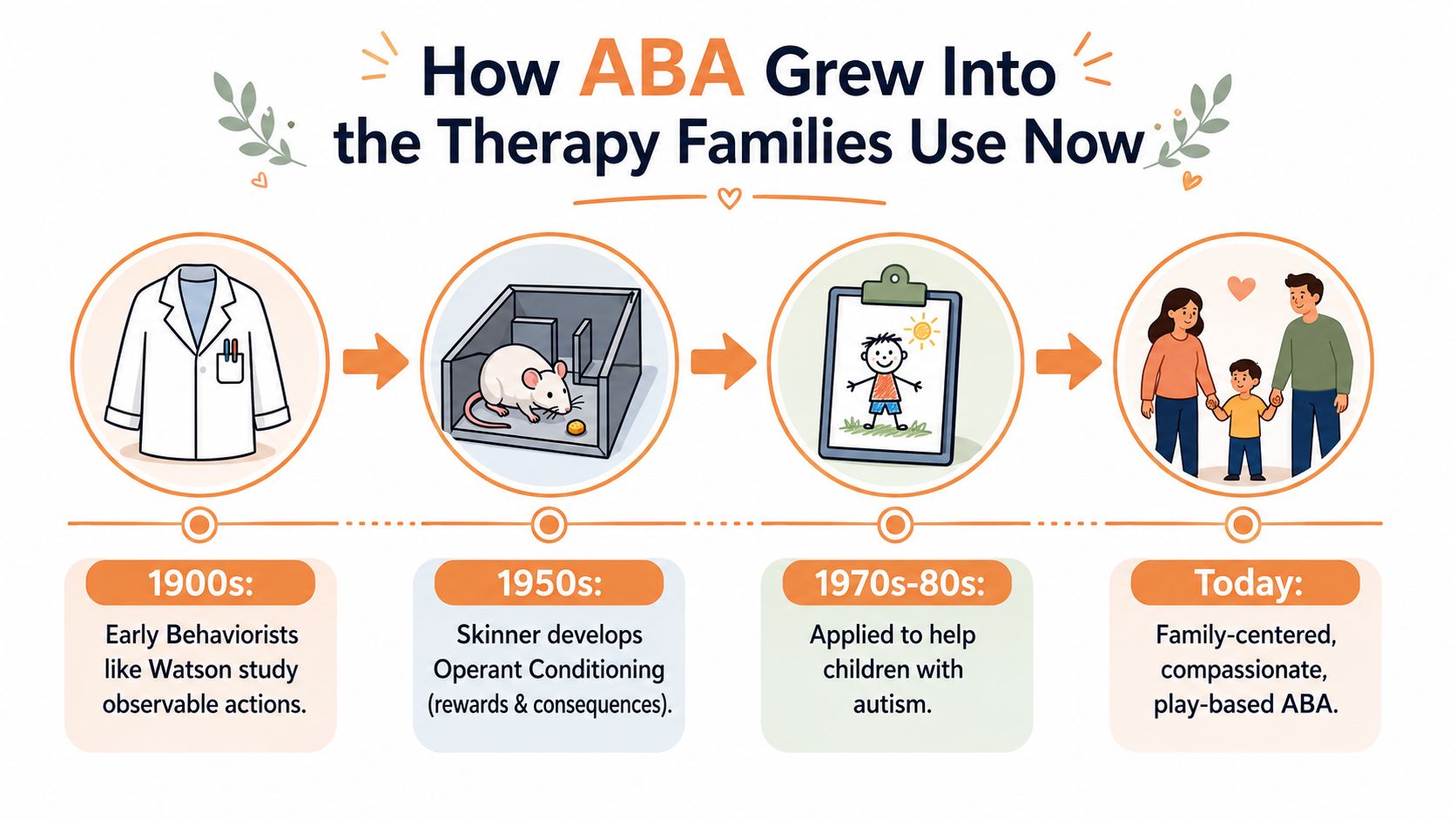
Behavior analysis began as a way to study observable actions and the conditions around them. John B. Watson formally introduced behaviorism in 1913, and B. F. Skinner developed radical behaviorism in the 1930s. Their work helped establish the study of how consequences influence future behavior. The first issue of the Journal of the Experimental Analysis of Behavior appeared in April 1958. This historical overview of ABA's scientific lineage traces how these ideas later supported applied work.
Families can take one practical lesson from this history: ABA was built to connect observation with useful change. The field became more clearly applied when the Journal of Applied Behavior Analysis launched in 1968, giving researchers and practitioners a place to study socially significant behavior in everyday settings. That focus included communication, learning, independence, and participation, not only behavior in controlled environments.
A major milestone in autism treatment came with Ivar Lovaas's 1987 landmark study, which reported that early, intensive behavioral intervention could produce substantial developmental gains. Later historical summaries describe how this work helped behavioral programs spread through schools, clinics, and homes during the 1980s and 1990s. A summary of ABA's development and ongoing debate provides broader context.
Credentialing and changing practice
The Behavior Analyst Certification Board launched certification in 1998, helping formalize training and ethical practice for behavior analysts. Families may hear BCBA, meaning Board Certified Behavior Analyst, and RBT, meaning Registered Behavior Technician. Their roles differ. A provider should explain who assesses, designs the plan, supervises treatment, and works directly with the child.
History also includes practices that families and autistic self-advocates have criticized. A trustworthy provider should discuss that record openly and explain how current services protect dignity, communication, participation, and assent. Families can also ask how the team works with caregivers' cultural values, home language, and routines, especially when a shortage of BCBAs affects supervision and consistency.
Modern ABA may occur during play, meals, school routines, sibling activities, or community outings. This shift from purely repetitive table drills reflects a family-centered principle: skills need to work where daily life happens, with clinicians, caregivers, and support staff sharing information and adjusting together.
This short video introduction to ABA therapy can help families visualize the general process before an intake conversation.
What ABA Looks Like Day to Day for Families
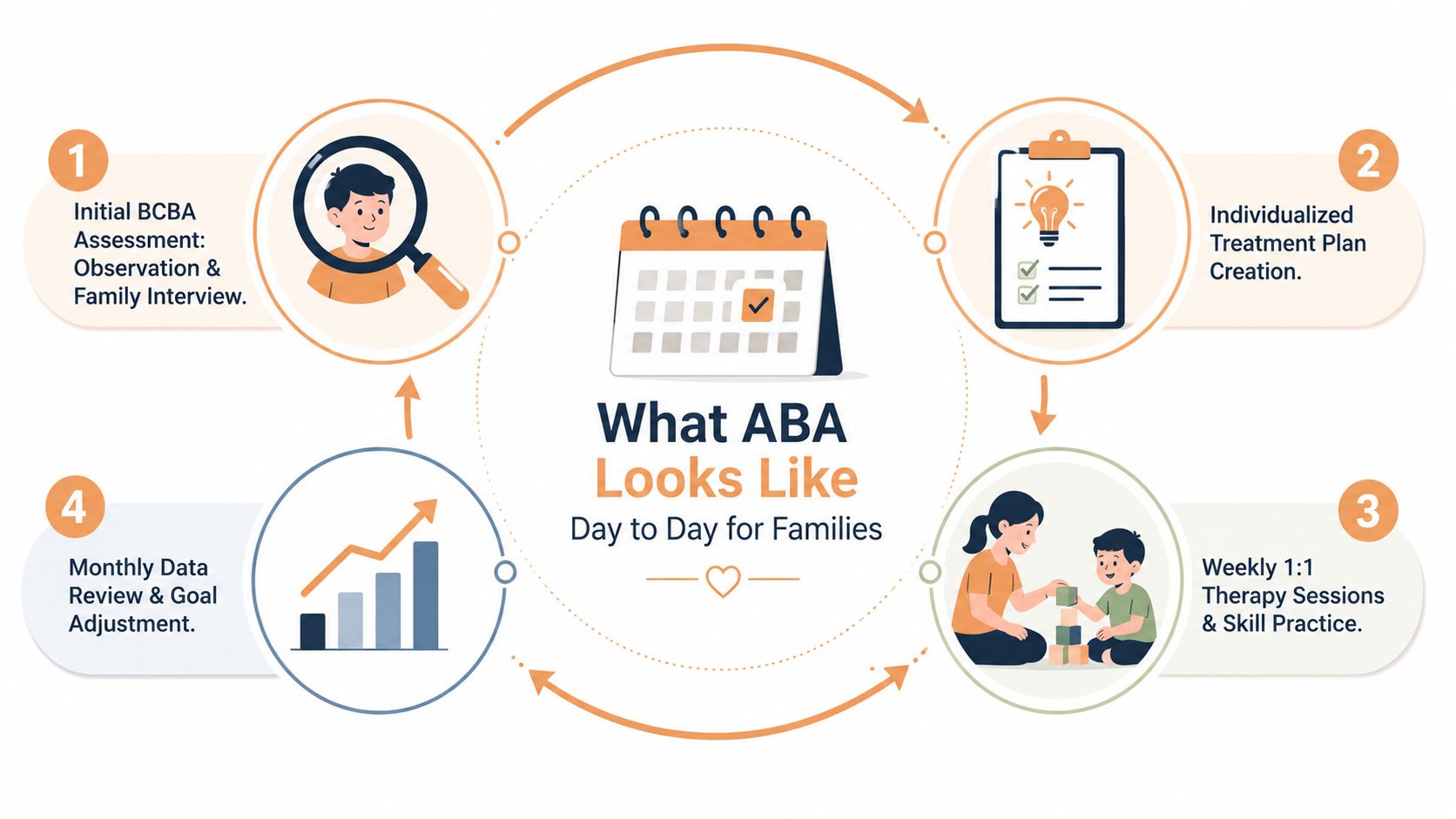
A morning routine can show a team more than a worksheet can. During an assessment, a BCBA may observe your child playing, eating, preparing to leave, or handling a transition your family has identified as difficult. The clinician may interview caregivers and review communication, independence, learning, social participation, strengths, and situations that create stress.
The assessment should lead to an individualized plan rather than a preset schedule. The plan can identify which skills matter most, what support already works, and how progress will be observed. Read the article on individualized ABA treatment planning for more detail.
Goals that belong in real life
A useful goal connects to an ordinary part of the day. It might involve tolerating a haircut, joining a classroom activity, asking for help, waiting during a sibling's turn, or moving through bedtime. “Improve behavior” gives a family little direction. A clearer goal describes what your child will do, where the skill will be used, and which support may help.
For example, a morning session might use a visual sequence for getting dressed, eating, and leaving home. At school, staff may support a child in requesting a break in the lunchroom, then gradually reduce that prompt as independence grows. During parent coaching, the team might practice a calmer bath-to-bed transition.
Families also contribute information between sessions. A brief note can record what happened before a difficult moment, what your child communicated, which response helped, and what happened afterward. Short observations from grocery trips, car rides, sibling play, or bedtime can help the team see whether a skill works outside therapy. The goal is shared problem-solving, not perfect recordkeeping.
Support beyond the therapy room
Insurance procedures can add work for families. A care coordinator may help explain authorizations, communicate with the clinical team, and organize administrative details. That support should make communication easier, while families still receive clear answers from the BCBA and know who is responsible for each decision.
Parent participation belongs in the treatment process. The Medicaid ABA toolkit describes caregiver involvement in treatment-plan development, goal setting, outcome assessment, and regular progress evaluation. It also presents a suggestion from some stakeholders of four hours per week of parent or caregiver involvement, not a universal requirement. Review the Medicaid ABA toolkit and ask what level fits your schedule, language, routines, and support network.
A quality program connects clinic learning with family life. Clinicians, caregivers, and support staff should share observations and adjust the plan together. If a skill appears only during sessions, ask how the team will help it carry over to the people and places your child knows. That question matters even more when a BCBA shortage limits supervision or staff consistency. A provider should explain how supervision will work and how your family's culture, home language, and routines will shape the plan.
Honest Worries and Common Misconceptions
Many parents worry that therapy will change who their child is. A respectful program should not treat harmless differences, preferences, or self-expression as problems just because they look unfamiliar to adults. The aim is to support participation, communication, safety, and quality of life while keeping the child's identity and dignity in view.
Ask how the provider defines a meaningful goal. Requesting help, joining another person in a preferred activity, communicating discomfort, or managing a safety routine differs from requiring a child to appear less autistic. A contemporary team should explain how it seeks assent, responds to distress, and changes course when a child shows that a task is too much.
A question worth asking: “How will you know whether this goal improves my child's life?”
Families may also worry about stigma, cultural mismatch, or language barriers. Coverage of ABA programs identifies cultural responsiveness as an ongoing gap. A survey of 61 ABA programs reported that 15% of faculty named cultural responsiveness as a gap. For parents, that concern matters because a plan can miss its purpose if it overlooks a family's language, values, routines, or understanding of respectful care. The same discussion identified workforce quality and preserving evidence as leading concerns. Read the discussion of pressing issues in ABA before an intake call.
The provider problem is real
Access can be difficult. Families may face waitlists, frequent staff changes, or limited supervision. An industry analysis describes demand as outpacing supply by roughly 50,000 BCBA positions, citing Bureau of Labor Statistics projections of 17% growth from 2024 to 2034 and approximately 48,300 average annual openings. It also says the field produces about 8,000 to 10,000 new BCBAs per year. Review the workforce analysis and its cited figures.
Those figures do not decide whether a provider fits your family. They do explain why a partnership needs clear supervision, staff coverage, communication, and respect for everyday family routines.
You can ask about historical practices, cultural fit, goals, consent, and staffing. A trustworthy provider will welcome those questions and give you time to consider the answers.

How to Choose a Provider Worth Trusting
Bring a written checklist to the intake call. You can take time before choosing, and a thoughtful provider will respect that pace.
Start with clinical accountability
Ask whether a BCBA completes the assessment, writes the treatment plan, and supervises your child's program. Ask how often you will meet with that BCBA, what supervision looks like during sessions, and who takes responsibility when the lead clinician is unavailable.
Staffing questions reveal how well a provider protects continuity:
- Coverage: Who supervises the case during vacation, illness, or a resignation?
- Turnover: How does the provider tell families about technician changes?
- Mentorship: How do new staff receive guidance before working independently?
- Continuity: What happens if the assigned team cannot keep the planned schedule?
The provider should explain how it measures progress. Look for goals connected to daily life, such as asking for help, joining classroom activities, tolerating a necessary routine, or becoming more independent. A schedule full of therapy hours does not show whether treatment is helping.
Test the partnership
Ask who selects goals and how your child's preferences shape sessions. Find out whether parent coaching includes observation, practice, feedback, and time to discuss what works at home. Parent participation can help skills carry from therapy into family routines, as described in the peer-reviewed article on parent involvement in ABA.
Cultural fit needs specific questions. Can staff communicate in your family's preferred language? Do they understand your routines and community? Ask how the team changes a recommendation when it conflicts with your family's values, schedule, housing, or support network.
A trustworthy plan should fit the child and the household, not force both into a preset template.
Watch for these warning signs:
- Rigid hour requirements: The provider recommends a fixed schedule before learning about your child's goals.
- Limited transparency: Staff will not share session information or explain what they measure.
- One-size-fits-all goals: The plan sounds the same as plans for other children.
- No family voice: Clinicians describe goals without asking what matters at home or school.
- Weak transition planning: The provider cannot explain how skills will carry across settings.
Families comparing local options can review this guide to find autism ABA therapy near you. Friendly ABA Premier describes services including individualized treatment planning, home-based ABA, school support, social skills development, parent coaching, and a dedicated care coordinator across its service states.
A Gentle Next Step for Your Family
Start with one routine, such as breakfast, bath time, getting dressed, or the car ride to school. Notice what happens before, during, and after the difficult moments. A few brief notes can reveal whether the challenge begins with an unexpected transition, a missing way to ask for help, an uncomfortable texture, or uncertainty about what comes next.
You do not need to record every detail or use clinical language. Describe what your child does, what you do, and what changes the moment afterward. That information gives a BCBA a practical starting point and helps keep the conversation focused on your family's priorities.
Bring any developmental paperwork, school notes, evaluations, or care plans you feel comfortable sharing. Before the intake call, write down questions about goals, supervision, communication, cultural responsiveness, scheduling, and how the team recognizes your child's assent or refusal.
Ask how the provider responds when a recommendation conflicts with your family's values, routines, language, housing, or available support. A quality team should be able to explain how it works with families and schools, especially when BCBA availability affects consistency or wait times. Clear answers can show whether the provider treats your household as a partner rather than just following a preset plan.
The parent training resource for autism may help you identify the kind of family partnership you want to discuss during intake. Parent involvement should support daily life, not turn caregivers into unpaid therapists.
An initial call is a conversation, not a commitment. Ask how assessment works, what the team measures, what happens when a goal is not helping, and how progress is shared. You can also ask how staff learn about your child's communication style, culture, and preferences.
ABA works best when therapists, caregivers, and schools exchange information and adjust together. You are not expected to understand every term before reaching out. Look for a team that listens carefully, explains its decisions, and builds support around your child's real life.
Friendly ABA Premier provides individualized ABA therapy, home-based support, school support, social skills development, parent coaching, and dedicated care coordination for families across CT, GA, MD, MA, NC, SC, VA, and WA. Visit Friendly ABA Premier to learn about your options and start a low-pressure conversation with the team.
Our Latest Insights































Experience ABA Therapy with a More Personalized Level of Support
Discover how FriendlyABA Premier combines evidence-based ABA therapy with dedicated coordination, proactive communication, and individualized family support.