


Noncontingent Reinforcement ABA: A Parent's Guide
Discover how noncontingent reinforcement ABA reduces challenging behaviors by meeting your child's needs proactively. Practical tips inside.

Last night at dinner, your child may have cried for your attention, pushed the plate away, or left the table the second you looked at your phone. You may have tried to hold the boundary, then wondered if you made things worse by waiting too long to respond. That's exactly the kind of moment where noncontingent reinforcement ABA can feel like a relief, because it shifts the focus from reacting after behavior starts to meeting a need before the spiral begins.
At its simplest, noncontingent reinforcement means giving attention, a break, praise, or another helpful reinforcer on a time-based schedule, not after a specific behavior earns it. That makes it different from the usual “if you do X, you get Y” approach many families already know. In ABA, that distinction matters because it can help calm the conditions that keep a behavior going.
Table of Contents
- Mealtime, when attention is the driver
- Playtime and transitions, when stopping is hard
- School routines, when call-outs or wandering start to build
What Noncontingent Reinforcement Means for Your Family
A parent at the kitchen table often puts it this way, “My child seems calm only when I'm right there, talking, playing, and paying attention. The moment I step away, the behavior ramps up.” That kind of pattern can drain everyone, especially at dinner, bedtime, or homework time, when the whole family is already tired. Noncontingent reinforcement gives your care team a way to respond to that pattern without turning every difficult moment into a tug-of-war.
The idea is simple. Instead of waiting for challenging behavior to pull attention in, the adult gives attention on purpose and on a predictable schedule. That might mean a warm check-in every few minutes during dinner, a planned cuddle before frustration builds, or a brief break before a child gets overwhelmed.
Rather than giving in, NCR fills the cup before it spills over. If a child's behavior is driven by wanting connection, comfort, or another social consequence, NCR can help meet that need in a calmer way and reduce the pressure that often fuels the behavior.
A major review in the ABA literature described NCR as a practical, generalizable treatment, not just a classroom trick, and linked it to predictable access to reinforcement as a way to weaken problem behavior maintained by attention, tangibles, or other social consequences (2000 review on NCR). For families, that means the strategy often fits real life, not just clinic life. It can be part of dinner routines, morning routines, and homework routines, as long as it's adapted to the child and the family.
Practical rule: If the behavior seems to surge when attention disappears, NCR may be one of the first tools your team considers.
Many parents find it helpful to start with a broader ABA overview before digging into one strategy, and this parent guide to understanding ABA therapy is a useful companion if the whole process still feels new.
How Noncontingent Reinforcement Works
A child waiting through dinner, car rides, or bedtime can get stuck in the same pattern. The attention, break, or comfort they need starts to feel far away, and challenging behavior can become their quickest way to bring an adult back. NCR changes that pattern by putting reinforcement on a planned schedule, before the pressure builds.
The key pieces in plain language
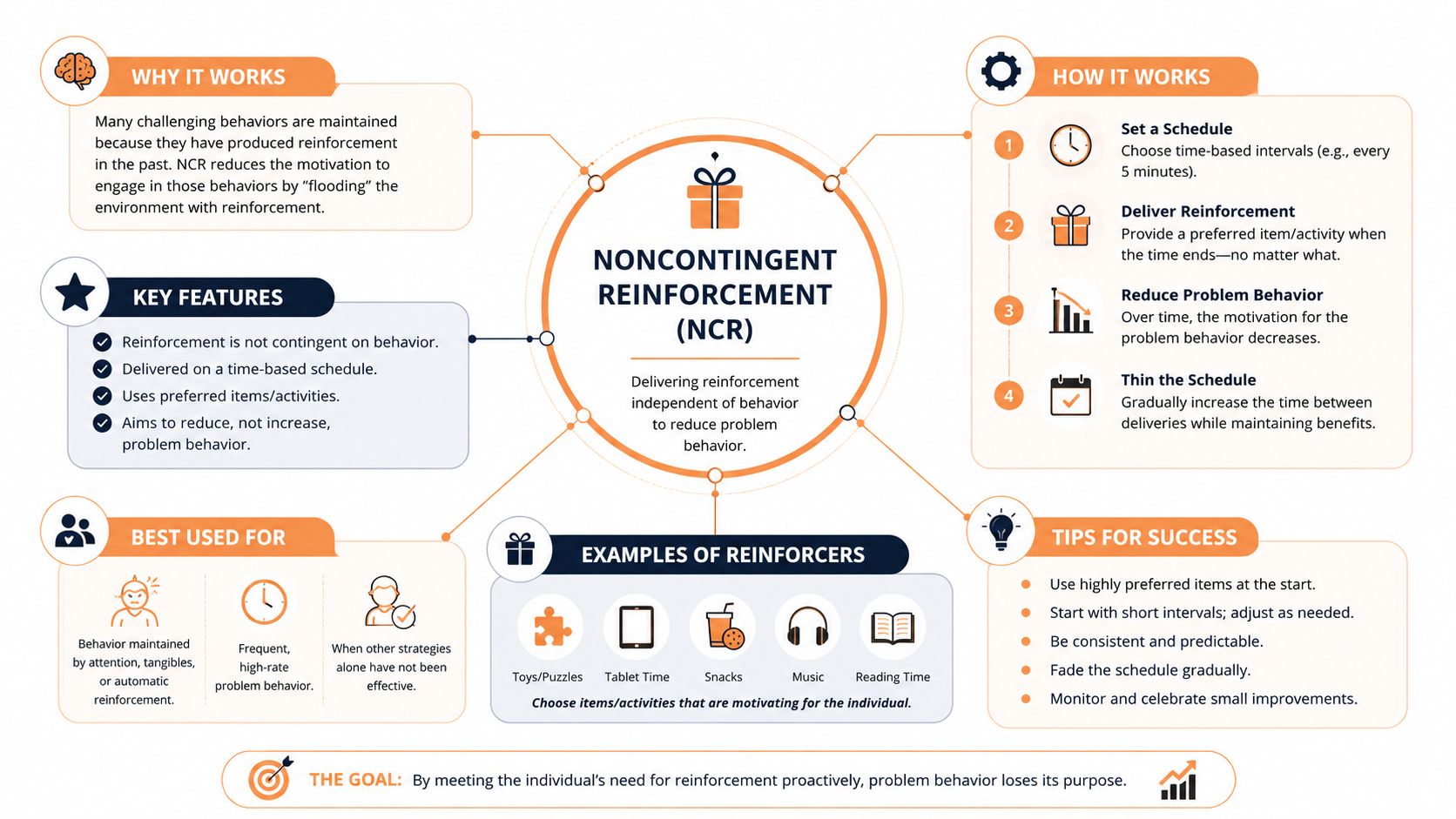
A reinforcer is something that matters to the child, like attention, a break, a favorite toy, or a short turn with an activity. A contingency is the rule that says a behavior has to happen before the reinforcer shows up. NCR removes that rule. The adult delivers the reinforcer independent of the behavior, on a schedule that is set ahead of time.
That schedule might look like attention every few minutes, a break at regular intervals, or access to a preferred item at planned times. A simple example is a parent checking in every 10 minutes during a tricky part of the day, even when the child is doing okay. The child gets the attention before they have to ask for it through yelling, grabbing, or crying.
A helpful way to picture it is a plant on a watering schedule. If the soil never gets bone dry, the plant is less likely to wilt all at once. NCR works in a similar way, steady reinforcement keeps the need from building to the point where behavior becomes the child's loudest signal.
The reason NCR often works is simple. It weakens the link between the problem behavior and the payoff. A major technical review in the ABA literature described the typical effect as a decrease in aberrant responding from baseline levels, especially when NCR is paired with extinction or differential reinforcement for socially maintained behavior such as attention-maintained problem behavior (review of NCR mechanisms).
The child does not need to “earn” every bit of attention when the plan is set up to provide attention before distress takes over.
Parents sometimes worry that this sounds like rewarding bad behavior. NCR is different because it gives the reinforcer on a schedule independent of the behavior, making it proactive instead of reactive. That is what lets families use it during real routines, like a calm check-in before the hard part of bedtime, a brief break during homework, or a planned bit of connection during a long car ride.
What the Research Shows About NCR Effectiveness
NCR has been part of evidence-based ABA for decades, and that history matters. Over time, it became a clearly described procedure, response-independent delivery of reinforcers on a time-based schedule (clinical study of NCR treatment selection). Earlier research reviews found a steady pattern, when reinforcement moved from being tied to a child's response to being delivered on a schedule, responding generally went down.
What the numbers mean in real family life
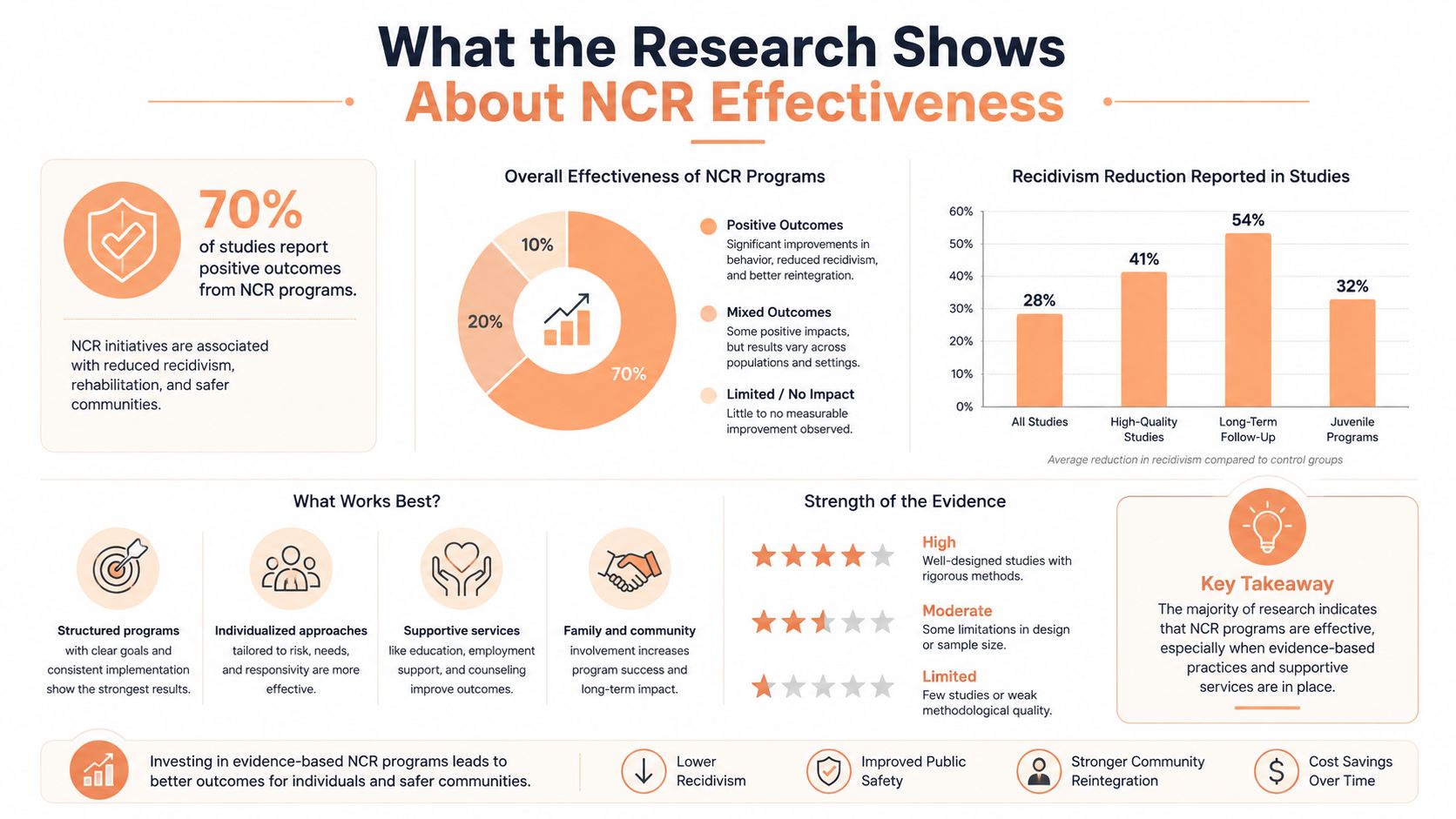
One important review highlighted a 1994 analysis of 152 functional analyses of self-injurious behavior in people with developmental disabilities. In that analysis, NCR using attention or play reduced SIB in 127 of 152 cases, or 83.6%. For families, that means NCR has often helped when behavior is being kept going by social attention or a similar payoff.
More recent clinical work points in the same direction. In one study across 27 applications in 21 individuals, NCR reduced severe problem behavior by at least 80% in 20 of 27 applications and by at least 90% in 19 of 27 applications. Across all applications, NCR with and without supplemental procedures produced at least an 80% reduction in 26 of 27 applications and at least a 90% reduction in 25 of 27 applications (clinical study of NCR treatment selection). Those percentages do not promise the same outcome for every child, but they do show why teams take NCR seriously.
A case study in the same paper found baseline problem behavior averaged 11 occurrences, fell to 2.8 during NCR, rose to 13.3 when NCR was withdrawn, and then dropped again to 0.7 after NCR returned. That pattern helps explain why clinicians view NCR as something they can test, measure, and adjust, not just a good idea on paper.
The most useful takeaway is simple. NCR tends to work best when the team matches it to the function of the behavior and folds it into an individualized plan, not a one-size-fits-all fix.
Real-Life Examples of NCR at Home and School
At home, NCR often looks ordinary on purpose. That's a good thing, because families need strategies that fit around meals, car rides, bedtime, and school mornings, not just therapy sessions. The plan should feel natural enough that you can use it when life gets messy.
Mealtime, when attention is the driver
At dinner, a child might throw food or call out because attention has become hard to get. A parent could build in short, pleasant check-ins during the meal, a quick comment, a smile, or a touch on the shoulder, before the child starts reaching for attention the hard way. The child experiences steady connection instead of waiting until frustration peaks.
Practical example: “I'm right here. Show me your bite,” said warmly every few minutes can do more than a long lecture after the plate goes flying.
Playtime and transitions, when stopping is hard
During play, some children melt down when an activity ends. NCR might look like a planned break, a quick choice, or brief adult engagement before the transition gets rough. If the child usually falls apart when the train set has to be put away, the adult can schedule connection during the play session so the end doesn't feel like a sudden cutoff.
The schedule can be thinner over time, but that change should be handled carefully. If a child gets used to frequent support, fading too quickly can backfire and make the behavior louder for a while. That's why good teams adjust slowly and with data, not guesses.
School routines, when call-outs or wandering start to build
In class, a teacher might use NCR by checking in with a student on a predictable schedule, especially during work periods or transitions. That can mean brief attention, a quick break, or a calm reminder that the teacher is available without the student having to call out or leave their seat first. It's a way to make the classroom feel more predictable and less like a constant test.
These examples aren't rigid protocols. They're starting points that help parents and teachers ask, “What does my child need most in this moment, and how can we provide it before distress takes over?”
How Your Care Team Builds an NCR Plan
Good NCR starts with understanding the behavior, not just the surface behavior, but the reason it keeps showing up. A functional behavior assessment helps your care team figure out whether the behavior is getting attention, escape, access to items, or something else. That matters because NCR only makes sense when the reinforcer matches the function.
The steps usually come next
First, the team identifies the likely reinforcer. Then they decide how often to provide it, using a time-based schedule that fits the child and the family routine. After that, they watch how the child responds and adjust the schedule carefully as progress builds.
Here's the part many parents appreciate most. You're not just handed a plan and sent home. Your observations about bedtime, meals, school pickup, and sibling dynamics give the team real information they can't get from a single session. That's where a dedicated care coordinator can help keep communication steady, so small changes don't get lost between appointments.
Parent insight: If a schedule works in the clinic but falls apart at bedtime, that doesn't mean the idea failed. It usually means the plan needs better fit.
NCR is often paired with other supports, especially extinction or differential reinforcement, when the behavior is socially maintained and the team needs a fuller behavior plan (review of NCR mechanisms). Families interested in a more hands-on role often benefit from structured parent coaching, because NCR works best when caregivers feel confident enough to use it consistently at home.
What helps the plan last
- Clear routines: The more predictable the day, the easier it is to deliver reinforcement on time.
- Shared communication: Parents, BCBAs, and school staff should know the schedule.
- Regular review: As skills change, the plan should change too.
- Simple language: If the adults can't explain it quickly, the child will feel the confusion too.
That kind of collaboration turns NCR from a technical term into something a family can live with.
When NCR May Not Be the Right Fit
NCR is helpful, but it's not magic, and it isn't the right first choice for every behavior. If a child's behavior is maintained mostly by automatic reinforcement, meaning the behavior itself is producing the sensory result, giving attention or access to items may not address the underlying driver. In those cases, the team may need a different strategy or a broader plan.
When the schedule is hard to identify or maintain
Sometimes the reinforcer is hard to pin down, or the family can't realistically deliver it on a tight schedule throughout the day. A plan that looks fine on paper can become stressful fast if it requires more attention than the caregiver can give. That's a sign to revisit the assessment, not a sign that the family is doing anything wrong.
Schedule thinning is another point where families can get stuck. If reinforcement is faded too quickly, the child may escalate again because the support disappeared before the new pattern had time to settle. Slower changes usually work better, especially when the child has depended on frequent access for a long time.
When NCR needs backup
NCR alone may reduce behavior, but not always enough. Some children need a combination of strategies, especially when the goal is not only fewer challenging behaviors, but also stronger communication, tolerance, and independence. That's why individualized assessment matters so much.
If your child's plan seems to stall, bring that up. Ask what the team thinks is maintaining the behavior, whether the reinforcement schedule is realistic, and whether other supports should be added. A good team won't treat adjustment as failure, they'll treat it as part of the work.
Bringing NCR Into Your Child's Broader Support Plan
NCR works best when it sits inside a bigger, thoughtful plan. On its own, it can lower the pressure around a behavior, but children also need ways to ask for help, wait, cope with change, and join family routines more smoothly. That's where communication goals, social skills, daily living skills, and parent coaching all fit together.
A child who gets regular attention during hard moments may still need help learning how to request that attention independently. A child who benefits from planned breaks may also need practice staying with a task a little longer each week. The most useful plans don't chase one behavior in isolation, they build the child's overall comfort and capability.
That's why consistency across home, school, and community matters so much. When adults use the same basic approach in different settings, the child doesn't have to relearn the rules every time the room changes. A school team that understands the plan can support it more smoothly, which is where school support becomes a real part of the child's day, not just a separate service.
The bigger picture is simple. Noncontingent reinforcement ABA can calm a pattern, but it works best when the whole care team keeps the child's strengths, routines, and family life in view. When clinicians, parents, and coordinators stay in close contact, small wins add up in a way that feels steady and human.
If you're looking for ABA support that feels personal, collaborative, and practical at home, school, and beyond, visit Friendly ABA Premier to learn how individualized care can support your child's routine and growth. Their team works with families who want clear communication, thoughtful planning, and a true partner in the therapy process.
Our Latest Insights


































Experience ABA Therapy with a More Personalized Level of Support
Discover how FriendlyABA Premier combines evidence-based ABA therapy with dedicated coordination, proactive communication, and individualized family support.