

Mand Training ABA: A Parent's Guide to Teaching Requests
Learn how mand training ABA works, from prompting and fading to reinforcement, with practical parent-implemented examples you can use at home today.

Your child reaches toward the snack, pulls at the container, and then cries because the request is trapped inside their body. You may know exactly what they want, but guessing can leave everyone tired and frustrated. Mand training ABA gives your child a practical way to communicate that want, whether the response is spoken, signed, pointed, shown on a picture system, or selected on a communication device.
The aim isn't to make every moment feel like therapy. It's to help communication work during breakfast, play, bath time, school routines, and ordinary family life. A well-designed plan also respects your child's motivation, communication style, and pace, while giving you coaching you can use without turning the kitchen into a treatment room.
Table of Contents
What Mand Training ABA Really Looks Like at Home
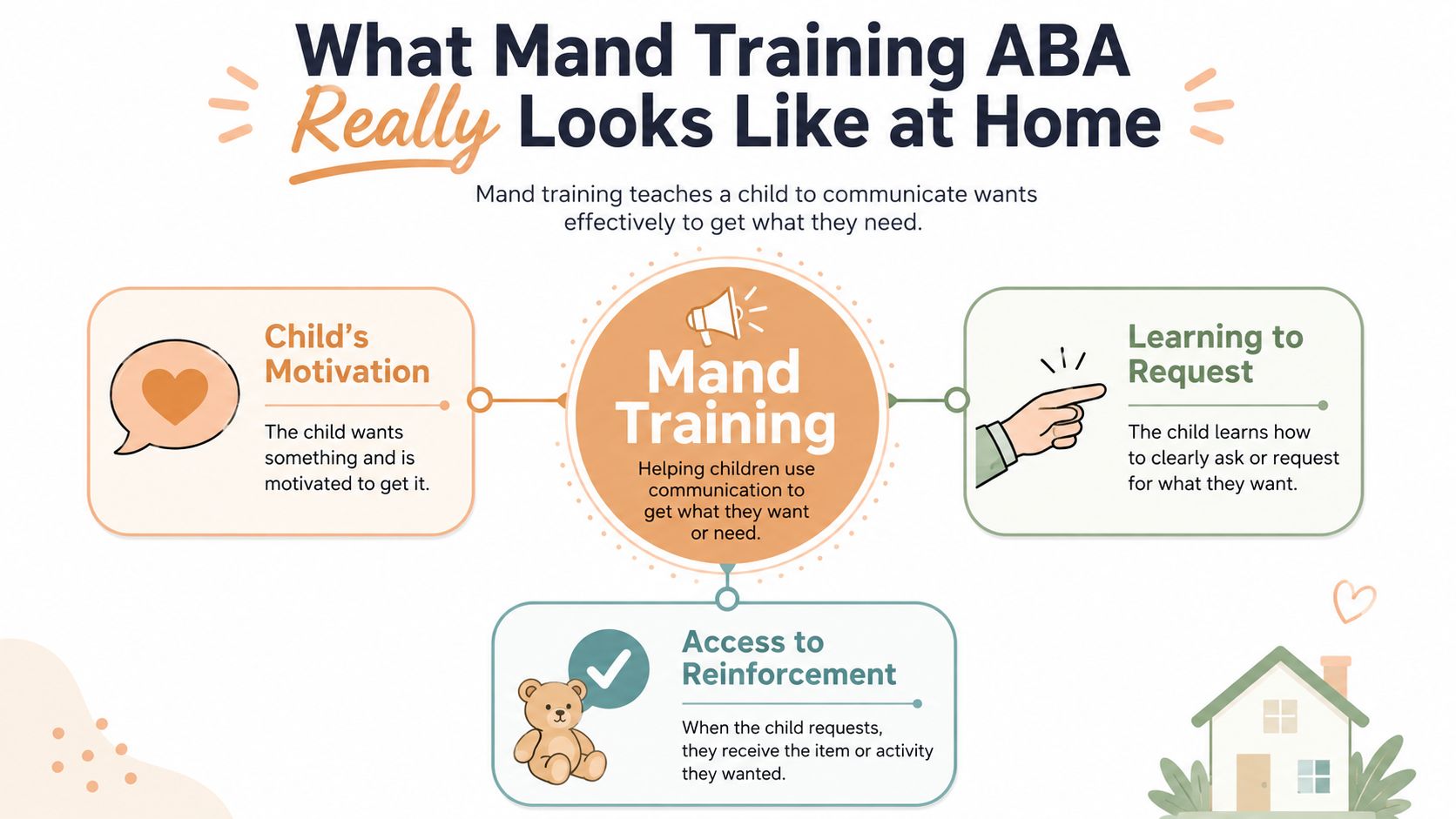
A mand is a request connected to something a child wants or needs at that moment. Your child might say “cracker,” sign “more,” point toward bubbles, hand you a picture, or use a speech-generating device to ask for a turn. The important part is the function, your child communicates in a way that can help them access a meaningful outcome.
Skinner described a mand as a verbal operant controlled by motivating conditions and reinforced by a specific consequence, as explained in this overview of mands in ABA. In everyday language, if your child asks for juice and receives juice, the request has a direct connection to what they wanted.
The parent's role is practical, not perfect
Behavioral parent training in the ABA tradition emerged in the 1960s. It grew partly from dissatisfaction with traditional child therapy, the rapid expansion of behavior modification, and the recognition that parents could use behavioral methods during daily routines. The field later moved from small component studies toward standardized intervention models and research on how skills generalize across settings, making parent training a core part of ABA service delivery (historical review of behavioral parent training).
That history matters at your kitchen table. Therapy sessions can introduce a skill, but family routines provide countless chances to make that skill useful. You might pause before opening a favorite snack, hold the bubbles still, or wait briefly before giving access to a preferred toy.
A flashcard drill might ask a child to repeat a word without a real reason to use it. At home, mand training looks different. Your child wants the car, you make the car available after a request, and the child experiences that communication can change what happens next.
Practical rule: Start with a real want, accept the child's current communication form, and reinforce the request promptly.
Don't require speech if speech isn't currently the most accessible response. Your ABA team can help determine whether spoken words, gestures, signs, pictures, or AAC should be included and how to shape that response gradually.
Mands, Tacts, and Echoics Explained in Plain Terms
A child can use the same word for different reasons, and the reason matters. If your child says “juice” because they want a drink, that's a mand. If they say “juice” after seeing a cup on the table without asking for it, that may be a tact, a label or comment about something in the environment.
An echoic happens when your child repeats a sound or word someone else has just said. During a book, you might say “dog,” and your child repeats “dog.” The response resembles your spoken model, while a mand is driven by the child's current desire.
| Verbal Operant | What the Child Does | Home Example | Driving Force |
|---|---|---|---|
| Mand | Requests a desired item, action, break, or attention | Says “juice” when wanting a drink | Motivation for a specific outcome |
| Tact | Labels or comments on something noticed | Says “dog” when one passes the window | Contact with something in the environment |
| Echoic | Imitates another person's sound or word | Repeats “dog” during story time | Matching a speaker's model and receiving social reinforcement |
A request can be especially valuable for a child who becomes upset when adults don't understand what they need. Mand training gives the child a functional alternative to reaching, grabbing, crying, or waiting for someone to guess. It doesn't mean every difficult moment will disappear, and it doesn't make frustration a child's fault. It gives your family another response to teach and support.
Mands, tacts, and echoics develop together. A child may learn to imitate “bubbles,” label bubbles in a picture, and request bubbles during play, but these are still different communication goals. Parents comparing these skills may find this example of tacting in ABA helpful.
Many clinicians prioritize mands because the consequence is immediate and meaningful. Your child doesn't have to understand a distant reward. The request works right there, during snack, play, or a favorite song.
Why Motivating Operations Matter More Than Words
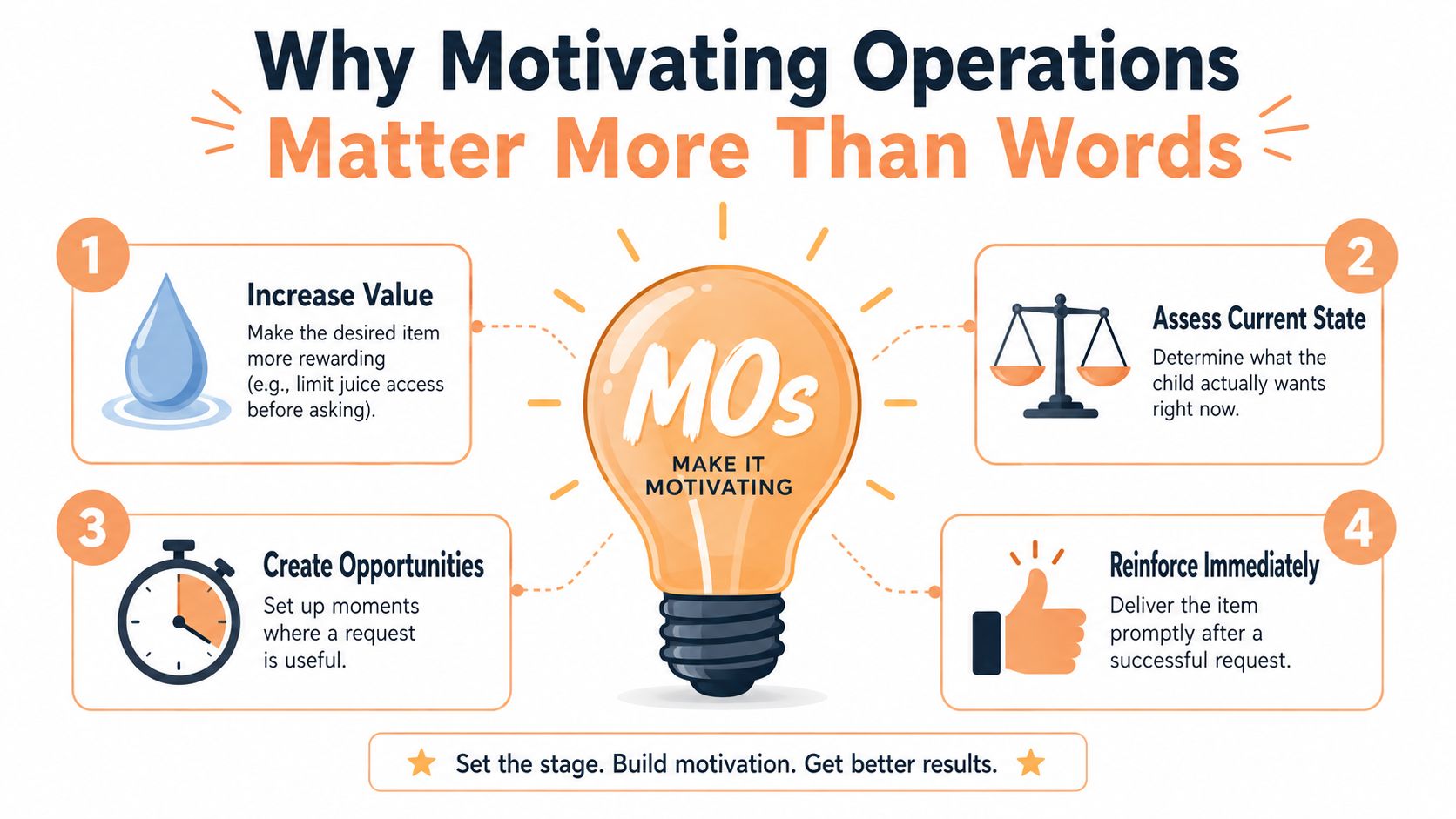
Words alone don't create a strong mand. Motivating operations, often called MOs, change how valuable something is right now. A child who just finished a large snack may have little reason to request another cracker. The same child may request one later when hungry.
Natural MOs appear throughout the day. Hunger can increase the value of food, boredom can increase the value of an activity, and curiosity can increase the value of an unfamiliar object. Tiredness may make a break or comfort item more valuable. Parents don't need to manufacture every opportunity. They can notice when interest is already present.
A contrived MO is a carefully arranged opportunity. You might place a favorite snack inside a clear jar that your child can see but can't open independently. The jar creates a reason to communicate, but it shouldn't create distress or remove reasonable access to food. Your care team can help you choose safe, respectful setups for your child.
Read the moment before choosing the prompt
Look for small signs of wanting:
- Body movement: Your child reaches, approaches, looks toward, or touches the item.
- Repeated attempts: They bring you a closed container or return to a toy.
- Changes in attention: Their face, posture, or gaze shifts toward a preferred activity.
- Natural communication: They gesture, vocalize, sign, or use a picture before you say anything.
If your child is full, deeply engaged elsewhere, or uninterested, prompting “say snack” may produce a response that isn't connected to genuine communication. Waiting for motivation doesn't mean waiting passively. It means arranging the environment so a meaningful request has a real purpose.
A request becomes stronger when the reinforcer follows quickly and matches what the child asked for. If your child asks for bubbles, give bubbles when appropriate. If they request help, provide help rather than offering a different reward. The ABA team can help balance access, safety, nutrition, and teaching goals.
Prompting and Fading the Request Step by Step
At home, prompting should feel like offering a handrail, not pulling your child through a response. The prompt gives enough support for success, while fading gradually shifts control to the child. Begin with the least intrusive cue likely to work, then add help only when needed. Because children respond differently, the clinical team should individualize the hierarchy, especially if physical guidance may be used.
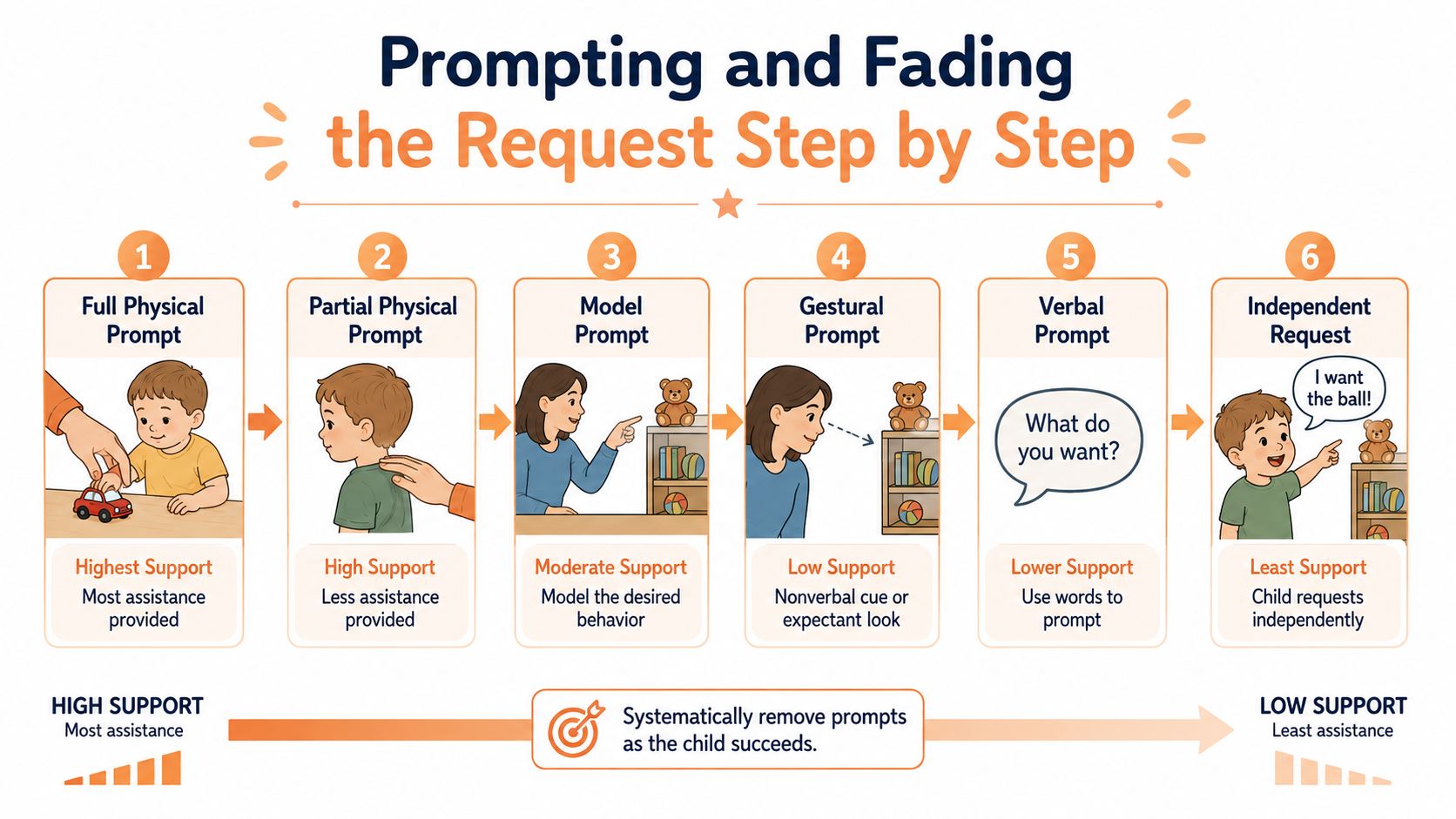
A simple home sequence
- Create the opportunity. Hold the bubbles, pause the iPad, or offer a closed container after your child shows interest.
- Wait expectantly. Look toward your child and the item, then allow a brief chance to respond. Your clinician can recommend a response window suited to your child. A speech-generating-device study used a 5-second response window before prompting (speech-generating device mand study).
- Use a small cue. Try a gesture, an expectant look, or a short model such as “help.”
- Increase support only if needed. A least-to-most sequence might move from gesture, to vocal prompt, to partial physical prompt, and then to full physical prompt. Use the progression your team has selected rather than adding assistance automatically.
- Reinforce immediately. When your child gives the agreed response, provide the requested item or action when it is safe and appropriate.
- Fade the prompt. If “say bubbles” worked, shorten it to “bubbles,” then try only a pause or gesture. Record the cue needed so the next opportunity can start with less help.
This sequence can travel across meals, play, siblings, and school. Behavioral skills training offers a related framework for practicing a skill, receiving feedback, and building consistency among caregivers.
A whisper, mumble, reach, picture exchange, sign, device selection, or vocal approximation can all provide useful information. The team may accept the current attempt and shape it gradually toward a clearer sound or fuller word. A reach can show motivation without making speech the only route to the item.
Prompting becomes less helpful when adults respond too quickly or repeat the same cue every time. Caregivers should use the agreed response form and reinforcement plan across settings. Ask the clinician how to handle errors, unsafe behavior, or requests that cannot be granted, so practice remains consistent without turning communication into a struggle.
Everyday Routines Where Mand Training Shines
Snack time, car rides, and bath routines already contain natural opportunities for requesting. Mand training works by pausing before giving access, then helping your child communicate what they want in a form the team has agreed to accept. The aim is to fit practice into real moments, not create a long series of artificial trials.
Snack time
Place a small, safe selection of preferred foods where your child can see it. When your child reaches toward a choice, pause briefly, then offer the planned prompt, such as a picture, sign, word model, or device selection. Provide the selected snack soon after the response so the connection stays clear.
Keep hunger out of the teaching plan. Offer appropriate choices and follow your care team's guidance when eating, allergies, or nutrition require special attention. A calm snack routine gives your child repeated chances to request without making food access feel like a test.
Play with siblings
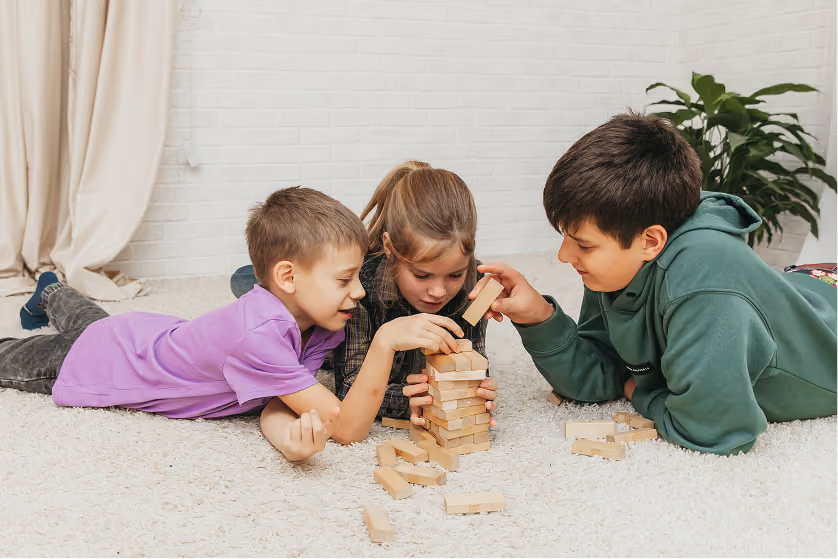
Block play can create a simple reason to request help. Give your child a needed piece or place a preferred toy in a container that requires assistance. If your child reaches, model “help,” support the planned response, and open the container promptly.
Games with siblings can also practice “turn,” “my turn,” “more,” and “stop.” Teach the sibling one small routine: wait, accept the agreed response form, and give the turn when appropriate. The sibling is participating in communication practice, not taking responsibility for treatment.
Bath and bedtime
Predictable evening routines make requests easy to repeat. Hold up two books and wait for a selection, pause a familiar song so your child can request “more,” or keep a preferred comfort item visible while supporting the planned response. A request for a towel, light, song, book, or another turn can carry more meaning because it changes what happens next.
Use the same response expectations with parents, grandparents, and other caregivers. Families can find more ideas for building communication skills in everyday moments, especially when practice needs to continue beyond therapy time.
| Routine | Target Mand | Prompt Level | Reinforcement |
|---|---|---|---|
| Snack | “Cracker,” “juice,” or a picture choice | Wait, then gesture or model | Provide the selected food or drink |
| Block play | “Help” | Gesture, model, or planned AAC support | Open the container or assist |
| Sibling game | “Turn,” “more,” or “stop” | Brief verbal or visual cue | Give the turn, continue, or pause |
| Bedtime | “Book,” “song,” or “more” | Choice display or verbal model | Read, sing, or continue the routine |
The Generalization Gap Most Articles Skip
A child may request juice accurately with one therapist and still grab the cup at home. That doesn't mean the clinic skill was meaningless or that your child isn't trying. The two situations may differ in people, objects, timing, noise, reinforcement, and the exact motivation present.
Research has repeatedly identified generalization as a challenge in mand training. Much of the literature is clinic-based and focuses on a single mand, while later reviews call for broader maintenance across people, settings, stimuli, and routines. A 2024 review found that generalization was assessed in only about half of participants, and when researchers measured it, they often tested just one dimension, such as a new setting or person (review of mand-training generalization).
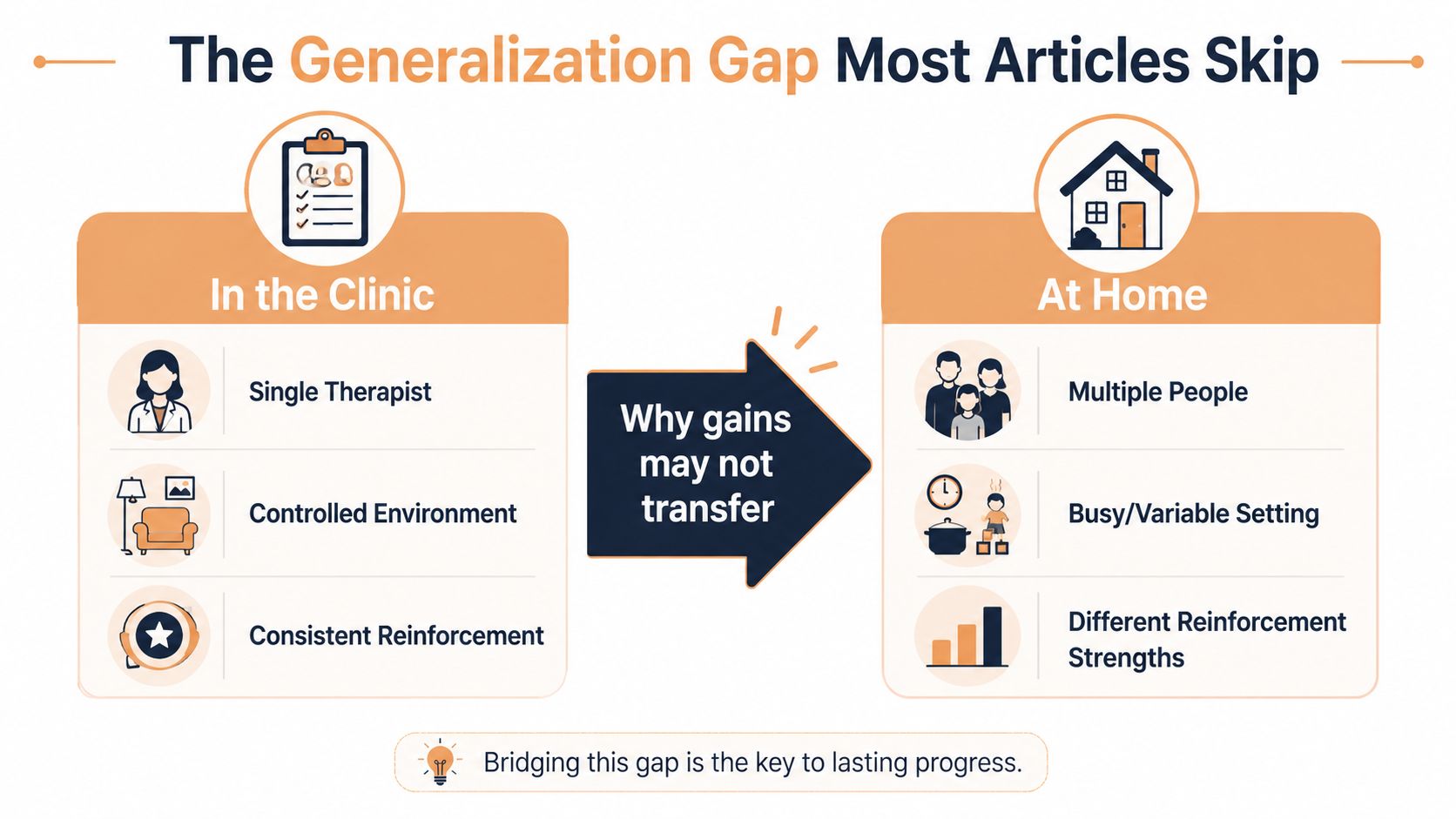
What carryover requires
Generalization means your child can use the communication response when important details change. Your team may deliberately vary:
- People: A parent, sibling, grandparent, teacher, or therapist responds.
- Places: The kitchen, bedroom, classroom, playground, or car.
- Items: Different cups, snacks, toys, and containers.
- Motivation: The request occurs during real interest, not only during a planned session.
- Timing: Your child learns that a short, appropriate wait can happen without losing the communication opportunity.
“Multiple control” describes situations where more than one feature affects a response. A child might learn to request only when a particular therapist holds a particular cup. Generalization planning helps the child respond when a different adult holds a different cup in a different room.
The school-based evidence base supports mand training broadly, with a systematic review identifying 93 studies involving 225 participants and finding substantial support for mand-training interventions for people with intellectual and developmental disabilities (school-based mand-training review). That evidence doesn't guarantee automatic carryover for an individual child. It does show why the home, school, and therapy teams should plan transfer directly instead of assuming it will happen.
Building Confidence as a Parent Partner
Consistency matters more than perfection. Choose one motivating item, one response, and one routine that your family can practice without adding pressure to an already full day. Helping your child request “help” during block play may be more useful than attempting a long list of targets at once.
Keep notes small and practical:
- Prompt: What did you do before the request?
- Response: Did your child point, sign, select a picture, use a device, vocalize, or speak?
- Outcome: What happened immediately afterward?
- Context: Who was present, and where did it happen?
These notes aren't a grade on your parenting. They give the ABA team information for adjusting the motivating operation, response form, prompt, or reinforcer. Parent training research supports caregiver implementation, but reviews also identify missing fidelity information and limited tracking of long-term parent use. Lower-burden formats, including brief video modeling and telehealth-delivered functional communication training, are being studied; one randomized trial reported a mean 98% reduction in problem behavior over 12 weeks, alongside improved mand production and task completion (caregiver-implemented functional communication training study). That finding doesn't establish a guaranteed result or answer how much coaching every family needs.
Avoid turning every request into a test. If your child is quiet, frustrated, or unable to respond, treat that moment as information. Ask the clinician whether the item was motivating, the prompt came too quickly, the response was too difficult, or the reinforcement wasn't strong or immediate enough.
Celebrate communication in every form while supporting greater independence. If aggression, prompt dependence, or limited progress continues, ask the care team to review the teaching environment rather than blaming yourself or your child. Parent-implemented mand training works best as shared problem-solving, with clinicians contributing behavioral expertise and caregivers contributing unmatched knowledge of the child's routines.
Friendly ABA Premier offers individualized ABA therapy, home-based support, school support, and parent coaching for families in Connecticut, Georgia, Maryland, Massachusetts, North Carolina, South Carolina, Virginia, and Washington. If you want a communication plan that includes caregiver coaching, proactive communication, a dedicated care coordinator, and regular progress check-ins, visit Friendly ABA Premier to schedule a consultation.
Our Latest Insights














Experience ABA Therapy with a More Personalized Level of Support
Discover how FriendlyABA Premier combines evidence-based ABA therapy with dedicated coordination, proactive communication, and individualized family support.