


Total Task Chaining in ABA Therapy: A Parent's Guide
Learn how total task chaining in ABA therapy helps children master daily living skills. Practical steps, examples, and home-based tips for parents.

You're standing near the bathroom door before school. Your child is half awake, the toothbrush is on the counter, and you can already feel the clock moving faster than you'd like. You want to help, but you also don't want to do the whole routine for them again.
That's the moment many parents are in when they first hear about total task chaining. The term sounds clinical, but the idea is simple. Your child practices the full routine, in order, every time, and you help only where help is needed.
For some children, that feels more natural than teaching just the first step or only the last step. For others, it's too much too soon. The question isn't whether total task chaining is a “good” method. It's whether it's the right fit for your child, this skill, and this setting right now.
Table of Contents
- What each method looks like in one tooth-brushing session
- Three decision questions to ask
- The choice isn't permanent
- Generalization starts narrow
- Deciding whether total task chaining will carry over well
- Coaching other adults without overwhelming them
- Fade adult presence too
What Total Task Chaining Looks Like at Home
You see it most clearly in an ordinary routine.
Your child is getting ready for bed. They walk into the bathroom, pick up the toothbrush, and then pause. They know some of the routine, but not all of it yet. With total task chaining, you still guide them through the whole sequence from start to finish. You help on the stuck parts, then step back again as soon as you can.
In plain language, total task chaining means your child practices every step of the routine during each teaching opportunity, and you give support only for the steps that still need help. That matches the standard ABA description of the method in this overview of total task chaining in ABA.
A home example
Take a morning bathroom routine:
- Walk to the sink
- Pick up the toothbrush
- Put toothpaste on the brush
- Brush top teeth
- Brush bottom teeth
- Spit
- Rinse toothbrush
- Put toothbrush away
With total task chaining, your child goes through that full sequence each time. If they can already walk to the sink and pick up the toothbrush on their own, you let those steps stay independent. If putting toothpaste on the brush is hard, you prompt that step. If they forget to rinse the toothbrush, you prompt there too.
A lot of parents find this easier to picture once they stop thinking of it as "teaching a program" and start thinking of it as coaching a routine. Your child is not practicing random pieces. They are practicing the activity, in the place, in the order.
That is often the biggest benefit at home.
What it feels like during real teaching
Total task chaining works like riding through the whole route with training support only where your child wobbles. You are not stopping after step one every time. You are not jumping straight to the last step. You stay with the whole routine, and your level of help changes from step to step.
For many families, that makes home practice feel more natural. Bedtime still looks like bedtime. Hand washing still looks like hand washing. The teaching is built into the routine instead of sitting beside it.
A plain-language summary from Helpful Professor describes the same core idea. The skill is broken into small steps, and the learner practices the chain in order during teaching. You can read that explanation here: plain-language explanation of task analysis and total task chaining.
When this method is usually a good fit
Parents are usually deciding between methods, not just learning definitions. The useful question is, "Should I teach the whole routine each time, or would my child do better starting with only one part?"
Total task chaining often fits best when:
- Your child can already do at least some steps. They are not completely new to the skill.
- The routine makes more sense as a whole. Tooth brushing, getting dressed, and washing hands all have a clear beginning, middle, and end.
- Your child can stay with the activity long enough to practice the full chain. They do not need to do every step independently yet, but they do need to tolerate the routine with support.
- Home life calls for a practical routine, not a split-up lesson. Many caregivers need a method that works during real mornings, real bedtimes, and real transitions.
If your child gets overwhelmed halfway through a routine, or cannot yet do any of the steps with success, total task chaining may be too much at first. In that case, a different chaining method may be easier to start with.
Simple rule of thumb: If your child can do some parts already and can move through the routine with your help, total task chaining is often worth trying.
Chaining procedures have been discussed in ABA research for many years. A review in the Journal of Applied Behavior Analysis describes total task presentation as one established option among several ways to teach chained skills, which is useful context when you are choosing a method for home routines, as summarized by University of Kansas researchers in this research review on chaining procedures.
Building a Task Analysis You Can Use Every Day
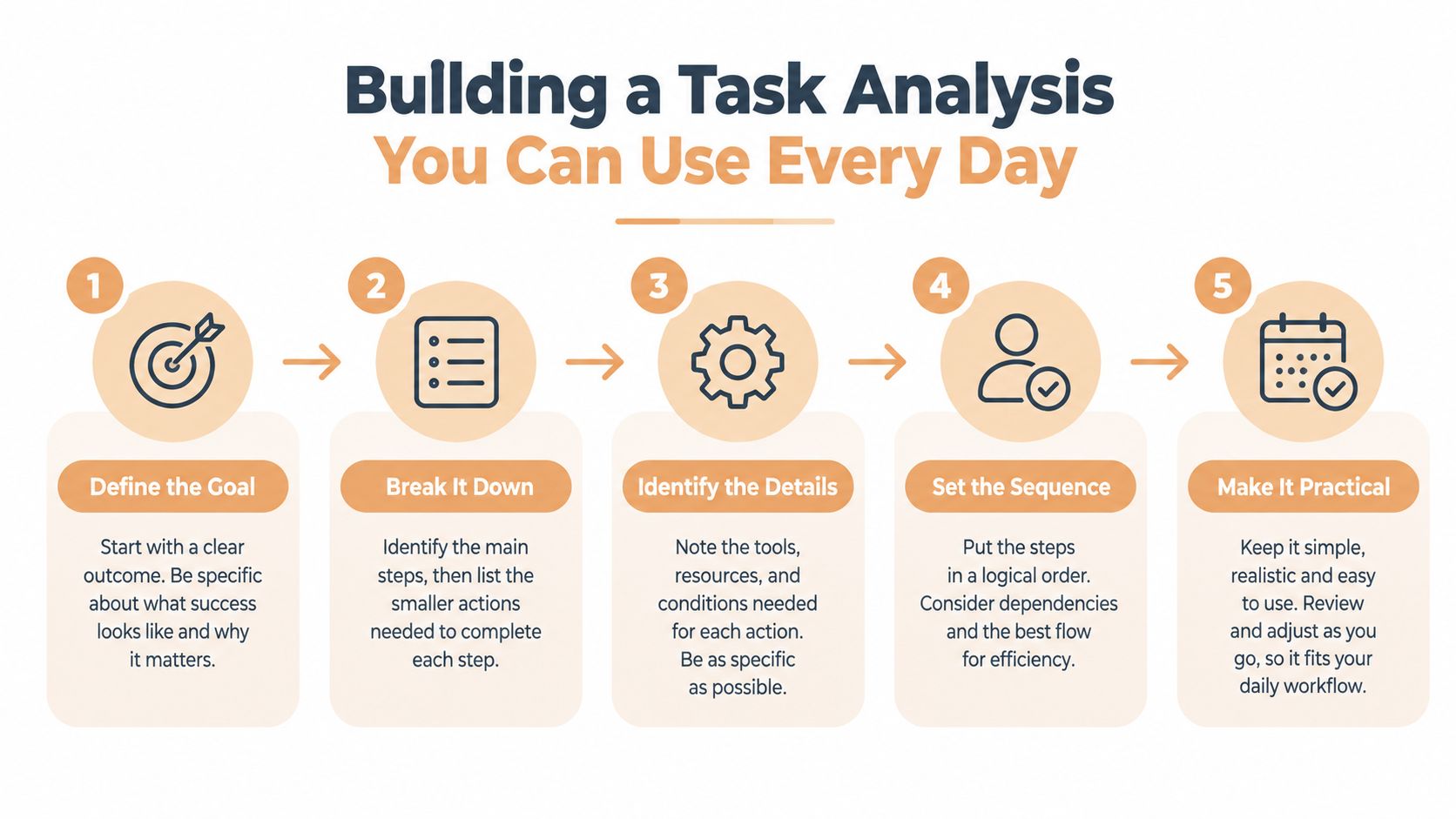
A task analysis is just a written list of the steps in a skill. That's it. It turns “wash your hands” into a clear teaching script that every adult can follow the same way.
A hand-washing example
“Wash your hands” sounds simple, but it includes several actions. A home version might look like this:
- Turn on water
- Wet hands
- Press soap dispenser
- Rub hands together
- Rinse hands
- Turn off water
- Dry hands
That list gives you something observable. You can see whether your child turned on the water or didn't. You can see whether they reached for the towel or waited for help.
What makes a task analysis useful
The strongest task analyses share three features.
First, each step is small enough for success. If you write “brush teeth” as one step, you may miss where the problem is. Maybe your child can brush but can't put toothpaste on the brush.
Second, the words are concrete. “Get ready at sink” is vague. “Turn on water” is clear.
Third, the steps match the actual environment. A pump soap bottle, a bar of soap, and an automatic dispenser each create different demands. If the towel is on a hook behind your child, that belongs in the teaching plan.
The best task analysis isn't the most detailed one. It's the one your family can actually use on a busy Tuesday morning.
If more than one adult helps with the routine, consistency matters. Parent, grandparent, babysitter, and therapist should all be teaching the same sequence, not four slightly different versions. That's one reason many clinicians also use behavioral skills training with caregivers, so adults can practice the same prompts, expectations, and feedback.
When to revise it
A task analysis should change when the routine changes.
Maybe your child moves from a step stool to reaching the sink independently. Maybe you switch from a hand towel to paper towels. Maybe school expects a different bathroom routine than home. When the environment changes, the steps may need to change too.
Choosing the Right Chaining Method for Your Child
This is the question parents usually care about most. Not “What are the definitions?” but Which method should we use?
The answer depends less on the name of the method and more on your child's starting point. Practical guidance on chaining notes that learner variables, task complexity, and treatment integrity often matter more than the chaining variant alone, and that total task chaining is usually implemented by teaching the whole sequence each trial after a clear task analysis is built, as described in this chaining guide for ABA practice.
What each method looks like in one tooth-brushing session
Say the target skill is brushing teeth.
| Method | What the Child Does Each Trial | Best Fit For |
|---|---|---|
| Total task chaining | Moves through the full brushing routine every time, with help on the hard parts | Children who can tolerate the whole routine and already show some related skills |
| Forward chaining | Starts with the first step and adds later steps gradually as earlier ones become independent | Children who need a smaller entry point and build confidence step by step |
| Backward chaining | Completes the last step first while an adult helps with the earlier parts | Children who benefit from ending with immediate success or when the last step is especially motivating |
Here's a visual example that helps many parents picture the difference:
Three decision questions to ask
When families are unsure, I usually come back to three practical questions:
- Can my child stay with the full routine? If attention drops quickly, total task chaining may be too demanding right now.
- Which step is naturally rewarding? If your child loves the final “all done” moment, backward chaining may create stronger early buy-in.
- Is there a safety reason to control part of the sequence first? Some tasks need more adult management at the start or middle.
A useful, often-missed point in practitioner guidance is that the bigger question is sometimes when total task chaining is the wrong choice. Current summaries emphasize that the decision should be based on baseline skill, motivation, and environmental barriers, not just on the task itself, and that step-level baseline and ongoing data should guide the choice, as outlined in this discussion of when to choose total task chaining.
The choice isn't permanent
Families sometimes worry that choosing one method locks them in. It doesn't.
A child might start with backward chaining for dressing, then move to total task chaining once the routine feels familiar. Good teaching is flexible. If frustration rises or progress stalls, the team can adjust the method rather than pushing harder.
Prompting, Reinforcement, and Fading in Practice
Once the routine is chosen, the next question is usually, “How much help should I give?” That's where parents often get stuck. Too little help can lead to frustration. Too much help can turn the routine into adult-led work.
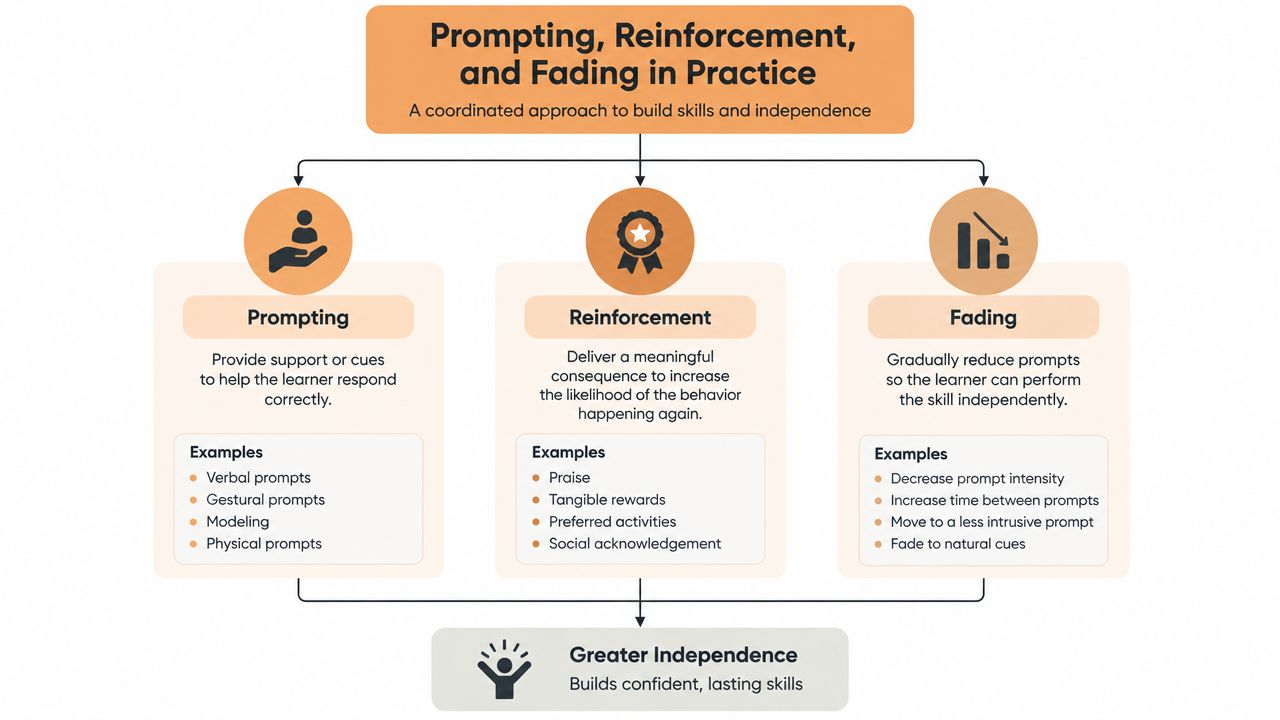
The general pattern in total task chaining is straightforward: your child attempts the whole sequence, you prompt only the steps they can't yet do, and then you gradually fade that help. Practical teaching summaries also note a common mistake: adults sometimes reinforce isolated steps instead of the completed chain, or skip baseline on each step before starting, as discussed in this applied summary of total task chaining.
A hand-washing example
Let's say your child can turn on the water and wet hands alone, but pauses at soap.
You might use a prompt sequence like this:
- Wait briefly first. Give your child a moment to respond on their own.
- Use a simple verbal prompt. “Get soap.”
- Add a gesture if needed. Point to the dispenser.
- Help physically only if needed. Guide the hand to press once.
Then the routine keeps moving. Rub, rinse, turn off, dry.
A home script might sound like this:
“Turn on water. Nice job. Wet hands. Get soap. Press. Rub hands. Rinse. Turn off. Dry hands. All done.”
That calm tone matters. You're not quizzing. You're guiding.
How fading should feel
Prompt fading across the full sequence is a core part of this method. The adult helps with harder steps at first, then reduces support gradually while keeping the full routine intact so the learner experiences the task as a connected whole, as explained in this overview of prompting and fading within chaining.
If a step needed hand-over-hand help last week, maybe this week it only needs a point or a short verbal reminder. The key is to reduce help in small, manageable shifts.
Don't wait for perfect performance before fading. Fade when your child is showing the start of understanding.
Reinforcement that supports the whole chain
Reinforcement is what makes the routine worth doing again. At home, that might be praise, a preferred activity after the routine, a song during clean-up, or access to breakfast after the bathroom routine is complete.
Many families benefit from keeping reinforcement simple:
- At first, reinforce every completed routine.
- Later, shift toward more natural reinforcement, such as the satisfaction of being ready for school or moving on to a favorite activity.
- If motivation drops, revisit what matters to your child.
If you want a parent-friendly refresher on how reinforcement schedules work as independence grows, this guide to schedules of reinforcement examples can help connect the dots.
Tracking Progress with Simple Home Data
Home data shouldn't feel like a second job. If the sheet is too complicated, no one will use it. The goal is to collect just enough information to notice patterns and share them with your child's supervising BCBA.
A practical concern in total task chaining is implementation fidelity. If the task analysis is incomplete or prompts are inconsistent, progress can look flat even when the overall procedure is a reasonable fit, which is one reason step-level data matters, as noted in this practice guide on total task chaining and treatment integrity.
What to write down
For each practice trial, record:
- How many steps were independent
- The highest prompt needed
- What reinforcement was used
- Any quick note that explains the day
That's enough to show whether independence is spreading across the chain or whether one step keeps causing the slowdown.
Sample Home Data Sheet for Total Task Chaining
| Date | Steps Completed Independently | Highest Prompt Needed | Reinforcement | Notes |
|---|---|---|---|---|
| Mon | 4 of 7 | Physical prompt at soap step | Praise and tablet time | Tired before school |
| Wed | 5 of 7 | Gesture prompt at soap step | Praise and breakfast | Less hesitation |
| Fri | 5 of 7 | Verbal prompt at drying step | Praise | Needed reminder to finish |
What patterns to watch
You don't need fancy graphs to notice useful trends.
Look for the step that stays dependent the longest. Watch whether prompts are getting lighter over time. Notice whether rough mornings, hunger, noise, or rushed schedules change performance.
Worth watching: If the same step stays stuck for several days, it may not mean your child “isn't getting it.” It may mean that step needs to be rewritten, prompted differently, or practiced at a better time of day.
Helping Skills Carry Over to School and Real Life
You teach hand washing at home, and your child can do it with you standing right there. Then the school says your child did not finish the routine after recess. A grandparent tries the same skill over the weekend and gets a different result. That can feel confusing fast.
A lot of parents hear the word generalization and picture a skill spreading everywhere on its own. In real life, carryover usually happens because adults make a simple plan for it.
Generalization starts narrow
Start by getting the routine steady in one place with one adult. Then widen only one part at a time.
That often looks like this:
- Same routine, new adult. You teach it first. Then a grandparent or babysitter follows the same steps.
- Same routine, new setting. The home bathroom comes first. The school bathroom comes after that.
- Same routine, new materials. One soap pump first. A different dispenser later.
This gradual approach matters because total task chaining asks your child to practice the whole routine each time. That can help the skill hold together across settings, but only if the adults around the child keep the routine recognizable at first. Too many changes at once can make it hard to tell whether the child is forgetting the skill or just reacting to a new setup.
Deciding whether total task chaining will carry over well
This is often the question for parents. Is total task chaining the best fit if the goal is success at school, in the community, or with other caregivers?
Sometimes yes. Sometimes no.
Total task chaining often makes sense when your child can tolerate moving through the full routine with support and benefits from seeing how all the steps connect. It works well for routines like washing hands, packing a backpack, or putting on shoes, where the order stays fairly stable across places.
A different chaining method may fit better if your child shuts down when the full routine is presented, or if one part of the chain is so hard that it disrupts everything else. In those cases, teaching one section first can reduce frustration and build momentum before you ask for the whole sequence.
A simple question can help: Will practicing the entire routine help my child understand the activity, or will it make the task too heavy right now? That is often the fork in the road.
Coaching other adults without overwhelming them
Other adults do not need a full training packet. They need a short, usable plan.
Share these four things:
- The exact step list
- The prompt to try first if your child pauses
- What success looks like
- What to avoid, such as changing the order or stepping in too quickly
You can say it in plain language: “Please wait a few seconds before helping. If she stops at the soap, point to it first. If that does not work, then help more.”
If school support is part of the picture, it helps to align one real routine across home and school instead of sending in a broad goal like “be more independent.” Families often get better follow-through when they share the same task analysis with the team providing ABA support in schools, so the child is not being taught three different versions of the same skill.
Fade adult presence too
Independence is not only about finishing the steps. It also includes doing them without needing one specific person beside the child every time.
So fade your presence on purpose. Stand a little farther away. Use fewer words. Let another adult run the same routine while you watch. Then step out for part of it if your child is ready.
That shift is easy to miss, but it matters. A child who can brush teeth only with one parent coaching every move is still learning the routine. A child who can follow the same sequence with another adult, in another bathroom, with only a brief reminder is starting to own the skill.
Carryover usually grows from that kind of steady practice. Same steps first. Then small changes. Then real life.
Moving Forward with Confidence
Parents often hope a new teaching strategy will create a straight line of progress. In real homes, it rarely looks that neat. A child may do a routine smoothly for several days, then suddenly need more help after a poor night of sleep, a schedule change, or a stressful school day.
That doesn't always mean the plan is failing. It often means your child is still learning a demanding sequence and needs steady support while that skill settles in.

A grounded next step
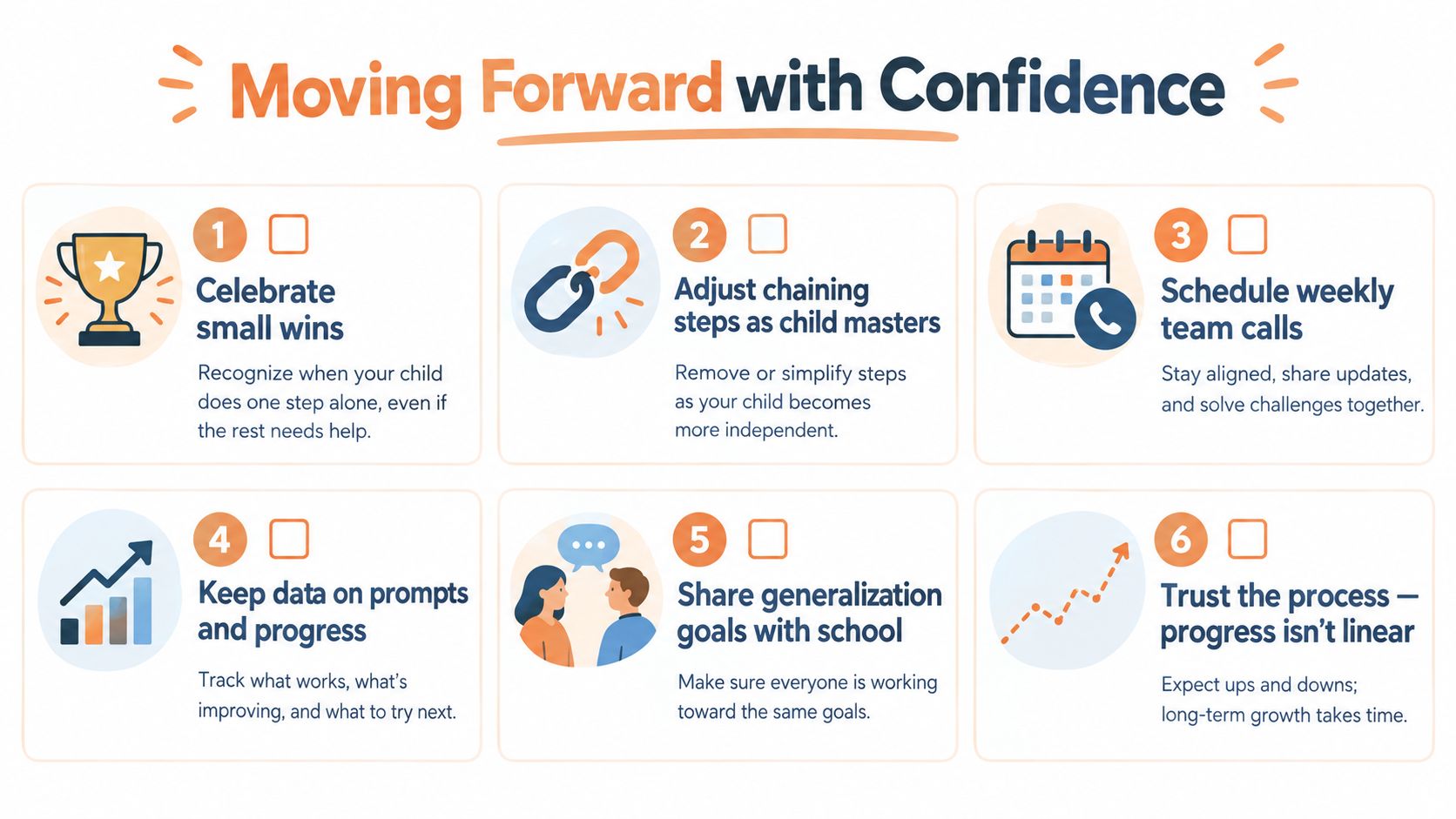
If you're thinking about trying total task chaining at home, keep the plan small and clear.
Choose one routine. Review the task analysis with your BCBA or care team. Decide what counts as independent, what prompt comes next if your child gets stuck, and what reinforcement makes sense for that routine.
A practical sequence might look like this:
- Pick one daily skill, like hand washing or brushing teeth.
- Write the steps the way they happen in your home.
- Take brief baseline notes on which steps your child already does.
- Practice the full routine consistently.
- Check in weekly to see whether prompts are fading.
What to celebrate
Small wins count here.
Maybe your child now reaches for the towel without being told. Maybe they stay with the whole routine without walking away. Maybe one step that used to need physical help now only needs a point. Those are meaningful signs that the chain is becoming more familiar and more manageable.
Progress with multi-step routines often comes in layers. First the child tolerates the routine. Then they participate. Then they begin owning more of it.
Partnership matters
This kind of teaching works best when adults stay calm, consistent, and responsive. Your presence matters more than perfect wording. Your child doesn't need a performance. They need repetition, clear expectations, and a parent or caregiver who can notice what's getting easier and what still needs support.
If the routine shifts, if a once-easy step becomes hard again, or if you're unsure whether the method still fits, it's worth bringing that back to your care team. Total task chaining isn't a one-time trick. It's a structured way to build independence over time, with room to adjust as your child grows.
If your family wants help teaching routines like hand washing, dressing, mealtime skills, or school-ready independence, Friendly ABA Premier offers home-based ABA, parent coaching, school support, and a dedicated care coordinator to help keep everyone on the same page. Their team works with families across CT, GA, MD, MA, NC, SC, VA, and WA, with personalized plans and steady communication that make strategies like total task chaining easier to use in real life.
Our Latest Insights































Experience ABA Therapy with a More Personalized Level of Support
Discover how FriendlyABA Premier combines evidence-based ABA therapy with dedicated coordination, proactive communication, and individualized family support.