

ABA in Schools: A Guide for Parents & Teachers
Learn how ABA in schools supports children through IEPs, classroom strategies, and teacher collaboration. A reassuring guide for parents.


The school year can feel like a relay race. You're getting your child out the door, trying to remember the lunch box, the backpack, the medication note, and whether today is the day the teacher wants to talk about transitions, behavior, or services. If you've heard the phrase ABA in schools and still aren't sure what it really means, you're not alone.
For many families, the confusion isn't about whether support is needed. It's about where that support happens, who is responsible for it, and how to keep school strategies aligned with therapy outside of school. That overlap matters because ABA in schools is usually not a separate “extra” program. It's part of the day, part of the classroom routine, and part of the IEP conversation.
Table of Contents
- School services and therapy services are not the same thing
- Why the overlap creates real-life confusion
What ABA in Schools Actually Looks Like
Maya's morning starts at the classroom door, not at a therapy table. A teacher greets her, shows her the visual schedule, and points to the first activity. When it's time to line up, the aide gives a quick prompt, then steps back so Maya can try it on her own. That's the shape of school-based ABA, it happens in the middle of real school life, inside the routines children already use.
The classroom, not a clinic
In schools, ABA usually shows up as support woven into the day. A child may get help during arrival, circle time, centers, lunch, recess, specials, and dismissal, because those are the places where skills either build or break down. The support might look like a teacher using reinforcement, a paraprofessional prompting a transition, or a team collecting quick notes on behavior and participation.
Practical rule: if a support plan only works during a formal pull-out session, it's not yet doing the full job school ABA needs to do.
That's why a strong school plan feels ordinary on the surface. It helps a child join the group, follow routines, ask for help, and stay regulated enough to learn. A school-focused white paper from the Ontario Association for Behaviour Analysis says ABA strategies should be implemented through the school, and a review in a peer-reviewed journal notes that many school systems still don't implement ABA as described in the literature, which can weaken fidelity and outcomes. The issue is not whether the strategy exists on paper, it's whether it shows up consistently in the classroom ONTABA school white paper, 2022 review on school ABA fidelity.
Parents often worry that ABA in schools means their child will spend the day being corrected. That's usually not the goal. Good school-based ABA is about helping children participate more fully in learning, peer interaction, and daily routines, with supports that match what happens at school. If you're still learning the basics of ABA itself, our guide to understanding ABA therapy is a helpful place to start.
How Schools Build a Behavior Support Plan
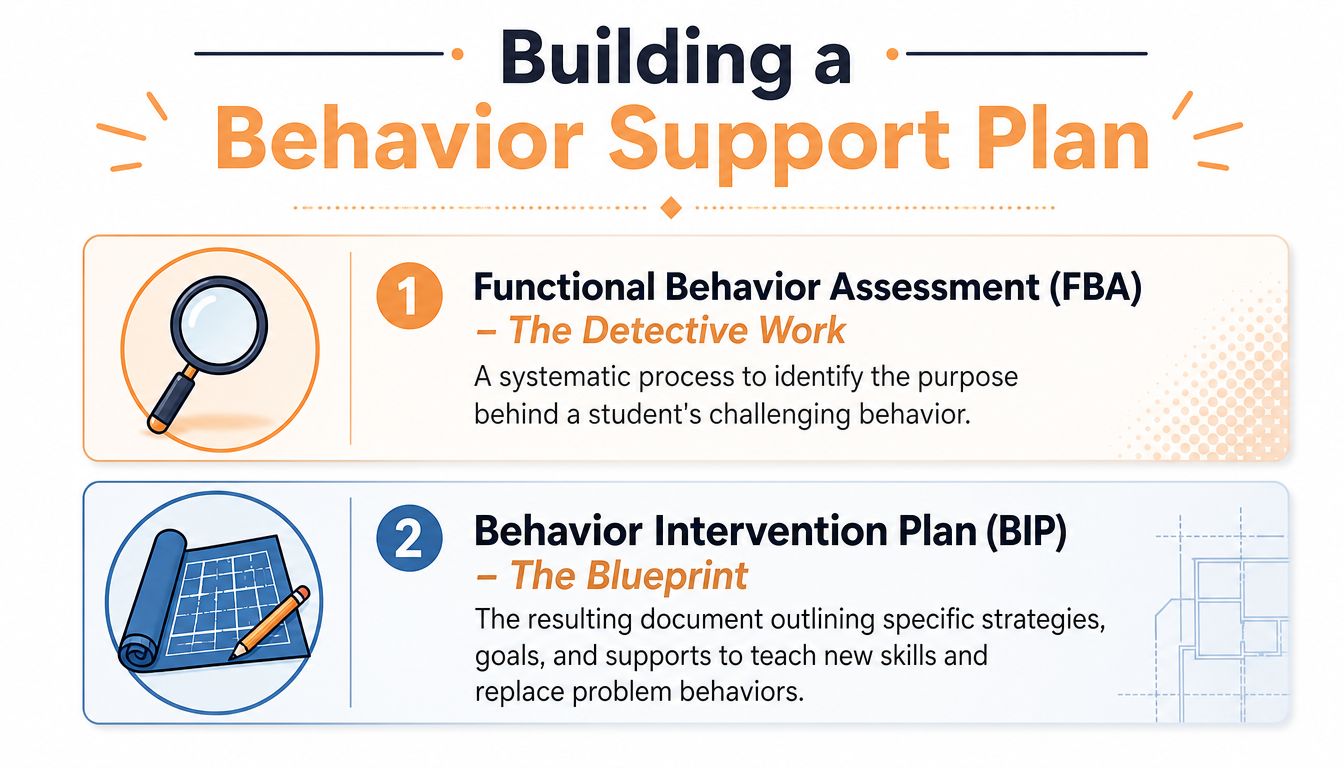
A classroom concern usually starts with a pattern, not a label. A child might melt down when math ends, refuse to clean up after art, or leave the group every time instructions get longer. Schools don't build a useful ABA plan by guessing. They start with an Functional Behavior Assessment (FBA), then turn that information into a Behavior Intervention Plan (BIP).
From behavior to function
The FBA asks a simple question with a detailed answer behind it, what is the behavior doing for the child? Sometimes a child is trying to escape a hard task. Sometimes the behavior gets attention, access to an item, or relief from noise or uncertainty. The school team gathers ABC data, then uses that pattern to match the support to the reason the behavior is happening school-based FBA and BIP overview.
If a child struggles every time the class transitions from art to reading, the plan might not be “stop the behavior.” It may be, “teach a replacement skill, adjust the warning before transitions, and reinforce the child for moving with the group.” That's the practical difference between a vague concern and a usable plan.
What the data actually means
Parents get thrown off by data terms, so here's the plain version:
- Frequency means how often something happens. If a child leaves the seat three times, that's a frequency count.
- Duration means how long it lasts. A 12-minute outburst is different from a 2-minute one.
- Latency means how long it takes to start after a direction is given.
- Prompt level means how much help the child needed, from a full hand-over-hand prompt to a simple gesture.
A plan on paper is only the beginning. What matters is whether the team is checking progress and changing the plan when the child's needs change.
That ongoing measurement is the heart of school ABA. It lets the team see whether the behavior is shrinking, whether the replacement skill is growing, and whether the support is helping the child function better across the day.
Classroom Strategies That Make ABA Work Daily
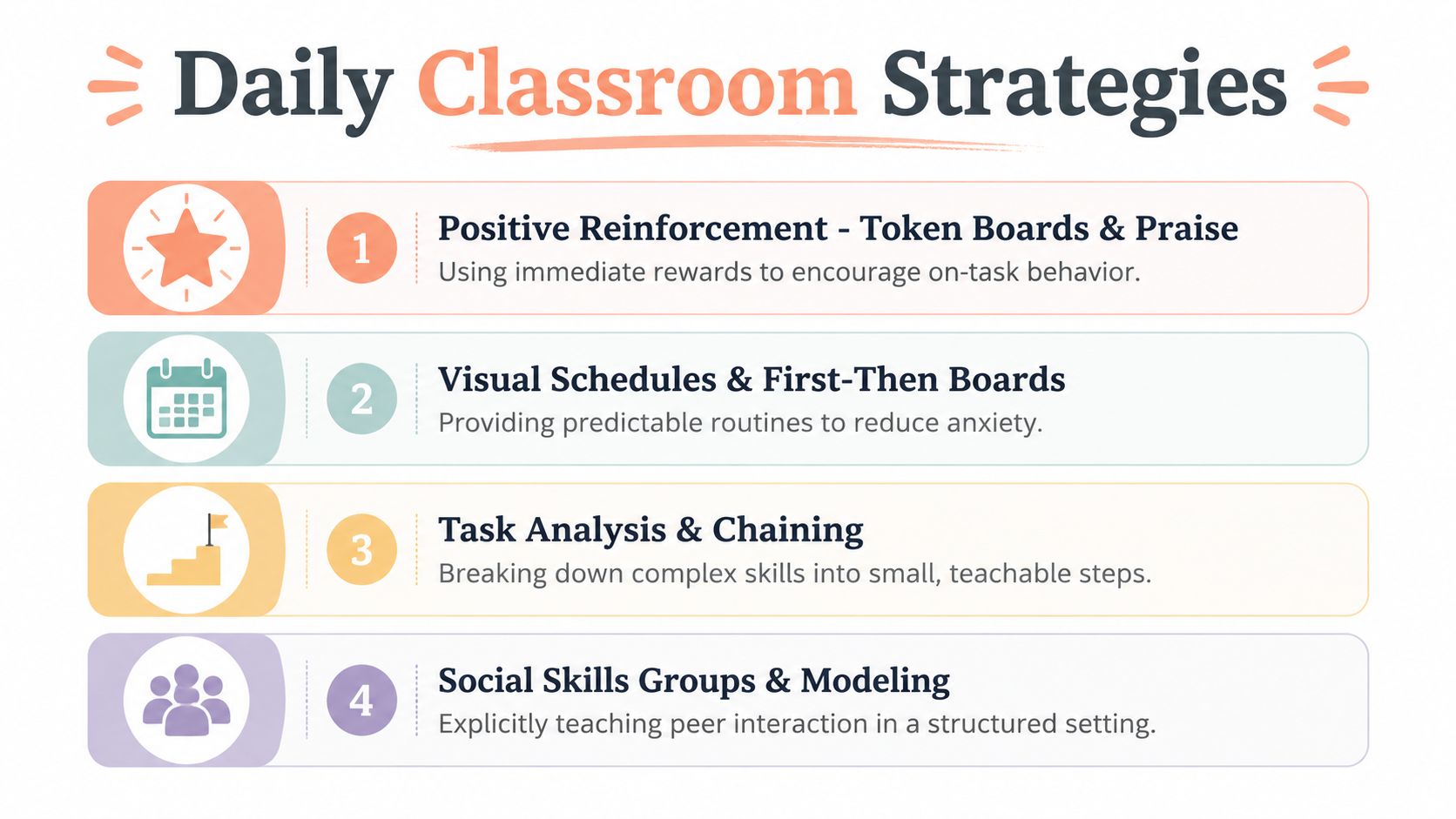
The best school support doesn't announce itself. It shows up in small, repeatable moments. A child sees the visual schedule before recess. A teacher praises a child for starting work right away. An aide gives just enough help to get through a difficult step, then fades back so the child can do more independently.
What it looks like in ordinary routines
During group work, a teacher may use prompting to help a child begin the first step, then reduce support over time. At lunch, a student might follow a first-then board, first eat, then choose a preferred activity. In reading time, staff may use reinforcement to strengthen staying with the group, answering a question, or waiting for a turn. These are not separate therapy tricks. They're classroom tools that shape participation.
One helpful way to think about it is this, ABA in schools works best when the strategy fits the routine instead of interrupting it. If the support only exists when a behavior problem appears, it can feel reactive and awkward. If it's embedded in the school day, children get repeated chances to practice the same skill in the same setting where they need it most.
Consistency is what makes the plan usable
A child can do well in one room and struggle in another if adults use different expectations. That's why school teams often rely on the same reinforcement system across classrooms, specials, and transitions. When a child hears the same cue in art, in PE, and in the hallway, the skill has a better chance of sticking.
Consistency across routines matters more than perfect language from one adult.
That doesn't mean everyone has to sound identical. It means the team agrees on the same goal, the same cueing style, and the same response when the child does well. It also means families can ask whether the school is tracking support during arrival, lunch, recess, and other everyday moments, not just during formal instruction.
For a plain-language example of how reinforcement can be used thoughtfully, see this overview of noncontingent reinforcement in ABA.
Understanding the IEP and Insurance Overlap
Many parents feel stuck. The school says a support belongs in the IEP. The therapist says the child needs more help. The insurer has its own rules. Those systems overlap, but they don't always line up neatly, and that's why coordination matters so much.
School services and therapy services are not the same thing
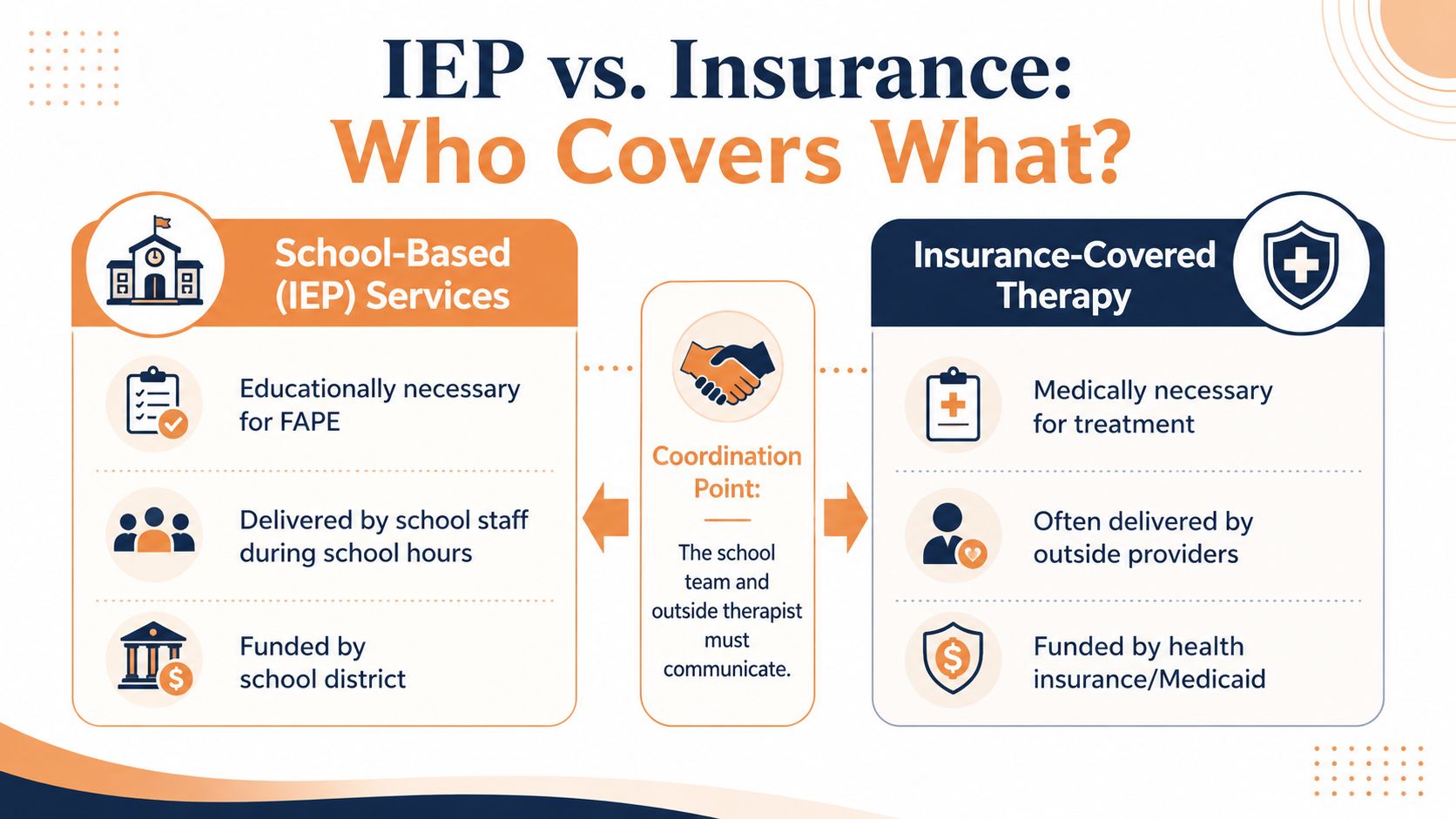
School-based supports are tied to educational need. In other words, the team is asking whether the service helps the child access learning and FAPE. Insurance-covered ABA, on the other hand, is tied to medical necessity and treatment rules. A school may deliver ABA-style supports during the day, while a family also uses outside therapy for broader skill building after school or in the home.
That distinction matters because payers can't always cover the same service twice. An autism legal resource guide notes that Medicaid cannot pay for ABA in schools when it would create improper double billing, and it also explains that a school does not have to allow ABA unless the IEP team determines it's necessary for FAPE. At the same time, ADA accommodations can create a separate pathway for access to medically necessary care in school, which makes the answer more nuanced than many parent handouts suggest ABA in school settings legal guide.
Why the overlap creates real-life confusion
A child might get a reinforcement plan at school, then receive direct ABA therapy after school, then have different expectations at home. That can work, but only if the adults talk to each other. If school staff use one prompt style and the outside therapist uses another, the child may look like they're “forgetting” skills when, really, the plan is just changing from setting to setting.
The practical question isn't only, “Does my child get ABA?” It's also, “Who is responsible for which part, and how will the team keep the supports from competing with each other?” Families who sort that out early tend to feel less whiplash later.
A 2024 Chalkbeat report on Denver showed that even after a state law intended to make access easier, some families were still being denied therapy services. That's a reminder that policy and daily reality are not always the same thing Chalkbeat Denver report.
Why Teacher Training Changes Everything
A school can write a beautiful plan and still miss the mark if the adults delivering it don't feel confident using it. That's why teacher and paraprofessional training isn't an extra. It's part of the service itself.
The adults around the child carry the plan
In one PubMed-indexed study, support plans produced an average 80 percent change in the frequency of target behaviors after teacher training in applied behavior analysis, and parent and teacher questionnaires showed beneficial effects for children and the educational environment at the end of the course teacher training study. That doesn't mean every child will have that exact result. It does show how much staff preparation can change what happens in class.
The reason is simple. A child's plan lives or dies in the hands of the people who greet them, prompt them, and reinforce them all day long. If the classroom teacher, aide, and related-service staff are trained differently, the child gets mixed messages. If they're trained together and checked for fidelity, the plan has a much better chance of holding up during transitions, group work, and unstructured time.
Questions parents can ask at school
You don't need to know every ABA term to ask useful questions. Try these:
- Who is trained on the plan? Ask whether the classroom teacher, paraprofessionals, and specialists all receive training.
- How is refreshers handled? Ask how often the team revisits the strategy when staff change or the plan gets updated.
- What happens if the plan isn't working? Ask how the team decides to adjust supports instead of waiting too long.
- How do school and home communicate? Ask how notes, calls, or shared data will move between settings.
If you're comparing service options and want a provider that also helps coordinate school communication, Friendly ABA Premier school support is one example families may review alongside district services and outside therapy. The point isn't to add more people for the sake of it. It's to make sure the adults already involved know what each other are doing.
Your Action Plan for School-Based ABA Success
Parents do their best work in this process when they move from guessing to asking. You don't need to become an ABA expert overnight. You do need a clear list of questions, a way to track what's working, and a plan for keeping school and home from drifting apart.
Start with the meeting you already have
If your child has an IEP meeting coming up, ask for the FBA data, the draft BIP, and the current progress measures before you sit down. That gives you time to read the plan instead of reacting in the room. If the school says a strategy is working, ask what data shows that. If it's not working, ask what the team will change first.
You can also ask one simple question that often opens a better conversation, “What does this look like during the school day?” That helps shift the discussion from theory to routine, which is where support happens.
Bring school strategies home in small ways
Home doesn't need to copy school perfectly. It just needs to match the parts that matter most. If school uses a visual schedule, try one during homework or bedtime. If a child responds well to immediate praise, use the same kind of specific feedback after a successful transition to the table or bath.
A few practical examples:
- After school: mirror one reinforcement strategy the child already understands at school.
- During meals: use the same short prompt style that helps with seat time or cleanup.
- At bedtime: keep the order of steps predictable, especially if transitions are hard.
Ask the school and your outside therapist to share the same language whenever possible. The child doesn't need three different systems competing for attention.
Families who want more hands-on coordination can also look for services that build in proactive communication, care coordination, and parent coaching. That kind of structure helps when a child receives both school support and therapy outside school, because someone is keeping the moving pieces connected instead of leaving parents to hold all of them alone.
Building a Partnership Between Home and School
The strongest school support usually doesn't look dramatic. It looks steady. A teacher uses the plan the same way on Monday that they used on Friday. A parent hears the same language from the therapist that they heard from the IEP team. A child gets to practice the same skill across settings until it starts to feel familiar.
That kind of progress grows from consistency, communication, and trust. Parents don't need to run the classroom, and teachers don't need to become therapists. They do need one another, because children make the most progress when the adults around them are sharing information instead of working in silos.
If you're in Connecticut, Georgia, Maryland, Massachusetts, North Carolina, South Carolina, Virginia, or Washington, Friendly ABA Premier can help families coordinate home-based therapy, school support, parent coaching, and communication across care settings.
Friendly ABA Premier offers individualized ABA therapy for children, along with school support, parent coaching, and a dedicated care coordinator who helps families keep school and therapy aligned. If you're trying to make sense of ABA in schools and want a partner who values clear communication, visit Friendly ABA Premier to connect with the team and learn what support could look like for your family.
Our Latest Insights


























Experience ABA Therapy with a More Personalized Level of Support
Discover how FriendlyABA Premier combines evidence-based ABA therapy with dedicated coordination, proactive communication, and individualized family support.