

Parent Coaching Training in ABA: A Practical Guide
A practical guide to parent coaching training in ABA, covering goals, formats, core skills, benefits, session structure, and how to choose the right program.

Some parents reach the end of the day feeling like they're holding a dozen therapy ideas in their head and still not sure what to do in the moment. Dinner is half-finished. A sibling needs help. Your child is upset by a sound, a transition, or a change nobody saw coming. You remember that someone mentioned visuals, prompting, or reinforcement, but in the middle of real life, it's hard to pull the plan together.
That's where parent coaching training matters.
It exists because children don't only learn during therapy hours. They learn during breakfast, in the car, at bath time, at the playground, and during the tough five minutes before bed. A good coaching program helps you use simple, practical strategies in those moments so progress doesn't stay inside a therapy session.
The bigger question isn't just whether a provider offers parent coaching training. It's whether the program is built well enough to help your family use it. That means looking past polished brochures and asking what the coach really does, how sessions are structured, and how the provider supports you when life gets messy.
Table of Contents
- The usual flow of a session
- The small skills that make a big difference
- What quality looks like in the room
- Signs that point to real quality
- Questions worth asking on an intake call
- Red flags that deserve a pause
When Therapy Hours Are Not Enough
A child might receive therapy for part of the week. The rest of the time, home life keeps moving.
That's often the hardest part for parents. You can agree with the plan in session and still feel stuck when your child refuses to get dressed, throws a favorite cup because the snack is wrong, or runs away from the bathroom when it's time to brush teeth. Those moments don't wait for the next appointment.
The part families carry every day
When people hear “ABA,” they sometimes picture a therapist teaching at a table. But many of the skills parents care most about happen somewhere else. They happen when a child asks for help instead of crying, moves through bedtime with fewer battles, or joins a sibling in play for a little longer than before.
That's why parent coaching isn't extra. It's the bridge between a clinical plan and your actual home.
Practical rule: If a strategy only works when the therapist is present, it's not finished yet.
A strong coaching program helps parents use the same basic teaching ideas in daily routines. Not perfectly. Not all at once. Just clearly enough that home starts to feel more predictable.
What this can look like at home
A parent might learn how to:
- Set up a simple visual routine so mornings don't rely on repeated verbal reminders
- Pause for communication during snack time so a child has a chance to request instead of grab
- Reinforce small wins by responding quickly when a child tries a better way to cope
- Handle transitions with a short warning, a clear expectation, and follow-through
- Reduce power struggles by changing the setup before behavior escalates
None of that means parents are expected to become therapists. It means you get support for the hours that matter most to family life.
Many caregivers feel relieved when they hear this. If therapy hasn't “carried over” at home yet, that doesn't mean you're doing anything wrong. More often, it means no one has shown you how to use the tools in your own routines, in your own words, with your own child.
What Parent Coaching Training Actually Means
Parent coaching training in ABA is structured teaching for caregivers. It isn't generic parenting advice, and it isn't a lecture about what you should be doing better.
A good coach teaches the way a skilled cooking instructor would. They don't hand you a recipe and walk away. They stand beside you, show one step, watch you try it, and adjust in real time until it feels usable.
What a coach is actually teaching
Most coaching sessions focus on a few core skills.
- Prompting means giving help so your child can succeed. That might be pointing to shoes by the door, holding up two snack choices, or using a short verbal cue like “say help.”
- Reinforcement means responding to a behavior in a way that makes it more likely to happen again. In plain language, when your child uses a helpful skill, you make that skill pay off.
- Shaping means building a harder skill from smaller steps. If saying a full phrase is hard, the coach may start by teaching a gesture, a sound, or one word first.
Those words can sound technical at first. In a good program, they're explained while you use them, not dropped on you in a long presentation.
What it is not
Parent coaching training is not about turning you into unpaid staff. It also isn't about correcting every part of your parenting.
The point is much narrower and more helpful than that. You learn a small set of strategies that fit your child and your routines. Then you practice them enough that they start to feel natural in ordinary moments.
The best coaching sounds less like a seminar and more like, “Try saying it this way,” or “Wait two more seconds before helping.”
That difference matters.
A family-centered provider should also treat your routines as real constraints, not obstacles. If mornings are rushed, the plan should match rushed mornings. If grandparents help after school, they should be included when possible. If a child melts down during toothbrushing because the sensation is too much, coaching should address that exact routine, not drift into vague advice.
The shared-language benefit
One quiet benefit of coaching is that everyone starts using the same map.
Parents, therapists, teachers, and caregivers can all describe what they're seeing in a similar way. That makes it easier to notice progress, solve problems faster, and stay consistent across settings. For many families, that shared language lowers stress almost as much as the strategy itself.
Common Formats and How They Differ
Parent coaching programs usually show up in a few different formats. None is automatically right for every family. The better question is which format gives you the most useful practice for your child, your schedule, and your home routines.
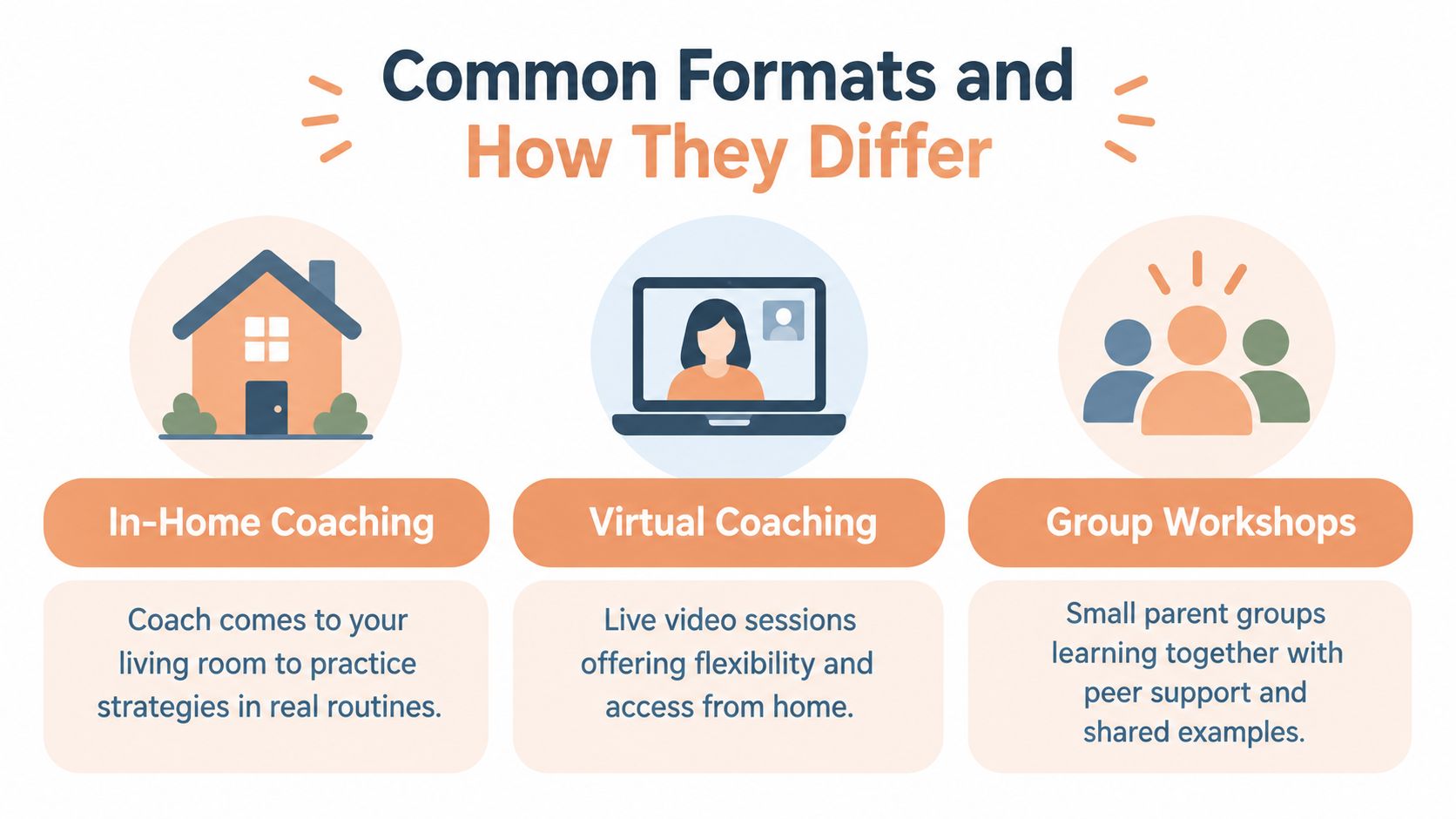
In-home coaching
This format brings the coach into the place where the hard moments happen. That's a major advantage.
If mornings fall apart at the front door, the coach can watch the backpack routine. If meals are stressful, they can see where seating, demands, noise, or timing may be getting in the way. That kind of observation makes feedback specific instead of generic. Families exploring in-home ABA support often like this option because the coaching happens inside real routines, not in theory.
What to watch for: a good in-home coach shouldn't just “manage behavior” while you observe. They should coach you into the routine so you leave with a skill, not just a calmer hour.
Virtual coaching
Telehealth has become an important option for families who need flexibility or live farther from specialized providers.
A 2025 community-based study of a time-limited telehealth RUBI adaptation reported high attendance, strong homework completion, significant reductions in parent stress, and clinically significant improvement for half of treatment completers. The same source also notes that a 2025 literature review found self-paced online parent training can be socially valid, but the evidence base is uneven, with 35% of included studies rated weak, according to the telehealth RUBI study summary on PubMed.
That tells parents something useful. Virtual coaching can work well, especially when families need lower-burden access. But providers should be honest about what the format does best and where extra support may be needed.
Group workshops
Group learning can reduce isolation. Parents hear questions they hadn't thought to ask, practice common scenarios, and realize they aren't the only ones struggling with bedtime, transitions, or public outings.
Group sessions can be a strong supplement. They're usually less individualized than home-based or one-to-one virtual coaching, so they tend to work best when paired with some personal follow-up.
Here's a simple way to approach it.
| Format | Often most helpful for | Potential limitation |
|---|---|---|
| In-home | Real routines like meals, dressing, sibling play | Scheduling can be harder |
| Virtual | Flexibility, access, quick check-ins, video review | Harder to coach during fast-moving behavior |
| Group | Parent education, role-play, peer support | Less tailored to one child |
Some providers blend formats. That can work very well if the plan is coordinated and the goals stay clear from one setting to the next.
What Happens in a Coaching Session
A strong session is usually calm, focused, and surprisingly practical. It shouldn't feel like a test. It should feel like someone helping you solve one piece of your day.
The usual flow of a session
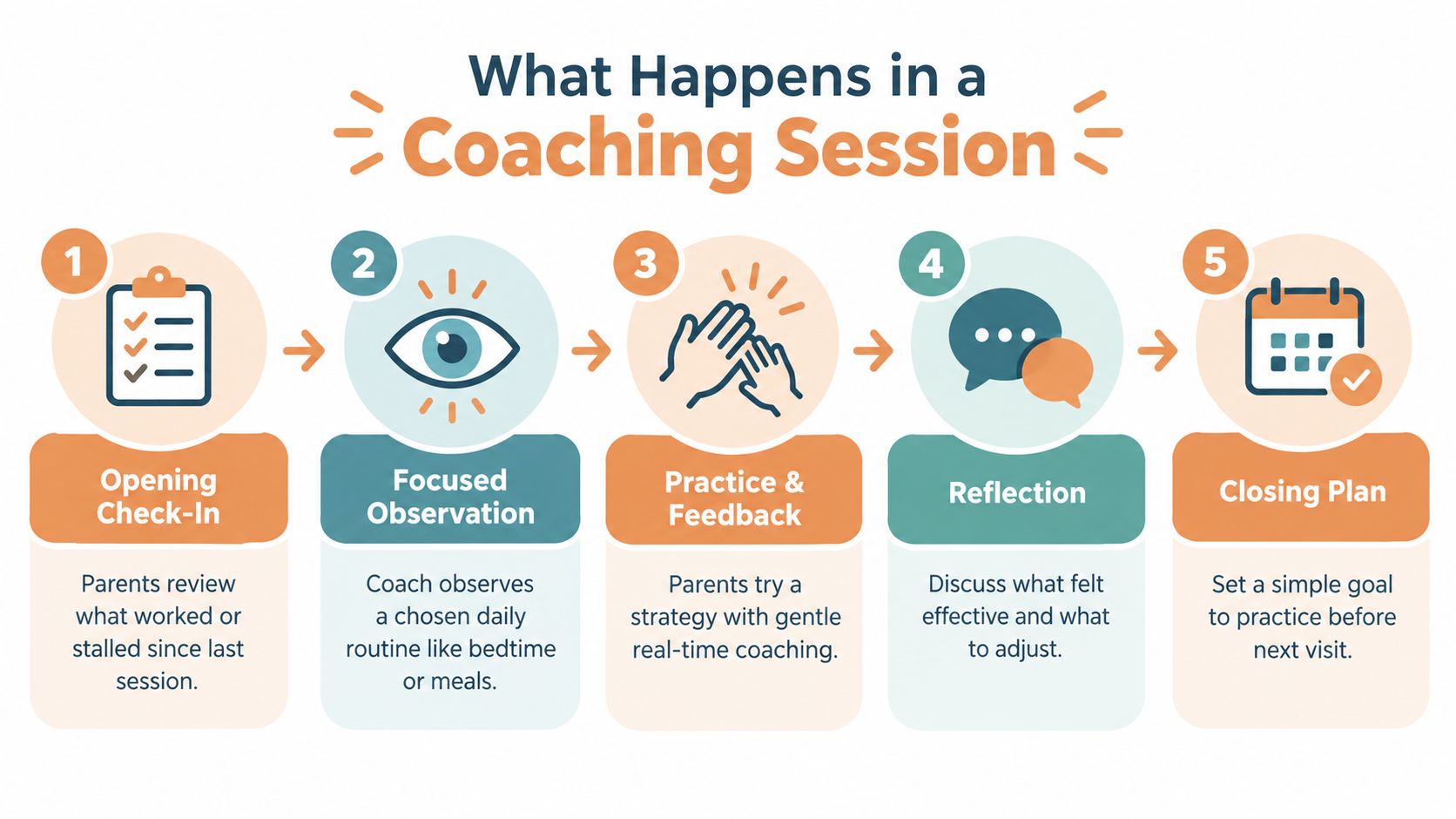
Many coaching visits follow a simple pattern.
Check-in
You and the coach review what happened since the last meeting. Maybe getting dressed improved, but snack time still falls apart. Maybe your child started asking for help more often, but only with one parent.Observation of one routine
The coach watches a specific part of the day. Good programs stay narrow here. One routine is easier to improve than trying to fix everything at once.Practice with support
The coach models a step, then has you try it. They may whisper a reminder, gesture toward the next move, or pause you to adjust wording.Debrief
You talk about what felt easier, what still felt awkward, and what seemed to help your child most.Closing plan
You leave with one clear practice target for the week.
Families who want a clearer picture of this teach-practice-feedback model can get a feel for it through behavioral skill training, which is a common framework for teaching adults new implementation skills.
The small skills that make a big difference
A coach may teach you how to:
- Prompt without overhelping so your child still has a chance to try
- Fade prompts by backing off as your child becomes more independent
- Follow your child's lead in play so interaction feels natural and motivating
- Reinforce quickly when a helpful behavior shows up
- Notice tiny data points such as “asked with a gesture twice” or “tolerated toothbrushing for longer”
Those details matter because they turn vague goals into something you can do on a Tuesday night.
A useful session leaves you with one or two moves you can remember under stress.
What quality looks like in the room
Many families get misled. A warm personality is helpful, but it isn't the whole picture.
A study of 25 early intervention sessions found low overall use of established caregiver-coaching techniques and substantial variability across providers, with collaboration and in vivo feedback showing up most often, according to the provider coaching fidelity study in the Journal of Autism and Developmental Disorders. In plain language, some providers say they coach parents, but they don't consistently use the coaching behaviors that make parent learning more likely.
That's why it's reasonable to ask exactly how your coach teaches. Do they model? Watch you practice? Give specific feedback? Track whether your confidence and follow-through improve? Those are stronger signs of quality than a general promise of “family support.”
What the Research Says About Outcomes
Parents deserve a clear answer here. The research supports parent-mediated and parent-implemented intervention, but it also tells a grounded story. Results are meaningful, usually not magical, and often strongest in everyday functioning.
A 2018 meta-analysis of randomized clinical trials for young children with autism found a pooled effect of Hedges' g = 0.23 across outcome domains, with effects ranging from 0.18 for communication-language to 0.27 for socialization. It also found moderate evidence quality for autism symptom severity, communication-language, and cognition, but very low evidence quality for socialization, according to the meta-analysis on PubMed Central.
That same analysis found outcomes were not significantly different by treatment dose, which is an important point for families. More hours alone may not be what matters most. Coaching quality and how consistently strategies are used at home may matter more.
Where gains often show up most clearly
Another evidence synthesis reported a weighted average Hedges' g of 0.23 across domains, and a later review found a clinically relevant improvement in parent-rated adaptive functioning of SMD 0.28 on the Vineland Adaptive Behavior Scales, plus a moderate effect on disruptive behavior of SMD 0.55, according to the systematic review summary on PubMed.
For families, that often means this: parent coaching may be especially reliable when the goal is smoother routines, better day-to-day behavior, and stronger carryover at home.
A separate systematic review and meta-analysis included 15 studies with 622 child participants and found overall moderately positive effects, according to the BMC Psychiatry review of parent training for autism.
Outcomes Associated With Parent Coaching in ABA
| Outcome Area | Typical Finding | What It Means for Families |
|---|---|---|
| Adaptive functioning | Small but clinically relevant improvement | Daily living skills may improve in practical ways |
| Disruptive behavior | Moderate improvement in some studies | Home routines may become more manageable |
| Communication and social skills | Positive gains, often modest to moderate | Progress may build gradually through repeated practice |
| Symptom-level change | Usually not dramatic | Coaching is better viewed as a way to build usable skills than as a quick fix |
One well-known randomized study of children ages 3 to 7 found that 24 weeks of parent training outperformed 24 weeks of parent education for disruptive and aggressive behavior, with a 47.7% decline on the Aberrant Behavior Checklist-Irritability subscale compared with 31.8% in the education group, as reported in the Emory University summary of the multisite parent training study.
That kind of change matters. So does a child asking for help once during dinner when they used to scream. Families shouldn't overlook smaller gains just because they don't look dramatic on paper.
How to Choose a High Quality Program
The hardest part of choosing a coaching program is that almost all of them sound supportive. Most websites promise collaboration, individualized care, and parent partnership.
The useful differences are usually underneath the marketing.
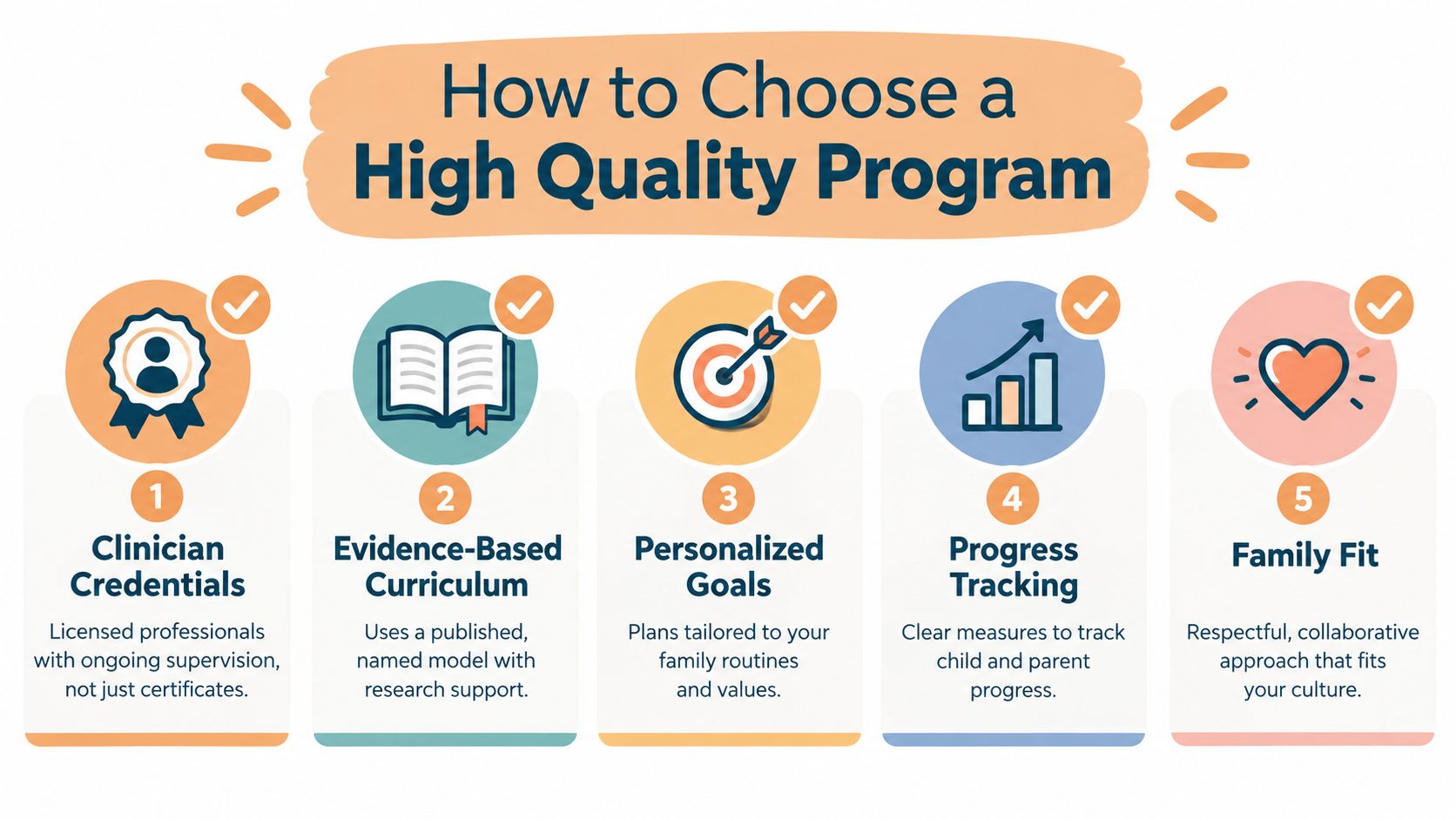
Signs that point to real quality
Start by asking how the program teaches parents, not just what it hopes parents will learn.
One strong sign is the use of a named, structured model. For example, an Early Start Denver Model parent-mediated pilot used a clear sequence: a 3-hour parent group training, an initial assessment, an individualized intervention plan, 8 weeks of live coaching, a final assessment, and a feedback meeting. In that pilot, families and coaches reported 91% overall implementation and high satisfaction, according to the ESDM parent coaching pilot on PubMed.
Structure like that tells you the program has thought through the learning process.
Another good sign is individualization tied to real family routines. A quality provider should ask where your day gets stuck and build goals around those moments. If support includes parent coaching, in-home care, and regular communication with a clinical team, one example families may compare is parent training and coaching services that are built around daily routines rather than a one-size-fits-all class.
Questions worth asking on an intake call
Bring these with you.
- Who supervises the coaching? Ask about clinician credentials, oversight, and whether the coach receives feedback on their own performance.
- How do sessions run? Listen for modeling, parent practice, and specific feedback. Be cautious if the answer stays broad.
- How are goals chosen? Strong programs connect them to routines like meals, toileting, bedtime, community outings, or school transitions.
- How do you measure progress? Ask how they track both child change and parent skill use.
- What support happens between sessions? Some families need quick troubleshooting, proactive check-ins, or a care coordinator who helps keep communication moving.
A 2023 meta-analysis of parent-implemented interventions drew on 51 effect sizes from randomized controlled trials involving 2,895 children and found a pooled effect size of g = 0.553, with positive behavior and social skills at g = 0.603 and language and communication at g = 0.545. The same source notes that in a 2022 study, 78% of providers reported specialized autism-intervention training and 68% reported training in parent coaching, reflecting how mainstream this competency has become, according to the summary linked here.
That means families can expect more than “we talk with parents sometimes.” Parent coaching should be a defined service with real methods behind it.
Ask this directly: “When you coach parents, what do you do in session besides explain strategies?”
Red flags that deserve a pause
Not every concern is a dealbreaker, but these should make you slow down:
- One script for every family with little discussion of your home life
- No clear data on what the parent is practicing or whether it's improving
- Pressure before assessment or vague answers about session frequency
- Heavy emphasis on handouts with little live practice
- No plan for generalization across home, school, and community routines
If a program can't explain how it teaches parents, it may not be coaching in the way families need.
Starting the Conversation With Confidence
A lot of parents feel nervous asking for coaching help. Some worry it means they've failed. Others worry they'll be judged, corrected, or expected to do everything perfectly by next week.
That isn't what good parent coaching training should feel like.
It should feel like partnership. You bring knowledge of your child, your culture, your routines, and your stress points. The clinician brings a teaching process. Together, you build something your family can use.
A simple way to get started
Before an intake call or first meeting, write down:
- Two or three routines that feel hardest. Think about getting dressed, homework, meals, bath time, or leaving the house.
- One daily-life question. For example, “How do I help my child ask for help before they get overwhelmed?”
- One support preference. Maybe you need in-home practice, virtual flexibility, or someone who can coordinate with school.
Those notes make the conversation easier. They also help you tell quickly whether a provider is listening for your family's reality or reciting a canned explanation.
What confidence can sound like
You don't need special language. You can ask plain questions.
“Will you watch me do the routine and coach me while I try it?”
“How do you measure whether I'm getting more comfortable using the strategy?”
“What happens if the plan works with one parent but not the other?”
Those are strong questions. Quality programs welcome them.
You do not need to arrive already skilled. The program should meet you where you are.
The right support often starts small. One better transition. One calmer bedtime step. One successful request during play. Over time, those moments add up, and families usually feel the difference long before they have the perfect words for it.
If you're comparing providers, trust the ones who can explain their coaching behaviors clearly, adapt to your family, and stay in communication as needs change.
Friendly ABA Premier provides home-based ABA, parent coaching, school support, and social skills services for families in CT, GA, MD, MA, NC, SC, VA, and WA, with individualized treatment plans, a dedicated care coordinator, and regular progress check-ins to help strategies carry into daily life. If you'd like support that treats parent coaching as a real partnership, not an add-on, visit Friendly ABA Premier to learn more or talk with the team about what your family needs.
Our Latest Insights































Experience ABA Therapy with a More Personalized Level of Support
Discover how FriendlyABA Premier combines evidence-based ABA therapy with dedicated coordination, proactive communication, and individualized family support.