


Care Coordination and Case Management in Pediatric ABA
A family-friendly guide to care coordination and case management in pediatric ABA. Learn how each role supports your child and what to look for in a provider.

Your phone has three voicemails. One is from the school. One is from the insurance company. One is from a therapist asking whether next week's schedule changed.
There's also an unread portal message about paperwork, an email you meant to answer two days ago, and a form sitting on the counter because someone needs a signature before services can move forward.
That's the part many families don't see coming. ABA isn't just sessions. It's coordination, follow-up, scheduling, records, approvals, school communication, and a long chain of “small” tasks that somehow all land on the parent.
Table of Contents
- Look at who actually coordinates
- Pay attention to when communication happens
- Judge the family experience, not just the promise
When ABA Feels Like Too Much to Manage
A lot of parents come into ABA thinking the hard part will be choosing goals or helping with home routines. Sometimes that is hard. But the quieter burden is being the person who has to hold the whole system together while still being mom, dad, grandma, or the caregiver who's already doing everything else.
You're the one remembering the pediatrician note. You're the one forwarding the school email. You're the one noticing that an authorization is about to expire because nobody else mentioned it. That kind of load wears people down fast.
What families are really carrying
In real life, overwhelm doesn't usually look dramatic. It looks like this:
- A missed callback turns into a delayed start.
- A school question sits unanswered because you've repeated the same background to three different people already.
- An insurance issue stalls for weeks because no one clearly owns the next step.
- A good therapy plan gets harder to follow because the clinic, school, and home aren't working from the same page.
Practical rule: If you feel like the family is acting as the main switchboard between providers, the support system isn't coordinated enough.
That's why care coordination and case management matter. These aren't brochure words. They describe two different kinds of support around your child and your family.
One keeps people connected. The other keeps services moving through the systems that fund and regulate care.
Why the distinction matters
Parents often hear these terms as if they mean the same thing. They don't.
If nobody handles care coordination, you end up repeating the same story, chasing updates, and trying to align home, school, and therapy by yourself. If nobody handles case management well, services can get tangled in paperwork, approvals, and deadlines.
Both matter. And when they're done well, daily life feels different. Fewer loose ends. Fewer stalled questions. Less guessing about who to call.
The best support doesn't make a family work harder to use it.
What Care Coordination and Case Management Actually Mean
The simplest way to understand the difference is this. Care coordination is about people, communication, and follow-through. Case management is about systems, documentation, and access.
Both sit around the same child. They just solve different problems.
Care coordination in plain language
Care coordination is the hands-on work of making sure the important adults in your child's life are connected. That can include the BCBA, behavior technician, school team, speech therapist, pediatrician, and of course the family.
In a strong ABA program, care coordination looks like someone noticing that your child's school routine changed and making sure the home team knows. It looks like helping prepare for a school meeting so therapy goals don't live in a separate bubble. It looks like a parent telling one person what changed, instead of explaining it four times.
The AHRQ Care Coordination Measures Atlas treats care coordination as a set of real processes, including information transfer, transitions, referral management, self-management support, and team communication. That's useful because it pushes families and providers to look for actual behaviors, not vague promises.
Case management in plain language
Case management is the systems-side work that keeps services authorized, documented, and on track. Families usually notice it when something goes wrong. A delayed approval. A missing document. A treatment review that snuck up on everyone.
Day to day, case management often includes:
- Insurance follow-through such as authorizations, renewals, and reauthorizations
- Document collection like diagnostic records, physician forms, and eligibility paperwork
- Deadline tracking for treatment-plan reviews or updated assessments
- Administrative problem-solving when a service is approved on paper but stuck in practice
This work may feel less personal than care coordination, but it's not optional. If care coordination keeps the plan connected, case management helps keep the plan covered.
Why titles can be misleading
Some providers use one title for both jobs. Sometimes a care coordinator handles school communication and insurance follow-up. Sometimes a case manager does both. The label matters less than the actual work.
What you want to know is straightforward:
- Who keeps everyone informed?
- Who tracks approvals and paperwork?
- Who notices a problem before it turns into a gap in care?
A NICE guideline for autistic children and young people states that every child or young person diagnosed with autism should have a case manager or key worker to manage and coordinate treatment, care, support, and transition to adult care, according to the NICE recommendations. That's a strong signal that families shouldn't be left to patch the system together on their own.
Care Coordination vs Case Management Side by Side
Here's the comparison most parents need. Not an org chart. Not job-description language. Just what each role changes in daily life.
| Criterion | Care Coordination | Case Management |
|---|---|---|
| Primary focus | Keeping the child's team aligned across home, school, therapy, and medical settings | Keeping services authorized, documented, and moving through insurance or funding requirements |
| What parents notice | Fewer repeated explanations, clearer updates, smoother handoffs | Fewer paperwork surprises, fewer stalled approvals, cleaner renewals |
| Typical tasks | Team check-ins, school communication, goal alignment, provider follow-up | Authorizations, record gathering, eligibility paperwork, treatment review tracking |
| Cadence | Ongoing and relational, often tied to weekly needs or active changes | Triggered by deadlines, payer rules, and documentation cycles |
| Main contacts | Family members, therapists, teachers, pediatricians, other providers | Insurance plans, billing or authorization teams, records offices, diagnostic sources |
| Main family outcome | Things stay connected | Things stay covered |
Care Coordination vs Case Management at a Glance
The easiest shorthand is this. Care coordination protects continuity. Case management protects access.
A family can have one without enough of the other. That's where frustration starts. You might have a warm, responsive team that communicates beautifully, but services still hit preventable delays because nobody owns the paperwork. Or you might have excellent authorization support while the school, clinic, and home all move in different directions.
Where many ABA providers struggle
Plenty of ABA settings put both jobs on one person's plate. That can work when the case is simple and the child's support network is small. It often gets shaky when school services enter the picture, another therapy joins the mix, or insurance demands become more complicated.
If one person is responsible for every call, every school handoff, every family update, every authorization issue, and every document deadline, things can fall through.
Families don't need perfect systems. They need clear ownership.
When you talk to a provider, skip the title question first. Ask who handles each kind of work for your child. If the answer is fuzzy, the support will probably feel fuzzy too.
A Day in the Life of a Dedicated Family Care Coordinator
The best way to understand a dedicated care coordinator is to look at the week they make possible.
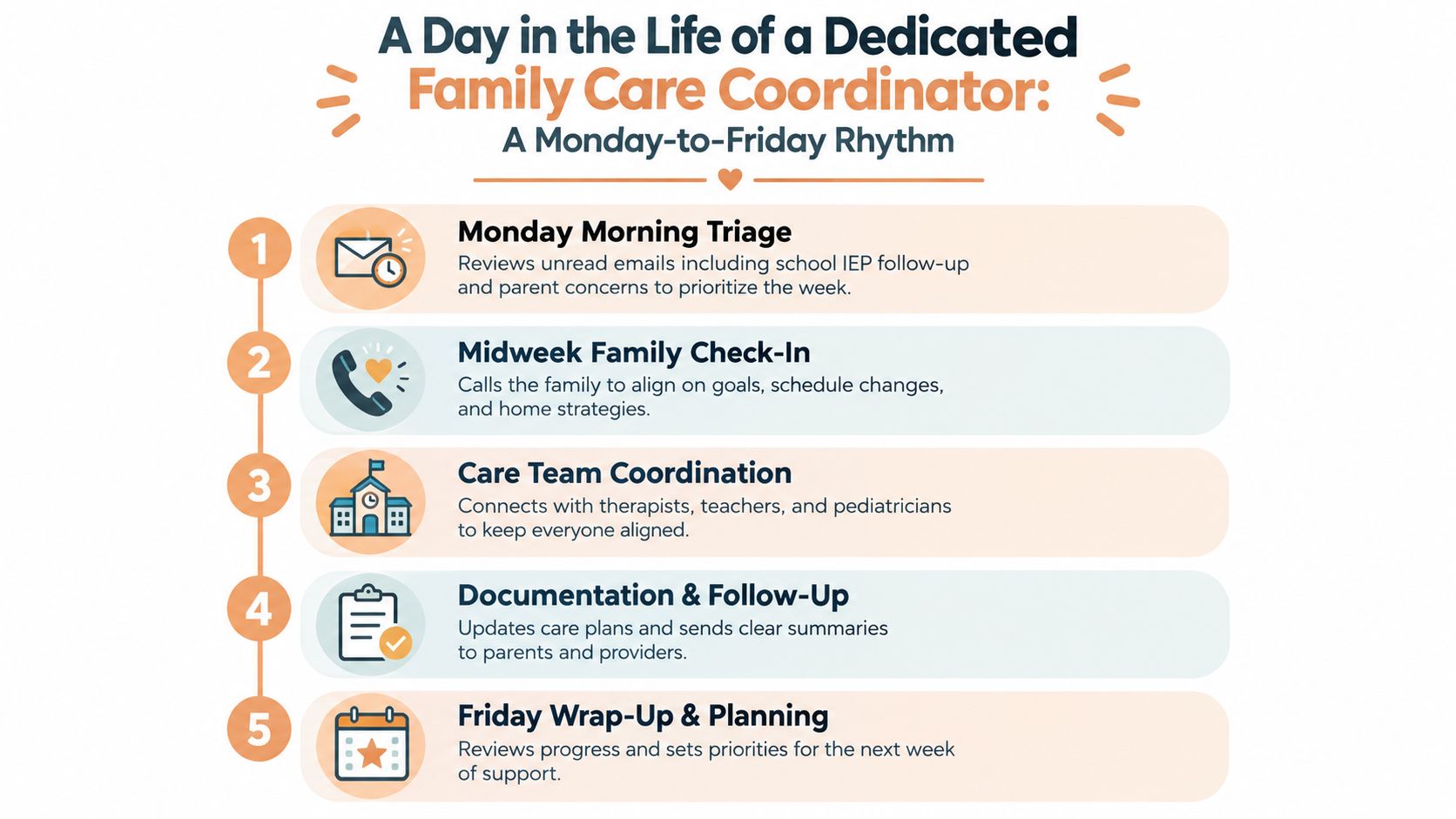
Monday starts with triage
By Monday morning, there's usually a pile waiting. An email from school asking for input before an IEP meeting. A parent message about a schedule change. A note that a form needs to be sent back to a physician's office. Sometimes there's a coverage question that can't sit until Friday.
A dedicated coordinator sorts that first. What's urgent, what needs follow-up, what can be translated into plain language for the family, and what belongs with the clinical team.
That first pass matters more than many realize. Families don't just need tasks completed. They need someone deciding what comes first.
Midweek is where the hidden work happens
By the middle of the week, coordination turns into a dozen small actions that keep things from unraveling.
One call might be a quick check-in after a tough session, making sure the parent's concern reaches the right clinician. Another might be logging a physician update so the behavior team isn't working from old information. Another might be preparing a short parent summary that says, in normal language, what changed and what happens next.
In school-age cases, this often includes support across classroom routines and provider communication. For families trying to understand how ABA fits into the school day, school support services can be a practical part of the coordination picture.
Friday is about closing loops
A good coordinator doesn't just answer what came in. They close the week cleanly.
That can mean confirming next week's sessions, checking that transportation or pickup changes were shared, making sure a school note got where it needed to go, or drafting an agenda for a family team conversation. It can also mean flagging an insurance or documentation issue before it becomes a Monday emergency.
Here's what parents usually feel when this role is done well:
- Less chasing because someone else is following the thread
- Less repeating because updates don't die in one inbox
- Less guessing because the next step is named clearly
A dedicated coordinator often does work the family never sees. That's the point. The system should feel lighter because someone else is carrying part of it.
What the Research Says About Coordinated Care for Children
The research on coordinated care is worth knowing, but parents don't need a stack of academic terms. They need to know what signs matter in real life.
One useful takeaway is that coordinated support tends to help most with the things families feel first. Satisfaction, adherence, continuity, and follow-through improve more consistently than sweeping promises about cost savings or major system-wide change. A systematic review of reviews found small but statistically significant improvements in patient satisfaction and stronger adherence-related outcomes, while results were mixed for total costs, mortality, and utilization, according to this PubMed review of case management evidence.
Questions the research turns into action
Ask yourself these:
- Do I have one person who knows the full picture?
- When something changes at school or home, does the therapy team hear about it quickly?
- Do I spend less time managing logistics than I did before?
A Journal of Developmental and Behavioral Pediatrics article on children with neurodevelopmental disabilities reported improved access to services, better joint care planning, stronger communication across providers, and better linkage with school supports. Families also said the intervention reduced stress around coordinating care, according to the journal article on improving care for families and children with neurodevelopmental disabilities.
What the evidence doesn't settle
Research does not give families a blank check to expect every coordinated program to reduce every crisis, save money fast, or solve every school problem. That's not how real care works.
It does support something simpler and more useful. When someone owns communication, follow-up, and connection across settings, families usually feel the difference. If you want to see how that looks in practice across real care journeys, provider case studies can help you compare what “coordinated” means on the ground.
How to Choose an ABA Provider That Coordinates Well
Most providers say they communicate well. That statement means almost nothing unless you ask better questions.
What matters is not whether a website mentions family support. What matters is whether a real person owns the work of keeping your child's care connected.
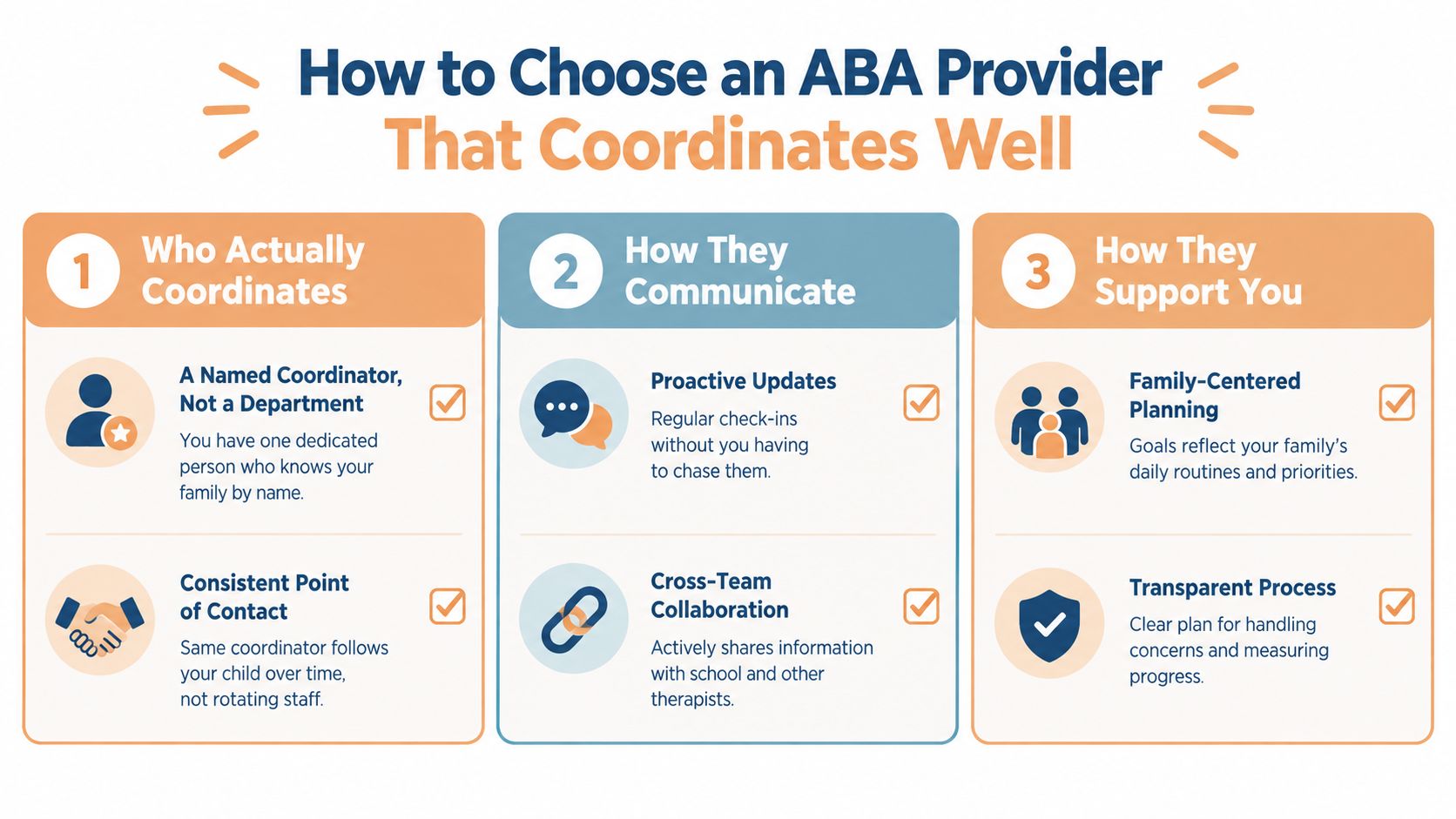
Look at who actually coordinates
Start here. Ask whether you'll have a named point of contact or a general office line.
If the answer is “our team handles that,” keep asking. Families do better when they know who to call, who knows their child's story, and who can tell the difference between a minor scheduling change and a problem that needs clinical follow-up.
One option families may come across is Friendly ABA Premier, which says each Premier family is paired with a dedicated care coordinator as part of its service model. That kind of structure is worth noting because it assigns the role clearly rather than scattering it across whoever happens to answer the phone.
Pay attention to when communication happens
Good coordination isn't only visible when something breaks. It should show up before that.
Ask whether check-ins are scheduled. Ask how updates are shared. Ask what happens if school concerns come up midweek or if insurance paperwork needs quick follow-up.
For families considering services in the home, it's also worth asking how coordination works across daily routines and parent communication in an in-home ABA setting.
What to listen for: specific routines, named responsibilities, and examples. Vague reassurance is not a process.
Judge the family experience, not just the promise
Parents usually know within the first few calls whether a provider feels organized.
Look for signs like these:
- Clear summaries after important calls or meetings
- Returned communication without constant chasing
- Continuity so you aren't reintroducing your child every time
- Respect for daily life where goals fit meals, mornings, play, and school routines
If your child sees multiple providers, this matters even more. If your child is in school most of the day, ask how often the ABA team communicates with school staff when needed. If you're brand new to ABA, ask who helps you make sense of the process in plain English.
A brochure can't answer that. A real workflow can.
A Simple Starting Point for Families
If this all feels like a lot, don't start with a giant checklist. Start with three questions on the first call.
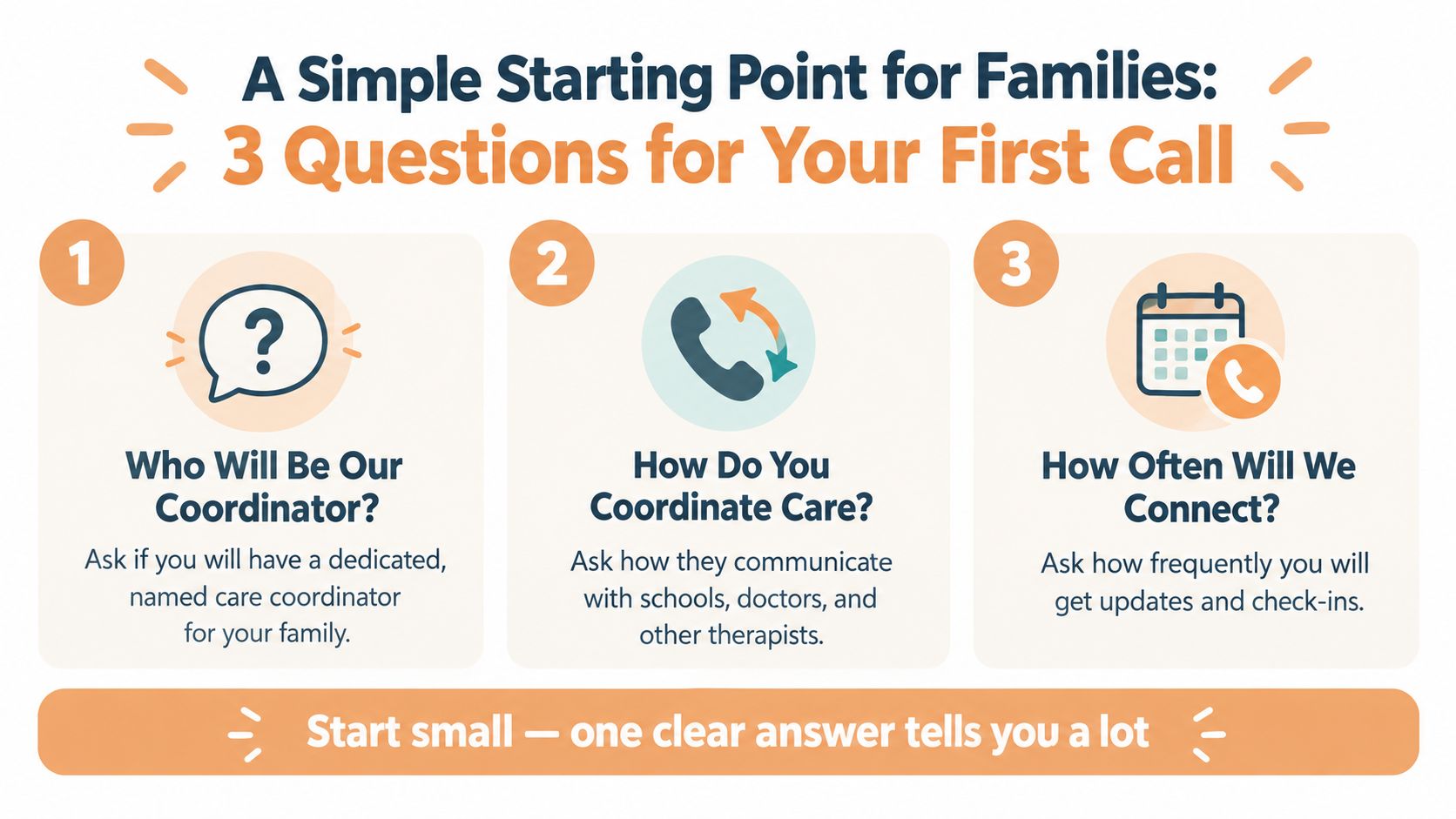
Three questions that tell you a lot
Who will be our point of contact if something changes at school, home, or therapy?
A strong answer includes a name or a clearly assigned role.Who handles insurance follow-up and paperwork deadlines?
You want to know who watches reauthorizations, records, and renewals before they become urgent.How often will we hear from someone when things are going normally?
The phrase “when things are going normally” matters. Anyone can react to a fire. Good coordination also exists on quiet weeks.
What a well-coordinated program feels like
It usually feels calmer. School callbacks happen faster. Reauthorizations are less messy. Fewer tasks boomerang back to the parent just because no one else took ownership.
Programs that lean heavily on case management may still be helpful, especially when insurance or records are complex. But if family communication feels thin, parents can end up with covered services and a disconnected experience.
Ask one direct question early: “Who keeps the moving parts connected so I don't have to?”
That answer will tell you more than a polished intake packet ever will. And as always, talk with your child's care team for guidance that fits your situation, especially when medical, school, or behavioral needs overlap.
If you want support that includes both thoughtful ABA services and a dedicated point of contact for the day-to-day logistics families face, Friendly ABA Premier offers home-based ABA, school support, parent coaching, and ongoing care coordination across CT, GA, MD, MA, NC, SC, VA, and WA. If you're comparing providers or just trying to understand what your family needs next, their team can talk through your situation in plain language before you make a decision.
Our Latest Insights









































Experience ABA Therapy with a More Personalized Level of Support
Discover how FriendlyABA Premier combines evidence-based ABA therapy with dedicated coordination, proactive communication, and individualized family support.