

6 Tacting ABA Example Strategies for Everyday Learning
Explore six tacting ABA example strategies with scripts, prompts, fading ideas, and parent-friendly progress markers for everyday communication.

A child points to a cup at dinner, taps a picture on a device, or says, “sad” after a hard day at school. Those small moments are tacting, the ABA term for labeling something a child notices in the environment or experiences in the body. In plain language, it's how a child connects what they see, hear, feel, or want with meaningful words, signs, gestures, or AAC selections.
For many families, tacting starts with everyday routines, not flashcards. A child might say “juice” at the table, name a toy during play, or label “tired” when their eyes are rubbing and their energy is fading. Progress can begin with an approximation, a pause, or a supported attempt, and the care team can shape prompts and goals around the child's communication style.
Table of Contents
1. Mealtime Requesting During Family Meals
Mealtime is one of the easiest places to build a tacting ABA example because the motivation is already there. A child wants the milk, the banana, or the crackers, and that real need gives the label a purpose. In ABA terms, tacting is labeling what's present, and at the table that can look like saying “milk” when the cup is in sight, or selecting “more” on an AAC device when snack time isn't over yet.

A simple dinner routine can support language without turning the meal into a drill. A 4-year-old who cries when thirsty can learn to say “milk” instead. A school-age child can use a device to ask for more of a favorite snack, while a toddler might point and say “apple” when fruit is on the plate, then receive it as the natural result of naming it.
A gentle script families can use
Keep the words short and predictable. “What do you want?” works for some children, but many do better when adults model the label first, then pause. If the child says “ju” for juice, that still counts as a real attempt, and praise plus access to the item helps the label matter.
Practical rule: Put the preferred food in view, but slightly out of reach. That small pause often creates a natural chance to label instead of grab.
A few mealtime habits help keep the learning steady.
- Use the same words across caregivers: If one adult says “milk” and another says “drink,” the child has to sort out two labels at once.
- Start with high-preferred foods: Familiar favorites usually create more successful attempts than a brand-new food.
- Reinforce the attempt quickly: If the child names it, they get it without extra delay.
- Celebrate approximations: A partial word or AAC selection is still communication worth noticing.
This kind of practice works best when the parent, therapist, and care coordinator are aligned. When everyone uses the same target words and prompt style, the child gets a clearer message at home and in therapy.
2. Labeling Objects During Playtime
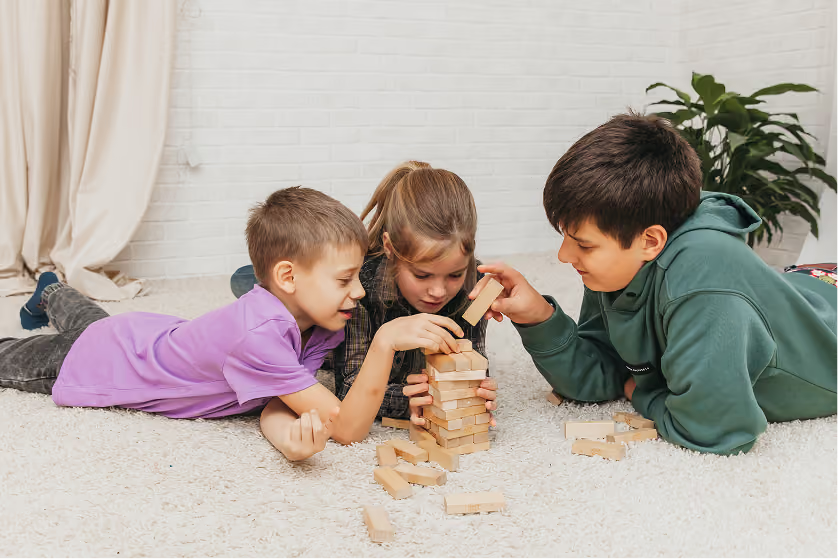
Play often gives tacting its easiest start. A child is already moving, reaching, and noticing, so labeling can fit inside the game instead of interrupting it. A tacting ABA example during play often feels like shared attention, not a formal lesson.

A toddler rolling toy cars might say “car,” “red,” or “fast.” A preschooler with a dollhouse may label “mommy,” “kitchen,” or “sleeping.” A school-age child building with LEGOs might name colors, shapes, or actions like “stacking” and “tall.” Each word comes from the object or action already in front of them, so the label has a clear place in daily life.
Play-based learning can support child development in everyday routines, especially when adults follow the child's lead and keep the moment light.
A parent-friendly script
Short, plain language works well. “That's a car” or “You found the blue block” gives the child a model without turning play into a quiz. If the child echoes only part of the word, that still counts as a real attempt.
Then adults can wait. That pause is like leaving space for the child to catch up and join the conversation.
Prompting usually works best in small steps. Start with a clear label, then a light cue if needed, and fade help as the child begins to label on their own. Some families use the object itself, a point, or a brief pause before giving more support.
A few routines keep playtime tacting steady.
- Follow the child's interest: If they are focused on cars, label cars, roads, colors, and movement.
- Use simple cues: “What do you see?” is easier to hear than a long string of questions.
- Change toys now and then: New materials create fresh chances to name what is there.
- Keep correction low-key: The goal is participation, not perfect wording.
Signs of progress are often small. A child may label before being asked, repeat a new word in another room, or use the same label with a different toy. When home, school, and therapy use similar words and prompt styles, those small attempts are easier to notice and build on.
3. Community Outing Tacting in Real-World Places
A grocery store, park, library, or sidewalk walk gives tacting a real-world purpose. Children see the apple in the produce section, the swing at the park, or the bus passing by, then connect the word to the actual thing in front of them. That kind of practice supports generalization because the skill shows up where daily life happens.
A child in the grocery store may label “apple,” “banana,” or “orange” while standing near the produce bins. At the park, they might name “slide,” “swing,” or “climbing wall.” On a walk, they can point out “car,” “rain,” or “baby” in a stroller. These are simple words, but they build confidence because the child is using language in the same place the word belongs.
The 2021 review of tact instruction for children with autism spectrum disorder found strong outcomes across many interventions, with extremely high effects in 23 interventions, high effects in 9, and moderate effects in 5 across 25 single-case studies and 37 interventions (review summary and data). That matters for families because it shows tacting isn't a narrow drill, it's a well-studied part of language teaching.
Keeping outings manageable
Short, planned outings usually work better than long, exhausting ones. A child who enjoys the library may label book colors and the word “quiet” before trying to label everything else. A parent can pick two or three target words ahead of time, then let the outing do the rest.
Start small, stay calm, and let the environment do some of the teaching.
Families often find it helpful to choose a familiar location first, then slowly build from there. Siblings can model the words, and a therapist or care coordinator can help decide what to practice so the child isn't overloaded.
When a child labels something during an outing, the natural payoff might be choosing the apple, finding the swing, or sitting with the family near the books. That real consequence helps the label feel useful, which is what makes it memorable.
4. School-Based Tacting in the Classroom
A classroom gives tacting a different kind of practice. The child is not just naming objects, but also labeling materials, peer names, activities, and feelings while the day keeps moving. That mix can feel busy, so teachers and therapists often work on one small goal at a time, the way a family might practice one new word during dinner before adding another.
School support in ABA can help with these everyday classroom moments, from naming materials to understanding transitions. A student might say “math,” “reading,” or “recess” as the schedule changes, or label “frustrated” during a hard task and get help sooner. Another child may learn peer names like “Mrs. Johnson” or “Tommy,” which supports both social awareness and language.
A practical classroom script might sound like this: “That's math,” “Now it's recess,” or “Tommy is at the table.” Teachers can prompt the word, then fade the help little by little so the child does more on their own. Signs of progress may be small at first, such as glancing at the schedule, repeating a label after a pause, or using the word in a new room.
The trial of 27 individuals with ASD that compared three prompting systems for tact teaching found that all three led to tact acquisition, with only minimal differences between systems (study details). For families, that points to a simple idea. The best plan often depends less on a single perfect method and more on consistency, fit, and follow-through.
Carryover works best when adults share the same plan. If a child labels “lunch” at school, that word is more likely to stick when home uses it the same way. Teachers, parents, and therapists can compare target words, prompt style, and reinforcement so the child hears a steady message across settings.
A few small habits help:
- Ask for classroom observation time: It helps the therapist see the child's real day, not just a clinic moment.
- Focus on useful words: Academic terms, peer names, and feeling words usually matter right away.
- Keep one shared plan: Adults can use the same goals and response style.
- Track transitions: “Math,” “recess,” and “lunch” can make the day easier to follow.
When a child can tact classroom routines, participation often grows because the words are ready when needed.
5. Emotion and Internal State Tacting for Self-Advocacy
A child who can name an inner state can ask for help earlier. That matters at home, in class, and on the playground, where “tired,” “frustrated,” or “overwhelmed” can work like a small warning light before behavior escalates.
At the table, a child might press a hand to their eyes and say “tired.” During puzzle time, they might say “frustrated” and learn that a short break is an okay response. In a classroom, the same skill can sound like, “I need a quiet space,” which gives the child a clearer way to speak up than crying or leaving the task.
The goal is not perfect language. Small attempts count, especially when adults respond in a steady way and match the support to the child's needs.
A recent peer-reviewed study summary found that instructive feedback could support tact generalization across primary and secondary languages, but it worked for 2 of 4 children with ASD. For families, that is a reminder to expect different paths for different children and to keep the plan flexible.
Making feelings concrete
Feelings become easier to label when adults connect them to something the child can see or feel. A picture card, a mirror, or a calm spoken model can turn an abstract word into something usable. “I'm feeling tired after work” and “You look excited for the playground” give the child examples without pressure.
The same idea can be folded into daily routines. A parent might point out a yawn and say, “Your body looks tired,” then pause for the child to repeat the word. A teacher can notice a tense face and offer, “You look frustrated. Let's try a break.” Home, school, and community settings work best when adults use the same feeling words and the same gentle response style.
A few practical habits help with emotion tacting.
- Start with common feelings: tired, happy, frustrated, and scared are often easier than less familiar labels.
- Use visuals: picture cards or simple charts can make a feeling easier to notice and say.
- Respond to the label right away: if the child says “frustrated,” offer support, not only praise.
- Connect the word to the body: “Your hands are tight, you might be frustrated,” can help the feeling make sense.
When a child can label an internal state before help is needed, self-advocacy gets stronger. The child still needs support, but the support can begin earlier and feel more understandable.
6. Parent-Coached Tacting in Daily Routines
A child does not need a separate lesson for every word. Bedtime, dressing, bath time, and car rides already give families plenty of chances to notice, name, and practice language together. parent coaching helps caregivers turn those ordinary moments into steady communication practice, one small label at a time.
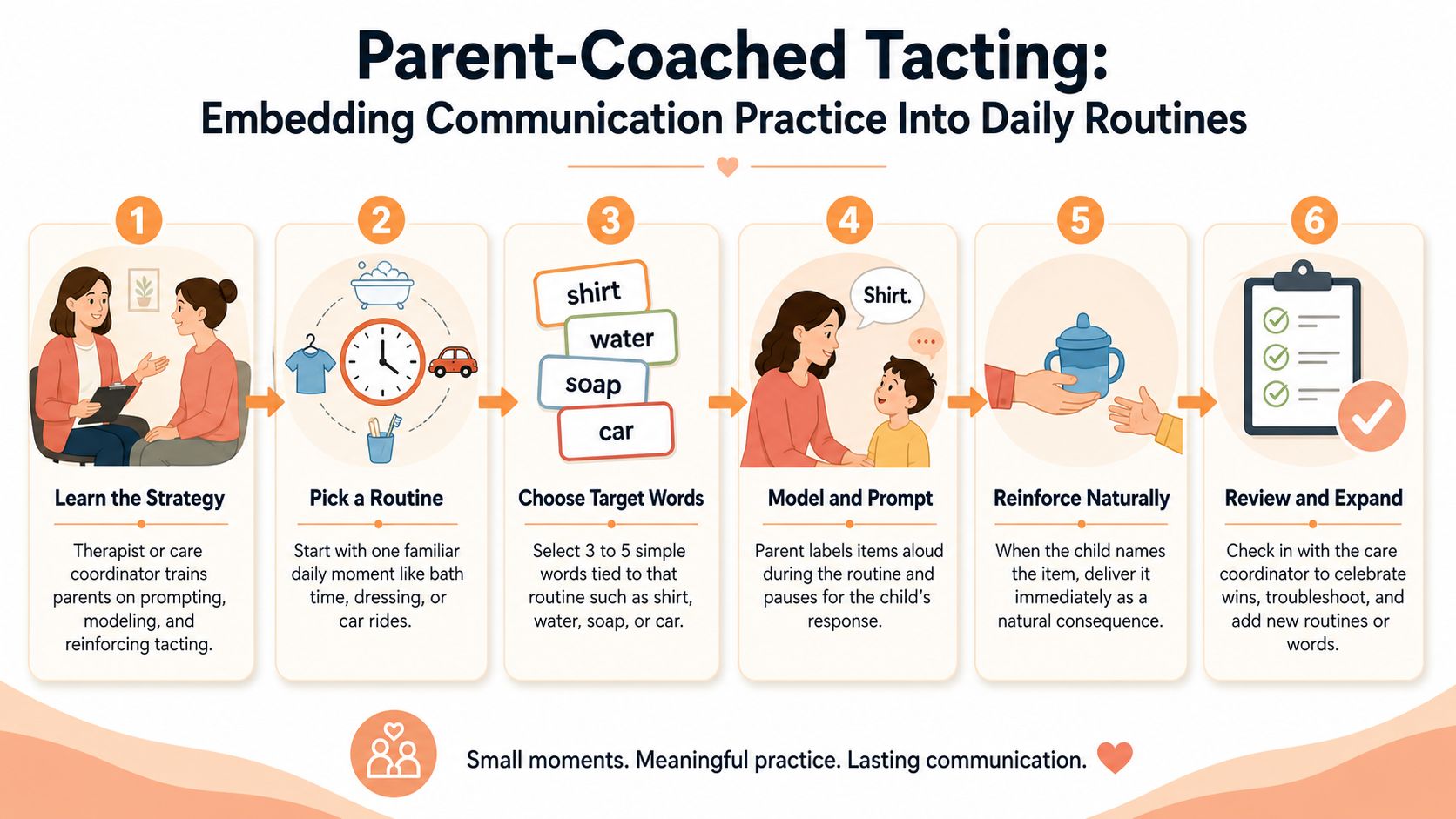
During dressing, a parent might say “shirt,” “pants,” and “shoes.” At bath time, the same child can hear “water,” “bubbles,” “soap,” and “washcloth.” In the car, the words may be “car,” “tree,” “dog,” or “stop sign.” These are familiar objects, so the child has something concrete to connect the word to, like a picture attached to a simple label.
That approach lines up with a study report showing that transfer-trial and nontransfer-trial tact teaching were both effective and efficient for teaching two-component tacts to three children with autism, and that all learners acquired the target skills. Families do not need a perfect script to benefit from that kind of structure. They need clear words, repeated practice, and adults who can keep the routine calm.
Small routines are easier to sustain
Starting with one routine works better than trying to teach every label at once. A parent who focuses on “shirt,” “shoes,” and “zip” during dressing can keep the plan simple enough to repeat. That matters, because repeated practice in the same routine gives the child more chances to hear the word, try it, and use it with less help.
Parent coaching keeps the routine practical. The coach may model the word first, pause for the child's response, and reinforce even small attempts. If the child needs more support, the adult can prompt gently and then fade that help over time, like training wheels that come off as balance improves.
Practical rule: Teach the words you use every day. Real routines give more chances than perfect practice sheets.
When home, school, and community adults use the same target words, the child hears a consistent message across settings. That consistency helps tacting become part of family life, not a separate task.
Tacting ABA: 6-Example Comparison
| Approach | Implementation Complexity 🔄 | Resource Requirements ⚡ | Expected Outcomes ⭐📊 | Ideal Use Cases 💡 | Key Advantages ⭐ |
|---|---|---|---|---|---|
| Mealtime Requesting: Building Communication During Family Meals | Low 🔄, routine-based, minimal training | Low ⚡, caregiver time during meals, common foods | ⭐⭐⭐ 📊 Faster expressive requests, increased independence | Family meals, snack times where hunger motivates | Natural motivation, frequent practice, immediate utility |
| Labeling Objects During Playtime: Making Learning Feel Natural | Low 🔄, follow-child, flexible prompts | Low ⚡, toys and parent engagement | ⭐⭐⭐ 📊 Expanded vocabulary, high engagement | Play sessions, toy play, peer playgroups | Joyful, low-pressure learning; peer modeling |
| Community Outing Tacting: Learning in Real-World Environments | Moderate 🔄🔄, planning, timing sensitivity | Moderate ⚡⚡, prep, shorter outings, supervision | ⭐⭐⭐ 📊 Strong generalization to real-life settings | Grocery stores, parks, libraries, neighborhood walks | High relevance, authentic contexts, boosts confidence |
| School-Based Tacting: Supporting Communication in the Classroom | High 🔄🔄🔄, coordination with staff and schedules | Moderate ⚡⚡, therapist/teacher time, classroom supports | ⭐⭐⭐ 📊 Improved classroom participation and socialization | Classroom routines, transitions, group activities | Targets high-demand environment; multidisciplinary support |
| Emotion and Internal State Tacting: Building Emotional Awareness and Self-Advocacy | High 🔄🔄🔄, abstract concepts need scaffolding | Moderate ⚡⚡, visual supports, consistent adult response | ⭐⭐⭐ 📊 Better emotional regulation; reduced problem behavior (slower gains) | Moments of dysregulation, teaching coping and self-advocacy | Replaces challenging behavior; builds self-awareness and empathy |
| Parent-Coached Tacting: Embedding Communication Practice Into Daily Routines | Moderate 🔄🔄, initial training then routine implementation | Moderate ⚡⚡, caregiver training, regular practice | ⭐⭐⭐ 📊 Large increase in practice frequency and faster generalization | Daily routines: dressing, bath, bedtime, car rides | Scales therapy, cost-effective, empowers caregivers |
Notice the Small Signals of Growing Communication
Progress in tacting often shows up in small, steady ways. A child may attempt a word, use a sign, choose an AAC symbol, label something in a new setting, or wait a little longer for a prompt before responding. They may also start using emotion words earlier, before frustration builds.
Those changes matter because they show communication is moving from isolated practice into real life. A child who labels “apple” at the table may later say it in the grocery store. A child who says “tired” at home may eventually use that same word with a teacher when they need a break. Families don't need identical performance every time, they need patterns that show the skill is growing across routines.
It helps to track tacting across meals, play, school, community outings, and bedtime. Share those observations with your care team, especially when a prompt needs to fade, a target word feels too easy or too hard, or a child starts using the skill in a new place. The right plan often changes as the child gains confidence, and that's a normal part of individualized ABA support.
FriendlyABA Premier works with families who want communication goals shaped around real routines, not generic teaching. Their model includes a dedicated care coordinator, regular progress check-ins, individualized planning, school support, home-based ABA therapy, and parent coaching, which can help keep tacting goals aligned across home and school. If you're trying to understand what your child's tacting ABA example might look like in everyday life, talk with a team that can help you build it into meals, play, classroom routines, and family moments with less stress and more consistency.
If you'd like help building tacting into your child's daily routines, Friendly ABA Premier can walk you through individualized ABA therapy, parent coaching, and school support. Their team works with families across Connecticut, Georgia, Maryland, Massachusetts, North Carolina, South Carolina, Virginia, and Washington, and they can help you map out practical next steps that fit your child's communication goals.
Our Latest Insights































Experience ABA Therapy with a More Personalized Level of Support
Discover how FriendlyABA Premier combines evidence-based ABA therapy with dedicated coordination, proactive communication, and individualized family support.