


What Does Underinsured Insurance Cover for ABA Therapy
What Does Underinsured Insurance Cover. Learn what underinsured insurance covers for ABA therapy, common coverage gaps, and how parents can verify benefits


You're at the kitchen table with your child's insurance card, an explanation of benefits, and a therapy schedule that finally feels helpful. Then one ABA session is denied, another is only partly paid, and the plan representative mentions a deductible, authorization requirement, or provider-network rule you weren't expecting. The question becomes less about whether ABA is listed on the plan and more about what the policy will pay for.
That gap is what many families mean when they say they're underinsured. It doesn't necessarily mean there's no coverage. It means the coverage may be too limited, too difficult to use, or too expensive to support the care your child's treatment plan calls for. A calm review of the rules can turn a confusing EOB into a practical list of next steps, whether you're arranging in-home ABA therapy, comparing providers, or deciding how to respond to a denial.
Table of Contents
- When Your Insurance Says Yes but Still Leaves You Struggling
- Four questions reveal the practical benefit
When Your Insurance Says Yes but Still Leaves You Struggling
Maria sat down after bedtime with an EOB from her health plan. The document showed that ABA was a covered benefit, but the latest session had been marked “not covered.” Another line applied toward her deductible, and a third showed an out-of-network adjustment. Her insurance card said yes. The bill in front of her felt like no.
Nothing about that moment means a parent has done something wrong. Insurance documents often separate the allowed amount, the amount credited toward a deductible, the insurer's payment, and the family's responsibility across several lines. A denial can also reflect a missing authorization, a coding mismatch, a provider-network issue, or a documentation question rather than a final decision about whether a child should receive care.
Practical rule: Treat an EOB as an explanation to investigate, not automatically as a final bill.
Families can feel underinsured even when their plan advertises behavioral health or ABA coverage. A deductible may need to be met before the plan contributes meaningfully. Coinsurance may apply after that. A narrow network may list providers who aren't accepting new clients, don't serve your area, or can't offer the schedule your child needs. An annual hour limit can make a benefit appear available while restricting how much care can be delivered.
The details matter because ABA plans are individualized. A child may need support with communication during play, transitions at school, mealtime routines, or daily living skills at home. If the policy pays for only part of the recommended schedule, the family must understand exactly where the gap begins and what choices remain.
This guide uses plain language to explain what underinsured insurance covers for ABA therapy, where coverage commonly falls short, how to verify benefits, and how to appeal or supplement a plan without making decisions in a panic.
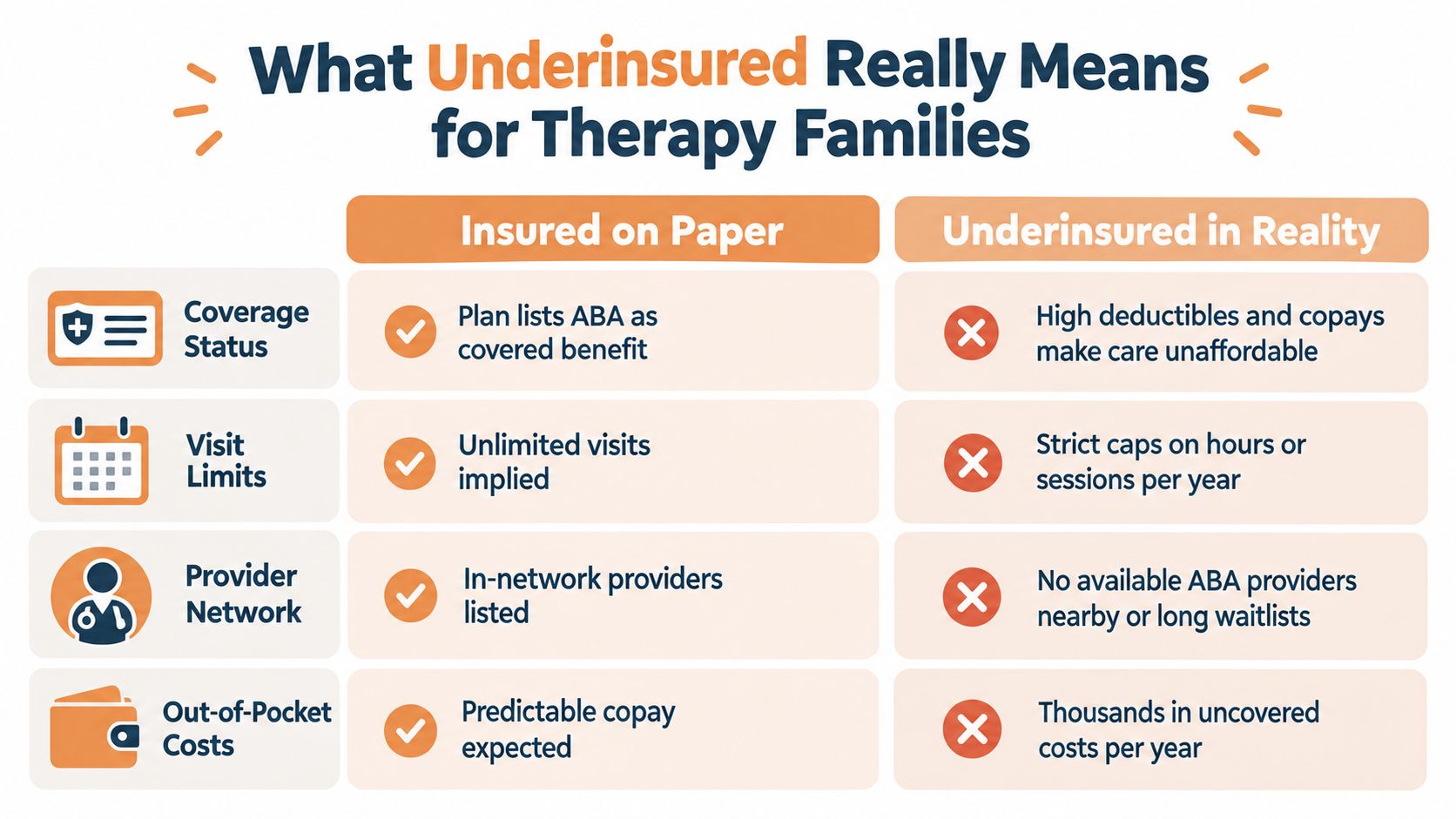
What Underinsured Really Means for Therapy Families
In an ABA setting, underinsured means a family has health coverage, but the coverage doesn't make medically appropriate care realistically accessible. The plan may list ABA as covered while leaving substantial costs, restrictive hour limits, or an unusable provider network. The family isn't uninsured, because a policy exists. It also isn't fully covered if deductibles, coinsurance, copays, or uncovered services prevent consistent access.
A benefits summary can look reassuring because it uses broad phrases such as “behavioral health” or “autism services.” The working details may appear elsewhere in the policy, authorization notice, medical-necessity criteria, or provider manual. A plan may also separate behavioral-health rules from other outpatient services, require approval before an assessment, or require periodic reauthorization after therapy begins.
Four questions reveal the practical benefit
Start by asking what the plan will provide in real terms:
- How many ABA hours or sessions are available? A dollar allowance doesn't tell you whether the schedule can support the authorized treatment plan.
- What will the family pay? Confirm the deductible, copay, coinsurance, out-of-pocket maximum, and whether each applies specifically to ABA.
- Can you access an appropriate provider? A directory isn't enough if listed clinicians aren't accepting patients or don't serve your location.
- What must happen before care starts? Prior authorization, treatment-plan review, and reauthorization can affect the timing and continuity of services.
A plan can therefore be insured on paper but underinsured in daily life. That distinction gives parents a useful way to evaluate coverage without blaming themselves or assuming that a denial means therapy must stop.
The Four Coverage Gaps That Show Up Most Often
A plan's actual value depends on more than whether ABA appears in the benefit summary. Four gaps tend to shape the family's experience.
Deductibles and cost sharing
A deductible can front-load the cost of care. For example, a family may owe the first $2,000 of eligible expenses before the plan begins sharing costs. After that point, coinsurance can still leave the parent responsible for part of each allowed charge. If the deductible resets annually, the same pressure can return at the start of the next plan year.
Annual or lifetime caps
Some policies limit the number of covered hours, sessions, or total dollars available for ABA. A treatment plan may remain clinically appropriate while the plan's benefit limit has been reached. Parents should ask whether the limit applies to ABA alone, behavioral health generally, or a broader category of services.
Network restrictions
Out-of-network care can create two separate problems. The plan may reimburse at a lower allowed rate, and the provider may bill the family for the difference when permitted by the policy and applicable law. A family may have to choose between changing an established care team, waiting for an in-network opening, or paying more to preserve continuity.
Weekly therapy-hour limits
A plan can authorize ABA but restrict the weekly schedule below the amount recommended in the treatment plan. If an assessment supports 25 hours per week and the plan permits only 10, the family faces a service gap even though the benefit technically exists. That limit may affect home sessions, caregiver training, school coordination, or other authorized components.
| Coverage Gap | How It Appears | Typical ABA Impact |
|---|---|---|
| Deductible and coinsurance | The family pays toward a deductible, then shares allowed costs | High early-year bills and continuing cost sharing |
| Annual or lifetime cap | The plan limits hours, sessions, or dollars | Services may reduce or stop when the limit is reached |
| Out-of-network restriction | The provider is outside the plan's preferred network | Lower reimbursement, balance billing risk, or a forced provider choice |
| Weekly hour limit | The plan approves fewer hours than the treatment plan recommends | Less time for communication, routines, caregiver support, and generalization |
These gaps often stack. A family can meet a deductible, pay coinsurance, use an out-of-network provider, and still discover that the approved weekly schedule is too small. That combination is why checking one benefit line isn't enough.
Why ABA Families Feel the Squeeze Especially Hard
ABA can place unusual demands on a family's coverage because the service may involve an assessment, ongoing direct therapy, supervision, caregiver participation, and coordination across home and school routines. A short course of outpatient care might fit comfortably inside a plan designed around occasional visits. A sustained ABA program can expose every limit in that same policy.
The difference is easiest to see side by side:
| Typical Short-Term Therapy | ABA Therapy Reality |
|---|---|
| A small number of appointments may address a focused concern | A treatment plan may involve recurring support across communication, play, transitions, and daily routines |
| Visits may occur weekly or less often | A child may need a larger, individualized weekly schedule |
| A family may reach a deductible gradually | Repeated services can make the deductible and coinsurance visible quickly |
| A provider directory may offer several practical choices | The nearest qualified provider may have limited availability or not participate in the plan |
Intensity changes the financial picture
A child's needs aren't measured only by the number of appointments. Skills may need practice during breakfast, getting dressed, community outings, classroom transitions, and peer play. A plan that treats ABA like a small number of office visits may not align with the way services are delivered or with the family's daily goals.
That doesn't mean every child needs the same schedule. ABA should be individualized, and the care team should explain why particular services and hours are recommended. It does mean parents should compare the authorized schedule with the treatment plan rather than accepting a broad statement that “ABA is covered.”
Duration exposes limits
A plan limit that seems generous at the beginning can become restrictive when services continue over time. Deductibles may renew, authorizations may expire, and a provider may need to submit updated progress information. The family can experience a new coverage question even when the child's goals and care team haven't changed.
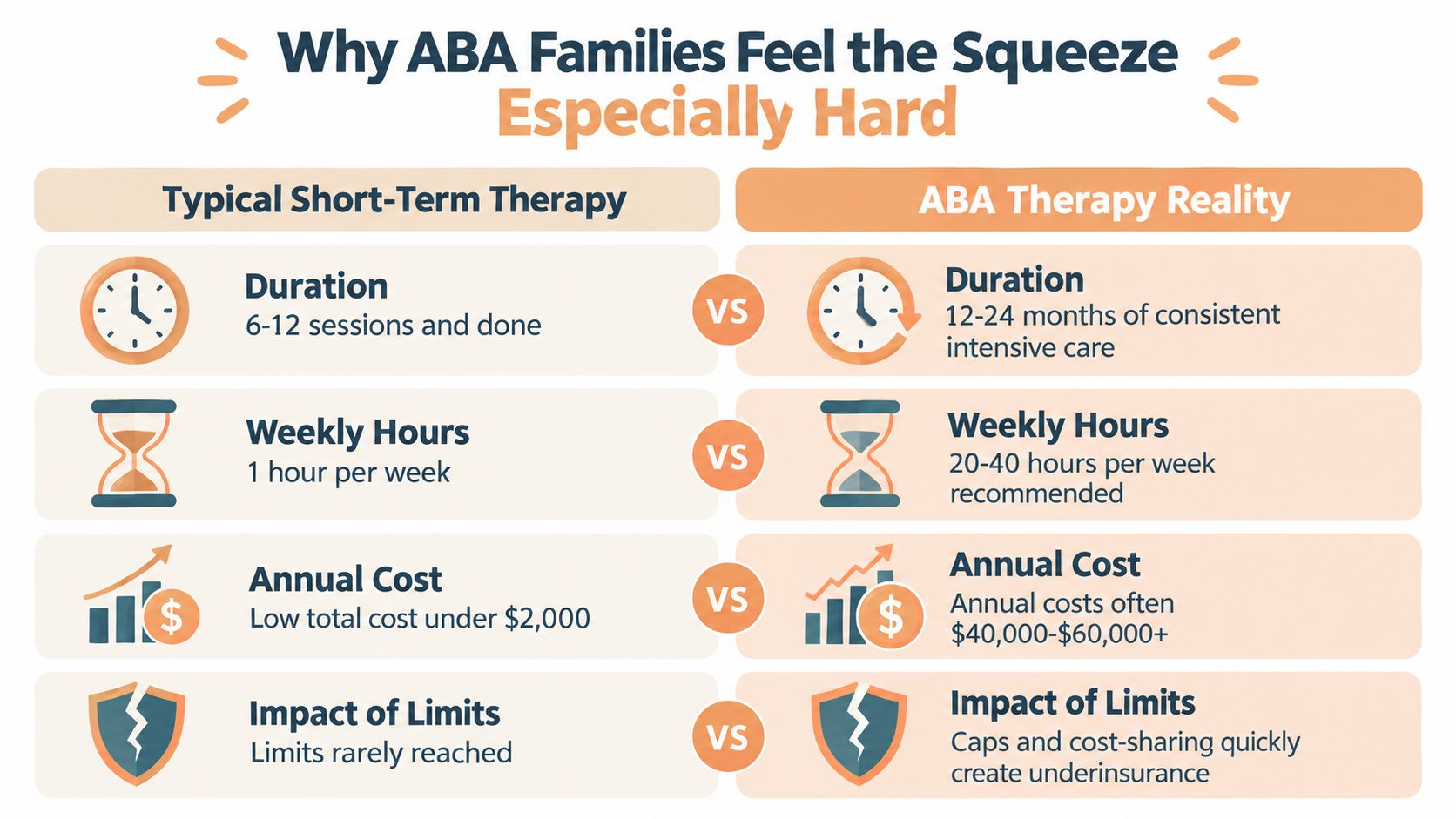
The practical issue is a mismatch between a plan's assumptions and the child's individualized support needs. Parents can reduce surprises by asking for the ABA-specific rules in writing and reviewing them with the provider before accepting a schedule.
A Real Month of ABA When Coverage Is Thin
Consider the Millers, a fictional family whose son receives 25 hours of ABA each week. Their regional billed rate is about $120 per hour, producing approximately $12,000 in services during a month with four weeks of care. Their plan has a $3,000 calendar-year deductible, and January begins with that deductible reset.
The family first pays toward the deductible. Once the plan starts sharing eligible costs, a 30% coinsurance obligation remains. The January exposure approaches $6,000 before any therapy-hour cap is considered. Because the BCBA is out of network, the plan processes claims using a lower reimbursement rate, and the family may also owe the permitted balance.
By the third month, the plan's 600-hour annual cap has been reached, leaving four months in the year. The family's schedule drops from five sessions each day to two. The child's team must reconsider how to prioritize goals, maintain routines, and involve caregivers while the family challenges the limit and looks for other supports.
| Cost Layer | Plan Rule | Family Pays |
|---|---|---|
| Deductible | The first $3,000 of eligible annual costs applies to the reset deductible | Up to $3,000 before plan cost sharing begins |
| Coinsurance | The family owes 30% of the allowed amount after deductible rules apply | A continuing share of eligible charges |
| Network status | The BCBA is out of network and the plan uses a lower reimbursement rate | The cost share plus any permitted balance |
| Hour cap | The plan allows 600 annual hours | Services are reduced after the limit is reached |
This example isn't a prediction of any family's bill. It shows why parents should ask how rules interact, not just whether each rule exists. A provider's estimate can help, but the insurer's written benefit determination controls the claim unless it's changed through correction or appeal.
For a broader discussion of pricing questions, families can review how much ABA therapy costs. Ask the provider to identify which assumptions are estimates and which amounts come directly from your plan.
How to Verify Your Benefits Before Starting
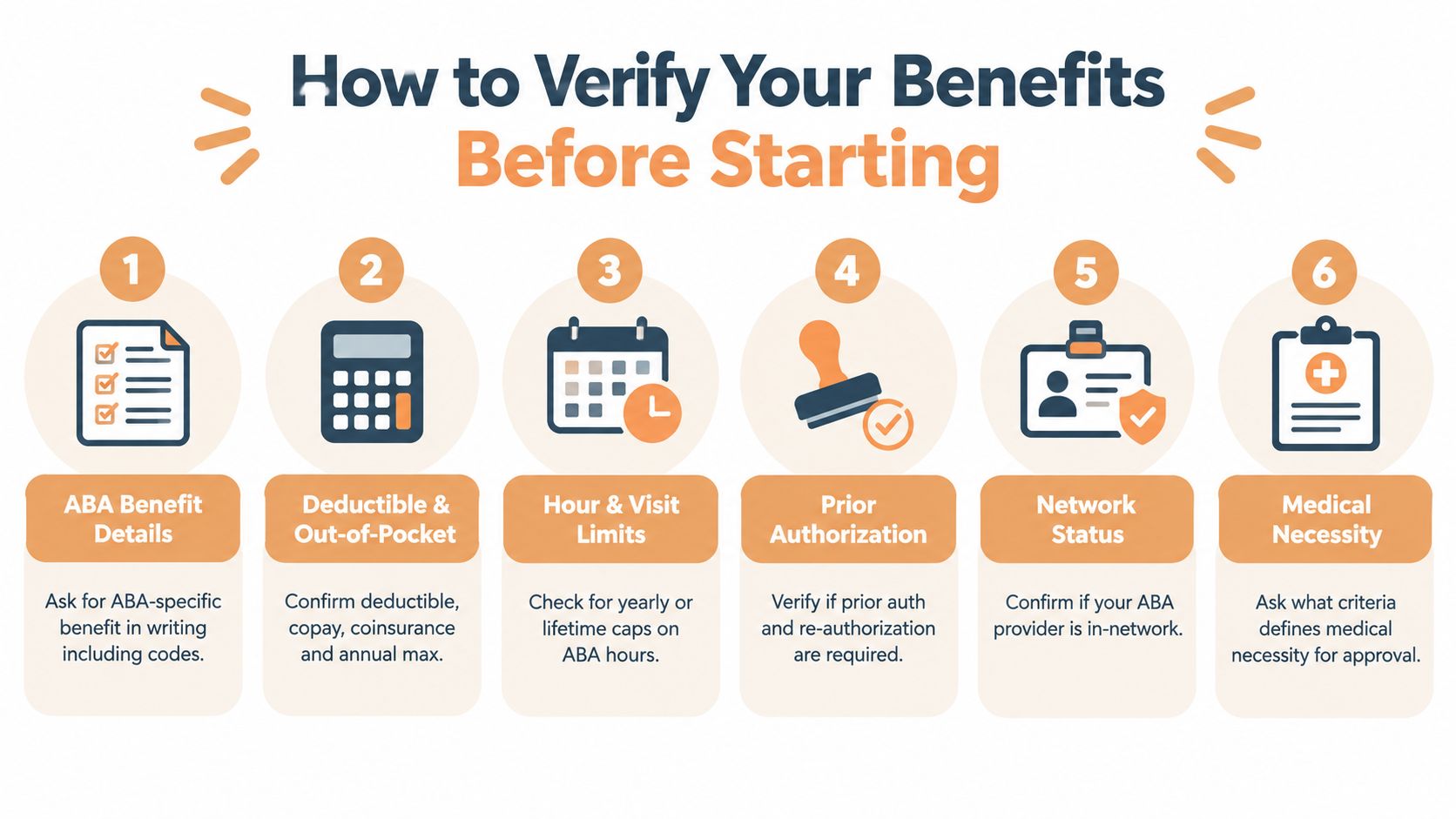
A benefits call is easier when you have a written checklist. Before scheduling an assessment, use the exact words ABA therapy, ask for the applicable benefit, and request the representative's call reference number.
Questions for the insurer
Ask the plan to confirm:
- The ABA benefit: Request covered codes, service categories, and whether benefits are expressed in hours, visits, or dollars.
- Your cost responsibility: Ask about the deductible, current progress toward it, copays, coinsurance, and the annual out-of-pocket maximum.
- The provider network: Confirm whether the BCBA, RBT, and practice are recognized as in-network for the specific plan.
- Authorization rules: Ask whether an assessment, treatment plan, prior authorization, concurrent review, or reauthorization is required.
- Medical necessity: Request the criteria used to approve services and the documents needed for review.
- Limits: Confirm whether annual or lifetime limits apply to ABA hours, sessions, dollars, caregiver training, or related services.
Questions for the provider
Ask which billing codes the practice uses, including 97151, 97153, 97155, and 97156 when applicable to the services being considered. Confirm whether the provider can request a single-case agreement if the practice is out of network, and ask how the practice handles authorizations, corrected claims, and denials.
The provider should explain what it can verify and what only the insurer can decide. A thoughtful care coordinator can help organize questions, but no provider can guarantee that a claim will be paid.
Keep one benefits folder
Save the Summary of Benefits, the detailed policy language, authorization letters, provider estimates, call reference numbers, representative names, and every EOB. Match each EOB to the date of service and ask promptly about unfamiliar adjustment or denial codes.
Use this short video as another starting point for organizing an insurance conversation.
Appeals, Supplemental Coverage, and Other Next Steps
A denied EOB gives you a reason and usually a deadline. Start there. A denial for missing authorization requires a different response from a denial based on medical necessity, coding, network status, or a stated benefit exclusion.
Build the appeal around the reason
First, request the relevant clinical and policy criteria. Then ask the ABA provider to prepare supporting records, such as the assessment, treatment plan, progress notes, requested hours, and an explanation of why the disputed service fits the child's goals. Submit the internal appeal in the plan's required format and keep proof of delivery.
If the internal appeal fails, ask whether a peer-to-peer review is available so the treating clinician can discuss medical necessity directly with the insurer's reviewer. Families may also request an external review when the plan permits it, and they can contact their state insurance department about complaint procedures and jurisdiction.
Keep the denial letter, appeal packet, fax confirmation, portal receipt, and every response together.
Consider layered support
A secondary policy or supplemental coverage may help when the primary plan leaves repeated deductibles, coinsurance, or uncovered services. The value depends on premiums, coordination rules, network requirements, and whether the secondary plan covers the specific ABA services involved. Medicaid may act as secondary coverage for eligible families, but parents should confirm eligibility and coordination details with the relevant program.
Employer plans can also coordinate benefits differently when both caregivers carry coverage. Ask each plan which is primary, how claims transfer, and whether one plan's authorization is recognized by the other. Don't cancel existing coverage or change a provider before understanding those rules.
Community resources can fill practical gaps without replacing individualized insurance review. Ask about sliding-scale clinics, university training clinics, school-district IEP services, parent-mediated intervention programs, and nonprofit grants. School services and health-plan ABA address different responsibilities, so the child's school team and clinical team should coordinate appropriately rather than assuming one will substitute for the other.
Moving Forward With Confidence and Support
Underinsurance can turn an approved care plan into a series of partial payments, authorizations, and unexpected bills. Families can stay oriented by verifying benefits before each authorization period, reading every EOB, and keeping insurance, school, community, and caregiver supports connected.
Your child's goals remain the focus. Coverage paperwork matters because it affects access to communication practice, smoother routines, school participation, and greater independence. It does not measure your child's progress.
家長培訓支援 can help caregivers carry approved strategies into daily routines. Learn more about parent coaching support, and ask your care team which guidance matches your child's individualized plan.
Friendly ABA Premier can help families review ABA benefits, organize authorization questions, and identify coverage gaps while coordinating individualized services. Visit Friendly ABA Premier to connect with a team offering home-based ABA, school support, social skills development, and parent coaching across its service areas.
Practical preparation makes insurance limits easier to spot and address. Keep your records together, ask questions before services begin, and involve your care team when coverage does not match the approved plan.
Our Latest Insights










































Experience ABA Therapy with a More Personalized Level of Support
Discover how FriendlyABA Premier combines evidence-based ABA therapy with dedicated coordination, proactive communication, and individualized family support.