


Care Coordinator Responsibilities in ABA Therapy
Learn care coordinator responsibilities in ABA therapy, what they do day to day, and how a dedicated coordinator supports your family from intake to progress.


You're packing a lunchbox while your child resists getting dressed, the morning schedule is slipping, and you're wondering who to call. The behavior technician has one piece of information, the supervising clinician has another, the school has noticed something new, and the insurance questions seem to belong to someone else entirely.
That's where a care coordinator in ABA therapy can make the experience feel more manageable. This person helps connect the family, clinical team, school, and administrative contacts so your child's care doesn't become a series of disconnected conversations. The coordinator doesn't replace your child's therapists or make clinical decisions alone. Instead, they help the right people communicate, keep plans moving, and make sure your questions have somewhere to go.
Table of Contents
- What a Care Coordinator Really Does in ABA Therapy
- Intake and onboarding
- Care plan and coordination
- Ongoing support and advocacy
What a Care Coordinator Really Does in ABA Therapy
A care coordinator is often the person who keeps the full picture in view. In a pediatric care setting, coordination can include assessing needs, planning services, transferring information, monitoring follow-up, and supporting families across home, school, and community settings. A review of care coordination for children with complex care needs describes the role as integrating information and goals across clinicians, schools, families, and community supports.
In practical terms, the coordinator may connect the behavior technician, the board certified behavior analyst, or BCBA, the school team, insurance contacts, and your household. The technician usually works directly with your child during sessions. The BCBA typically oversees assessment, treatment goals, clinical decisions, and supervision. The care coordinator focuses on the thread connecting those parts.
The coordinator's job isn't to make every decision. It's to make sure the right decision-makers have the information they need, and that your family knows what happens next.
That distinction can prevent confusion. A scheduler may arrange appointment times. A billing representative may answer a question about a claim. A case manager may oversee a broader insurance or community-services plan. A care coordinator may work alongside all of them, while serving as the familiar contact who helps you understand how the pieces fit together.
The role is more than passive follow-up. In a review from the U.S. National Library of Medicine, formal care coordinators are described as people who manage information and needs across clinics and sectors, help families in the home, and connect them with longer-term services and supports. For families receiving ABA, that can mean clarifying a recommendation, sharing a school concern with the BCBA, tracking a referral, or helping address a gap before it disrupts services.
A good coordinator also learns your family's priorities. Maybe your first goal is a calmer morning routine, more independence at mealtime, or smoother participation in classroom activities. The coordinator helps keep those priorities visible while the clinical team develops and adjusts the treatment plan.
Core Responsibilities Families Can Expect
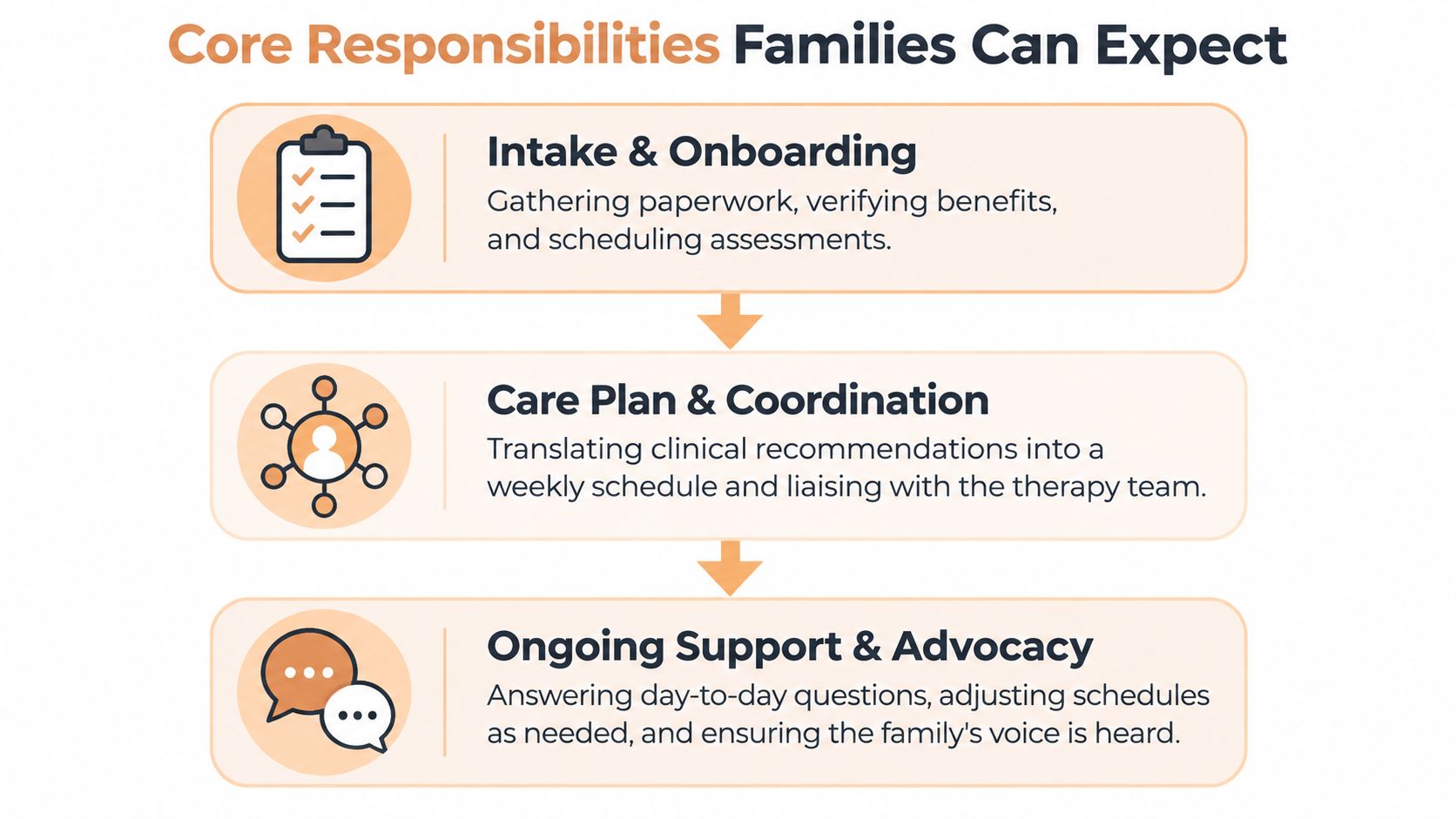
The care coordinator's responsibilities usually fall into three connected areas. The exact scope varies by provider and setting, so ask how the role works before services begin.
Intake and onboarding
Before therapy starts, the coordinator may help gather records, insurance information, referral paperwork, and scheduling preferences. They may explain what happens during the initial assessment, what information the clinical team needs, and how services will fit around school, work, transportation, siblings, and family routines.
This early guidance matters because families often receive several instructions at once. A coordinator can help separate “needed before the assessment” from “helpful to bring later,” reducing avoidable back-and-forth.
Care plan and coordination
Once services are underway, coordination becomes more active. The coordinator may help build a workable weekly schedule, share updates with the BCBA, arrange communication with school staff when appropriate, and track whether referrals or recommendations were completed.
They may also help parents understand how a strategy can fit into daily life. For example, a plan for requesting help might be practiced during play, snack preparation, or getting ready for school. The coordinator doesn't turn that example into a clinical prescription. They help ensure the family and therapy team discuss what's realistic and useful.
Parent coaching is another possible part of this partnership. Families can explore practical ways to participate in care through parent training for autism, while keeping individualized guidance with their care team.
Ongoing support and advocacy
Communication shouldn't begin only when something goes wrong. Some ABA coordinator roles include regular family contact, including weekly check-ins even when there's no major update, as well as documenting conversations and follow-ups, as described in this ABA care coordinator role listing.
That support may include:
- Scheduling help: Adjusting session times when school, illness, or family responsibilities change.
- Early problem-solving: Alerting the appropriate team member when attendance, staffing, authorization, or communication issues appear.
- Family advocacy: Bringing your priorities and concerns into conversations about services.
- Progress communication: Helping you understand updates without requiring you to decode every clinical term.
A coordinator may not be available at every hour or able to answer every question personally. What matters is that the provider explains the process clearly, including who responds, how urgent concerns are handled, and how information moves between the family and clinical team.
A Day in the Life Through Family Moments
The role becomes easier to understand through ordinary moments. On Monday morning, a child may resist leaving the breakfast table, become upset when the routine changes, or struggle to move from getting dressed to walking out the door. A parent might message the coordinator with a short description of what happened.
The coordinator may acknowledge the concern, help identify whether the BCBA should be involved, and make sure the family receives guidance through the appropriate clinical channel. The response may be as simple as clarifying the next step or arranging a conversation. The important part is that the parent doesn't have to guess which department owns the issue.
School pickup
At pickup, a teacher may mention that the child has started covering their ears during a particular classroom activity. The parent can share that observation with the coordinator, who can pass it to the BCBA and help determine whether a school meeting or additional information is needed.
School coordination should respect consent, privacy, and the roles of educators and clinicians. The coordinator isn't there to direct the classroom. They help the adults around the child exchange relevant information so home, school, and therapy aren't working from completely different assumptions.
Evening questions
Later that evening, a parent may remember a question about approved hours, an upcoming authorization, or whether a schedule change affects services. The coordinator can explain who handles the answer, contact the right internal team, or provide a clear follow-up rather than leaving the parent to make several calls.
A family-focused model may include assessment, individualized planning, coordination among providers, progress monitoring, and plan adjustments when needs change, as outlined in this overview of healthcare coordination for autism.
The end of the week
By Friday, the coordinator might help organize a progress update, confirm the next week's schedule, or flag a staffing change before it creates a surprise. Before an IEP meeting, they may help the family gather questions and understand which provider can participate, subject to the school's process and the family's permission.
These small touchpoints create continuity. The coordinator's value often appears not in one dramatic intervention, but in fewer unanswered questions and clearer next steps.
How a Dedicated Coordinator Helps Families Feel Supported
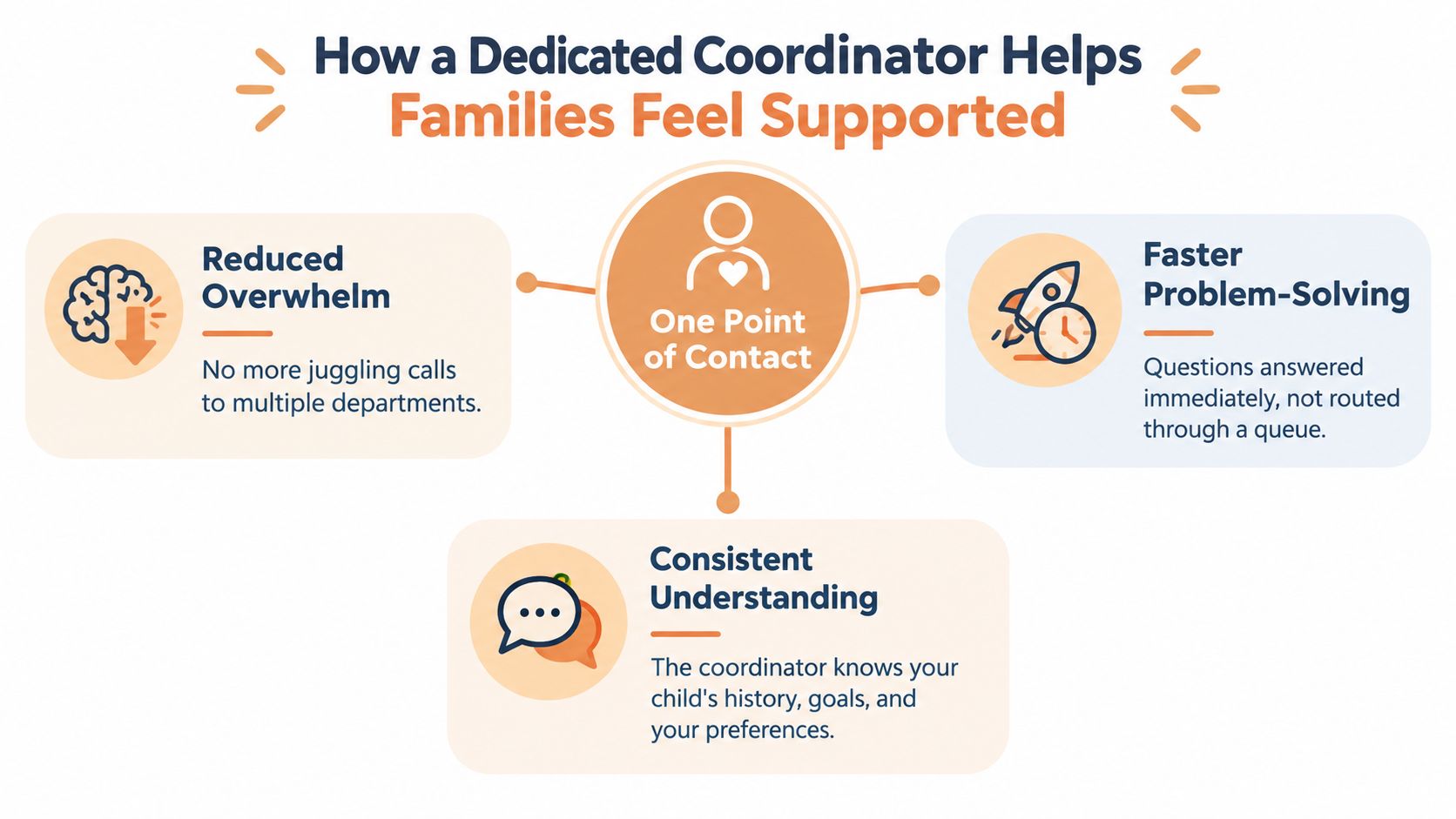
Families often feel overwhelmed because they're carrying several kinds of work at once. They're observing daily routines, communicating with providers, answering school messages, managing appointments, and trying to understand insurance language. A dedicated coordinator can reduce that load by giving the family one familiar starting point.
Less repetition
Without a consistent contact, parents may repeat the same history to intake staff, schedulers, clinicians, and billing representatives. A coordinator who understands the family's priorities can help route information more efficiently, while still confirming details when accuracy or privacy requires it.
That doesn't mean the coordinator remembers every detail forever or replaces written documentation. It means the family has a person who can help organize the conversation instead of starting from the beginning each time.
Clearer communication
Clinical language can be difficult to connect to daily life. A parent may say, “Dinner is taking an hour because my child leaves the table,” while a clinician may describe goals using technical terms. The coordinator can help each side understand the practical concern and identify which member of the clinical team should respond.
This communication also works in the other direction. A teacher's observation, a grandparent's concern, or a parent's note about a difficult transition can reach the team in a usable form.
Support becomes real when a family knows who will receive the question, who will answer it, and when to expect an update.
More continuity across settings
A strategy that helps during play at home may need thoughtful adaptation at school or during a community outing. The coordinator helps keep the conversation connected, while the clinical team determines whether a strategy is appropriate and how it should be individualized.
Families seeking hands-on support may also find parent coaching services useful for discussing how therapy goals can fit into routines such as dressing, meals, play, or bedtime. The goal isn't to turn parents into therapists. It's to make sure families understand how they can participate comfortably and consistently.
Trust grows through small details. A coordinator may notice that schedule changes repeatedly affect attendance, remember that a parent prefers text messages, or flag an authorization concern before it interrupts a routine. Those actions don't guarantee a particular clinical outcome, but they can make the care experience more understandable and responsive.
Smart Questions to Ask Any ABA Provider
You don't need to interrogate a provider to learn how coordination works. A few direct questions can show whether the role is active, accessible, and connected to the clinical team.
Start with access
Ask:
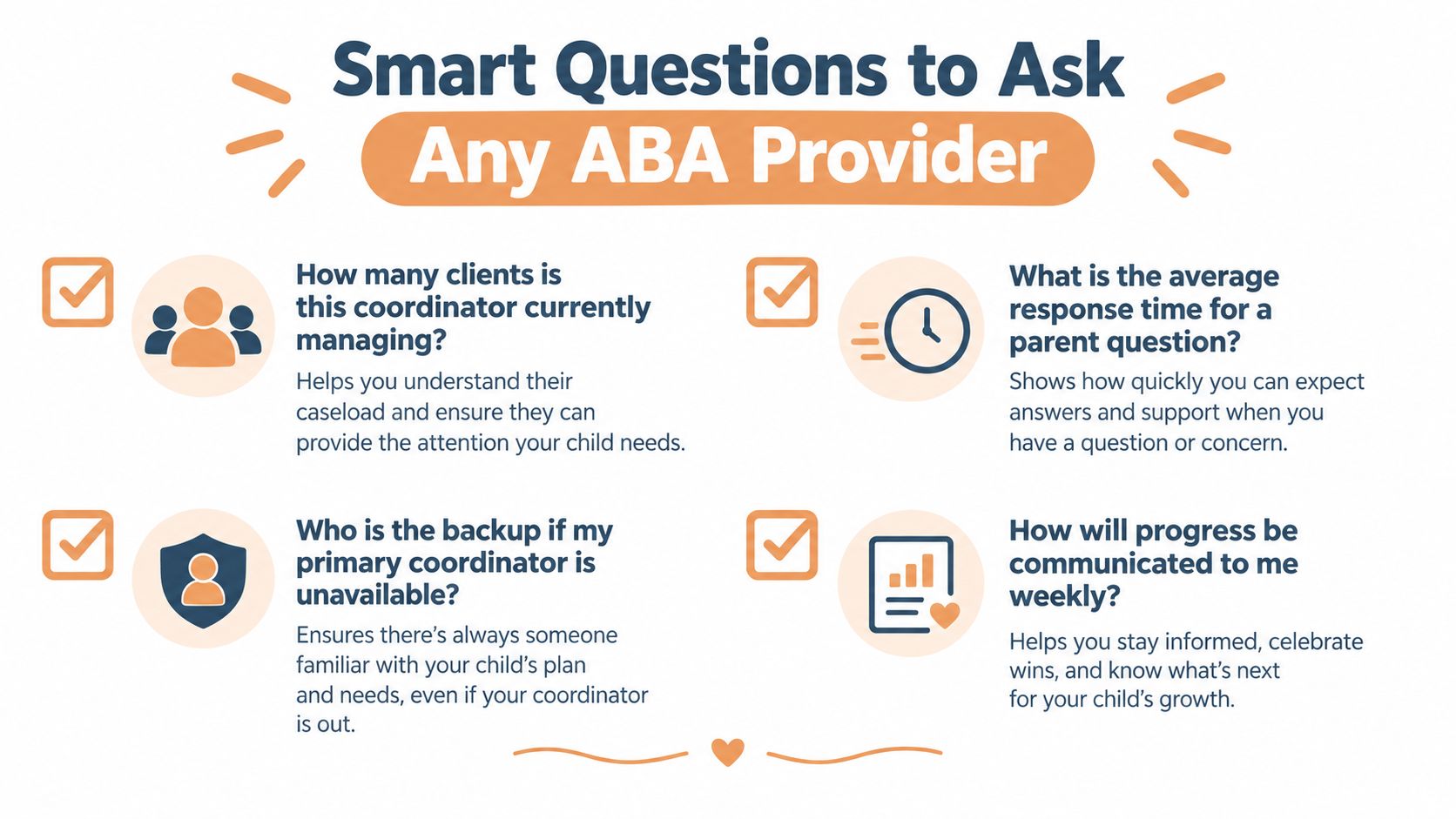
- “How many families does one coordinator manage?” A coordinator's workload can affect how much individual attention families receive.
- “What's the usual response time for a parent question?” Ask what happens when a morning routine suddenly stops working or a school concern needs attention.
- “Will I have one primary contact?” Find out whether you'll be passed among intake, scheduling, billing, and clinical departments.
- “Who covers questions when my coordinator is unavailable?” A clear backup process matters during vacations, illness, or unexpected absences.
The provider should be able to answer without making you feel difficult for asking. Responsibilities vary between organizations, and a systematic review of care coordination definitions notes that settings don't always use the same terminology or measures. Ask for the provider's actual process rather than relying on the job title alone.
Ask about school and clinical follow-through
You might say, “Who can join an IEP conversation if appropriate, and who follows up on school recommendations afterward?” Also ask how the coordinator communicates with the BCBA, behavior technician, teachers, and other providers when you authorize that communication.
Then clarify progress updates:
- “How often will you share progress?” Ask whether updates happen through meetings, written summaries, calls, or another method.
- “Can I review session notes or treatment updates?” The provider should explain what families can access and how clinical information is shared.
- “Who handles insurance authorizations?” Learn whether the coordinator helps directly or connects you with a separate authorization team.
Finally, notice how the answers feel. Does the person listen carefully, explain limits clearly, and ask about your family's priorities? A thoughtful process often tells you as much as a polished promise.
Why the Premier Care Coordinator Model Stands Apart
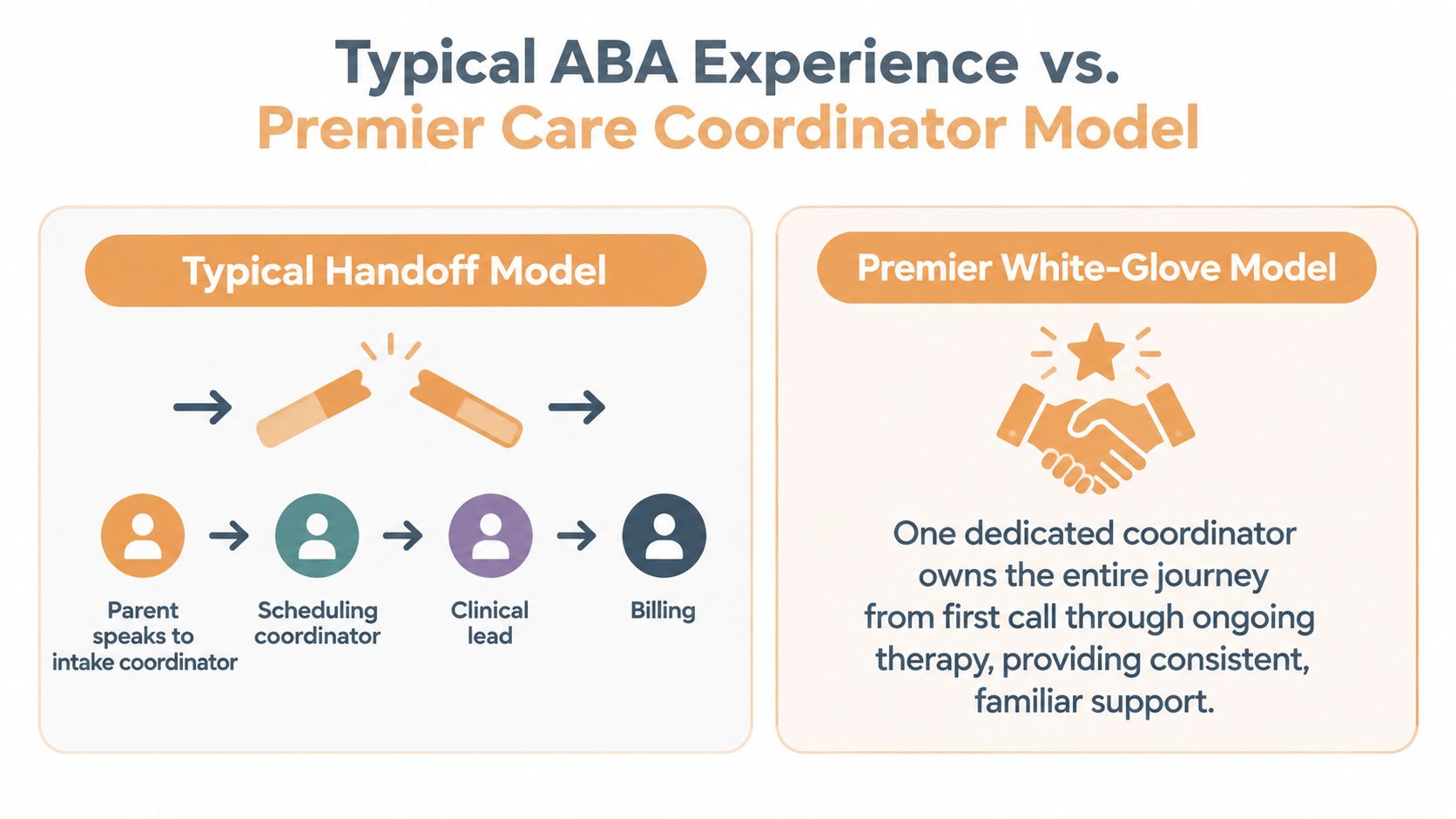
The difference between coordination models often appears in the handoffs. In one arrangement, a parent may speak with an intake coordinator about paperwork, a scheduler about appointment times, an authorization specialist about insurance, and a clinical lead about progress. Each person may be helpful, but the parent may still have to repeat the same context.
A dedicated model aims to keep one person connected to the family's journey. The coordinator may still work with billing, scheduling, authorization, and clinical staff, but the family has a consistent contact who helps connect those conversations.
The difference families notice
Consider a difficult morning. In a handoff-heavy experience, a parent may need to decide whether to message the technician, call the scheduler, contact the BCBA, or ask billing whether a change affects authorized services. In a dedicated coordinator model, the parent starts with the person who knows the family's history and can route the concern correctly.
That coordinator doesn't independently change a clinical plan. Instead, they can help the BCBA understand what happened, check whether the afternoon schedule needs attention, and follow up with the parent after the appropriate team members respond.
The same continuity can help during annual reviews, school conversations, staffing changes, and insurance questions. The coordinator carries useful context about the child's routines, the family's communication preferences, and the priorities that matter most at home.
Friendly ABA Premier describes its approach around individualized care, dedicated coordination, progress check-ins, and collaboration among families and clinicians. You can learn more about Friendly ABA Premier's approach and compare it with the coordination process offered by other providers.
The goal isn't to eliminate every separate department. It's to prevent the family from becoming the messenger between all of them.
A coordinated model also creates a natural place for family feedback. If mornings are improving but mealtimes remain difficult, that information can shape the next conversation. If a schedule is technically full but impossible for the household, the coordinator can help the team understand the practical barrier.
You can also watch this short video for a visual explanation of how a dedicated coordinator can connect the family and therapy team.
The model still depends on clear boundaries, timely responses, appropriate consent, and qualified clinical oversight. A dedicated contact is valuable because it improves connection and accountability, not because one person can replace every professional involved in a child's care.
A Gentle Path Forward for Your Family
Choosing ABA therapy can feel like adding another system to an already full family schedule. A care coordinator should make that system easier to understand, not add another layer of confusion.
At its most useful, the coordinator becomes a steady point of contact. They help organize logistics, clarify who handles each question, connect family observations with the clinical team, and keep your priorities present during planning conversations.
Progress may show up in ordinary ways. A child might move through part of the morning routine with less support, participate more comfortably in a family meal, communicate a need more clearly, or manage a school transition with a little more confidence. These moments deserve attention, even when progress isn't immediate or perfectly consistent.
The coordinator also helps keep expectations grounded. They can help you ask what the treatment team is working toward, how progress will be reviewed, and how the plan can be adjusted when a goal doesn't fit your child's current needs or your family's routine. Individualized guidance should always come from your child's qualified care team.
Before choosing a provider, ask who will be your main contact, how communication works, and what happens when a concern crosses clinical, school, scheduling, or insurance boundaries. The answers can help you decide whether the provider's approach matches the kind of partnership your family wants.
You don't have to solve every question before making the first call. A short conversation can help you share your child's strengths, describe the routines that feel hardest, and learn whether the provider offers the kind of coordinated support you're looking for.
Friendly ABA Premier provides individualized ABA therapy, home-based support, school support, social skills development, and parent coaching with a dedicated care coordinator to help connect families and clinical teams. Visit Friendly ABA Premier to learn more, ask questions, and explore whether its care coordination model fits your family's routine.
Our Latest Insights














































Experience ABA Therapy with a More Personalized Level of Support
Discover how FriendlyABA Premier combines evidence-based ABA therapy with dedicated coordination, proactive communication, and individualized family support.