

Head Banging Autism
Head banging autism. Head banging in autism explained for parents. Learn common causes, safety steps, ABA-based support, and when to seek urgent care

At bedtime, the house is finally quiet. Then you hear it, a soft, repeated thump from the crib rail, wall, floor, or pillow. You rush in, check your child's face and scalp, and wonder whether this is a phase, a sign of pain, or something connected to autism.
If you're searching for head banging autism, you're probably looking for two answers at once: why it's happening and what you should do right now. Head banging can be frightening, but it's often a child's way of regulating sensory input, expressing an unmet need, or responding to discomfort they can't explain.
The safest path combines calm observation, medical attention when needed, environmental protection, and individualized behavioral support. The aim isn't to punish a child or eliminate harmless self-regulation at any cost. It's to understand the behavior, prevent injury, and teach safer ways to communicate or cope.
Table of Contents
- Make the immediate area safer
- Stay close during predictable high-risk moments
- Capture useful information
A Moment Many Parents Know Too Well
A parent notices the movement after a long day. Their child is lying in bed, rocking forward and gently tapping their forehead against the pillow. The motion is rhythmic, almost steady enough to seem calming. Then the child shifts toward the crib rail, and the sound changes from a muffled bump to a sharper knock.
The parent's first reaction is immediate fear. Is there a bruise? Did the child lose consciousness? Could this cause lasting harm? The parent checks the skin, watches the eyes, and mentally reviews the evening. Dinner was difficult. The grocery store was noisy. Bath time ran late. The usual bedtime routine changed.
That quick safety check is appropriate. So is feeling confused. But head banging isn't proof that you've failed as a parent, and it doesn't predict your child's future. It's a behavior that can carry information, even when the message isn't obvious.
A useful starting point: Treat head banging as something to understand, not as a character flaw or a parenting verdict.
For some children, repetitive movement helps organize an overloaded sensory system. For others, it communicates “I hurt,” “stop,” “help me,” “I need a break,” or “I can't handle this transition.” Sometimes the behavior appears during excitement or fatigue, and sometimes it starts suddenly because a medical problem has changed how the child feels.
You don't need to solve the entire problem in one night. Move hard objects away, stay close, lower the stimulation, and contact the appropriate care professional if you're concerned about pain or injury. Then begin noticing what happened before, during, and after the episode.
The rest of this guide will help you move from that raw moment of alarm toward a steadier process: understand the behavior, check for safety concerns, look for patterns, and work with your child's care team on a plan that fits.
What Head Banging Really Means in Autism
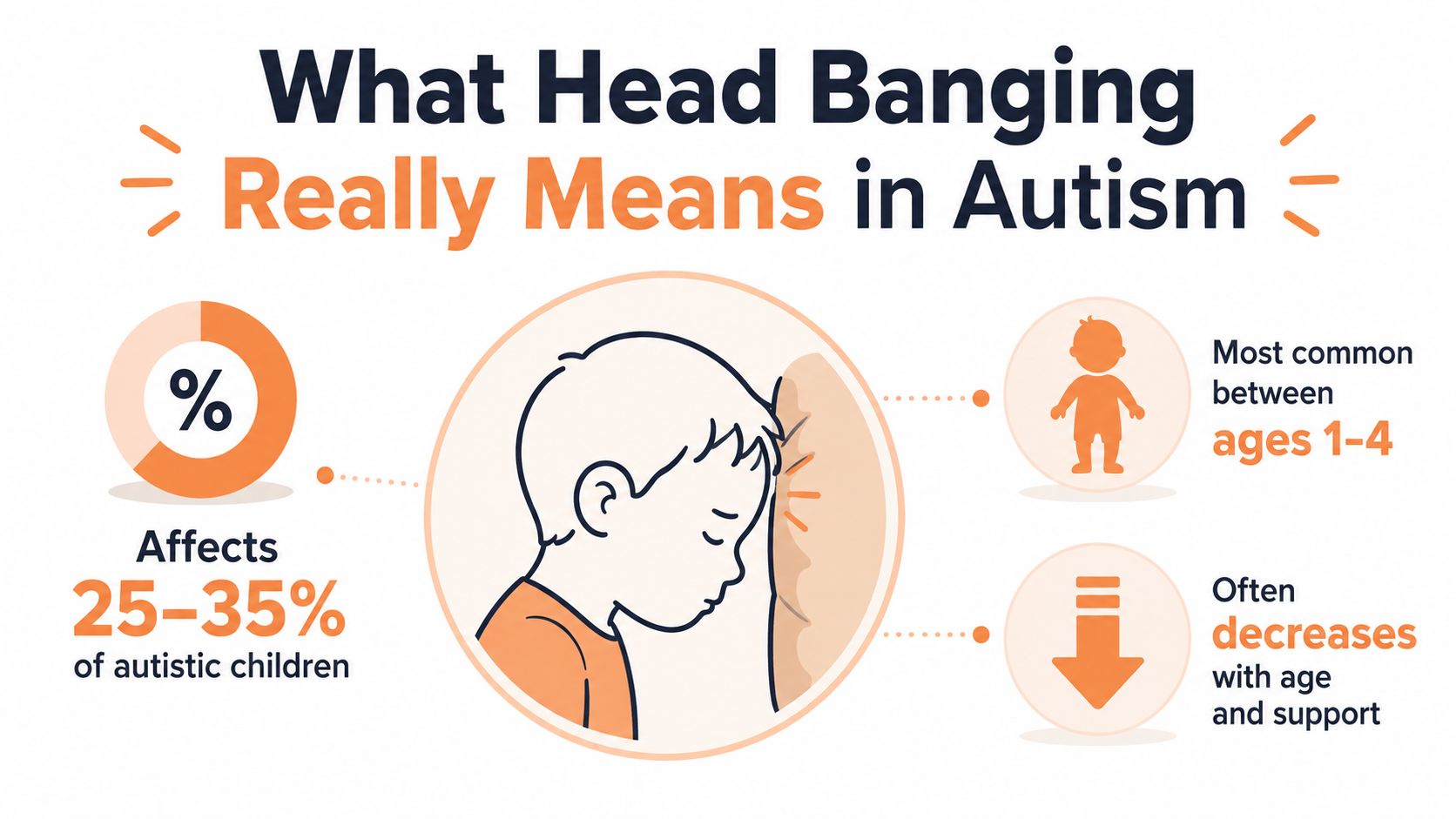
Head banging generally means repetitive contact between the head and a surface, ranging from gentle rhythmic tapping to forceful impact. In autism, it falls within the broader category of self-injurious behavior, or SIB. The behavior can vary widely in intensity, frequency, setting, and purpose, so the same label doesn't always describe the same experience.
A 2020 meta-analysis pooling 14,379 participants across 37 studies estimated that self-injurious behavior in autism had a pooled prevalence of 42%, with a 95% confidence interval of 38% to 47%. The review also found substantial variation between studies, meaning observed rates depend on factors such as age, setting, and how researchers measure the behavior. You can read the 2020 meta-analysis on self-injurious behavior in autism for the full context.
A behavior can carry a message
Think of head banging as a pressure valve. When internal stress, sensory input, pain, or frustration builds beyond what a child can manage, the behavior may release or communicate some of that pressure. The movement doesn't tell you exactly which pressure is building, but it gives you something observable to investigate.
Head banging isn't automatically the same as an ordinary toddler bump. Young children may briefly hit their heads during exploration, fatigue, or frustration, and those movements may fade as communication and self-regulation grow. Persistent, forceful, worsening, or injury-producing behavior deserves closer attention, especially when it interferes with sleep, play, meals, school, or family routines.
A 2021 study of children with autism reported self-injurious behavior in 22.1% of the sample. Among the children who engaged in self-injury, head banging was the most common form at 47%, followed by self-hitting at 27.8%. Those figures come from the PubMed-indexed study of self-injury topographies in autistic children.
The numbers don't tell you what your child's head banging means. They do show that this is a recognized clinical concern rather than an isolated or inexplicable behavior. Your child's pattern still needs an individual look at health, communication, sensory needs, surroundings, and what happens after each episode.
Common Reasons Children Bang Their Heads
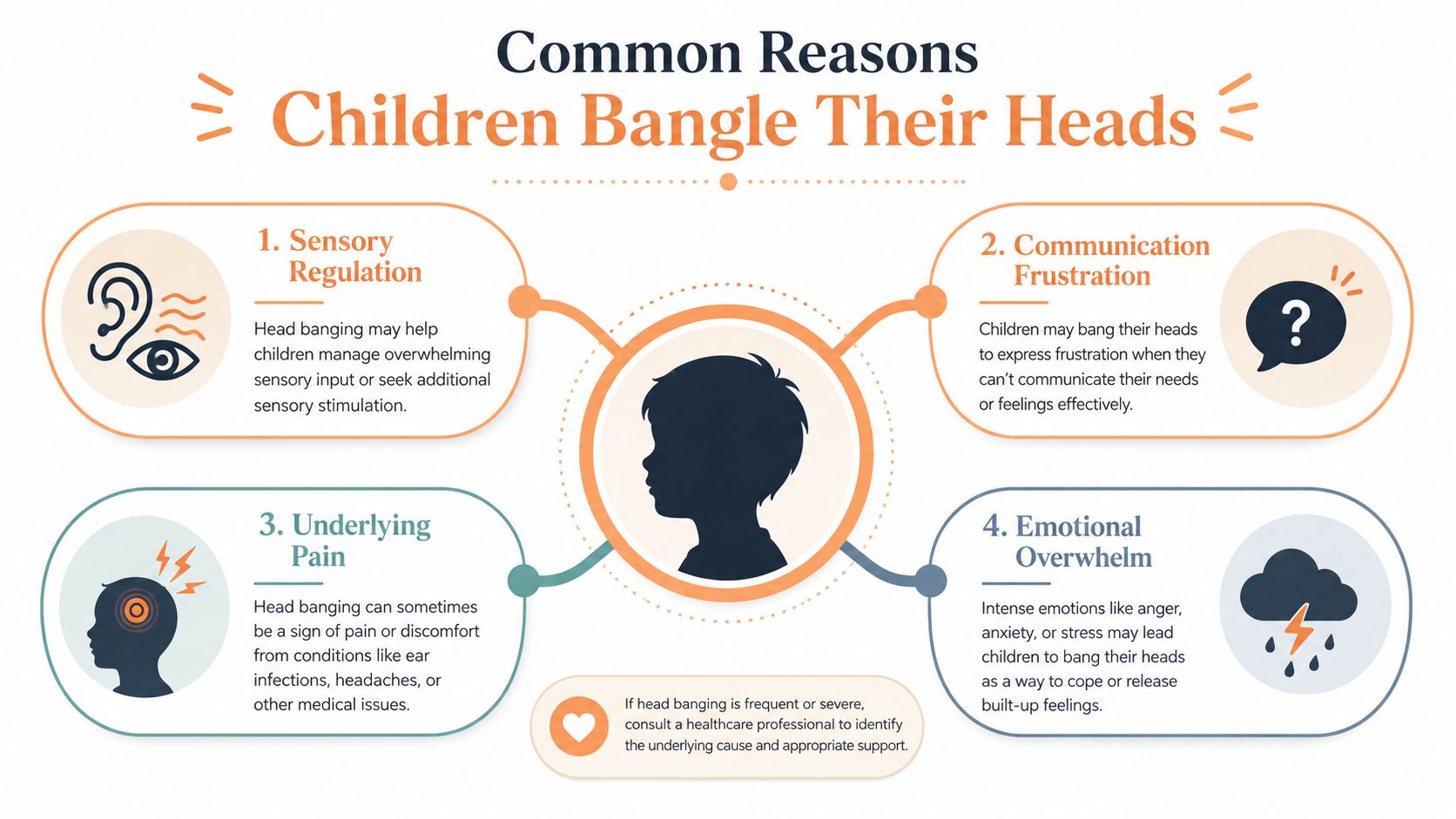
Head banging can have more than one function, and the function may change from one situation to another. A child might seek sensory input during quiet play but use the same behavior to escape a difficult demand later that day. The categories below are a practical lens for observation, not a diagnosis.
Sensory regulation
Some children seek the predictable pressure or rhythm created by impact. Others may bang when lights, voices, textures, or movement become overwhelming, using repetition to narrow their attention or settle their body.
For example, a child may start thumping their forehead during a noisy grocery trip. Another child may tap their head against the mattress during a quiet period before sleep. The difference matters because one situation may call for reduced stimulation, while the other may call for a safe replacement that provides appropriate movement or pressure.
Communication frustration
A child may be trying to say something without having a reliable speech, sign, picture, or AAC response available. The message might be “I'm finished,” “I want the tablet,” “help me,” “I don't understand,” or “I'm overwhelmed.”
Consider a child who bangs their forehead after a preferred toy is unavailable. The behavior may be communicating disappointment, requesting the item, seeking help with waiting, or trying to end the interaction. Responding effectively requires finding out what outcome follows and teaching a safer way to request it.
Pain or physical discomfort
New or unusual head banging should never be dismissed as “just stimming.” Ear infections, dental problems, headaches, and other discomforts can be difficult for a child to describe, particularly when communication is limited. The clinical review of self-injurious behavior in autism notes that head banging can occur among children with ASD and that cases of SIB including head banging have been reported as early as 12 months of age, supporting attention to emerging impact behaviors in toddlers.
Environmental stress
Transitions, loud environments, interrupted routines, fatigue, hunger, and unexpected changes can raise stress. A child who usually copes well may bang their head after school because the day demanded sustained effort, or during a rushed morning when dressing happens differently.
For several days, record the time, location, activity, people present, what happened immediately before, how long the behavior lasted, and what happened afterward. Patterns often become clearer when you compare bedtime with mealtime, home with school, or familiar routines with unexpected changes.
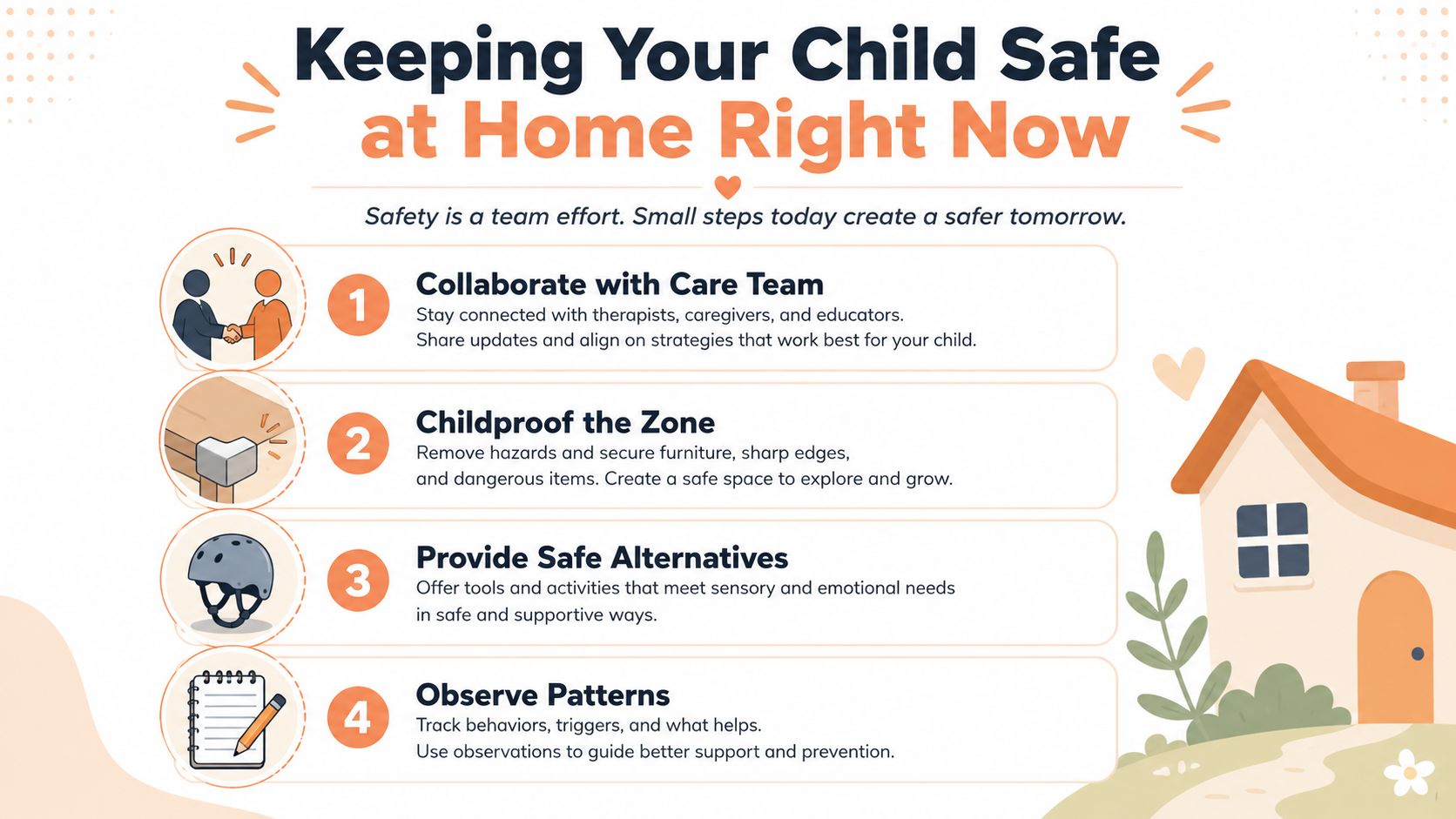
Keeping Your Child Safe at Home Right Now
Safety begins with collaboration. A pediatrician, BCBA, occupational therapist, speech-language pathologist, teacher, or other member of your child's team can help you decide which protections fit the behavior. You don't need to design a complete plan alone, and you shouldn't use specialized protective equipment without professional guidance.
Make the immediate area safer
Start with the location where head banging most often occurs. Move hard furniture, sharp objects, and unstable items away from the child's reach. Add padding to accessible corners, use a soft rug where appropriate, and check crib rails, bed frames, walls, and floor surfaces for impact risk.
A protective helmet, head bumper, or other device may be appropriate in some situations, but a physician or qualified care professional should guide that decision. Equipment should support safety while the team investigates the reason for the behavior, not replace assessment.
Stay close during predictable high-risk moments
If head banging commonly occurs during bedtime, transitions, or busy family routines, remain within arm's reach when possible. Keep your movements calm and use only the physical support you've been taught by a professional. Avoid restraining your child unless a trained care team has provided a specific, safe plan.
Lower lights, reduce background noise, pause extra conversation, and offer a familiar calm-down routine. Depending on your child's needs, that might include a quiet corner, a favorite book, slow rocking, or a physician-approved sensory option such as a lap pad. Weighted products aren't suitable for every child, so ask the care team before using them.
Capture useful information
A brief log is more helpful than trying to remember every detail later. Write down what happened before the episode, the type of surface involved, the apparent intensity, any visible injury, and what helped your child return to calm.
You can also review behavioral skill training as part of a broader conversation with your providers about teaching safer responses. The immediate goal is protection. The longer-term goal is understanding and replacement skills, and both priorities can exist at the same time.
Keep the record neutral: “Head tapped the pillow after lights went off” gives a team more useful information than “had a bad behavior.”
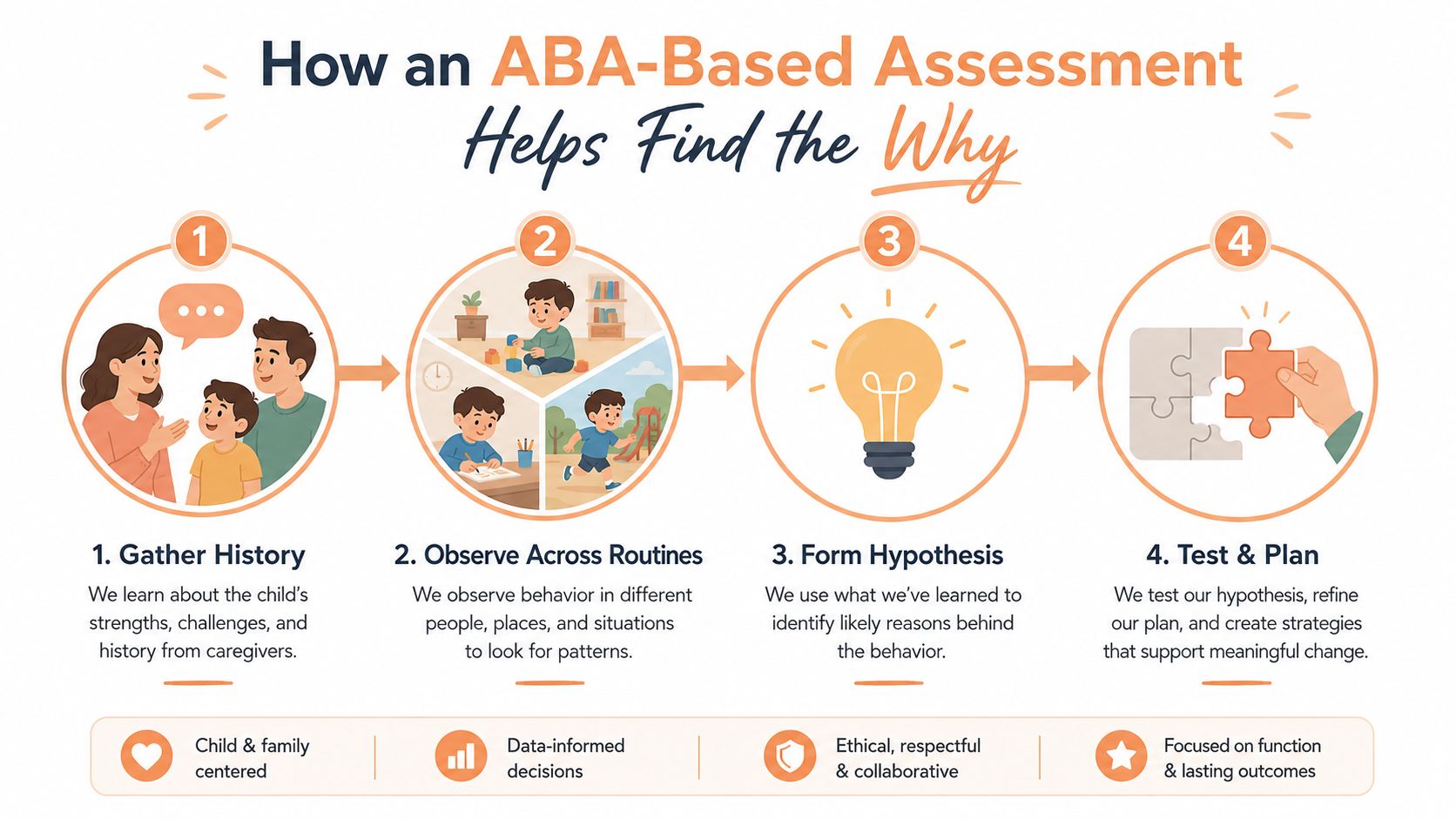
How an ABA-Based Assessment Helps Find the Why
A Functional Behavior Assessment, often called an FBA, is a structured way to study what happens around a behavior. It doesn't label your child as difficult or assume that one explanation fits every episode. It helps the team form a reasonable, testable idea about what the behavior may accomplish.
A BCBA may begin by gathering your child's history. That can include health changes, communication methods, sleep patterns, routines, school reports, and your observations at home. The BCBA may also speak with teachers or other caregivers who see your child in different settings.
The assessment follows the pattern
Observation matters because head banging during a demand may have a different function from head banging during free play. The team looks at what happens immediately before the behavior, what the child does, and what follows. This is sometimes summarized as antecedent, behavior, consequence, or what happened before, what happened, and what happened afterward.
Possible functions include:
- Sensory input: The movement produces a sensation the child seeks or uses to regulate.
- Escape: The behavior delays or ends a difficult task, transition, or overwhelming situation.
- Attention: Caregiver or teacher responses may become the outcome the child is seeking.
- Communication: The behavior signals pain, frustration, a request, refusal, or another unmet need.
A child can have different patterns in different routines. That's why a strong assessment looks beyond one dramatic incident and considers the child's whole day.
From hypothesis to support plan
The assessment produces a hypothesis, not a permanent label. The BCBA uses that hypothesis to design a function-based Behavior Support Plan, then watches whether the plan works and adjusts it when the data or the child's needs change.
For example, if head banging appears to communicate “break,” the team may teach a spoken word, picture, sign, gesture, or AAC response that produces a break safely. If the behavior appears related to sensory regulation, the plan may build in appropriate sensory activities before difficult periods.
The process should be collaborative and respectful. Parents give consent, share what they know, and help decide what is practical in daily life. A dedicated care coordinator can make communication between family members, clinicians, and school staff easier, particularly when everyone needs to respond consistently.
Before an assessment begins, it can help to read what to expect during your first ABA assessment. Bring your notes and questions, including concerns about medical causes, equipment, communication, and how the plan will be used at home.
What Individualized ABA Support Can Look Like
Two children can bang their heads for completely different reasons. A sensory-seeking child may need safer access to movement and pressure, while a child who becomes distressed during transitions may need communication tools and a more predictable way to stop or change activities.
Take a four-year-old who repeatedly bangs their head against the tile during recess. The behavior appears during active outdoor play, especially when the child has limited access to climbing, jumping, or crashing activities. The team might arrange safe movement options, such as trampoline breaks or crash pads, and teach the child to request that input before frustration builds.
Now consider a seven-year-old who hits their forehead when asked to stop a preferred activity. This child's plan might focus on transition warnings, a visual schedule, a brief and teachable “more time” or “break” request, and shorter task demands immediately after the preferred activity. The team may practice the communication response when the child is calm, then reinforce its use during real transitions.
The plan changes with the child
Both plans may include reinforcement, which means making a safer replacement worthwhile by responding consistently when the child uses it. Both may adjust what happens before the behavior, such as changing the demand, offering a choice, or providing a visual cue. But the actual replacement skill, sensory support, teaching pace, and caregiver response should reflect the child's communication level and daily needs.
A child who uses pictures may need a picture card within reach. A child who speaks may need a short phrase practiced during low-stress moments. Another child may need a gesture, sign, or AAC button. The most useful response is the one the child can access quickly when overwhelmed.
Individualized doesn't mean complicated: It means the support fits the child, the routine, and the reason the behavior occurs.
Caregivers also need coaching. Everyone should know how to respond to a request for help, a break, sensory input, or more time. Consistency doesn't require identical wording from every adult, but it does require a shared understanding of the replacement behavior and the safety plan.
You can explore noncontingent reinforcement in ABA as one concept to discuss with your BCBA. Progress may be gradual, and a plan may need revision as communication, school demands, sleep, health, and independence skills change.
When Head Banging Needs Urgent Attention
Not every head tap is an emergency, but you shouldn't ignore signs of injury or a sudden change. The National Autistic Society explains that self-injurious behavior can affect autistic people of all ages and advises families to contact emergency services immediately in emergencies or extreme circumstances. Its guidance on self-injurious behavior can help families discuss safety with their care team.
Monitor and document
If the movement is light, brief, familiar, and leaves no mark or change in your child's alertness, make the area safer and record the pattern. Contact your pediatrician or care team if the behavior is new, persistent, becoming more forceful, happening more often, or interfering with sleep, eating, school, or play.
A same-day call is especially sensible when you suspect ear pain, dental pain, headache, illness, or another physical problem. New head banging without an understandable pattern deserves medical consideration before assuming it's behavioral.
Seek urgent medical evaluation
Go to urgent care or contact an urgent medical service when there's visible swelling, bruising, a cut, bleeding, unusual drowsiness, confusion, vomiting, dizziness, or a clear change from your child's typical behavior after an impact. A clinician can decide whether further evaluation is needed.
Seek immediate emergency help for loss of consciousness, a seizure, serious or uncontrolled bleeding, inability to wake your child, severe or worsening symptoms, or active head trauma that appears forceful. If you believe your child is in immediate danger, call emergency services rather than trying to manage the situation alone.
Keep perspective without minimizing risk
A single light bump doesn't automatically mean brain damage. Repeated or forceful impacts, visible injury, and changes in alertness or behavior deserve evaluation because the risk depends on the impact, surface, pattern, and symptoms.
For older children, new self-injury paired with suicidal language requires immediate attention and crisis support. Stay with your child, remove immediate hazards if you can do so safely, and contact emergency services or an appropriate crisis resource in your area.
Urgency is information gathering, not panic. Write down the time, setting, impact, symptoms, and recovery, then share the record with the pediatrician and behavioral team. Ask your provider for a printable symptom log if keeping notes on your phone or paper would make follow-up easier.
Friendly ABA Premier offers individualized ABA support for children, including home-based therapy, school support, social skills development, and parent coaching across Connecticut, Georgia, Maryland, Massachusetts, North Carolina, South Carolina, Virginia, and Washington. If head banging is affecting your child's safety or daily routines, visit Friendly ABA Premier to connect with a team that includes a dedicated care coordinator, proactive communication, and ongoing family partnership.
Our Latest Insights









Experience ABA Therapy with a More Personalized Level of Support
Discover how FriendlyABA Premier combines evidence-based ABA therapy with dedicated coordination, proactive communication, and individualized family support.