

Why Are Social Skills Important for Kids to Build
Why are social skills important for kids? See how they shape school success, friendships, and well-being, and how ABA therapy supports growth at home.

You're standing at the kitchen counter, packing a snack while your child watches a group of children play outside. At school, your child may be quiet during group work, unsure how to enter a game, or frustrated when a conversation changes direction. You might hear that your child “needs to work on social skills,” then wonder what that really means and whether support will ask your child to become someone they're not.
Social skills aren't a collection of manners that children either have or lack. They're developing abilities that help a child communicate, understand other people, participate in shared activities, handle small social problems, and build relationships that feel meaningful. Those abilities grow through temperament, environment, practice, and supportive relationships.
For children with autism or developmental delays, social learning may need more explicit teaching and more carefully planned opportunities to practice. The purpose isn't to erase a child's personality or force neurotypical behavior. It's to help a child communicate preferences, join activities when they want to, ask for help, share enjoyment, protect their boundaries, and feel more understood.
Table of Contents
- The Everyday Moments That Make You Wonder
- Foundational skills help children tune in
- Interpretive skills help children make sense of people
- Relational skills help relationships grow
The Everyday Moments That Make You Wonder
At a birthday party, your child may stand near the wall, holding a familiar toy while other children race toward a game. You offer a gentle prompt, but your child doesn't move. On the drive home, you replay the scene and wonder whether your child wanted to join but didn't know how, felt overwhelmed by the noise, or preferred watching.
A playdate can raise similar questions. One child builds a tower while the other lines up cars nearby. They're together, but the play never quite becomes shared. When the other child reaches for a car, your child pulls it back, and the visit ends with tears. Nothing about that moment makes your child unkind. It may show that turn-taking, flexibility, or communicating “not yet” is still emerging.
Teachers may describe another version. Your child may know the classroom material but hesitate during group work, miss an unspoken instruction, or become upset when classmates change the rules. At home, your child might talk enthusiastically about a favorite subject but struggle to notice when a listener has stopped responding.
These moments can feel personal to a parent. They may bring worry about friendships, school, independence, or whether other children will understand your child. Still, noticing a challenge isn't a verdict. It's useful information about what your child may be ready to learn next.
A helpful starting point: Ask, “What skill would make this moment easier for my child?” rather than, “Why can't my child act like the other children?”
Social skills develop in layers. A child may be ready to practice greeting a peer, while another child first needs support tolerating the unpredictability of shared play. One child may understand emotions but not know how to repair a conversation. Another may communicate clearly with adults but need help carrying those skills into a noisy classroom.
The small scenes at breakfast, recess, and bedtime can help you see which abilities are forming and where thoughtful support could make participation feel more comfortable. You don't have to solve everything at once. A calm observation is often the first step toward an individualized plan.
What Social Skills Really Mean for a Growing Child
Social skills include much more than saying please, making eye contact, or waiting. They help a child notice another person, exchange ideas, respond to changing information, and create a shared experience.
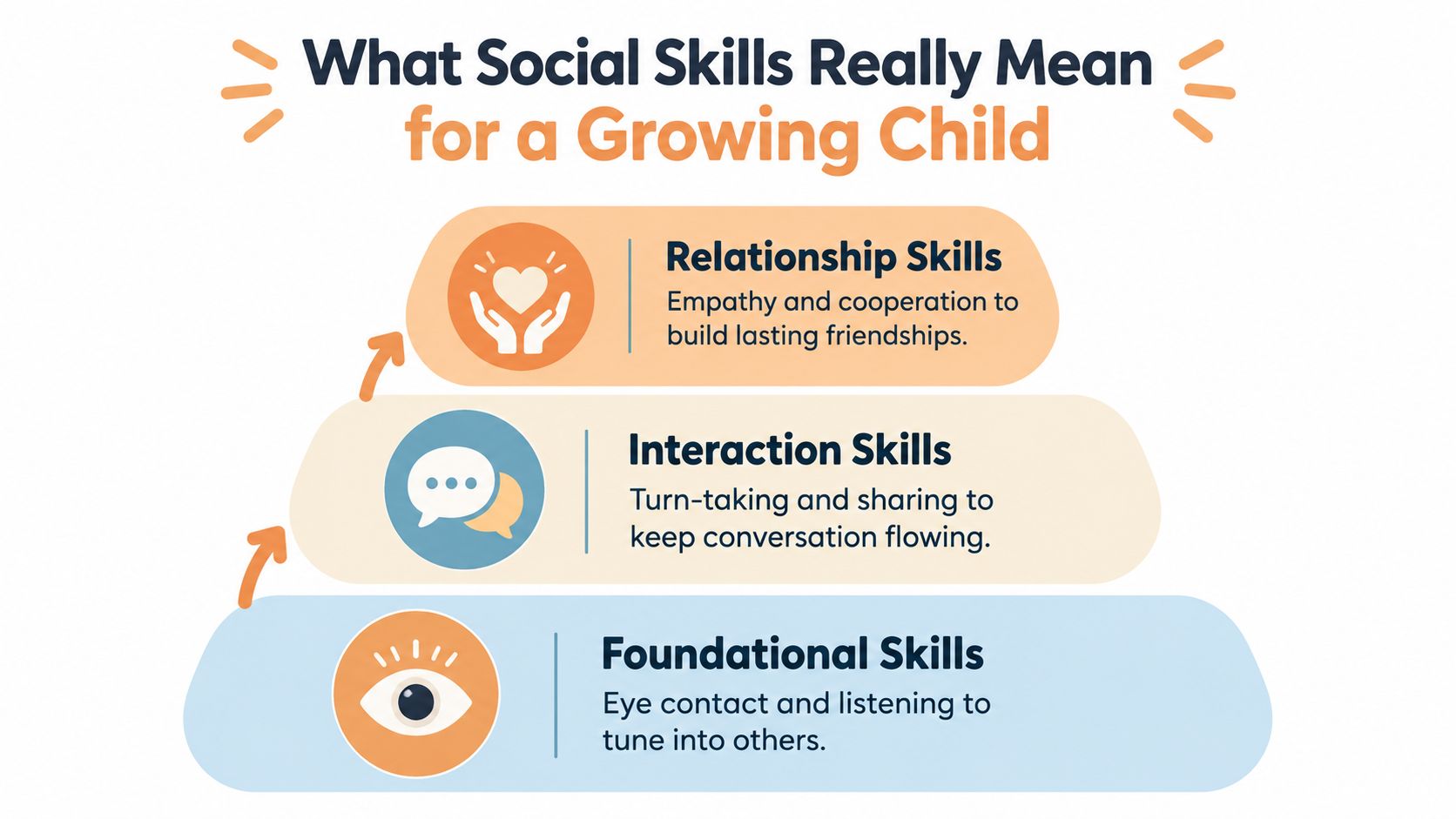
A useful way to understand them is to picture three connected layers. The layers overlap, and children may move back and forth depending on fatigue, sensory demands, familiarity, and the setting.
Foundational skills help children tune in
These are the early building blocks of social participation. They can include orienting toward a speaker, listening in a way that works for the child, noticing a partner's actions, waiting briefly, and taking a turn.
Eye contact isn't the only way to pay attention, and it shouldn't be treated as the sole measure of connection. A child may listen while looking elsewhere, using movement to stay regulated, or focusing on an object while still following what someone says. The practical question is whether the child can access and respond to information in a comfortable, functional way.
At snack time, a foundational skill might look like pausing while a sibling chooses a cracker. During a board game, it might mean waiting for the dice and watching whose turn comes next.
Interpretive skills help children make sense of people
Children also learn to recognize emotions, understand that another person may want something different, and adjust their response to the situation. A child may need support noticing that a friend's face, voice, or body indicates disappointment, even when the friend doesn't say, “I'm disappointed.”
Perspective-taking doesn't mean guessing perfectly. It can mean learning to ask, “Did that hurt?” or “Do you want a break?” When a parent says, “Your brother looks upset because the blocks fell,” the child hears social information connected to a real event.
Relational skills help relationships grow
The highest layer involves starting conversations, joining play, sharing interests, negotiating, setting boundaries, and repairing missteps. A child might learn to say, “Can I play too?” or offer an alternative when a friend says no.
These abilities develop over time, not on one fixed schedule. Temperament, communication style, developmental differences, past experiences, and access to welcoming peers all shape the learning process. Use the layers as a map for choosing support, not as a checklist for judging your child.
How Social Skills Shape School, Friendships, and Well-Being
Social skills act as practical support across a child's day. A child who can enter a group, follow the shared plan, or ask for clarification has more ways to participate in learning. A child who can communicate discomfort or request a break may have an easier time staying engaged when the classroom becomes busy.
The relationship between social and emotional skills and school outcomes is documented across education research. The OECD reports that higher levels of these skills are linked with greater achievement in mathematics, reading, and the arts, as well as lower rates of tardiness and skipping school. Task performance skills such as persistence and self-control, along with curiosity, show especially strong relationships with those outcomes in the OECD survey report on social and emotional skills.
A longitudinal study also found that teacher-rated social skills predicted academic performance two years later. In that study, a 1-unit increase in social skills was associated with a 0.220 increase in Norwegian achievement, after researchers controlled for prior achievement, age, cultural background, and gender, as reported in the longitudinal research study.
The ripple reaches beyond the classroom
Friendship gives children a place to practice flexibility, humor, negotiation, and recovery. A child who experiences a misunderstanding and then finds a way to reconnect learns that one difficult moment doesn't have to end a relationship.
Social and emotional skills also relate to well-being. The OECD describes cooperation, sociability, and stress resistance as competencies that support health, well-being, academic achievement, and job performance. One framework study found that these skills explained 26.6% of the variance in adolescents' health behavior, with a standardized effect of β = 0.375 and an indirect effect of 6.68% of the total effect through anxiety, as summarized by the OECD overview of social and emotional skills.
| Area of life | What strong social skills support | What the research shows |
|---|---|---|
| Classroom learning | Joining discussions, cooperating in groups, asking for help, and responding to teacher cues | Social and emotional skills connect with achievement, attendance, engagement, and motivation |
| Friendships | Sharing interests, negotiating play, repairing misunderstandings, and respecting boundaries | Social-skills groups for autistic children showed improvements in overall social competence and friendship quality in a Cochrane review |
| Emotional well-being | Expressing feelings, reducing isolation, and seeking support | Stronger social skills are associated with better well-being, while poor social skills are associated with stress and loneliness |
| Future participation | Communicating, collaborating, and adapting across settings | Jobs requiring high social interaction have become more common in the labor market |
The labor-market connection matters, too. In the United States, the share of jobs requiring high levels of social interaction rose by nearly 12 percentage points between 1980 and 2012. Workers who combined social and technical skills experienced a 7.2 percentage-point increase in available jobs and a 26% wage increase over that period, according to Pew Research Center's analysis of employment and social skills.
For school-based ideas and collaboration with educators, parents can also explore ABA support in schools. Social skills are not an optional extra added after academics. They're part of the infrastructure that helps a child learn, belong, advocate, and take part in daily life.
What Social Skill Challenges Can Look Like at Home and at School
A child's day can reveal social-learning needs without any single dramatic incident.
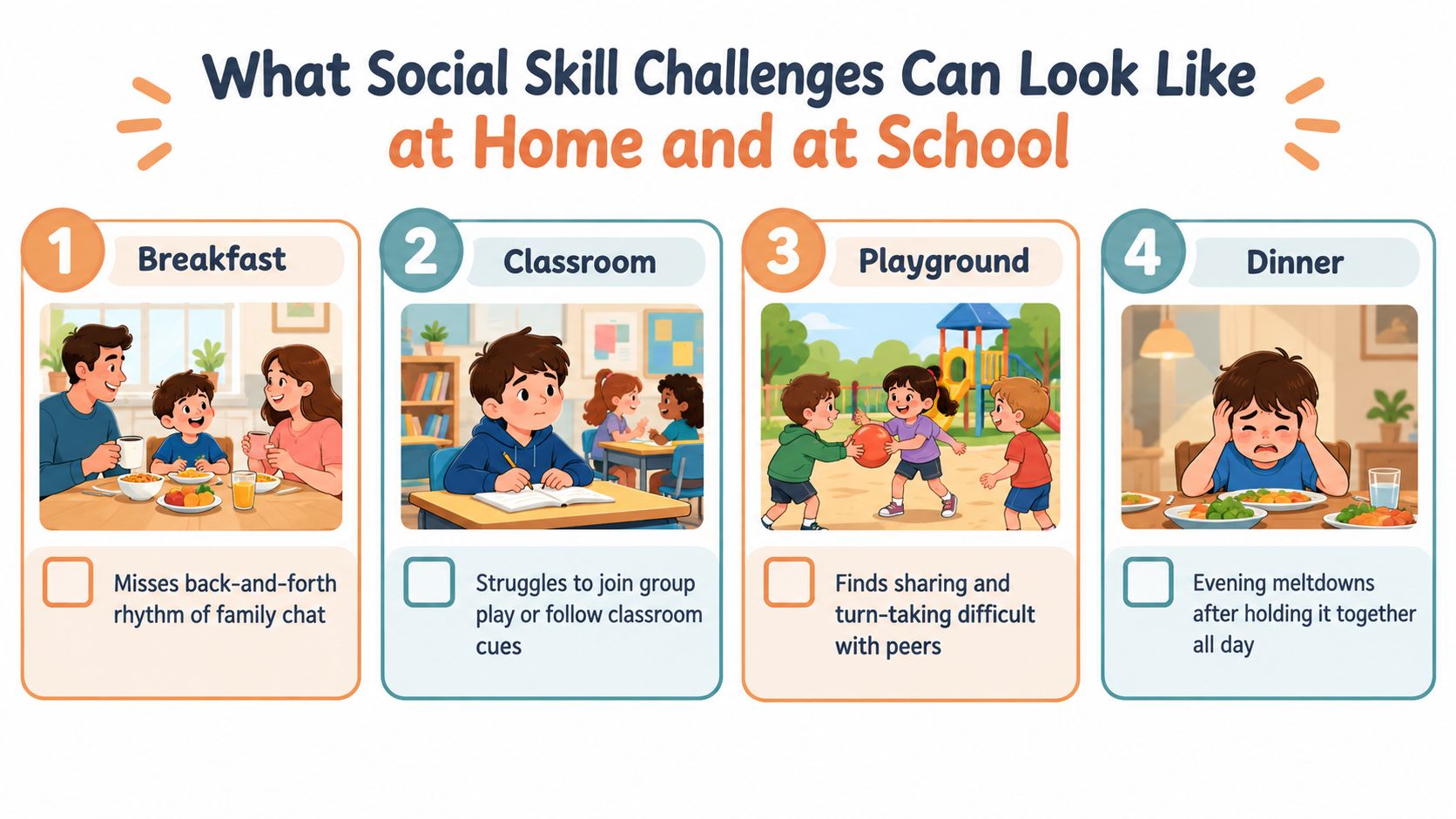
At breakfast, your child may answer a question with one word, continue talking about a preferred interest, or miss the back-and-forth rhythm of family conversation. Your child may not realize that a sibling has finished speaking, or may become upset when someone interrupts. These moments can reflect differences in timing, attention, language processing, or regulation rather than a lack of interest in family members.
At school, the challenge may be harder to see. Your child might understand the teacher's direct instructions but miss a classroom cue such as “find a partner.” During group work, your child may wait for someone else to assign a role, take over because the group's plan feels unclear, or leave when the activity changes.
A closer look at peer routines
On the playground, the noise and movement can make social information difficult to sort. Your child may watch a game from the edge, approach after the group has started, or become distressed when another child changes the rules. A child with autism may spend about 30% of recess alone compared with 9% for typical peers, according to a review available through Georgetown University's repository.
At a playdate, parallel play may be more comfortable than shared make-believe. Your child may want connection but lack a reliable way to suggest an activity, share materials, or respond when the other child says, “Let's do something else.” Teaching greetings, sharing, imitation, asking for help, and responding to conversation can increase the duration and frequency of peer interactions, as described in that same review.
Dinner may bring the effects home. A child who held everything together through school may melt down over a small request, retreat from conversation, or struggle to explain what went wrong. The behavior is communication, even when the message isn't immediately clear.
A short video can help families recognize social-learning moments in familiar routines.
Observation works best when it stays specific. Instead of writing “bad at friends,” note what happened before, what your child did, how peers responded, and what support helped. Those details give parents, teachers, and clinicians something useful to work with.
Why the Goal Is Real Connection, Not Performance
Many parents worry that social-skills therapy will teach their child to perform a set of memorized behaviors. That concern is reasonable, especially when goals focus too narrowly on eye contact, scripted greetings, sitting still, or saying the expected phrase without considering how the child feels.
Meaningful social development looks deeper than visible compliance. It may involve sharing a moment of excitement, showing another person an interesting object, tolerating a small change, asking for space, or returning to an activity after a misunderstanding. A child may communicate connection without using conventional eye contact or typical body language.
A rehearsed phrase can be useful when it gives a child a starting point. “Can I play?” may open a door at recess. But the larger aim is helping the child understand what to do when the peer says yes, says no, changes the game, or suggests a different activity.
What progress can look like
Success might mean your child:
- Communicates a preference: “I want cars,” “different game,” or “break.”
- Shares attention in a comfortable way: brings you a book, points to a dog, or notices a sibling's excitement.
- Handles a small mismatch: accepts that a friend chose another color or asks for a new turn.
- Repairs a difficult moment: returns after grabbing a toy, offers an apology in a meaningful form, or tries again.
- Builds self-advocacy: tells a teacher that the room is too loud or asks for an explanation.
The child's own interests should help shape intervention. If your child loves trains, train play can become a natural setting for turn-taking, commenting, requesting, and shared problem-solving. If your child prefers movement, a cooperative obstacle course may create more connection than a seated conversation practice.
Meaningful connection doesn't require a child to look, sound, or move like everyone else. It requires access to communication, choice, participation, and relationships that respect the child.
Families and schools can ask whether a goal improves the child's daily life. Does it help the child join an activity, make a request, understand a peer, recover from frustration, or feel safer expressing a boundary? Those questions keep social-skills programming connected to the child's strengths and real priorities.
How ABA and Social Skills Programming Support Growth
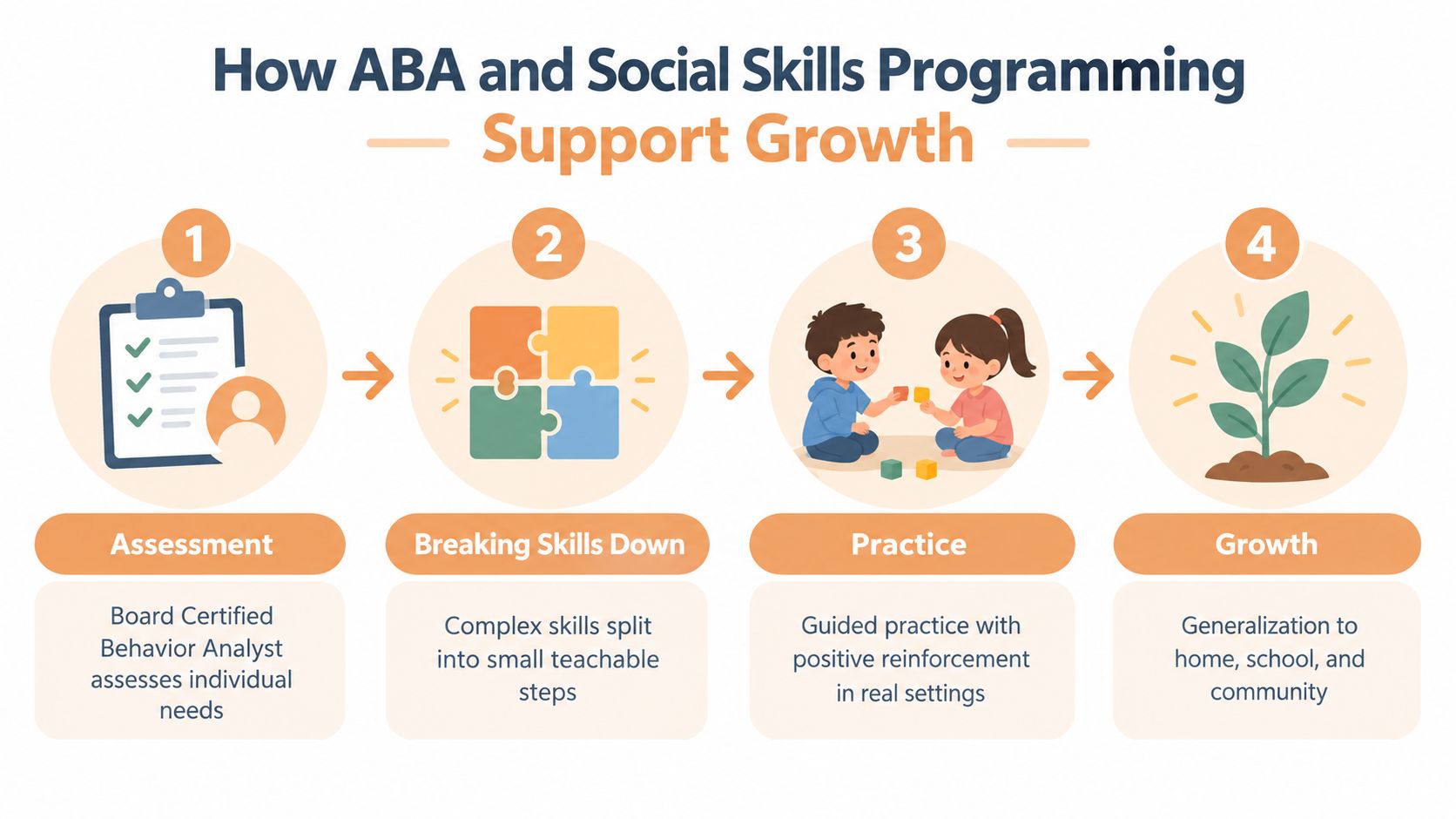
ABA, or Applied Behavior Analysis, is a way of understanding how skills develop and how adults can arrange practice so children have a better chance to use those skills. Social-skills programming should begin with the child, not with a generic list of behaviors.
A Board Certified Behavior Analyst may observe the child at home, school, or in community routines. The clinician looks at what happens before and after a social moment, what communication is already working, and which supports help the child participate. The family's priorities matter just as much. One family may want support with joining a game, while another may prioritize asking for help, tolerating a sibling's changes, or communicating during meals.
Skills become easier to learn when they're broken down
“Make a friend” is too broad to teach directly. A plan might begin with orienting toward a peer's activity, moving closer, using a preferred communication method to request a turn, waiting, and responding to the peer's answer.
Teaching may include modeling, role-play, visual supports, prompting, and positive reinforcement. The clinician might practice a turn-taking game at the table, then arrange a short activity with a sibling, and later help the child use the same skill with a peer.
The practice needs to reach beyond the therapy session. A child may learn to ask, “Can I play?” in a quiet role-play but need additional support using that request during a crowded recess. Parent coaching helps caregivers recognize opportunities, offer prompts that don't take over, and respond consistently when the child communicates.
Everyday practice supports flexible use
A strong program measures more than whether a child repeats a phrase. It looks at whether the child uses a skill with different people, in different places, and during naturally occurring activities. It also tracks whether the support can gradually fade as the child gains independence.
Research supports this practical focus. A randomized study of social-skills training for youth with autism found significant improvement on Vineland Socialization, a measure related to everyday adaptive functioning, with an effect size of Cohen's d = 0.39 for standard social-skills training and d = 0.43 when parent training was added. Treatment as usual showed no significant improvement in that study, as reported in the randomized study of social-skills training and parent training.
A Cochrane review of social-skills groups for children and young people ages 6 to 21 with autism found improvements in overall social competence, with an effect size of 0.47, and friendship quality, with an effect size of 0.41. One study also found a reduction in loneliness, with an effect size of -0.66, as summarized in the Cochrane evidence review.
These findings don't promise one identical result for every child. They show that structured support can produce measurable changes, especially when goals are functional, individualized, and practiced across real settings. Families comparing providers may look for individualized treatment planning, a dedicated care coordinator, regular progress check-ins, and proactive communication so home and clinical teams stay aligned. Friendly ABA Premier offers social-skills development alongside home-based ABA, school support, and parent coaching in its service areas, including Connecticut, Georgia, Maryland, Massachusetts, North Carolina, South Carolina, Virginia, and Washington. Parents can learn more about social skills development services.
Small Steps You Can Take This Week and Where to Go Next
Social learning doesn't require turning every family routine into a lesson. Short, warm moments often give children useful practice without making the interaction feel like work.
Try one small practice during an ordinary routine
During a sibling disagreement, narrate your own thinking: “You both want the blue truck. I'm going to pause, listen to each person, and find a plan.” Your child hears language for perspective-taking and problem-solving without being asked to solve the conflict immediately.
Before a playdate, preview the first few minutes. You might say, “We'll say hello, show your friend the blocks, and then choose whether to build or draw.” Keep the preview brief, and offer a visual or concrete choice if that helps your child prepare.
At bedtime, pause during a picture book and label what a character might feel. Rather than testing your child with “How does she feel?” you can model several possibilities: “Her tower fell. She might feel disappointed. She might need help or a new idea.”
At school pickup, ask two specific questions instead of “Did you play with anyone?” Try, “Who was near you at recess?” and “What game did you notice?” These questions can reveal social experiences without implying that your child must have made a friend that day.
Watch, share, and choose the next support
Keep a simple note for a week. Record the setting, the activity, the challenge, what your child communicated, and what helped. Look for patterns such as fatigue after school, easier interaction with familiar children, or stronger participation when an activity involves a preferred interest.
Bring those observations to your child's pediatrician, school team, or care team. You can ask the school about social-emotional screening, classroom supports, peer opportunities, and ways to communicate progress between home and school. If social learning feels stuck or daily routines remain difficult, an ABA evaluation may help identify practical goals and appropriate supports.
Parents often benefit from guidance that fits their actual household. Helping children navigate social situations with confidence can include preparation, modeling, visual supports, careful prompting, and noticing what your child already does well.
Social skills grow through repeated, respectful interaction. Your child doesn't need to master every social situation before participating in life. One shared game, one clear request, one repaired misunderstanding, and one supported conversation can become part of a larger pattern of connection.
Friendly ABA Premier provides individualized ABA therapy, social-skills development, school support, and parent coaching for children across Connecticut, Georgia, Maryland, Massachusetts, North Carolina, South Carolina, Virginia, and Washington. If you'd like a responsive care team with a dedicated care coordinator and proactive family communication, visit Friendly ABA Premier to schedule a consultation.
Our Latest Insights








Experience ABA Therapy with a More Personalized Level of Support
Discover how FriendlyABA Premier combines evidence-based ABA therapy with dedicated coordination, proactive communication, and individualized family support.