

ABA Therapy Preschool Programs: What Parents Should Know
Discover what ABA therapy preschool programs look like, how they support early learning, and what to expect. A reassuring guide for families exploring options.

You may be comparing preschool classrooms, calling insurance plans, and searching “ABA therapy preschool” late at night, all while wondering what your child's day would feel like. That uncertainty is understandable. A program should support development, but it also needs to fit your family's schedule, communicate clearly, and respect your child as an individual.
ABA-based preschool can help children build communication, social, play, and daily living skills through carefully planned learning opportunities. The right program isn't just the one offering the most therapy hours. It's the one that understands your child's strengths, partners with caregivers and educators, and makes progress visible in everyday life.
Table of Contents
Understanding ABA-Based Preschool Programs
After a recent autism diagnosis or developmental concern, many parents start with a basic question: What does ABA look like for a preschooler? One parent might picture a clinic room, a table, and a long series of drills. Another might worry that their child will be separated from peers or expected to behave in ways that feel unnatural.
A thoughtful ABA preschool program looks much more like early childhood learning with individualized support woven into the day. A therapist might help a child request a favorite toy during play, follow a short classroom routine, or ask for help when a puzzle piece doesn't fit. The teaching is intentional, but it can happen through play, movement, songs, snack, and shared activities.
Applied Behavior Analysis, or ABA, focuses on understanding how children learn and then creating supportive opportunities to build useful skills. In preschool, those skills often include expressing wants and needs, joining an activity, responding to a teacher, tolerating a small change, playing near or with peers, and becoming more independent during routines.
Learning without losing childhood
Quality care isn't about making a child sit still for the sake of sitting still. It's about finding a meaningful reason to participate. If a child loves bubbles, a therapist may use that interest to encourage requesting, waiting, or taking turns. If a child enjoys trains, the same play may become an opportunity to practice imitation, shared attention, and flexible play.
Early intensive ABA-based intervention has shown measurable developmental gains in higher-quality evidence syntheses. An individual-participant meta-analysis published in 2021 found that, after 2 years, children receiving early intensive ABA-based intervention improved by an average of 7.00 points on the Vineland Adaptive Behavior Scales, compared with comparators, with a 95% confidence interval of 1.95 to 12.06. The analysis also found a mean cognitive ability gain of 14.13 IQ points, with a 95% confidence interval of 9.16 to 19.10. These findings support the value of intensive early intervention during a period when language, adaptive behavior, and learning readiness are developing quickly, but they don't guarantee a particular result for any individual child. (2021 individual-participant meta-analysis)
A helpful question: “What will my child be learning during play, routines, and relationships?” tells you more than simply asking how many therapy hours are offered.
Families should also ask how the program defines success. A meaningful goal might be communicating a need with a picture, gesture, device, or words, depending on the child. It might be entering the classroom more comfortably, participating in a group activity, or washing hands with less support. The plan should be individualized, respectful, and reviewed with the people who know the child best.
How ABA Integrates with Early Childhood Education
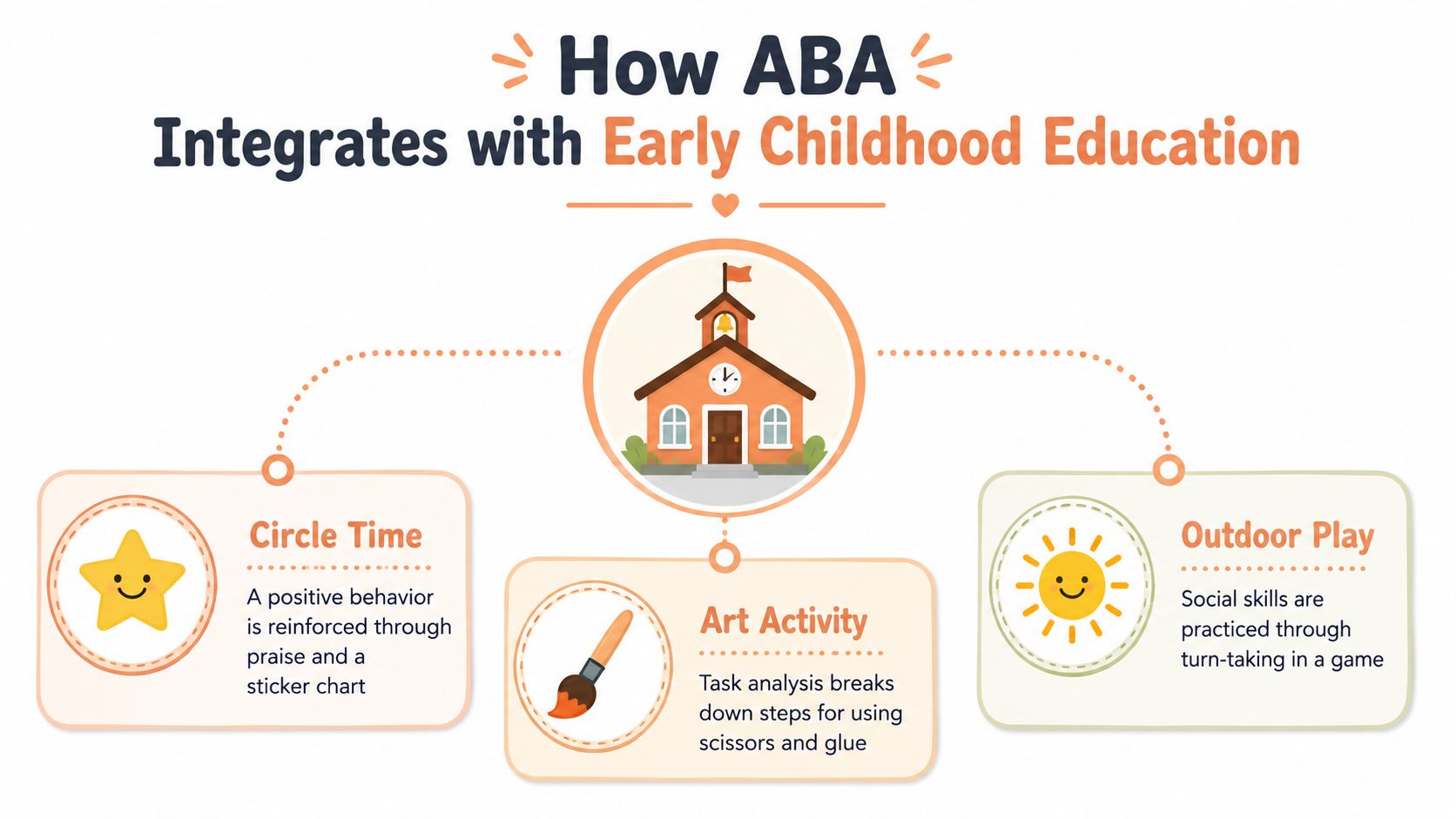
ABA preschool works best when therapy strengthens the child's participation in early education rather than replacing the experiences that make preschool valuable. Circle time, art, outdoor play, meals, and free-choice centers all offer natural moments to practice skills.
Start by looking at the routine, then identify the skill that would make participation easier.
Communication in ordinary moments
At snack, a therapist may arrange choices so a child has a reason to communicate. The child might point to crackers, use a communication device, sign, or say “more.” The adult responds to that communication and gradually supports clearer, more independent requests.
During a puzzle, the child can practice asking for help rather than abandoning the activity. During cleanup, the teacher can use a visual cue, a short direction, and praise for completing the first step. These small exchanges matter because children need communication skills across the entire day, not only during a planned session.
Social and play skills
Peer interaction often begins with manageable steps. A child might watch another child build with blocks, imitate a simple action, pass a toy, or wait briefly for a turn. On the playground, waiting for the slide can become practice with turn-taking, asking to join, and coping with the natural pace of a group.
Play support should preserve the child's interests while expanding possibilities. A therapist may join a child's preferred activity, follow their lead, and then introduce a shared action, such as rolling a ball back and forth or adding another piece to a pretend game.
Routines and independence
Preschool routines create repeated opportunities for adaptive skills. Children can practice carrying a lunchbox, opening a container, putting materials away, washing hands, and moving from one activity to another. Staff may break a routine into smaller steps, provide visual support, and reduce assistance as the child becomes more independent.
For families seeking a deeper look at classroom collaboration, ABA support in schools describes how individualized strategies can connect therapy and education. The key is coordination. Therapists, teachers, and caregivers should use compatible approaches and share observations about what helps the child participate.
What a Typical Day Looks Like in ABA Preschool
A preschool day should include structure without becoming monotonous. Children benefit from predictable routines, but they also need movement, choice, exploration, peer experiences, and opportunities to follow their interests.
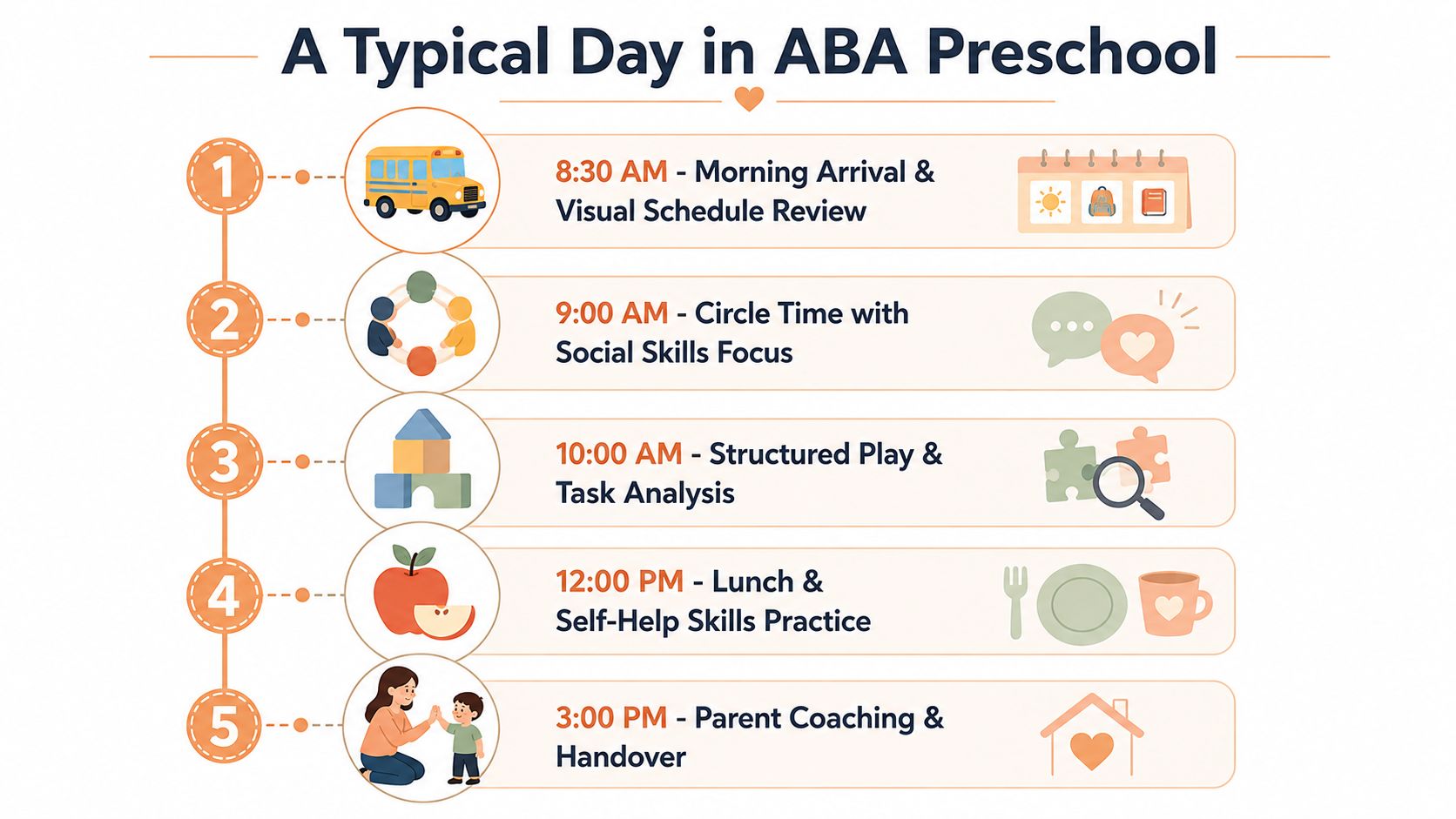
A typical day may begin with a warm greeting at arrival. Staff can help the child check a visual schedule, put belongings away, and choose a starting activity. This routine supports predictability and gives the team an early opportunity to observe communication, transitions, and regulation.
A balance of group and individualized learning
Circle time might include songs, movement, a story, or a greeting routine. Some children may need a seat nearby, a visual cue, a shorter participation goal, or an adult model. The purpose isn't identical behavior from every child. It's helping each child access the group experience in a way that fits their needs.
Learning stations can target communication, fine motor skills, matching, early academic readiness, play, or self-help. A child might work one-on-one with a therapist for part of an activity and then practice the same skill with a teacher or peer. This helps the skill move beyond a single adult or setting.
Outdoor play adds natural movement and social practice. Staff can support asking for a turn, waiting, joining a game, navigating space, and communicating discomfort. Snack and lunch can build independence through opening containers, using utensils, making choices, and cleaning up.
What happens during difficult moments
Transitions can be challenging for many young children. A responsive team may preview the change, use a timer or visual schedule, offer a simple choice, and acknowledge the child's communication. If the environment becomes overwhelming, staff should consider sensory needs, the pace of the routine, and whether the child has a reliable way to request a break.
Data collection should happen purposefully. Staff may record whether a child used a communication response, completed a routine step, or needed support during a transition. Those observations help the clinical team adjust goals. They shouldn't turn the classroom into a place where a child feels watched every second.
The day should still contain laughter, curiosity, and unplanned discoveries. Therapy is woven into childhood activities, not treated as a substitute for childhood.
Evaluating Different ABA Preschool Options
Families may encounter several program models, and the names can sound similar even when the daily experience differs. A center-based ABA preschool may provide intensive services in a specialized setting. A public preschool may offer classroom supports with consultation from behavior professionals. A hybrid plan may combine a community preschool with ABA sessions at another time or location.
| Program Type | Typical Structure | Key Considerations |
|---|---|---|
| Center-based ABA preschool | Therapy and early learning occur in a specialized center with individualized support throughout the day | Ask how the program includes peer interaction, play, family communication, and transition planning |
| Public school preschool with ABA consultation | The child participates in a public early education setting with supports described in the educational plan and consultation from specialists | Ask how classroom staff and outside providers coordinate, and how goals are measured |
| Hybrid preschool and ABA model | The child divides time between a traditional preschool setting and separate ABA services | Ask who shares information, how schedules fit together, and whether skills are practiced across both environments |
Questions worth asking during a tour
- Individualization: How are goals chosen, and how does the team incorporate my child's interests, communication style, and sensory preferences?
- Staff preparation: Who supervises the program, who works directly with children, and how do team members receive guidance?
- Family communication: How will I hear about progress, difficult moments, schedule changes, and decisions about treatment?
- Classroom access: Will my child participate in art, music, outdoor play, meals, and peer activities, or spend most of the day apart?
- Progress review: What information will the team share, and how will we decide whether a goal needs to change?
- Transitions: How will the program prepare my child for kindergarten, a new classroom, or a different service model?
Intensity deserves careful discussion. Early intensive ABA or EIBI is commonly delivered at about 20 to 40 hours per week over 2 to 3 years, and systematic-review evidence associates that dosage with gains in adaptive behavior, IQ, and language compared with treatment as usual. The same reviews report inconsistent effects on core autism symptoms and note that overall study quality is often low, so more hours don't automatically mean better care. (systematic review of early intensive ABA and EIBI)
A strong provider will discuss fit, not just volume. Your child's needs, family schedule, transportation, available coverage, and the quality of the teaching relationship all matter.
The Role of Parent Involvement and Coaching
Parents don't need to become therapists to support learning at home. They do need a clear understanding of what their child is practicing, why the skill matters, and how to respond consistently during ordinary routines.
Caregiver coaching might begin with observation. A therapist demonstrates how to offer a choice, wait for a response, prompt only as much as needed, and reinforce communication. Then the parent practices while the therapist offers feedback. The conversation can focus on a real challenge, such as leaving the playground, getting dressed, or asking for a preferred snack.

Small routines carry skills a long way
A child who practices requesting during therapy can use the same communication system at home during breakfast. A child working on turn-taking can practice with a sibling, a caregiver, or a familiar game. The goal is generalization, meaning the child can use a skill with different people and in different settings.
The parent coaching service can be one part of a broader plan that connects clinical goals with family routines. Nationwide Children's behavioral intervention program describes caregiver coaching, ongoing training for caregivers and providers, and school consultation that can support individual, classroom, and building-wide needs. (Nationwide Children's behavioral intervention program)
Seattle Children's ABA early intervention program also uses a weekly parent education group to teach practical skills through play and common routines, address challenging behaviors, and help families understand available public services. (Seattle Children's ABA early intervention program)
Coaching should feel achievable
Parents may worry they'll use the wrong prompt or miss an opportunity. A supportive program won't expect perfection. It will help you choose one routine, practice a manageable strategy, and adjust it when real life gets messy.
The Association for Science in Autism and Treatment describes parent training as a way for caregivers to take an active role and extend learning across everyday environments. (ASAT parent training guidance)
Ask whether coaching is scheduled, individualized, and connected to your priorities. Regular communication should include more than a daily summary. It should help you understand what your child is learning and how the adults around them can work as a team.
Addressing Common Concerns and Practical Barriers
A program can be clinically appropriate and still leave a family struggling to make the schedule work. Preschool ABA may not cover early mornings, after-school hours, holidays, or summer breaks. Independent coverage notes that families using IDEA preschool and center-based ABA may still need private wraparound care, which can cost roughly $800 to $1,800 per month. (childcare coverage gaps for children with autism)
Access can also take time. A 2026 projection cited in industry reporting estimates a 288,000-BCBA shortage in the United States, while a national survey found 61% of autism centers had waits longer than four months, with 15% reporting waits over a year or closed intake lists. (BCBA shortage and autism service access reporting)
Practical rule: Ask about the waitlist, assessment date, authorization process, staffing, and expected start date in the first conversation.
While waiting, families can ask the pediatrician, school district, early intervention team, or prospective provider about interim supports. Keep a record of referrals, calls, documents, and questions. If a service becomes available sooner elsewhere, you can compare the full arrangement rather than focusing only on the earliest opening.
Coverage varies by plan and location. Medicaid's ABA toolkit states that CMS doesn't endorse or require one autism treatment modality, including ABA, and notes that EPSDT coverage doesn't require a specific diagnosis for services. (Medicaid ABA services toolkit) Ask your insurer and provider to explain eligibility, authorization, covered settings, family cost-sharing, and what happens if requested hours change. For a practical discussion of financial questions, see how much ABA therapy costs.
ABA also isn't limited to reducing behavior adults find difficult. A respectful program teaches communication, independence, play, and coping skills, while considering the reason a child is struggling and honoring individual differences. Families should feel comfortable asking whether goals support participation and quality of life, not just quiet or compliance.
Taking Your Next Steps with Confidence
Start by contacting more than one program if you can. Ask about the initial ABA assessment, wait times, staffing, family coaching, school coordination, insurance, and the practical hours your child would receive.
Gather your child's developmental history, diagnostic or referral documents, insurance information, current school records, and examples of strengths and challenges at home. During an assessment, your child may be observed through play, routines, communication attempts, and interactions. You can help by sharing what motivates your child, what feels overwhelming, and what goals matter most to your family.
You're allowed to reassess. A program should welcome questions, explain decisions, and adjust the plan when your child's needs or family circumstances change. Trust your knowledge of your child, and include your pediatrician, educators, and care team when you need another perspective.
Friendly ABA Premier offers individualized ABA support, parent coaching, social skills development, home-based therapy, and school support across Connecticut, Georgia, Maryland, Massachusetts, North Carolina, South Carolina, Virginia, and Washington. Families receive a dedicated care coordinator, scheduled progress check-ins, and proactive communication as part of a collaborative care model. Visit Friendly ABA Premier to start a conversation about preschool support that fits your child and your family's everyday life.
Our Latest Insights






























Experience ABA Therapy with a More Personalized Level of Support
Discover how FriendlyABA Premier combines evidence-based ABA therapy with dedicated coordination, proactive communication, and individualized family support.