

Center Based ABA Therapy: A Parent's Guide
Explore center based ABA therapy vs. in-home and school options. Learn what to expect, compare settings, and find the best fit for your child's growth.

You may be sitting at the kitchen table with a referral in one hand and a dozen browser tabs open in the other. One provider describes a bright therapy center, another offers sessions at home, and your child's school is already talking about classroom support. It's a lot to sort through, especially when you're trying to make a thoughtful decision without knowing exactly what a typical day of ABA looks like.
Center based ABA therapy can offer structure, peer practice, specialized materials, and close clinical teamwork. But it isn't automatically the right choice for every child or family. The best setting depends on your child's goals, learning style, daily routines, transportation, school schedule, and the kind of support your family can use consistently.
Table of Contents
- Choosing the Right Therapy Setting for Your Child
- A typical day in the center
- Why the structure matters
- How parents stay involved
Choosing the Right Therapy Setting for Your Child
A parent I once spoke with described the decision this way: her child communicated well during favorite games but became overwhelmed by transitions, group activities, and unfamiliar places. She wondered whether therapy should happen at home, where her child felt safest, or in a center, where there might be more opportunities to practice with other children.
That question has no universal answer. A therapy setting should serve your child's goals, not define them. Some children benefit from practicing requests and routines in the kitchen. Others are ready for a predictable center environment where they can work on communication, play, transitions, and peer interaction with a consistent clinical team. School-based support may be especially useful when classroom participation or educational routines are the immediate concern.
A good provider will ask about more than diagnosis or availability. The team should want to understand what mornings look like, how your child handles changes, what happens during meals, which activities spark interest, and where your family needs practical support. Those details help clinicians build an individualized plan rather than placing every child into the same schedule.
A helpful starting point: Choose the setting that makes meaningful practice possible across your child's real day.
You also shouldn't have to interpret every treatment update alone. A dedicated care coordinator can help organize communication between your family, clinicians, and other support systems, while scheduled check-ins give you a clear place to discuss progress, concerns, and changing priorities. The goal is a partnership that feels manageable, responsive, and connected to home life.
What Center Based ABA Therapy Actually Looks Like
A center-based program usually takes place in a setting designed for learning, movement, play, and small-group practice. It may include individual therapy spaces, activity areas, materials for communication and daily living skills, and quieter places where a child can regroup. The environment should feel welcoming and purposeful, not like a series of tests.

A typical day in the center
At drop-off, a behavior technician may help your child enter the building, put belongings away, and move into the first activity. These transitions can become learning opportunities. A child might practice greeting a familiar adult, requesting a preferred toy, checking a visual schedule, or asking for help.
The BCBA, or Board Certified Behavior Analyst, develops and oversees the treatment plan. Behavior technicians carry out many teaching activities and record information about how your child responds. The BCBA reviews that information, observes sessions, coaches staff, and adjusts goals when the current approach isn't helping your child learn comfortably.
Teaching often happens through play and ordinary routines. During snack, your child might practice requesting a food or opening a container. During a board game, the therapist may support turn-taking, waiting, coping with a change, or using a communication system. A transition from a play area to a table can become practice for following a direction and moving between activities.
Why the structure matters
A center can make it easier for the team to keep materials, teaching language, and expectations consistent. It can also provide planned opportunities for peer interaction, such as playing alongside another child, joining a group activity, or practicing how to enter a game.
ABA became a distinct discipline when the first volume of the Journal of Applied Behavior Analysis published its defining paper in 1968, a milestone described in this history of ABA and autism services. That history helps explain why modern programs often use observable goals, ongoing data collection, and systematic teaching. It doesn't mean every program looks the same, or that a structured setting should replace a child's ordinary childhood experiences.
How parents stay involved
Parent training may happen during scheduled meetings, observation opportunities, or coaching woven into regular communication. You might learn how to support a request during breakfast, prepare for a grocery-store transition, or respond consistently when your child needs a break.
Ask how often the team will share updates and what those updates will include. A useful report should connect therapy goals to daily life, such as communicating during meals, participating in play, managing dressing steps, or moving through a school routine.
Comparing Center-Based, In-Home, and School-Based ABA
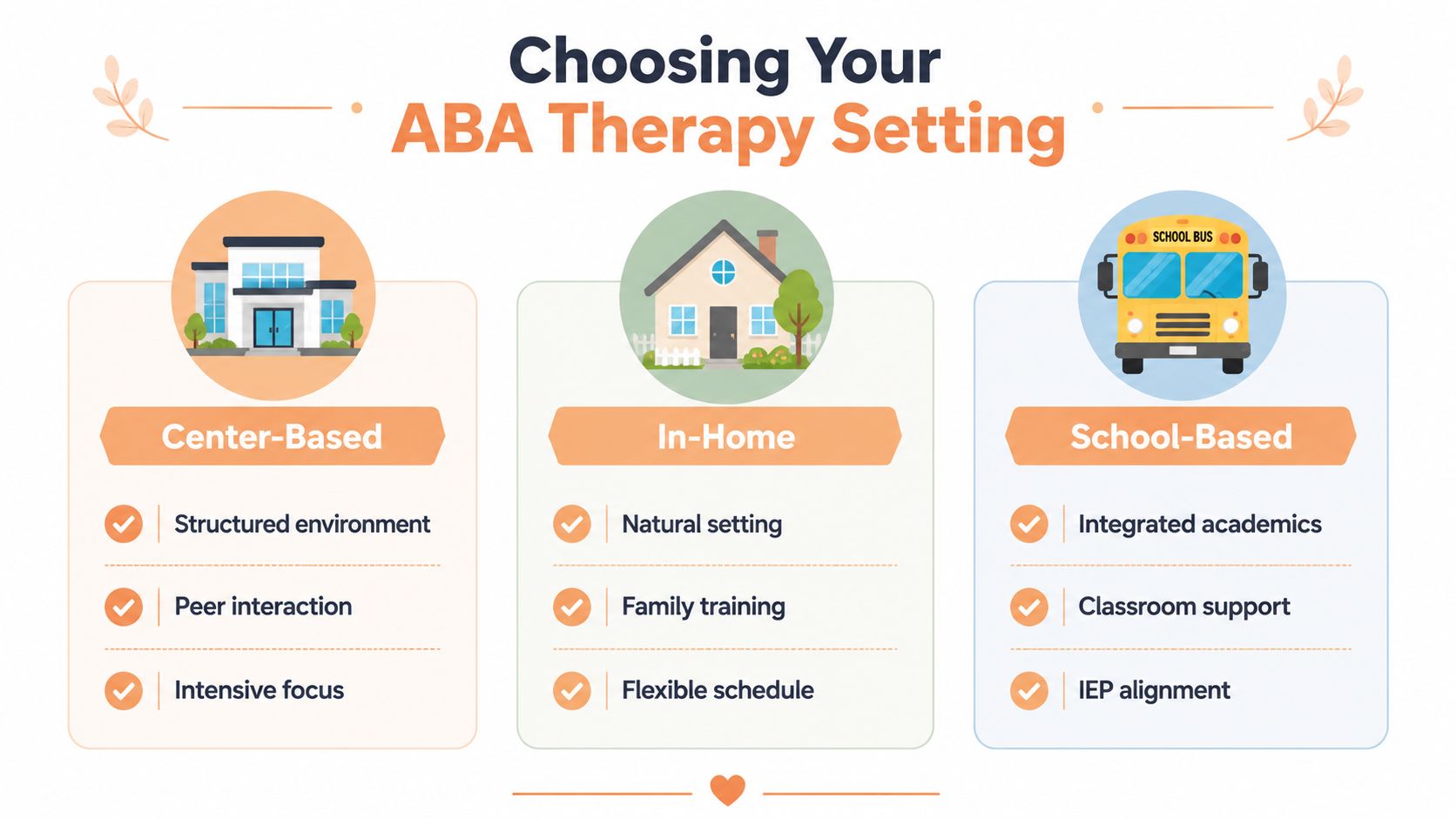
Parents often compare settings by asking, “Which one works better?” A more useful question is, “Where does my child most need practice right now?” A center may offer peer opportunities and concentrated clinical oversight. Home sessions can address routines exactly where they happen. School-based support can connect goals to classroom participation and educational plans.
| Decision Factor | Center-Based ABA | In-Home ABA | School-Based Support |
|---|---|---|---|
| Primary environment | A structured clinic designed for learning and therapy | The child's familiar home and family routines | The classroom, playground, and school day |
| Generalization | Skills must be intentionally carried into home and community life | Skills are practiced directly in everyday routines | Skills are practiced in educational and peer settings |
| Peer practice | Often built into planned group or shared activities | Depends on siblings, visitors, or community opportunities | Naturally connected to classmates and school routines |
| Family schedule | Requires travel and coordination with center hours | May fit more easily into home routines | Follows the school day and educational schedule |
| Clinical supervision | Team members can observe and collaborate within the center | Supervisors visit the home and review implementation | Collaboration includes school staff and the clinical team |
| Parent coaching | May happen through meetings, observation, and home-practice plans | Takes place directly during family routines | Focuses on carrying strategies across school and home |
| Best fit may include | Children working on foundational skills, transitions, social learning, or structured practice | Families targeting mealtimes, dressing, toileting, play, or home safety | Children needing help with classroom participation, communication, or peer interaction |
Generalization is the part families should question
A child may learn to request a snack in a center but need support using that skill at home. The clinical team should plan for this transfer from the beginning. Ask how staff will help your child use communication, play, and independence skills at home, in the community, and at school.
For families considering therapy in the home, home-based ABA therapy can make family routines the teaching environment. That may be useful when the central goals involve getting dressed, eating, playing with siblings, or handling transitions between rooms.
Schedule and relationships matter
A center can provide a predictable rhythm, but transportation and travel may place pressure on work, siblings, or school schedules. In-home services may reduce travel while requiring the household to prepare a workable therapy space. School-based support can reduce separation from classmates, though the provider must coordinate carefully with educators and the child's educational plan.
No setting works well without communication. During a tour or consultation, ask who will contact you, how concerns are escalated, whether parents can observe or participate, and how the team coordinates with school staff and other providers.
When a Center Setting Often Leads to Faster Skill Growth
A child who struggles to learn a new skill during a busy home routine may make progress in a center with consistent materials, predictable steps, close supervision, and planned practice. That structure can help some children learn efficiently, but the test is whether the skill travels home with them. Families should ask how the team will connect center practice to mornings, meals, errands, play, and other ordinary moments.
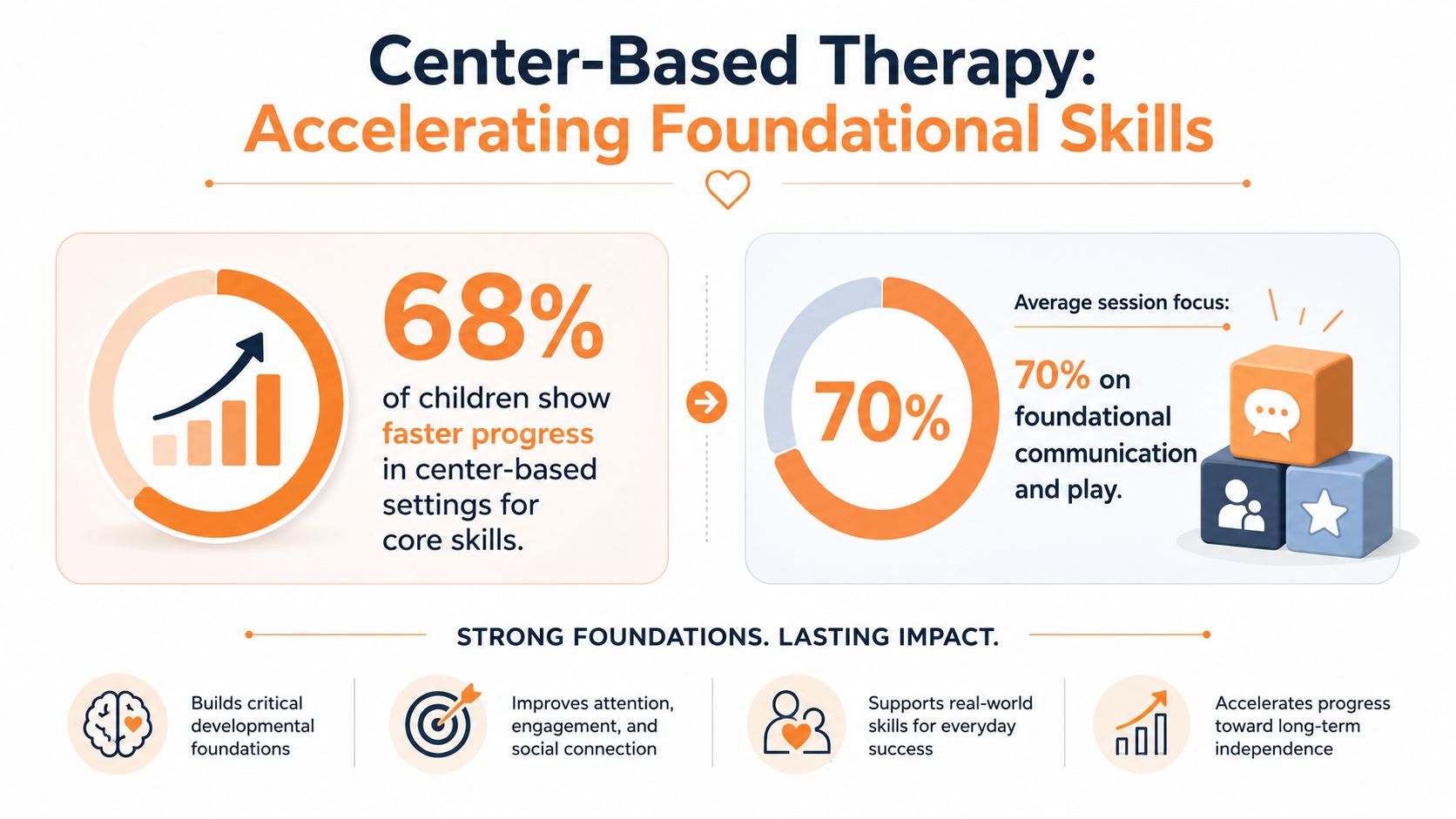
A 2017 evaluation of 313 children receiving ABA associated center-based services with stronger learning rates than home-based services. Children in the center-based group mastered more learning objectives per hour, with reported averages of M = 0.103 compared with M = 0.053. Among children who received both formats, mastery was reported as 100% higher per hour in the center than at home. The published evaluation of center-based and home-based ABA describes an association, not a guaranteed result for every child.
Why a center may support concentrated learning
In that evaluation, the center-based group received an average of 16.97 weekly treatment hours across an average age of 6.68 years. The home-based group received 13.46 weekly hours across an average age of 7.22 years. Differences in setting, treatment hours, and group characteristics affect how families should interpret the comparison.
A center gives staff a stable place to organize teaching materials and observe learning across activities. A child might practice asking for help at a table, then use that communication skill during play, a group activity, or a transition. Peer opportunities can support turn-taking, shared attention, conversation, and flexible play. Ask how the team will help the child use these skills with parents, siblings, teachers, and unfamiliar people, rather than only with clinic staff.
Center routines may also support goals related to safety. A longitudinal report from a large ABA provider described an 86% reduction in unsafe behavior, including aggression, self-injury, elopement, and property destruction, along with a nearly 20% reduction in treatment dosage over time. The reported center-based early-intervention findings are provider-reported evidence, so families should not treat them as an expected outcome for every child.
Intensity should leave room for childhood
Schedules differ by child and program. ABA programs often involve 30 to 40 hours per week, while focused ABA generally involves 10 to 25 hours of direct treatment per week, plus clinical direction and caregiver training, according to the ABA model coverage policy. The Medicaid ABA toolkit describes an individualized range of 5 to 40 hours per week.
More scheduled therapy does not automatically mean better progress. Children also need time for eating, toileting, napping, family connection, school, and unplanned play. Medicaid guidance notes that 40 hours of ABA per week is not a best practice when treatment crowds out daily routines, as described in this summary of the federal guidance. Ask the care team why the proposed schedule fits your child, how it affects family routines, and when they will review or adjust it.
How Therapy Setting Shapes Family Life and Long-Term Progress
A child may use a picture card successfully in a therapy room, then struggle to use it at breakfast or on the playground. The goal is for that skill to work with different people, materials, places, and routines. Generalization means using a learned skill across everyday situations, not only where it was first taught.
A center can provide a steady starting point, with prepared materials and consistent practice. Families still need a clear bridge into home and community life. A child might first use a picture card to request a preferred activity during center play, then use it at home, ask for a turn at the playground, or request a break during an outing.
The family routine is part of the treatment plan
Ask the team to connect goals with moments your family already handles each day. If mornings are difficult, coaching can focus on dressing, breakfast, and leaving the house. If meals create stress, the plan might address communication, sitting with family, manageable steps, and requesting help. If siblings find it hard to join play, clinicians can help adults create simple, positive opportunities for shared activities.
Parent coaching should feel practical, not like a test. You should learn what to try, why it may help, and how to adjust it when your child is tired, the schedule changes, or family preferences differ. Share your household's culture, energy, and routines so the plan fits the people expected to use it.
Communication protects the partnership
Families need more than occasional updates that therapy is going well. Ask for clear descriptions of current goals, examples of progress, explanations for changes, and a reliable way to raise concerns between scheduled meetings. A care coordinator can help connect parents, clinicians, and other adults supporting the child.
Center-based therapy may also require communication with school staff. Discuss how clinical goals relate to classroom participation, and use ABA support in schools to consider ways information can travel between settings. The school has its own role and routines, so the therapy team should coordinate respectfully rather than assume one setting can address every challenge.

A sustainable plan leaves room for meals, rest, friendships, play, and community life. If the schedule keeps your household rushed, tell the team. Family capacity is useful treatment information, and a workable plan should support progress without taking over the whole day.
A Practical Way to Choose the Right ABA Setting
Start with your child's current priorities. Write down the situations that matter most, such as requesting needs, joining play, tolerating transitions, participating in school, or completing self-care steps. Then note where those challenges happen most often.
Ask four practical questions
Where does learning need to happen first? If the main concern is getting through the morning routine, home-based support may offer direct practice. If peer interaction is the priority, a center or school setting may provide more natural opportunities.
What environment helps my child participate? Consider noise, movement, unfamiliar adults, transitions, and preferred activities. A center can offer structure and specialized spaces, while home may feel more familiar and easier to adjust.
What can our family sustain? Look at travel, work, siblings, meals, sleep, school, and caregiver availability. A clinically appropriate plan still needs to fit real life.
How will progress travel across settings? Ask for specific examples. “How will my child use this communication skill at home?” is more useful than a general promise to support generalization.
Evaluate the provider, not just the building
During a consultation or tour, ask who supervises sessions, how staff are trained, how goals are selected, and what happens when progress slows. Find out how parents receive updates and whether caregiver training includes practice with your actual routines.
A personalized program should be able to explain your child's goals in everyday language. It should also show how clinicians use observations and treatment information to make decisions, rather than following a fixed checklist for every child.
For questions about the assessment process, review what to expect during your first ABA assessment. You can bring your notes to a consultation and ask the care team to compare center-based, in-home, and school-based options without pressure.
Friendly ABA Premier offers individualized ABA therapy, home-based services, social skills development, school support, and parent coaching across Connecticut, Georgia, Maryland, Massachusetts, North Carolina, South Carolina, Virginia, and Washington. Families can ask whether its care coordination and communication model fits their needs.
Answers to Common Questions About Center Based ABA Therapy
How soon will I see progress? Every child's pace is different. Ask the team which early signs they'll monitor, such as more consistent communication, smoother transitions, or greater participation in play.
Can center therapy work with school support? It can, when providers and educators communicate clearly about goals, routines, and responsibilities. Ask who will coordinate those conversations.
What happens after a difficult day? A caring team should look at what made participation hard, adjust support, and tell you what they noticed. Your child shouldn't be treated as a problem because one session was challenging.
How will I stay informed? Ask about progress notes, scheduled check-ins, caregiver training, and who to contact with questions. A care coordinator can help keep communication organized.
Uncertainty is normal. A conversation with a care coordinator can help you connect your child's strengths, needs, and family routines to a realistic therapy setting.
Friendly ABA Premier offers individualized center, home, and school support with parent coaching, scheduled progress check-ins, and a dedicated care coordinator to help connect therapy with daily life. Visit Friendly ABA Premier to start a conversation about the setting and support that may fit your family.
Our Latest Insights









































Experience ABA Therapy with a More Personalized Level of Support
Discover how FriendlyABA Premier combines evidence-based ABA therapy with dedicated coordination, proactive communication, and individualized family support.