

Best Autism Therapy Near Me How to Choose with Confidence
Searching best autism therapy near me? Compare home, clinic and telehealth options, quality signs and a checklist to find in-network care with confidence.


You've made dinner, helped with homework, and finally have a quiet moment to search “best autism therapy near me.” The results bring clinic names, therapy models, insurance questions, and waitlists, but not always a clear answer about what would fit your child's actual life.
The best choice usually isn't one universally “best” provider. It's a service that understands your child's communication, play, mealtime, school, and independence goals, then works with your family to support those goals consistently. This guide will help you compare therapy settings, recognize meaningful quality signals, ask better insurance and waitlist questions, and choose your next step with less guesswork.
Table of Contents
- Finding the Best Fit When You Search Best Autism Therapy Near Me
- Evidence and individualized planning
- Look for a plan built around your child
- Ask how communication works
- Follow the data
- Check measurement reliability
Finding the Best Fit When You Search Best Autism Therapy Near Me
A parent might search for help after noticing that mornings have become difficult. Getting dressed takes much longer than expected, a child becomes distressed when breakfast changes, or a teacher reports that joining group activities is hard. Another family may be looking for support with communication because their child reaches or cries instead of asking for a favorite snack or toy.
Those situations call for different starting points. A provider that's convenient but rarely communicates with caregivers may not be the right fit for a family that needs coaching at home. A clinic with excellent play spaces may be useful for peer interaction, while home-based support may make more sense when the priority is toothbrushing, dressing, meals, or transitions between routines.
| What to compare | Questions to ask | Why it matters |
|---|---|---|
| Treatment goals | Will goals reflect our child's strengths, needs, and daily routines? | Therapy should address meaningful skills, not a standard checklist. |
| Service setting | Can support happen at home, school, in a clinic, or through telehealth when appropriate? | The setting affects how easily skills carry into everyday life. |
| Family partnership | What does parent coaching look like between sessions? | Caregiver involvement helps strategies become usable outside therapy. |
| Progress tracking | What data will be collected, and how often will we review it? | Clear measurement helps the team adjust support responsibly. |
| Access and logistics | How long is the wait, and can authorization begin during that time? | A transparent process helps families plan instead of waiting without information. |
You don't need to understand every clinical term before making an inquiry. Start by describing one or two routines that matter most. For example, you might say, “We'd like our child to request help during meals,” or, “We want school mornings to feel less overwhelming.”
A useful reframe: Don't ask only, “Who offers the most therapy?” Ask, “Who will understand our priorities, communicate clearly, and help us use skills in real life?”
A strong first conversation should leave you with practical information, not pressure. You should know who will coordinate care, how goals are chosen, what parent participation involves, and what happens if your child's needs or schedule change.
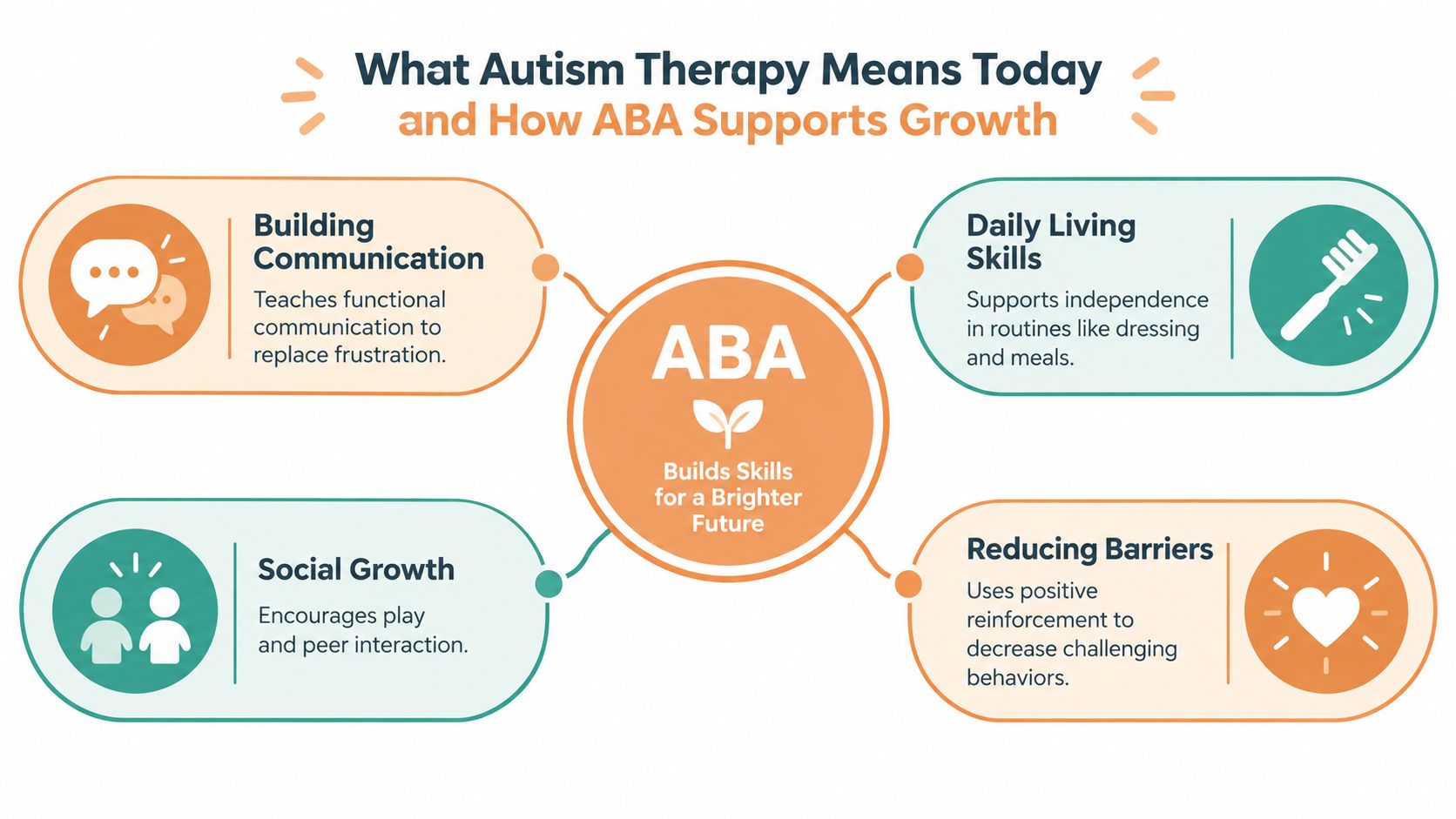
What Autism Therapy Means Today and How ABA Supports Growth
Applied Behavior Analysis, or ABA, is a structured way to understand how a child learns and to teach useful skills through individualized support. Modern ABA can address communication, social interaction, daily living, learning readiness, and independence. It may also reduce barriers that make it harder for a child to participate safely and comfortably in family, school, or community routines.
For example, a plan might teach a child to request a break instead of leaving the table, follow a visual routine for getting dressed, take turns during a simple game, or ask for assistance when a toy is difficult to use. The goal isn't to make every child behave the same way. The goal is to build communication and participation in ways that respect the child and support the family's priorities.
Autism recognition has changed substantially over time. Leo Kanner's 1943 clinical description helped establish autism as a distinct condition, autism first appeared as its own psychiatric diagnosis in DSM-III in 1980, and the CDC's latest estimate identified autism in about 1 in 31 children aged 8 years, or 3.2%, in the United States. These historical facts are summarized in the CDC's autism data and research information.
More families are therefore entering therapy systems earlier and looking for individualized support. Many communities now have a larger network of providers, but families may also encounter insurance complexity, uneven availability, and long waits. That makes responsiveness and care coordination important parts of your comparison, not minor administrative details.
Evidence and individualized planning
ABA remains one of the most studied autism interventions. A 2025 mixed-methods systematic review and meta-analysis reported that 16 randomized controlled trials found positive effects across adaptive behavior, daily living skills, socialization, expressive and receptive language, joint attention, and autism symptom severity, as described in the published systematic review.
The same review cautioned that many studies had a high risk of bias and that evidence quality differed by outcome. It reported moderate certainty for language skills and low or very low certainty for several other endpoints. For families, the practical message is balanced: structured behavioral intervention can be valuable, but the quality of assessment, planning, implementation, and family engagement matters.
ABA isn't a cure, and no ethical provider should promise a guaranteed result. A responsible team should discuss goals in everyday terms, explain how progress will be measured, and invite you to share what works during meals, play, bedtime, and school routines. You can also read this plain-language guide to understanding ABA therapy before an intake call.
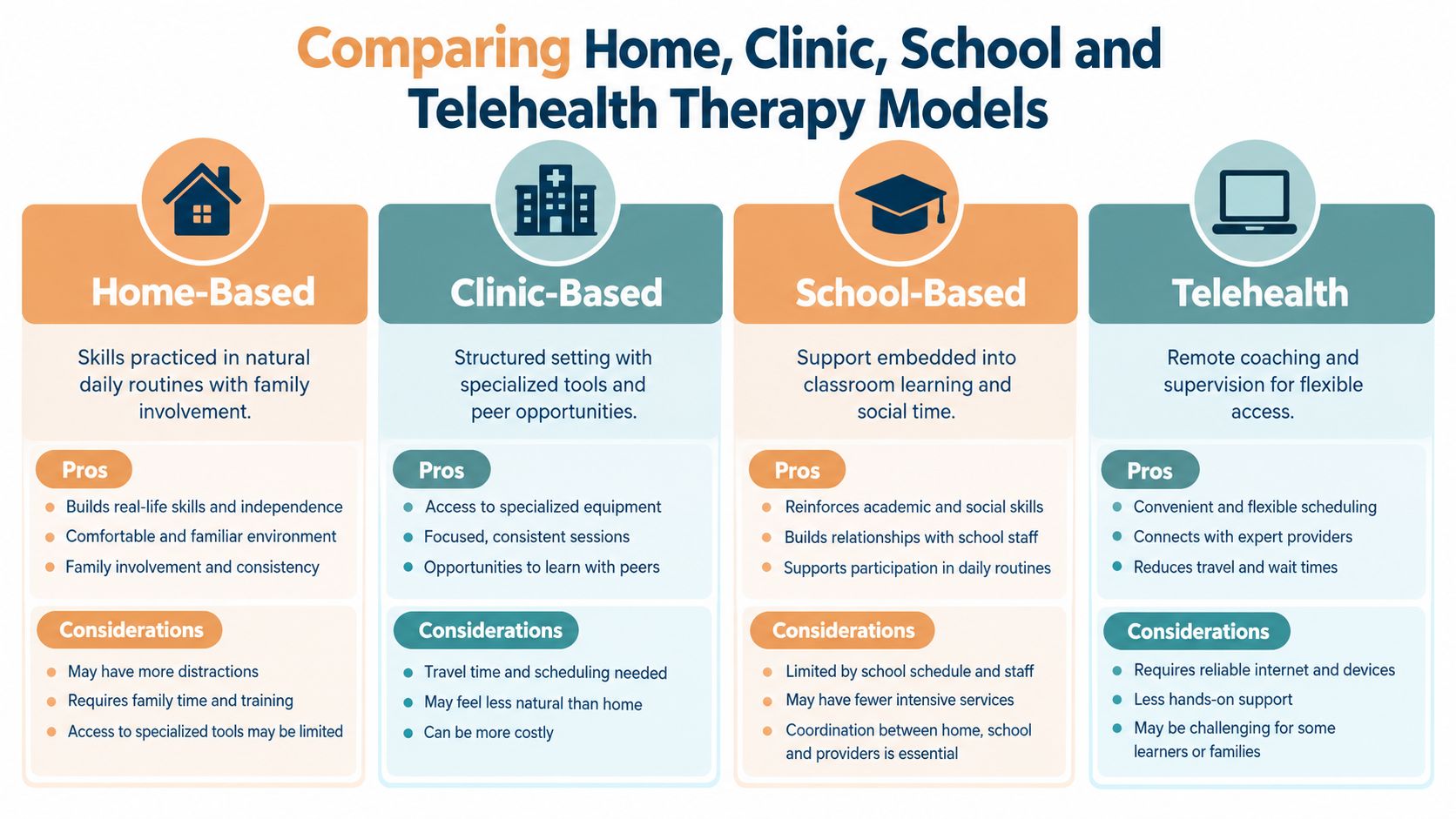
Comparing Home Based Clinic School and Telehealth Therapy Models
Your child may practice asking for help at breakfast, taking turns during play, or following a classroom transition. The setting affects whether those skills become useful beyond the session. No model suits every child or family. Choose the setting that gives the team access to the routines, people, and environments linked to your priorities.
| Model | May fit when | Questions to consider |
|---|---|---|
| Home-based ABA | Your priorities include meals, dressing, communication with family, play, transitions, or independence at home. | Can the team work respectfully within your routines? Will caregivers receive practical coaching? |
| Clinic-based ABA | Your child benefits from a structured learning environment, specialized materials, or planned peer opportunities. | How will the team help skills transfer from the clinic to home and school? |
| School-supported therapy | Classroom participation, peer interaction, transitions, or communication with educators are central concerns. | How will the provider coordinate with the school and protect the child's educational experience? |
| Telehealth or parent-mediated support | Travel is difficult, local availability is limited, or caregivers want coaching within real routines. | What technology, supervision, privacy protections, and hands-on support are available? |
Home-based therapy
Home sessions place practice inside the routines where skills need to work. A therapist might help your child request assistance during breakfast, accept a change in the usual order of activities, put laundry in a basket, or take turns with a sibling. You can observe the strategy in the same setting where your family will use it later.
The arrangement should also respect your household. Ask how the provider schedules sessions, prepares siblings, manages distractions, and adjusts when dinner runs late or plans change. Review this guide to in-home ABA therapy when deciding whether home-based care matches your priorities.
Clinic-based therapy
A clinic can provide structured rooms, specialized materials, and planned peer practice. For a child developing play skills, the team may move from playing beside another child to taking turns or joining a small-group activity.
Ask how those skills will travel home. If your child learns to request a toy at the clinic, the provider should explain how caregivers will practice the same request in the living room, on the playground, or during a school activity. Look for shared examples, clear progress updates, and a plan for communicating with educators when the family agrees.
School-supported and telehealth options
School support connects therapy goals with classroom work, lunch, recess, and transitions. It can help teachers and caregivers respond consistently, provided collaboration follows school policies and the family's consent.
Telehealth allows a clinician to coach a parent during an actual routine, such as toothbrushing, getting dressed, or preparing for a change in plans. Ask how the provider decides whether remote coaching fits your child, how privacy is protected, how supervision works, and what happens if a hands-on service is needed. If local programs have waitlists, ask whether telehealth coaching can begin while you wait and whether the provider can help clarify insurance authorization steps. That support can keep practice going without treating a temporary wait as lost time.
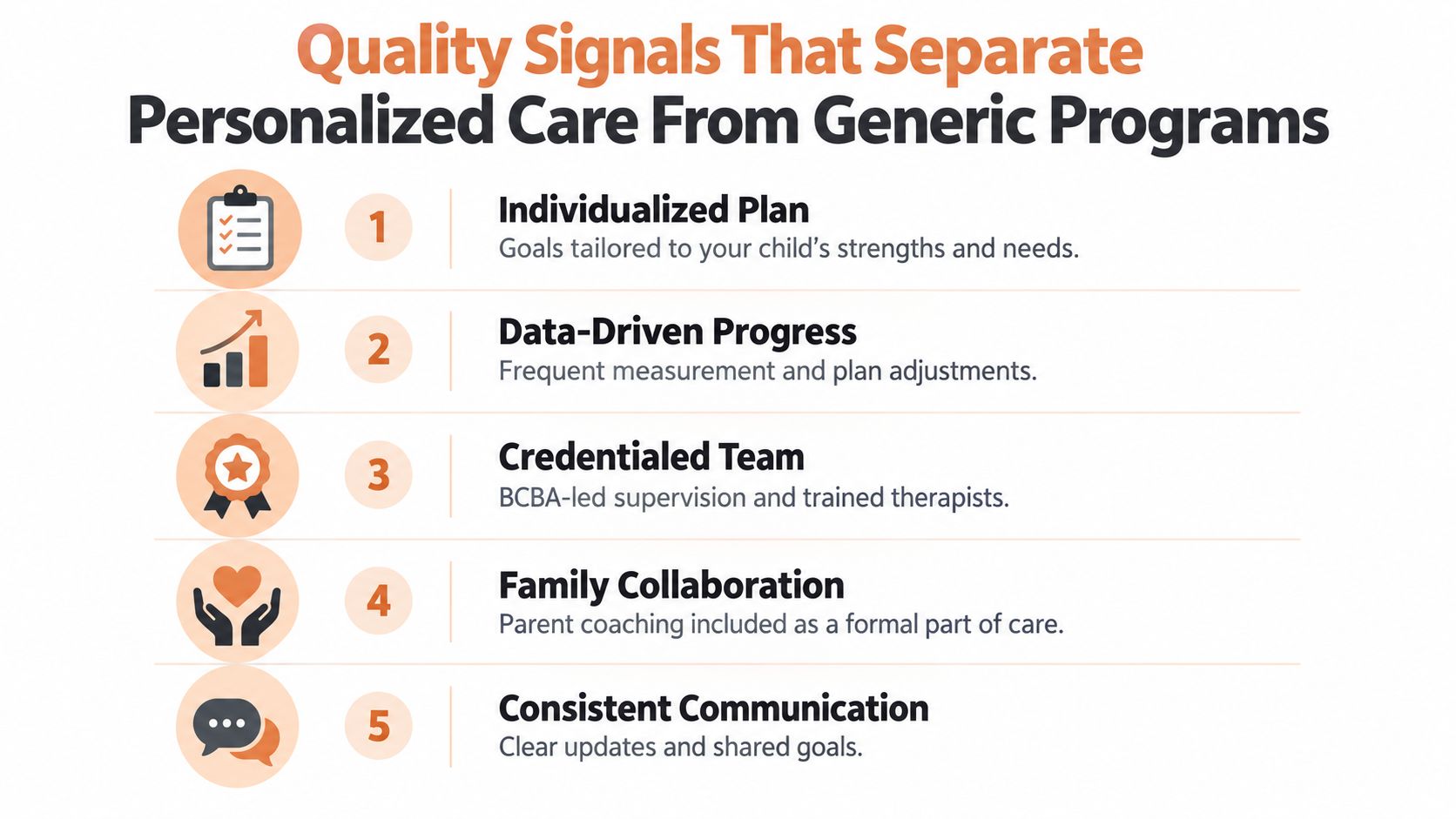
Quality Signals That Separate Personalized Care From Generic Programs
The location of therapy tells you where services happen. Quality signals show how thoughtfully the team works. During an intake call or visit, listen for specific answers rather than broad promises about individualized care.
Look for a plan built around your child
An individualized plan should connect clinical goals to meaningful routines. The team may ask what your child enjoys, how they communicate, which transitions are hardest, and what independence looks like for your family. A goal such as “requesting a break during a difficult task” is more useful than a vague promise to improve behavior.
Ask who helps set priorities. The BACB clarification on ASD practice guidelines says parents and other caregivers should be involved in treatment planning and trained to implement selected parts of the plan so gains can carry into home, school, and community settings.
Ask how communication works
A dedicated care coordinator can give families one clear point of contact for scheduling, questions, and coordination. That person doesn't replace the clinical team, but can help reduce the experience of repeating the same information to multiple people.
Ask practical questions:
- Who will contact us after the assessment?
- How often will we receive progress updates?
- What happens if a therapist is absent or our schedule changes?
- How will our pediatrician or school team be included when appropriate?
Proactive communication should be visible in the process. You should know when meetings happen, who attends, and how concerns are handled.
Follow the data
The ABA practice guidelines recommend collecting, quantifying, and analyzing direct observational data on target behaviors during treatment and follow-up. The guidance identifies measures such as change in target behaviors over time, the number or rate of goals met, and changes in standardized assessment scores. Progress review may occur weekly, bimonthly, or monthly, depending on the child's needs and service intensity, according to the ABA practice guidelines.
A provider should be able to explain the data without making you feel like you need a statistics background. If your child is learning to request help, you might see how often requests happen during relevant activities and whether the skill appears with different people.
Check measurement reliability
Direct observation is more trustworthy when observers score behavior consistently. Interobserver agreement, or IOA, checks whether two observers record the same behavior in similar ways. Practical guidance commonly targets IOA checks in at least 20% of sessions, with 80% or higher agreement as a threshold for dependable data, as explained in this ABA treatment quality resource.
Ask whether the team uses direct observation, rate measures such as requests per hour, and adaptive-behavior tools such as the Vineland scales. The answer should be clear, specific, and connected to your child's goals.
How Parent Coaching Helps Skills Carry Into Everyday Life
A child may request help during therapy yet stay silent at breakfast or in the classroom. Parent coaching helps families connect those settings by practicing small skills during ordinary routines, such as offering two breakfast choices, pausing during play for a request, or following a visual sequence before school.

Consider pouring water. A therapist can divide the task into steps, identify where support is needed, and show a caregiver how to prompt without doing the task for the child. The family can practice at a calm time, then gradually reduce help while keeping spills and other safety concerns in mind.
Parent coaching does not make caregivers solely responsible for clinical treatment. BACB guidance describes family training as support for treatment, not a replacement for clinician-directed ABA services. Caregiver-training time should not replace direct therapy time. Ask how coaching is scheduled beside direct sessions, and review resources such as parent training in ABA to understand what that support may include.
What useful coaching looks like
Good coaching gives a caregiver something specific to try and a way to judge whether it helps. Rather than saying, “Use reinforcement more,” a clinician might suggest offering a favorite puzzle after the child places dishes in the sink, then discuss whether the routine becomes easier.
Coaching may include:
- Demonstration: The clinician shows a strategy during play, meals, dressing, or transitions.
- Practice: The caregiver tries it while the clinician gives supportive feedback.
- Adaptation: The team changes the approach when it does not fit the family's schedule, culture, space, or resources.
- Follow-up: The provider reviews what happened and adjusts the plan when needed.
A systematic review found a moderate effect size of 0.7 for response training. It also reported that remote parent-mediated training improved parent knowledge, implementation fidelity, and child social-communication outcomes. The findings appear in this systematic review of parent-mediated interventions.
Keep practice manageable
One routine is enough to start. Choose one strategy with the care team, use it during a predictable activity, and record a simple observation. If your child uses a gesture, picture, sign, or words to request more snack, respond consistently and tell the clinician what happened.
Practice should fit family life, not turn every meal into a therapy session. Children have difficult days, and schedules change. A useful provider welcomes feedback such as, “This strategy does not fit our evening routine,” then works with the family to adjust it. Consistent coordination, practical coaching, and clear follow-up help skills carry from therapy into home, play, and school.
Your Checklist for Evaluating Local Providers Insurance and Waitlists
Searching locally works better when you use the same questions for every provider. Keep a simple notes document with the provider name, contact person, service model, insurance information, expected wait, and next action.
Start with access
Families commonly face 6 to 12 months for autism assessment and another 3 to 9 months before ABA begins, with some regions exceeding 18 months, according to reporting on autism waitlist times. Rural and underserved areas may report waits of 12 to 18 months or more, while some urban markets are faster, as described in coverage of the autism family waitlist crisis.
Ask:
- What is the current wait for an assessment?
- What is the expected wait after assessment?
- Can the provider begin insurance authorization while we're waiting?
- Will we receive updates if availability changes?
- Are there interim parent-coaching, social-skills, or school-support options?
Waitlist transparency matters because silence makes planning harder. A provider may not be able to offer an immediate opening, but it should explain the process and what you can do while waiting.
Confirm insurance details
Ask whether the provider is in network with your plan and which documents are required. Medicaid coverage can include more than direct therapy hours. The Medicaid ABA Toolkit explains that services commonly included in an ABA treatment plan may be covered under other benefit categories when they meet the benefit definition and are delivered by qualified providers. It gives caregiver training and behavioral coaching as examples that may fit preventive-services rules.
Coverage varies by plan and location, so request a written explanation of authorization steps, required assessments, copays or other family responsibilities, and what happens if authorization is delayed. Families in Connecticut, Georgia, Maryland, Massachusetts, North Carolina, South Carolina, Virginia, and Washington may also want to ask how the provider handles state-specific payer requirements.
Assess the partnership
Before choosing, ask how often families meet with the clinical team, whether a care coordinator is assigned, how school communication works, and how goals are revised. Some funding systems make parent training a defined part of care. The NCBI summary of ABA guidelines and standards notes that the ACD requires a minimum of six parent or caregiver training sessions for every six months of ABA services under its stated policy requirements.
Write down how each provider responds. A warm, clear answer to a difficult question often tells you more than polished website language.
Next Steps to Choose Confidently and Connect With Support
You don't need to solve every decision in one afternoon. Begin with your family's highest-priority routine, such as requesting help at meals, joining play, getting ready for school, or completing a bedtime step. Then identify the service setting that gives the team a realistic opportunity to practice that skill.
If possible, speak with two or three in-network providers and compare their answers. Prioritize the essentials: an individualized plan, qualified clinical supervision, clear data review, family coaching, transparent waitlist information, and a reliable communication process. Features such as travel distance, session flexibility, and clinic resources can help you decide between otherwise suitable options.
Ask your child's pediatrician, teacher, speech-language pathologist, or other care team members for relevant observations. With your permission, a coordinated provider can use those observations to connect therapy goals across settings. A child who practices requesting a break at home may need the same communication option during classroom work or a busy community outing.
Progress often grows through small, repeated moments. A child points to a preferred cup, waits briefly for a turn, places one item in a backpack, or accepts help with a difficult zipper. Those moments deserve attention because they show how therapy can support communication, participation, and independence without promising a fixed timeline or guaranteed result.
Asking detailed questions isn't being difficult. It's how you find care that fits your child and your family.
Friendly ABA Premier provides individualized home-based ABA therapy, social skills development, school support, and parent coaching across Connecticut, Georgia, Maryland, Massachusetts, North Carolina, South Carolina, Virginia, and Washington. If you're comparing local options, visit Friendly ABA Premier to connect with a team that offers dedicated care coordination, scheduled progress check-ins, and collaborative support for your family's goals.
Our Latest Insights



































Experience ABA Therapy with a More Personalized Level of Support
Discover how FriendlyABA Premier combines evidence-based ABA therapy with dedicated coordination, proactive communication, and individualized family support.