

Behavioral Skill Training for Parents: A Warm Guide
Learn how behavioral skill training works through instruction, modeling, rehearsal, and feedback. Practical steps and tips for parents supporting their child's

Behavioral skills training is a structured, practice-based teaching method that combines explaining a skill, demonstrating it, letting the child practice, and giving supportive feedback. Its four core components are instruction, modeling, rehearsal, and feedback, and its history reaches back more than 40 years, although the specific term first appeared in the literature in 2004 (Southern Illinois University research).
You may already be using pieces of this approach without calling it behavioral skills training. Perhaps your child is trying to ask for help while opening a snack, get dressed before school, or move from playtime to dinner. You explain what to do, show them, offer a chance to try, and respond kindly when the attempt is close but not quite there.
That everyday rhythm is the heart of this approach. It doesn't ask parents to become therapists at the kitchen table. Instead, it gives families a clear way to make teaching more predictable, supportive, and connected to routines that already matter.
Table of Contents
- Instruction makes the target clear
- Modeling gives your child a visible example
- Rehearsal turns watching into doing
- Feedback shapes the next attempt
Understanding What Behavioral Skill Training Actually Looks Like
Your child reaches for a favorite snack, but the container will not open. You say, “Ask for help,” and repeat yourself when no response comes. Frustration grows on both sides. The missing piece may be a clear, practiced response rather than motivation.
Behavioral skills training turns that brief struggle into a teachable routine. You can say, “Say help, please,” show how to say or indicate it, invite your child to try, and respond with warm, specific feedback. The whole practice may take seconds, so snack time remains a family moment rather than becoming a formal lesson.
A familiar routine with more intention
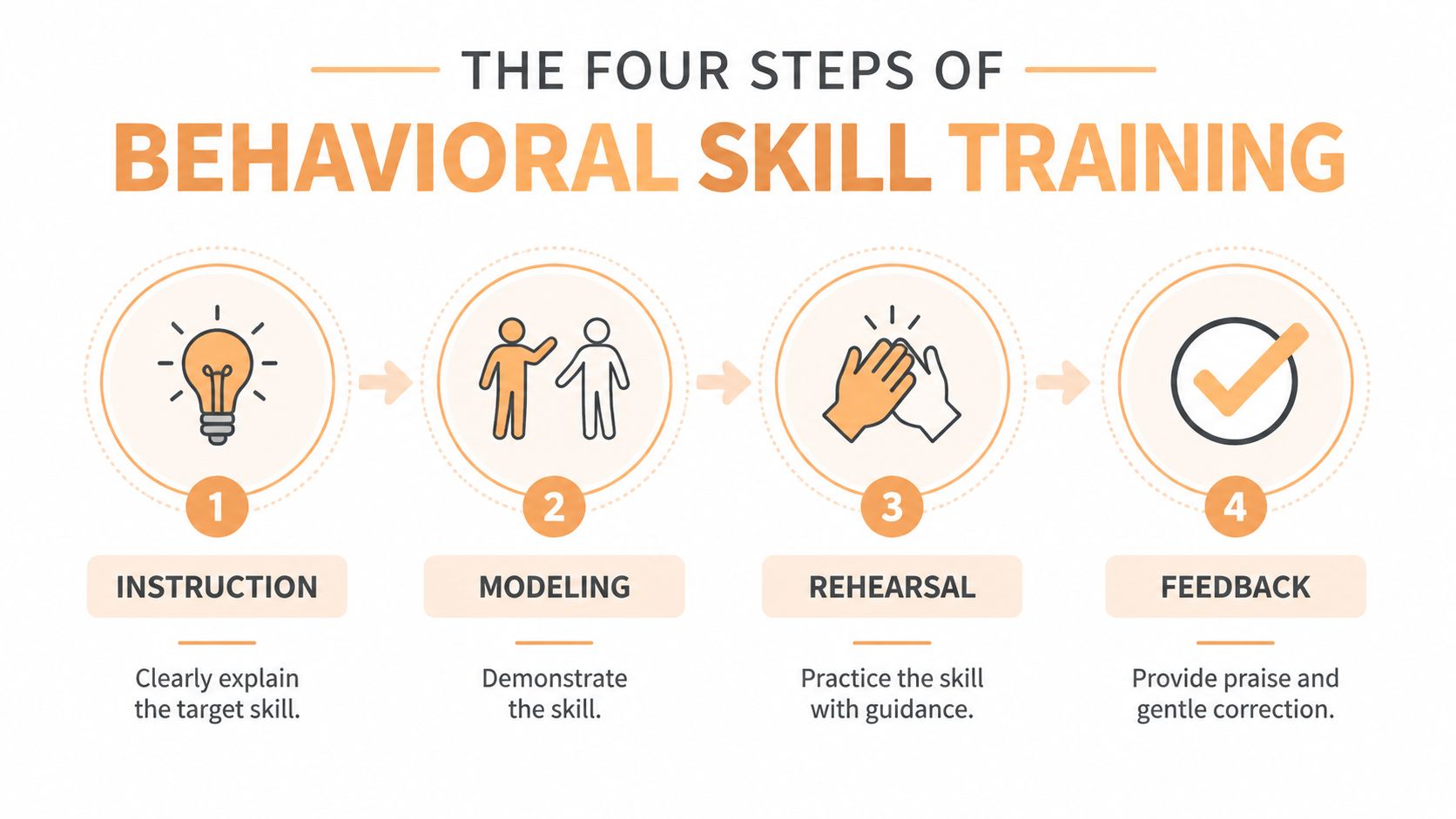
The method connects four parts:
- Instruction: Explain the skill in clear, simple language.
- Modeling: Demonstrate what the skill looks or sounds like.
- Rehearsal: Give your child a chance to practice.
- Feedback: Identify what went well and gently guide the next attempt.
Each part answers a different question. An instruction such as “Use your words” may leave the response unclear. “Say ‘help’” gives your child something specific to understand and try. Modeling makes the expectation visible, rehearsal turns watching into action, and feedback shows which response to repeat.
This approach can fit communication, social interaction, daily routines, and school-related skills. A 2021 systematic review examined 20 single-subject studies involving 67 individual cases and concluded that parents, particularly parents of children with autism or intellectual disability, could be trained successfully to use evidence-based practices with their children (systematic review in PubMed).
Why this can feel reassuring
ABA vocabulary can make home teaching sound clinical, especially for a parent encountering it for the first time. Used thoughtfully, behavioral skills training can make one small moment easier to understand. You choose a response, show what it looks like, create a low-pressure chance to try, and notice the support your child needs.
The same structure often used for professional training can be translated into ordinary family routines, including meals, dressing, and play. It does not require a parent to recreate a therapy session. For a broader introduction to ABA and family involvement, explore what parents should know about ABA therapy.
The Four Steps of Behavioral Skill Training Explained
A difficult puzzle, homework task, or family routine can become a chance to teach one useful response. The four steps of behavioral skill training provide a clear path: explain the skill, show it, let your child try, and respond to the attempt. They are a flexible guide, not a test your child must pass. Adjust the words, materials, pace, and support to fit your child's communication style and the routine.
Consider a child learning to request a break during a challenging puzzle.
Instruction makes the target clear
Begin with language your child can use. “Ask for a break” might mean saying “break,” pointing to a break card, using a gesture, or selecting a button on a communication device. Follow the child's established support plan so the response matches how they already communicate.
Make the direction specific and calm. Explain both when to use the skill and what will happen afterward: “If the puzzle feels hard, say ‘break,’ and we'll pause.” Clear instructions work like a simple signpost. They show your child which response to use and what that response will accomplish.
Modeling gives your child a visible example
Show the skill immediately after explaining it. Hold up the break card, say “break,” and move to a quiet place for a short pause. A demonstration can answer details that words leave unclear, including how loudly to speak, which item to use, and what action follows the request.
Your child does not have to copy every detail right away. The model gives them something concrete to watch before they attempt the response.
Rehearsal turns watching into doing
Create a low-pressure opportunity to practice. Present one puzzle piece, pause, and invite your child to request a break. If your child needs help, the care team can guide you on the appropriate assistance and how to reduce that support gradually.
Practice can take place through role-play, during the actual routine, or in a brief planned opportunity. Each attempt gives you information about what your child understands and where the next prompt may help.
Feedback shapes the next attempt
Feedback should identify what worked and clarify what to adjust. “You showed me break. Nice asking” tells your child which response you want to strengthen. General praise may feel encouraging, but specific feedback connects the words to the action.
If your child reaches for the card without using it, acknowledge that attempt and follow the individualized guidance from the care team. Responding consistently helps your child understand that communication is effective.
A meta-analysis of 46 single-case studies found that BST produced a statistically significant improvement in discrete-trial implementation fidelity, supporting its use for teaching caregivers or staff to carry out ABA procedures accurately (meta-analysis record from ERIC). Parents who want guided practice can explore parent coaching services for support that considers their family's routines.
Practical rule: If your child cannot perform the skill yet, make the next practice attempt easier rather than repeating the same instruction more loudly.
Putting Behavioral Skill Training Into Real Family Moments
A family doesn't need to schedule every learning opportunity. The strongest practice often fits inside routines that already happen, such as washing hands, putting on shoes, joining a sibling's game, or preparing for bed.
Suppose mornings are difficult because your child moves from a preferred activity to breakfast. You might give a short instruction, “Tablet away, then table,” and show the first action by placing the tablet in its spot. Then you invite your child to do the same, offering feedback such as, “You put it away and came to the table.”
The sequence stays the same, but the routine gives it meaning. Your child practices transitioning in the setting where the skill matters, rather than only answering questions in an unfamiliar practice situation.
One routine, four opportunities
At mealtime, behavioral skills training might look like this:
- Instruction: “Put the spoon in the bowl.”
- Modeling: You place your spoon in the bowl.
- Rehearsal: Your child tries with their own spoon.
- Feedback: “You put the spoon in. That keeps the table tidy.”
For communication, you might teach a child to request a preferred toy during play. Explain the request, model the word, sign, picture, or device response, pause for practice, and respond to the attempt according to the child's plan.
The same structure can support getting dressed. A parent might identify one manageable action, such as pulling a shirt over the head, demonstrate it with their own shirt or a doll, let the child try, and give feedback about the specific step completed.
Keep practice connected and brief
Short opportunities can be easier to repeat than long sessions. If a child is tired, hungry, overwhelmed, or unwell, the priority may be comfort and connection rather than practice. Ask the care team how to adapt the routine, particularly when a skill involves safety, challenging situations, or a formal behavior plan.
Consistency doesn't mean every adult uses identical words in every moment. It means the child receives a reasonably clear expectation and predictable support across important settings. A parent, teacher, and therapist may coordinate examples so the child can use a communication or independence skill at home and school.
For more ideas about embedding practice into ordinary routines, see building communication skills in everyday moments.
Practice should make a routine more understandable, not make home feel like a classroom all day.
Practical Tips for Parents Using Behavioral Skill Training at Home
A method can be clear and still feel difficult on a busy Tuesday. Siblings need attention, dinner is waiting, and your child may not be ready to practice the exact skill you had in mind. Sustainable behavioral skill training leaves room for real family life.
Start with one skill and one routine. If your focus is requesting help, choose a predictable opportunity such as opening a snack or reaching a favorite toy. A small target makes it easier to notice attempts and share useful information with your care team.
Five ways to keep practice manageable
- Keep sessions short: A few focused attempts may be more comfortable than a long, demanding lesson. Stop while your child can still participate positively.
- Use natural opportunities: Practice during dressing, meals, play, errands, and transitions instead of creating extra tasks whenever possible.
- Be consistent: Use the same target response and follow the agreed plan across caregivers when you can. Written instructions and a fidelity checklist can help adults remember the important steps.
- Celebrate small wins: Notice approximations and meaningful attempts, not only a fully independent response. Specific feedback helps your child understand what they did successfully.
- Be patient: Skills may develop unevenly. A difficult day doesn't erase earlier learning, and a slower pace may signal that the teaching approach needs adjustment.
A protocol for school and staff training recommends repeating rehearsal and feedback until the learner can perform the behavior successfully without assistance. It also highlights written instructions, realistic role-play, and a fidelity checklist as tools for tracking accurate steps and identifying what needs more practice (BST and effective feedback protocol).
When your child refuses
Refusal is information, not a reason to force the moment. Pause, reduce the demand, offer a choice when appropriate, or ask the clinician to help identify whether the task is too difficult, unclear, uncomfortable, or poorly timed. Never change a formal intervention plan on your own when safety or significant distress is involved.
Your own feedback matters, too. One implementation study reported 98% average procedural integrity across four sessions, with a range of 90% to 100%, while another reported 98.6% across baseline, training, and maintenance videos, with 895 of 915 trainer steps completed correctly (procedural-integrity study). These findings illustrate why checklists and coaching can help adults follow a plan, not why parents should expect perfection.

Building Confidence and Continuing the Journey Together
A father practices a turn-taking routine with his son at the park. The first attempt lasts only a moment, and the child looks away. Later, after a little space and a simpler invitation, he returns the high-five. That small response gives the family useful information, and it gives the child another successful experience.
Behavioral skills training is one tool among many. Your child may need different supports for communication, social interaction, daily living, or school participation, and the right plan should reflect the child's strengths, preferences, needs, and environment.
Support after the first practice
Ask your care team to show you the skill, watch you rehearse it, and explain what to do when the routine changes. A 2025 systematic review of pyramidal training noted that maintenance supports such as feedback and coaching weren't routinely incorporated, even though continued support is important for keeping trained skills useful in everyday settings (systematic review of pyramidal training).
That matters for families because learning doesn't end when an initial training conversation ends. A dedicated care coordinator, scheduled progress check-ins, individualized treatment planning, and proactive communication can help parents know what to practice, what to report, and when a strategy needs to be revisited.

You don't have to teach every skill perfectly, and you don't have to figure out the next step alone. Small, respectful practice opportunities can build confidence for both you and your child, especially when your care team listens to what works in your actual home.
Friendly ABA Premier offers home-based ABA therapy, parent coaching, social skills development, and school support across Connecticut, Georgia, Maryland, Massachusetts, North Carolina, South Carolina, Virginia, and Washington. To discuss individualized behavioral skill training, coordinated communication, and a plan that fits your family's routines, visit Friendly ABA Premier and schedule a consultation.
Our Latest Insights


























Experience ABA Therapy with a More Personalized Level of Support
Discover how FriendlyABA Premier combines evidence-based ABA therapy with dedicated coordination, proactive communication, and individualized family support.