

Applied Behavior Analysis Data Sheets: A Complete Guide
Learn how to use applied behavior analysis data sheets effectively for home-based therapy. Includes frequency, duration, ABC, task analysis & IOA templates.

Applied behavior analysis data sheets are structured forms that help families and therapists objectively track behavior frequency, duration, antecedents, and skill mastery to support evidence-based treatment decisions. Modern ABA resources list at least 13 distinct data-sheet formats, giving teams different ways to measure what matters for an individual child (Rethink Behavioral Health).
You may notice a therapist marking a clipboard during play, or you may find yourself trying to remember what happened before a difficult transition at home. The purpose isn't to judge your child or expect perfect recording. It's to turn everyday observations into useful information that helps the people supporting your child understand patterns, recognize small steps forward, and adjust care thoughtfully.
Table of Contents
Why Data Sheets Matter in Your Child's Therapy Journey
Dinner is almost finished, and your child pushes the plate away. During the next transition, the same response happens when it's time to leave the playground. You may already sense a pattern, but memories from busy days can be incomplete. A simple data sheet gives you and the therapy team a shared place to record what happened, when it happened, and what support was available.
Applied behavior analysis data sheets replace broad impressions with observable details. Instead of writing that a child “had a hard evening,” a caregiver might record how often a response occurred, how long it lasted, or what happened immediately beforehand. These records help clinicians compare observations across home, school, and therapy without asking parents to become behavior analysts.

Data creates a shared language
A sheet can also capture progress that feels easy to miss. A child may still need support to request a break, but may now use a gesture before becoming upset. A learner may not complete an entire bedtime routine independently, yet may manage one step with less prompting.
A useful data sheet should make your child's progress easier to see, not make family life feel harder.
The best plans are individualized. Your care team can help decide which observations are meaningful, how often to record them, and when the information suggests a change in support. Families contribute valuable context, while clinicians bring measurement and treatment-planning expertise. Together, those perspectives create clearer, more compassionate decisions.
Understanding the Evolution of ABA Data Collection
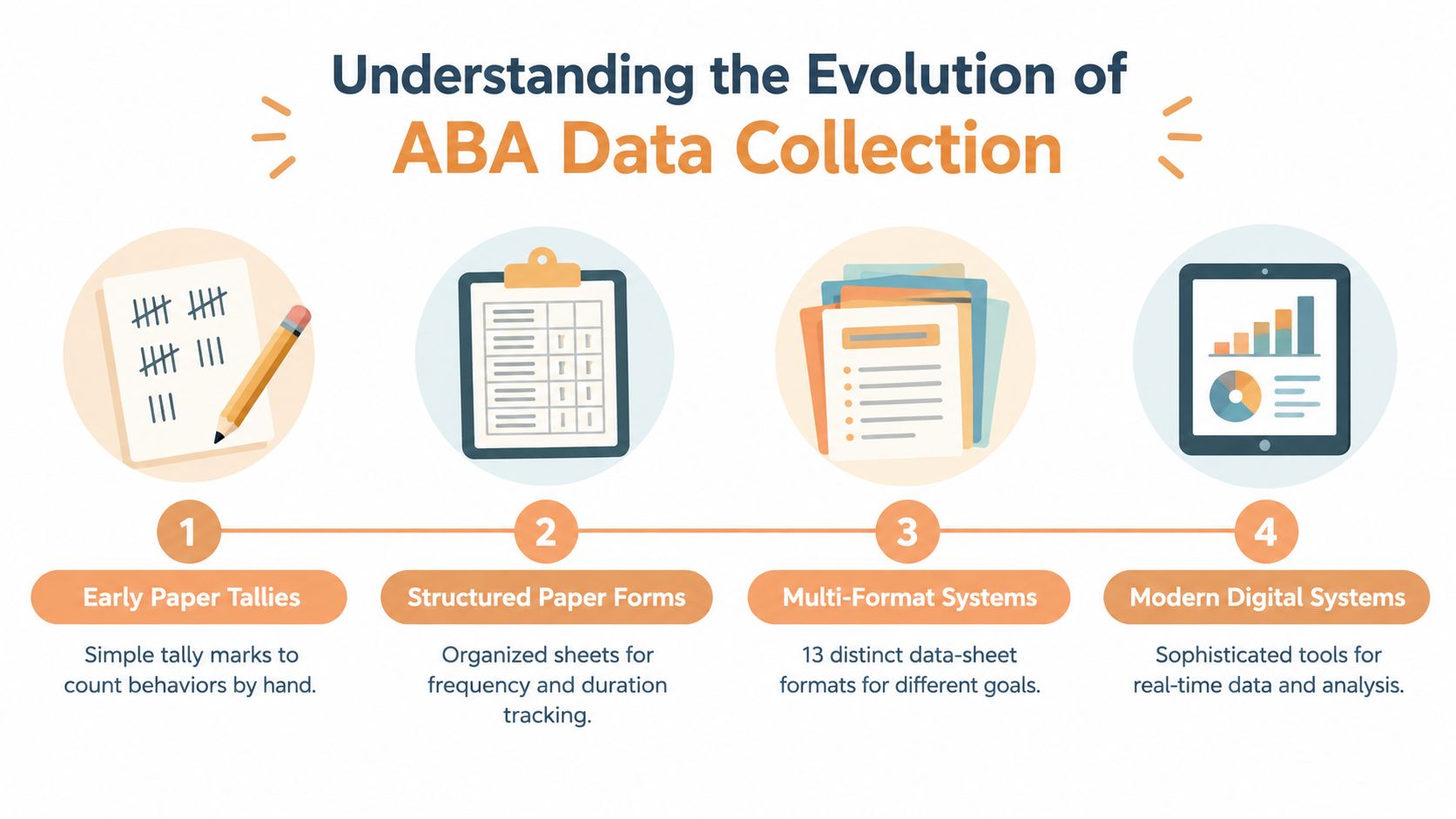
At home, a caregiver may begin with a paper tally card beside the activity area. Earlier ABA records often relied on handwritten marks or mimeographed forms. Over time, those simple records grew into structured sheets for behavior measurement, skill teaching, and progress review. The change is less about replacing family observations than making them easier to compare and discuss.
Modern resources now offer more than a dozen formats, including forms for ABC recording, frequency, duration, latency, interval recording, and task analysis (Rethink Behavioral Health). Each format answers a different question. A family counting requests during play needs a quick tally, while a team teaching handwashing may need space for each step and prompt.
From paper records to analyzable information
ABC collection organizes observations around the Antecedent, Behavior, and Consequence. Checklist-based forms can be easier to complete than unrestricted narrative, especially during a busy home routine. They may provide a focused snapshot early in a functional assessment, rather than requiring a parent to document every detail (Spectrum Unlocked).
Digital tools extend the same basic approach. Some products provide print measurement forms and digital Google Forms options, while other systems let users export row-level entries to Excel for totals, percentages, and trend charts. These tools support consistent storage and review, but a clinician still helps determine what the records mean and which format fits the goal.
For caregivers, good data collection is a practical balance. Record enough to show change, but choose a method the family can sustain during real routines. Clear, consistent entries give parents stronger questions for progress meetings, such as how a goal is measured and how observations shape an individualized treatment plan.
Building Your Foundation With Operational Definitions First
Before choosing a form, define exactly what everyone will record. An operational definition describes a behavior in clear, observable terms so different people can identify it in the same way (University of Illinois).
“Frustration” may mean different things to different adults. A more recordable description could be, “The child pushes materials away and says ‘I can't do it' within five seconds of being asked to start a task.” Your clinician should help create definitions that fit your child and treatment goals.
A simple preparation checklist
- Name what can be seen or heard: Avoid labels such as “defiant” or “uncooperative” without describing the observable action.
- Clarify when the behavior starts: Identify the first action that counts.
- Clarify when it ends: Decide what tells the recorder that the episode is over.
- Separate similar responses: Distinguish pushing materials away from leaving the table if they're being tracked separately.
- Check shared understanding: Ask caregivers, teachers, and technicians to describe an example and a non-example.
This foundation reduces guesswork. It also helps families and clinicians compare notes across sessions, settings, and caregivers. If people aren't using the same definition, a change in the data may reflect different recording habits rather than a change in your child's behavior.
Choosing the Right Measurement Method for Your Goals
The right measurement method depends on the question your team is asking. Frequency tells you how many times something happens. Duration tells you how long it lasts. Latency measures how long it takes to begin after a cue, while interval recording notes whether a behavior occurred during defined time blocks (Spectrum Unlocked).
| Method | What It Measures | Best For |
|---|---|---|
| Frequency | The number of occurrences | Countable responses, such as requests or completed routines |
| Duration | The length of time a behavior continues | Behaviors or activities with a clear start and end |
| Latency | The time from a cue to the start of a response | Task initiation, answering, or beginning a transition |
| Interval recording | Whether a behavior occurred during set time blocks | Behaviors that are difficult to count continuously |
Match the form to the everyday goal
If you're counting how many times your child asks for a preferred toy during play, frequency may fit. If the concern is how long a difficult episode lasts, duration can provide information that a simple count cannot. Two episodes can happen with the same frequency but have very different effects on a routine if one lasts much longer.
Latency is useful when starting is the challenge. For example, a team may want to know how long it takes a child to begin homework after receiving a clear direction. Interval recording may be more realistic for ongoing engagement during a family activity when tracking every moment would interfere with caregiving.
Ask, “Are we measuring count, time, response speed, or presence during an interval?” That question often clarifies why a particular sheet was selected.
Use one measurement dimension consistently across comparable sessions unless your clinician recommends a change. Switching methods without documenting the change can make trends harder to interpret. Your care coordinator or behavior analyst can help select a method that captures useful information without asking your family to monitor everything at once.
Using ABC Data Sheets to Understand Behavior Patterns
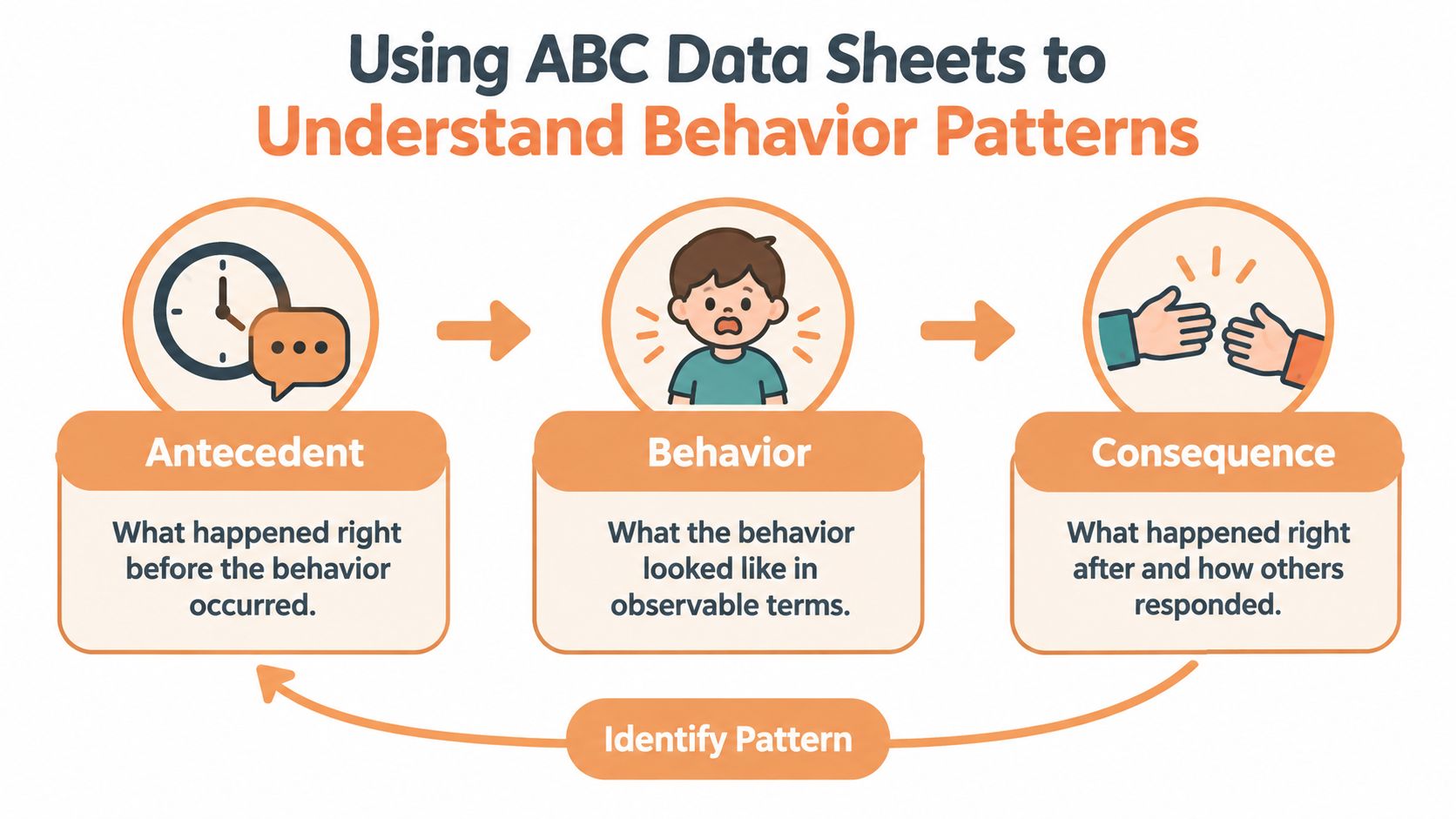
ABC sheets organize a behavior event into three parts:
- Antecedent: What happened immediately before?
- Behavior: What did the child do that could be observed?
- Consequence: What happened immediately afterward?
This structure can make a stressful moment easier to examine without assigning blame. At homework time, the antecedent might be a request to put away a tablet. The behavior could be pushing the worksheet away and moving from the table. The consequence might be that an adult offers help, delays the task, or returns the tablet.
ABC forms capture the context around an event, including what preceded a meltdown during a transition or what followed a request for a preferred item (Autism Classroom Resources).
Keep the record brief and concrete
Contemporary ABA guidance favors checklist-based ABC recording over free-form narrative. That design helps caregivers make a quick note during a busy routine rather than reconstructing a long story later. The aim is to capture a useful snapshot, not every detail of the day.
ABC data is often used near the beginning of a functional assessment to help identify possible patterns. It shouldn't be treated as proof of why a behavior happens based on one event. A clinician reviews the context across observations and considers the child's communication, environment, preferences, and support needs.
The information can also reveal moments when a child successfully handles a challenge. You might record that a visual warning came before a transition, your child used a break request, and the routine continued with support. That kind of observation helps the team understand which strategies are practical in your home.
Here's a visual explanation of how the three parts fit together:
Share ABC notes with the care team rather than trying to interpret them alone. A clinician can help distinguish a meaningful pattern from an isolated event and decide whether another measurement method is more appropriate.
Tracking Skill Mastery with Task Analysis Sheets
Some goals involve a chain of smaller actions. Task analysis breaks that chain into observable steps, and a trial-by-trial data sheet records how the learner performs each step, including prompt level, reinforcement delivered, and immediate outcome (SOAP Note AI).
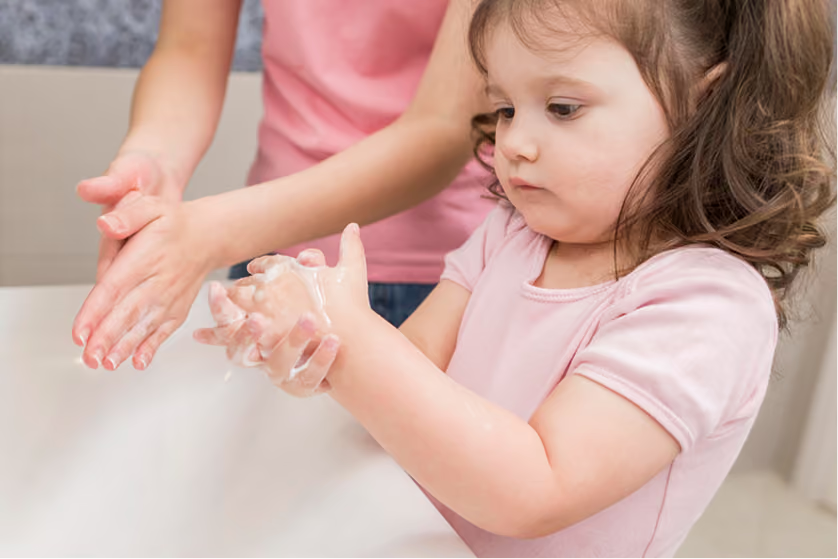
Consider handwashing. A plan might separate the routine into turning on the water, wetting hands, applying soap, rubbing hands, rinsing, and drying. The sheet can show which steps are independent, which need a verbal or visual prompt, and where the routine becomes difficult.
Make a large routine manageable
A parent might record:
- Step one: Child turns on the water independently.
- Step two: Child wets hands after a gesture prompt.
- Step three: Child applies soap with help.
- Later steps: Child rinses and dries with the current level of support.
This doesn't mean the routine has failed because assistance is still needed. It shows where teaching can be focused and gives the child credit for each independent action.
Trial-by-trial forms also help the team review implementation and response together. If a child struggles, the clinician can examine whether the prompt was delivered as planned, whether reinforcement followed the target response, and whether the task needs adjustment.
Communication goals often benefit from the same stepwise approach. Families can find related guidance on supporting better communication, while keeping the actual teaching plan individualized with their clinical team.
Supporting Data Integrity and Procedural Fidelity
During a busy home routine, a caregiver may wonder whether to prompt first or record first. A well-designed data sheet can provide that reminder while also showing exactly what to document. A 2022 review of ABA data sheet design in practice found that one-page sheets were common, and that many included instructions and operational definitions.
These details protect consistency across caregivers. A brief instruction, such as “record the first observable response,” reduces guesswork. An operational definition gives everyone the same boundary for counting a behavior, much like using the same measuring cup when several people follow one recipe.
Let the form support the plan
Some enhanced data sheets include randomized targets and prompts for treatment components. The review found that these forms improved treatment fidelity compared with standard sheets, suggesting that the page can support more consistent implementation when it reminds the recorder what comes next.
Procedural fidelity means following the steps agreed on with the care team. At home, the sequence might be presenting a choice, waiting, offering a prompt if needed, and recording the outcome. The sheet should make that sequence easier to follow without making family life feel like an exam.
Direct observation can help the team check fidelity, though schedules at home and school may limit how often it occurs. Ask your care coordinator:
- Is the target behavior defined clearly?
- Does the sheet remind us of the treatment steps?
- What should we record if the routine is interrupted?
- How will the team review our entries?
Caregivers can also practice the routine through behavioral skill training for implementing ABA procedures. Rehearsal creates a safe place to ask questions, correct small misunderstandings, and protect data quality without expecting perfect recording from the start.
Balancing Clinical Needs with Family Feasibility
Good data collection has to fit the life it's meant to support. A form that captures rich information but sits unused in a drawer won't help the team understand a routine. Parent-facing guidance recommends practical adjustments such as measuring fewer behaviors, using phone notes or apps, and placing sheets where a routine naturally prompts their use (NYS ABA Parent).
Start with the smallest useful plan. If mornings are already demanding, your team may choose one communication goal rather than asking you to record every behavior, interaction, and transition. A quick note after breakfast may be more sustainable than continuous tracking that creates stress and inconsistent entries.
Choose a routine and a recording cue
The recording method can be paper, a phone note, a digital form, or a workflow integrated into therapy software. App-based tools may make time entries and sharing easier, while paper may be more accessible during meals, play, or school preparation. Neutral comparisons of these options for reliability, family stress, and decision quality remain limited, so the best choice depends on your household and care plan.
Try linking collection to an existing cue:
- Keep a frequency sheet beside the toy shelf.
- Place a duration form near the homework materials.
- Use a phone reminder after the evening routine.
- Ask the school and home teams to agree on the same definition and recording language.
A care team should help you decide when enough data has been collected and when to pause or simplify. In-home services can make it easier to adapt collection to natural routines, as described in this overview of in-home ABA. Consistency with a few meaningful targets is more useful than perfection across too many targets.
Quick Reference Guide to Common Data Sheet Formats
Save this section for a quick reminder, then confirm the final choice with your child's care team. The form should match the goal, the routine, and the person collecting the information.
- 🔢 Frequency sheet: Counts how many times a defined response occurs. Use it for requests during play, completed greetings, or other behaviors with clear individual occurrences.
- ⏱️ Duration sheet: Records how long a behavior or activity lasts. Reach for it when the start and end are clear, such as time engaged with a task or the length of an episode.
- 🧩 ABC sheet: Captures what happened before, what the behavior looked like, and what followed. Use it to document context during transitions, homework, mealtime, or other routines where patterns are still unclear.
- 🪜 Task-analysis sheet: Breaks a routine into separate steps and records independence, prompts, reinforcement, and outcomes. It fits daily living skills such as dressing, brushing teeth, or washing hands.
- 👀 IOA sheet: Compares how two observers record the same events. A clinician may use it to examine whether a definition and measurement process are being applied consistently.
A frequency form shouldn't be used to answer a duration question, and an ABC form isn't a substitute for every other type of measurement. The team may use different formats for different goals within the same individualized plan. Ask for a plain-language explanation of what each column means and how the notes will influence decisions.
Moving Forward with Confidence in Your Data Collection
At first, a data sheet can feel like one more responsibility added to an already full day. Over time, many families find that a few carefully chosen observations help them describe routines more clearly. A note about a child starting a task after a visual cue, completing one new step, or using a functional request can give the team something concrete to build on.
The purpose isn't to produce flawless records. Missed entries, interrupted routines, and unexpected days are part of family life. Tell the care team what made collection difficult so the plan can be adjusted rather than treating the difficulty as a failure.
Use your observations as conversation starters
Bring questions to your clinician or dedicated care coordinator:
- What does this measure tell us about the goal?
- Are we asking too much of the caregiver recording it?
- Do home and school staff use the same operational definition?
- What progress would we hope to see over time?
- When will we review the data and decide whether support should change?
A responsive care team should make room for those conversations. Individualized treatment planning, proactive communication, and regular progress check-ins help families understand not only what is being recorded, but why it matters for their child's daily life.
Each data point is one moment, not a verdict. Used thoughtfully, applied behavior analysis data sheets can support partnership, reveal meaningful growth, and help adults coordinate support around skills that matter at home, school, and in the community.
Friendly ABA Premier offers individualized ABA therapy, home-based support, school coordination, social skills development, and parent coaching across CT, GA, MD, MA, NC, SC, VA, and WA. Visit Friendly ABA Premier to talk with a team about practical data collection, dedicated care coordination, and a treatment plan shaped around your family.
Our Latest Insights





























Experience ABA Therapy with a More Personalized Level of Support
Discover how FriendlyABA Premier combines evidence-based ABA therapy with dedicated coordination, proactive communication, and individualized family support.