

Choosing an ABA Therapy Center for Your Child
Learn what an ABA therapy center offers, what to look for during a tour, and how to choose the right fit for your child's growth and your family.


You're standing in the doorway with a child who's not sure about the new room, the new people, or the new routine. That first visit to an ABA therapy center can feel like relief and uncertainty at the same time, because you're hoping for help and still don't know what help should look like.
A thoughtful center makes that moment feel steadier. You might notice a welcome sign at child height, staff who speak to your child by name, and a play area that looks used, not staged. Those small details matter because they tell you how a team treats families when no one is trying to impress anyone.
This guide walks through the parts parents usually want to understand first, what ABA looks like day to day, who works with your child, how home-based and center-based options differ, and what a tour should reveal before you commit.
Table of Contents
- A First Visit That Feels Less Overwhelming
- What a session usually feels like
- Why this approach can feel familiar to kids
A First Visit That Feels Less Overwhelming

A parent often walks into an ABA therapy center carrying two emotions at once, relief that support may finally be close, and worry about whether the setting will feel right for their child. That mix is normal. The first visit is rarely just about the room itself, it's about whether the people in it help your family feel understood.
A calm center usually shows its style in small ways. Staff greet you without rushing, toys are within reach, and the waiting area feels like a place where kids are expected, not tolerated. If a center also has a dedicated care coordinator, that person should make the process feel more organized from the start, especially when insurance, scheduling, and next steps all hit at once.
Families searching for aba therapy center options usually want more than a brochure. They want to know how a place handles real life, a child who needs a break, a parent with questions, or a schedule that's already crowded.
Practical rule: If the first visit leaves you with clearer next steps, not more confusion, that's a meaningful sign.
What follows is the kind of ground-level information parents often wish they had before the tour, what services tend to exist, who's on the team, and how to judge whether the center is a genuine fit for your child and your routines.
What ABA Therapy Actually Looks Like Day to Day
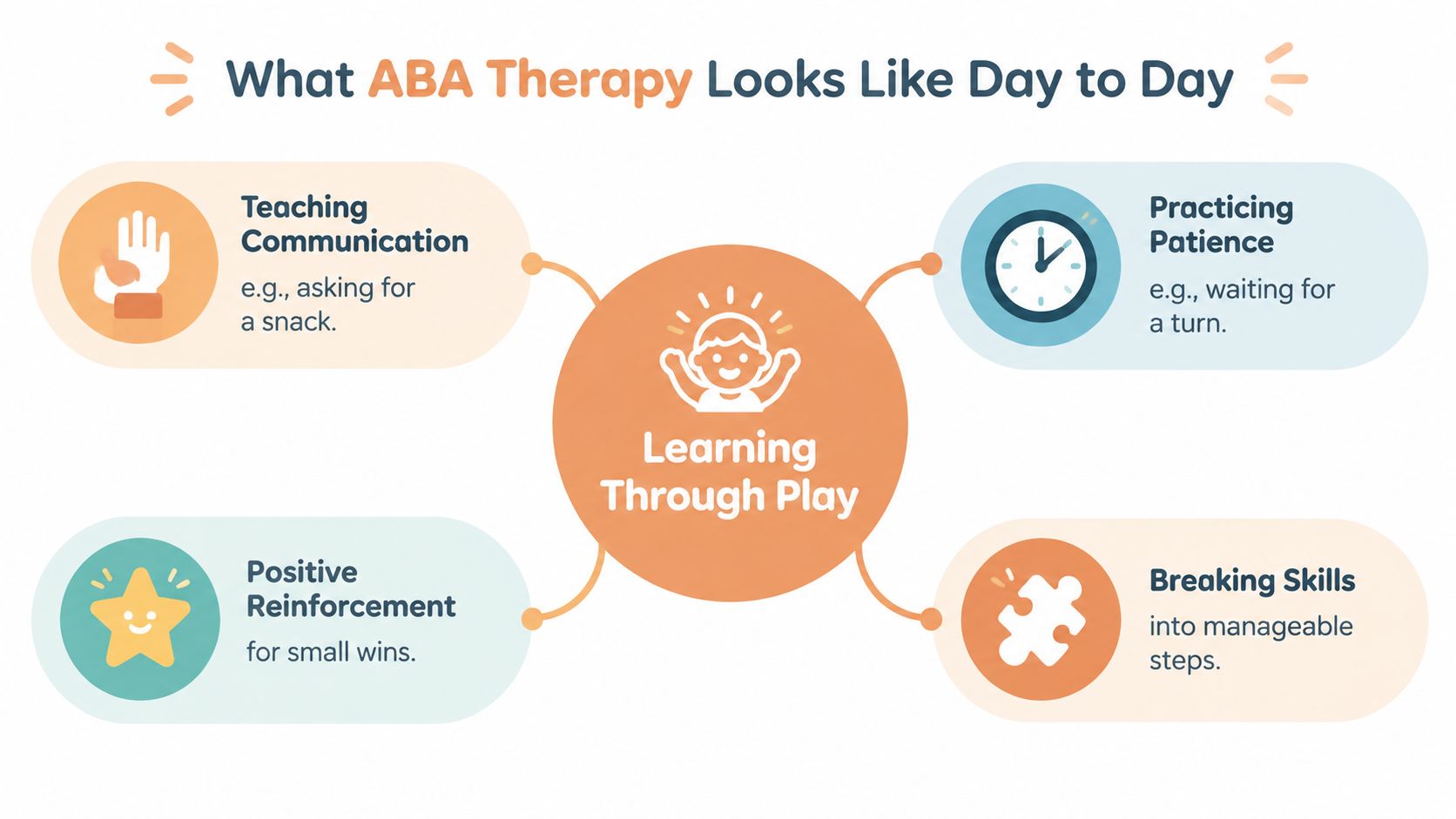
ABA, or Applied Behavior Analysis, sounds technical until you see it through everyday life. It's basically a way of teaching skills in small, repeatable steps, then practicing them often enough that they start to show up outside therapy too. The field became a formal, research-based autism intervention in the 1960s, with roots that include early behaviorist milestones and the UCLA Young Autism Program's structured treatment model (NCBI Bookshelf).
A child might work on asking for a snack instead of reaching for it, waiting for a turn at the playground, or moving through a morning routine one piece at a time. Those are ordinary moments, but they're often the moments that make family life feel smoother. The center's job is to turn those moments into teachable steps.
What a session usually feels like
A session doesn't have to look rigid to be structured. A therapist might spend a few minutes on a communication goal, then move into play, then practice a transition like cleaning up and switching activities. The point is repetition with support, not pressure.
ABA works best for many families when the skill is practiced where it matters, during snack time, bath time, mealtime, or a hallway transition before school.
That's why a good center talks about generalization, even if it uses simpler language. The child isn't just learning in a room. They're learning so the same skill can show up at home, in the classroom, or at the park.
Why this approach can feel familiar to kids
Children usually do better when learning feels connected to what they already know. A therapist may break a task into manageable pieces, give positive feedback right away, and repeat the same routine until it feels predictable. The structure can be comforting because it reduces guessing.
If you want a plain-language picture of the daily rhythm, this is it. The child practices a small skill, gets support, repeats it in a different moment, and slowly uses it with less help. That's ABA at its most practical.
Core Services an ABA Therapy Center Offers
A child's day at an aba therapy center works best when the services fit together. The goal is not just therapy in one room, but steady practice across home, school, and center routines so families are not left to piece everything together alone.
One part of that picture is direct treatment. ABA practice guidelines describe programs with 30 to 40 hours per week of direct treatment, while focused programs usually use 10 to 25 hours per week. Supervision is added on top of those direct hours, not counted inside them, because the plan still needs review and adjustment as the child grows and changes (ABA Practice Guidelines).
The main services families usually see
One-to-one sessions are the core of many programs. A therapist works directly with your child on communication, routines, play, or daily living skills, then shares what happened with the supervising clinician.
Parent coaching matters too. Recent guidance says parent training is often part of ABA, not an extra, and many state-regulated plans cover it when it is medically necessary (insurance guide). When parents use the same strategies at home, the child sees a more consistent pattern from one setting to the next.
Social skills groups add peers to the lesson. Children practice turn-taking, conversation, and group routines with support, which can feel more like real life than one-to-one work alone. You can see one example of how centers describe that kind of programming in this social skills development overview.
Home-based programming brings goals into everyday routines, like getting dressed, brushing teeth, or moving through bedtime. School support ties goals to classroom participation, transitions, and communication with teachers. Some families only need one setting, but many do better with a mix.
| Service | What It Focuses On | How It Looks for a Family |
|---|---|---|
| Direct one-to-one therapy | Communication, routines, daily living skills | A therapist works beside your child during planned activities |
| Parent coaching | Carrying skills into home life | Caregivers learn how to respond the same way between sessions |
| Social skills groups | Peer interaction and turn-taking | Children practice group routines with support |
| School support | Classroom participation and transitions | The team helps align goals with school expectations |
| Home-based programming | Daily routines in the home | Goals are built around meals, dressing, or bedtime |
The strongest centers do not treat these as separate products. They connect them so your child's plan fits real life, and so parents know what happens before a tour, during services, and after the first weeks of care.
Who Works With Your Child and What Their Credentials Mean
At an aba therapy center, the titles can sound crowded at first, especially if this is your first tour. A clearer way to read the team is this, one person plans the work, one person carries out most sessions, and one person keeps your family informed and organized. That setup matters because parents should not have to sort out care by asking the same question three different ways.
The three roles most families meet
The BCBA, or Board Certified Behavior Analyst, is the person who builds the plan, reviews progress, and changes goals based on data and family feedback. In many centers, this role stays active after the first visit. The BCBA supervises staff, checks whether the plan still fits your child, and adjusts it as needs change.
The RBT, or Registered Behavior Technician, is usually the therapist working directly with your child during sessions. This person practices skills, follows the plan, and shares what is helping or getting stuck. A well-run center should give the RBT regular coaching and supervision, so your child's sessions do not depend on one person guessing their way through the day.
The care coordinator handles the family side of care, including scheduling, paperwork, communication, and often insurance questions. For many parents, this role is what makes the weekly routine feel manageable. If a center says it has a dedicated coordinator, ask how that person stays in touch before the tour, after intake, and once services begin.
Good question to ask: “Who do I call if I need to change the schedule, ask about progress, or sort out a billing issue?”
What credentials and communication should look like
A BCBA should be easy to reach, not hidden in the background. Parents should expect progress notes, regular reviews, and time to ask questions in plain language. The ABA practice guidelines also describe supervision as part of good care, with regular oversight built into direct treatment (ABA Practice Guidelines).
That same family lens helps you judge the center before you commit. During a tour, ask who writes the plan, who works with your child each day, how often the BCBA checks in, and how parent coaching is built into the schedule. If the center also offers home-based support or a mix of settings, ask how the team keeps the same goals and communication across each place. A dedicated coordinator should be able to explain that without making you chase answers.
The main idea is simple. You are joining a coordinated team, not hiring one therapist in isolation. When the team is set up well, you should leave the first visit feeling informed, not left out.
Home-Based, Center-Based, or a Mix of Both
A first decision about ABA often comes down to where your child learns best. One family may feel relieved by a center because their child does well with peer practice, a set routine, and a clear space for learning. Another family may need support at home, where the hardest parts of the day happen around meals, transitions, and bedtime.
How the settings feel in real life
Center-based ABA can help when a child needs practice with social interaction, group routines, or learning away from home distractions. Home-based ABA often feels more natural when the goal is to work on everyday routines in the place they happen. ABA can be delivered in the home, community, and school settings, and home-based programs often include parent training so caregivers can carry the work into daily life (program description).
A blended plan can give a family the structure of a center and the practical, day-to-day application at home. That matters when one setting alone does not cover the whole picture. If a child is calm in the center but struggles when routines change at home, a mix of settings may fit better than forcing everything into one place.
The practical tradeoffs families usually weigh
Commute time, sibling schedules, and caregiver stress all matter. So does the skill being taught. A child working on peer interaction may benefit from a center, while a child working on dressing or mealtime may do better with home sessions or a combination.
Consider these options:
- Center-based: Helpful when your child needs more peer practice, structure, and a dedicated therapy space.
- Home-based: Helpful when daily routines, transitions, and family participation are the main goals.
- Hybrid: Helpful when your family needs both, without asking every skill to fit one setting.
Before you decide, ask how flexible the provider is about changing settings over time. Some children start in one place and shift as goals change. If you want a closer look at how home services fit into everyday routines, this in-home ABA overview can help you compare what that usually looks like.
What a Tour and Intake Visit Usually Include
The first phone call usually tells you a lot about how a center treats families. A good coordinator will ask about your child's history, your concerns, and insurance details, then explain the next step without making you feel rushed. Some families also use that call to compare waitlists and ask how flexible the center is with scheduling.
What to watch for on the tour
During the tour, look at how staff interact with the children already there. Do they speak kindly, keep transitions calm, and give children enough time to move from one activity to another? Those details tell you more than polished marketing language ever will.
You should also notice how the spaces are used. Are there therapy rooms, play areas, and places where a supervisor can observe without interrupting care? A thoughtful layout helps the team tailor sessions and keep the day running smoothly.
The intake process often includes observation time, a caregiver interview, and a goal-setting meeting. That's where the team learns what matters in your home, at school, and in everyday routines. The point isn't to label your child, it's to understand where support would fit best.
Ask directly: “How are progress notes shared, how often do parents get check-ins, and who explains the treatment plan to me?”
If you want a preview of that process, this first ABA assessment guide can help you know what questions to bring.
A good first visit should leave you with clarity about what happens next, not a vague promise to “follow up soon.” If you leave still wondering who calls you back, how many children each therapist sees, or how parent coaching fits in, keep asking. The right center won't mind.
Signs a Center Is the Right Fit for Your Family
A center can look polished and still not feel right for your family. The more useful question is whether the team listens well, explains clearly, and treats your concerns as part of care instead of an interruption. That's often where fit shows up.
Green flags are easy to spot once you know what matters. Staff greet your child by name, the BCBA is present enough for you to recognize them, and someone can explain the plan in ordinary language. If parent coaching is built into the schedule, that usually means the center expects families to be partners, not spectators.
Red flags look different. Intake conversations feel rushed, answers about supervision stay vague, or the team seems reluctant to share how progress will be measured. If a center pushes for a commitment before the assessment is complete, slow down.
Pay attention to the language people use about your child's goals. Good teams talk about routines, communication, school participation, and daily life, not just “fixing behavior.” That shift in language often tells you whether the center sees your child as a whole person.
A center that fits well should feel calm, organized, and open to questions. It should also make it obvious who handles communication when your schedule changes or you need a follow-up. That kind of partnership can matter as much as the therapy itself.
The First Month After You Start Services
The first month is usually more structured than parents expect, and that's a good thing. It gives the team time to learn your child, shape the plan, and avoid guessing. It also gives you a rhythm to follow so the process feels less mysterious.
A realistic early timeline
The first week often includes a formal assessment, observation, and a few low-pressure pairing sessions where the therapist gets to know your child. Pairing sounds clinical, but in practice it just means building trust first. A child who feels safe is more likely to participate, especially when everything is new.
By weeks two and three, families usually see a written treatment plan, regular session times, and an early parent coaching conversation. That's the point where the team starts showing you how to reinforce the same skills at home. If the plan is clear, you should be able to understand what's being taught without decoding a stack of jargon.
By week four, the BCBA should be reviewing progress data and adjusting goals if needed. Many families also get a recurring check-in rhythm from there, so they know when to expect updates instead of waiting and wondering. That steady cadence helps because ABA retention and intensity can be hard to sustain in real life, and one large U.S. outcomes study found that while 66% of referred children started ABA, only 46% remained in ABA for 24 months, and just 28% received a full dose defined as at least 80% of recommended hours (outcomes study).
A simple way to decide
Start with your child's needs and your family's routines. Then compare center-based, home-based, and hybrid models against that picture, not against a generic idea of what ABA “should” look like. If the tour showed real supervision, clear communication, and parent coaching that fits into life, you're probably close to a good match.
If a provider also has a dedicated care coordinator, that's a practical bonus, because it means one person can help you track scheduling, funding, and follow-up questions while the clinical team stays focused on treatment. That kind of support doesn't make the therapy better by itself, but it can make the whole experience far easier to manage.
Choosing an ABA therapy center isn't a one-time test you have to ace. It's the beginning of a working relationship. Ask questions as often as you need to, and expect the team to welcome them.
Friendly ABA Premier provides individualized ABA therapy, home-based support, social skills development, school support, and parent coaching for families across CT, GA, MD, MA, NC, SC, VA, and WA. If you're comparing an ABA therapy center with a more family-centered, coordinated approach, visit Friendly ABA Premier to talk with a team that can walk you through assessment, scheduling, and next steps with care.
Our Latest Insights




























Experience ABA Therapy with a More Personalized Level of Support
Discover how FriendlyABA Premier combines evidence-based ABA therapy with dedicated coordination, proactive communication, and individualized family support.