

In Home ABA Therapy: What Families Need to Know
Discover what in home ABA therapy looks like, how sessions fit into family life, and what to expect when choosing a provider for your child's care.

The first morning after a diagnosis or referral can feel oddly ordinary and completely overwhelming at the same time. Breakfast is on the counter, a toy is missing, and you're trying to figure out how therapy could possibly fit into a real household with work calls, siblings, naps, and the rest of family life.
That's where in home ABA can feel different from what many parents picture. Instead of asking a child to adapt to a clinic room right away, the therapist comes into the rhythms already happening at home, then uses those moments to build communication, play, and daily living skills in a way that feels connected to your child's real day.
Table of Contents
- What In Home ABA Therapy Actually Looks Like
- Warm-Up and first teaching moments
- Practice during real routines
- Wrap-up and parent handoff
What In Home ABA Therapy Actually Looks Like
A therapist might walk in while your child is reaching for a favorite snack, or while blocks are spread across the rug. That first stretch often looks calm and familiar, because the goal is to join the routine, not interrupt it.
Applied Behavior Analysis, or ABA, is a way of understanding how children learn from what happens around them. The formal field was defined in 1968, when Donald Baer, Montrose Wolf, and Todd Risley published the founding paper that established ABA's defining dimensions in the first volume of the Journal of Applied Behavior Analysis. Its roots go back further, through Watson's behaviorism in 1913, Skinner's operant conditioning in 1938, and later structured autism-focused applications in the 1960s.
That history matters because in home ABA isn't a casual wellness service, it comes from a long tradition of careful observation, teaching, and measurement. The modern version feels much more family-centered than the old stereotype of rigid table work.
A better way to think about it is this. Your therapist looks for small learning moments inside everyday life, then helps your child practice them in the place they already spend most of their time.
Practical rule: if a skill matters at the table, during bedtime, or in the car, it should probably be practiced in those places too.

For many families, that means the session starts with everyday things, then gradually becomes more intentional. A child might practice asking for juice, waiting for a turn with a toy, or moving from play to cleanup with less frustration.
The point isn't to turn home into a classroom. The point is to make learning easier to carry into the life your family already has.
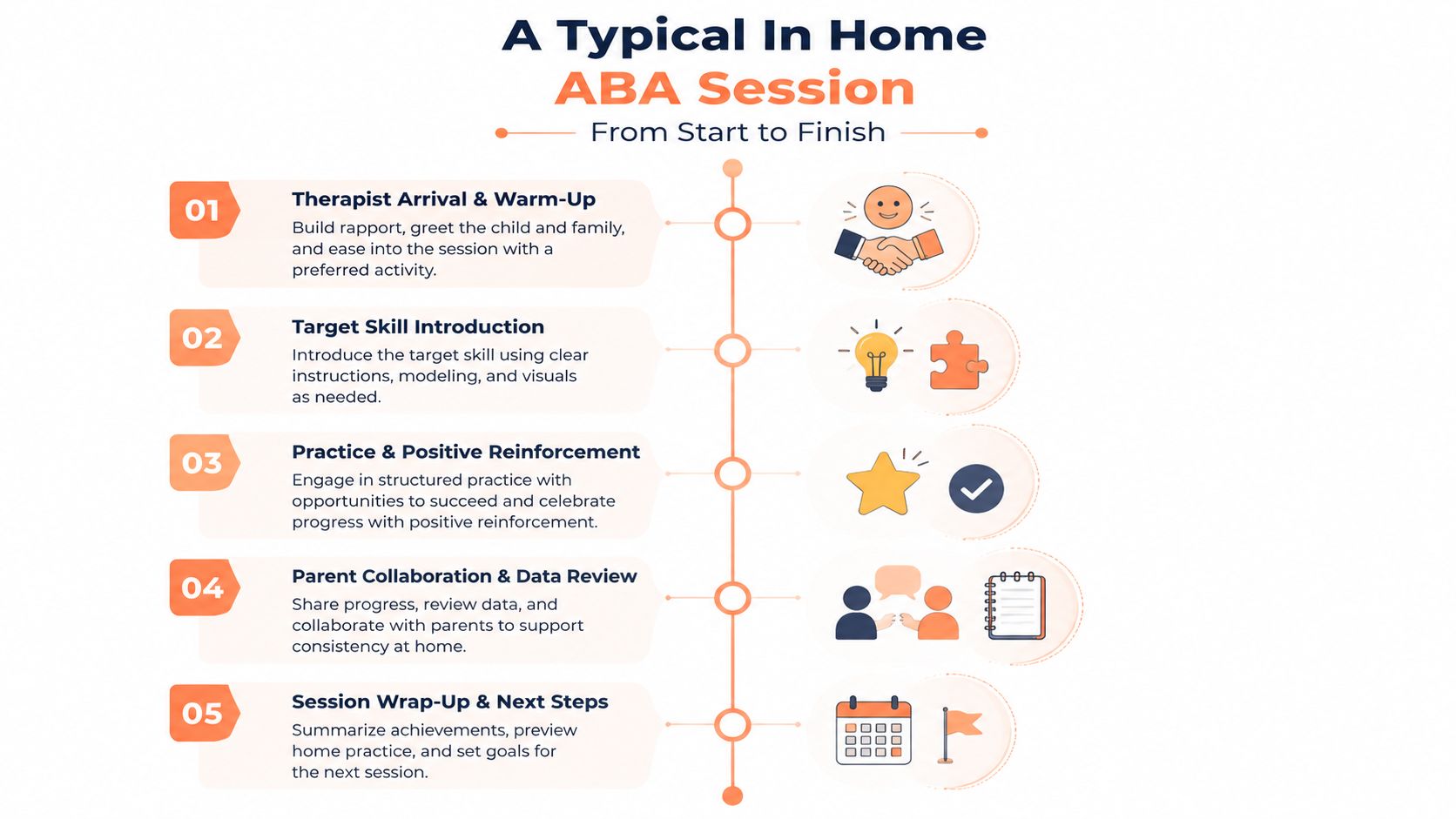
A Typical In Home ABA Session From Start to Finish
Before the first visit, families typically wonder whether the therapist will sit at the kitchen table, whether worksheets will appear, and what happens if their child is tired that morning.
A typical session usually starts with a short arrival routine. The therapist greets your child, settles in, and spends a few minutes watching mood, energy, and current interests so the session can start in a way that feels workable.
Warm-Up and first teaching moments
The early part of the session often uses favorite items or familiar play to build momentum. If your child loves cars, the therapist might use cars to practice requesting, sharing, or matching colors.
A Registered Behavior Technician commonly delivers the day-to-day session, while a BCBA, or Board Certified Behavior Analyst, oversees the plan and adjusts goals as needed. The BCBA helps make sure the teaching matches your child's needs, while the RBT is usually the person working directly with your family on the floor, at the table, or during routines.
The therapist also collects data during the session. That sounds technical, but in practice it usually means tracking whether a skill happened, how much support was needed, and what worked well that day.
Practice during real routines
Mid-session is often the most useful part of in home ABA because the teaching happens inside ordinary routines. A child might ask for a cracker during snack, practice taking turns with a sibling, or work on moving from one activity to another without a big upset.
If a child is learning to request help, the therapist may pause just long enough for the child to try. If the child points, signs, says a word, or uses a communication tool, the therapist responds right away and reinforces that effort.
The flow can shift from day to day. A tired morning may call for more play and fewer demands, while a high-energy afternoon might be better for movement, transitions, and short bursts of structured teaching.
Wrap-up and parent handoff
The end of the session usually includes a quick review with you. You may hear what skills were targeted, what your child responded to well, and what to keep practicing between visits.
That handoff matters because in home ABA works best when the provider structure keeps the load off parents. A strong team gives families a clear point of contact, shares updates without making them chase information, and helps the next session build on what happened today. With that support, therapy feels more like part of the household rhythm, the same way a good recipe follows the same steps but still adjusts for a child who is tired, hungry, or full of energy.
When a provider does this well, the session feels less like an appointment in your house and more like a guided part of your family's routine.
Why Parent Training Is the Key to In Home ABA Success
Parents often worry they'll be expected to perform therapy perfectly between sessions. That's not the point. What matters is whether caregivers are coached clearly enough to use the same strategies in real life, not just watch them happen.
A review of parent-implemented home therapy programs found preliminary evidence of gains in speech and language, especially when home programs were delivered at high dosage and paired with direct parent training. That doesn't mean more hours alone solve everything. It means the coaching matters just as much as the time spent.
A useful way to think about treatment fidelity is consistency. It's not perfection, it's whether the adults around the child are using the same prompting, reinforcement, and error-correction steps often enough for learning to stick.
The home setting works best when caregivers aren't left to guess.
That's why many programs include parent training sessions, often 1 to 2 hours per week, alongside direct therapy time, so caregivers can learn the same techniques used during sessions and carry them into meals, play, and bedtime. One practical example of that kind of support is parent coaching, which helps families practice strategies with guidance instead of trying to figure them out alone.
The broader pattern from the evidence is clear enough for families to use. In home ABA tends to be strongest when the provider treats parent training as part of the treatment, not an optional extra.
That also changes the emotional experience for parents. Instead of feeling like you're being asked to become a therapist, you're being asked to become a supported partner who knows what to do during ordinary moments.
In Home ABA Versus Center Based Therapy
A lot of parents get stuck on the question of which setting is “better.” The more useful question is which setting fits the goal, the child, and the family's actual day.
Home and center settings each bring different strengths. An evaluation comparing settings reported that children who received both home and center services mastered 100% more per hour in the center than at home, which shows how structure can change the pace of learning. At the same time, in-home ABA can be powerful for building skills where they'll be used.
A later review also summarized mixed evidence from a randomized trial, with stronger gains for clinic-based programs in social and communication outcomes and parent-reported competence. That doesn't make home care less useful. It means the setting should match the goal instead of assuming one model works best for everything.
In Home ABA vs Center Based ABA at a Glance
| Factor | In Home ABA | Center Based ABA |
|---|---|---|
| Environment | Familiar home routines, siblings, meals, play spaces | Structured therapy setting with fewer household distractions |
| Generalization | Strong for practicing skills where they naturally happen | Good for preparing skills, then bringing them home later |
| Parent involvement | High, with direct coaching built into the routine | Varies by program, often less embedded in daily life |
| Scheduling flexibility | Often easier to fit around work, school, and naps | More fixed around clinic hours and travel time |
| Social opportunities | Depends on who is present at home | Often stronger chances for peer interaction |
For many families, in-home ABA makes the most sense when goals include bedtime, toileting, meal routines, communication at home, or smoother transitions. Center-based care may fit better when a child needs a highly structured teaching environment or more built-in peer interaction.
The hidden tradeoff is coordination. Home therapy can reduce travel and bring support into real routines, but it also asks the family to manage space, timing, and follow-through.
The best choice usually isn't the one that sounds most impressive. It's the one that matches your child's needs without overwhelming the rest of the household.
How to Choose the Right In Home ABA Provider
Not every provider organizes home therapy the same way. Some families get a strong clinical plan but very little communication, while others get friendly visits and no real structure. The difference usually shows up in the details.
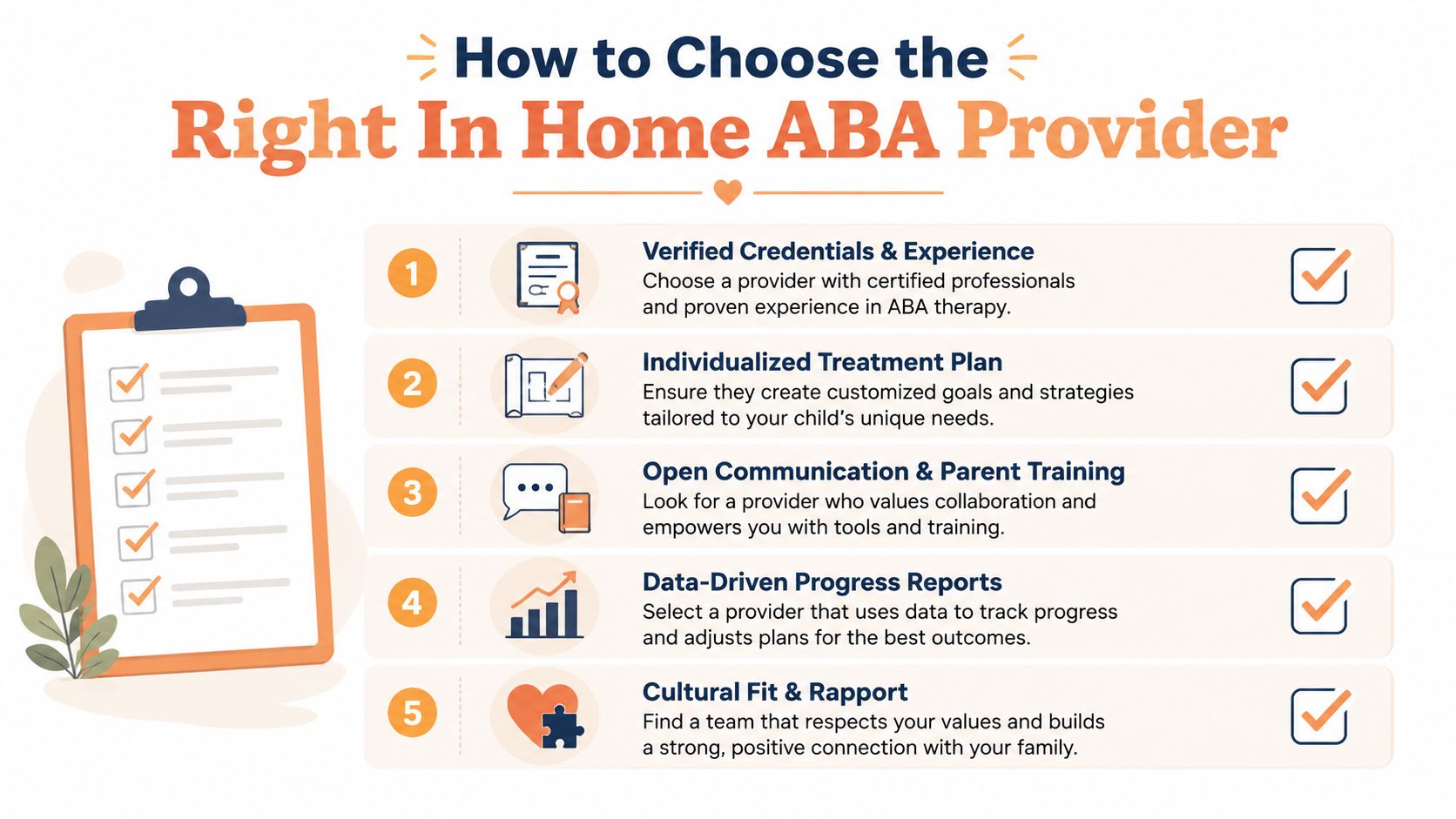
A good provider should be able to explain how they build goals, how often they check progress, and who helps your family stay on track. If you're comparing options, the approach should feel individualized, not like a script that gets reused for every child.
Look closely at the pieces that shape your day, not just the credentials on paper.
- Verified Credentials and Experience: Ask who supervises the case, who delivers sessions, and how the team handles changes when something isn't working.
- Individualized Treatment Plan: The plan should name specific goals, methods, an estimated timeline, and clear responsibilities for parents and therapists.
- Open Communication and Parent Training: A strong provider explains strategies in plain language and gives you a way to ask questions before problems pile up.
- Data-Driven Progress Reports: You should know how progress is tracked and how often the team reviews it with you.
- Cultural Fit and Rapport: Your child should feel safe, and you should feel respected, heard, and included.
A few red flags are worth noticing early. High staff turnover, vague answers about supervision, or a provider who treats parent training as optional can make home services feel much harder than they need to be.
A dedicated care coordinator can change that experience in a very practical way. When one person helps manage scheduling, insurance questions, and progress check-ins, parents spend less time chasing information and more time supporting their child.
That's the kind of structure that turns therapy from one more task into something the household can sustain.
Scheduling Insurance and Getting Started With Confidence
The logistics often feel heavier than the therapy itself at first. Parents are trying to fit sessions around school, naps, work, siblings, and the simple reality that home life already has a rhythm.
Insurance can be part of the relief. One source states that most major commercial policies and state Medicaid programs cover in-home ABA when it's prescribed by a qualified professional, and that parent training may be included as a standard part of the plan. Since coverage always depends on the policy, it's smart to confirm benefits before starting and ask how the provider helps with authorizations.
A helpful next step is to ask how scheduling works in real life. Some families need early mornings before school, others need afternoons after work, and others need a slower start while everyone adjusts.
If you're also trying to understand the money side of things, this overview of ABA therapy costs can help you think through the practical questions that come up before services begin.
Starting therapy can bring hope and a little nervous energy at the same time. That mix is normal.
The right provider should help you plan for the first assessment, talk through what the first few weeks may look like, and keep communication steady so you aren't left guessing. A good home program should feel like support entering the house, not another source of pressure.
Friendly ABA Premier helps families build in home ABA around real routines, with a dedicated care coordinator, individualized treatment plans, and parent coaching that fits daily life. If you're looking for a team that treats communication and follow-through as part of care, visit Friendly ABA Premier to start a conversation and see whether home-based support is the right fit for your family.
Our Latest Insights









































Experience ABA Therapy with a More Personalized Level of Support
Discover how FriendlyABA Premier combines evidence-based ABA therapy with dedicated coordination, proactive communication, and individualized family support.