

What Is a Behavior Intervention Plan? a Parent's Guide
Learn what is a behavior intervention plan, how it's created from an FBA, and how families and schools work together to support your child's growth.

A behavior intervention plan is a personalized, evidence-based action plan built from a functional behavior assessment that identifies why a behavior happens and outlines specific strategies to teach replacement skills and support positive change. In U.S. special education, the plan connects assessment, prevention, teaching, and progress monitoring within a legally recognized framework.
You may be hearing about one because a teacher says your child needs a BIP during an IEP meeting. The conversation can feel unsettling, especially when phrases like “challenging behavior,” “functional assessment,” or “behavior support” make it sound as though your child is being defined by a problem. A well-designed plan should do the opposite. It should help adults understand your child's communication, strengths, needs, and environment so they can respond more effectively.
Table of Contents
- Step one identifies the pattern
- Step two turns observation into a hypothesis
- Step three builds the plan around the function
- A clear description of the target behavior
- A function that guides every decision
- Prevention before the behavior begins
- Replacement skills and direct teaching
- Reinforcement and responses
- Look for evidence of your child's actual experience
- Compare the hypothesis with what you see
- Check implementation quality
Understanding What a Behavior Intervention Plan Really Is
You are sitting in an IEP meeting when the team recommends a behavior intervention plan. It is natural to wonder whether your child is in trouble, whether punishment is involved, or whether adults have already decided what your child is doing “wrong.” A BIP gives the team a structured way to understand behavior and respond with useful support.
A BIP works like a teaching roadmap. It describes an observable behavior, records the team's best-supported idea about why it occurs, and connects prevention strategies, replacement skills, adult responses, and data collection. Guidance from the Oregon functional behavior assessment and BIP framework emphasizes plans that are hypothesis-driven, student-centered, and monitored over time. For parents, those features provide practical quality checks: the plan should explain why each strategy fits this child, show who will use it, and include a way to review whether it helps.

Behavior can communicate a need
Consider a child who leaves the classroom when noise rises or a transition begins. Calling the behavior “eloping” may describe what adults see, but it does not explain what the child needs. A function-based BIP asks: What is the child trying to communicate or obtain?
The answer might involve escaping an overwhelming situation, reaching a trusted adult, finding a quieter space, or responding to an unpredictable change. The plan could teach the child to request a break, use a visual transition cue, walk with a staff member, or communicate “too loud” through speech, gestures, or an AAC system.
Practical rule: A BIP should teach what the child can do instead, going beyond what adults want the child to stop doing.
This approach became part of U.S. special education policy through the 1997 reauthorization of the Individuals with Disabilities Education Act. The law directed IEP teams to consider positive behavioral interventions and supports when behavior impeded learning. In certain discipline situations, it also required a functional behavioral assessment before, or no later than 10 days after, specified disciplinary actions. The 1997 IDEA amendments connected behavior intervention plans with individualized education programs.
An IEP describes the student's special education program and services. A BIP addresses behavior-related supports within that broader program. Families can evaluate the connection by asking whether the plan reflects their child's communication, strengths, settings, and daily routines, and whether staff have a shared, practical response. That is the difference between a document that sits in a file and one adults can implement consistently.
How a Functional Behavior Assessment Leads to a BIP
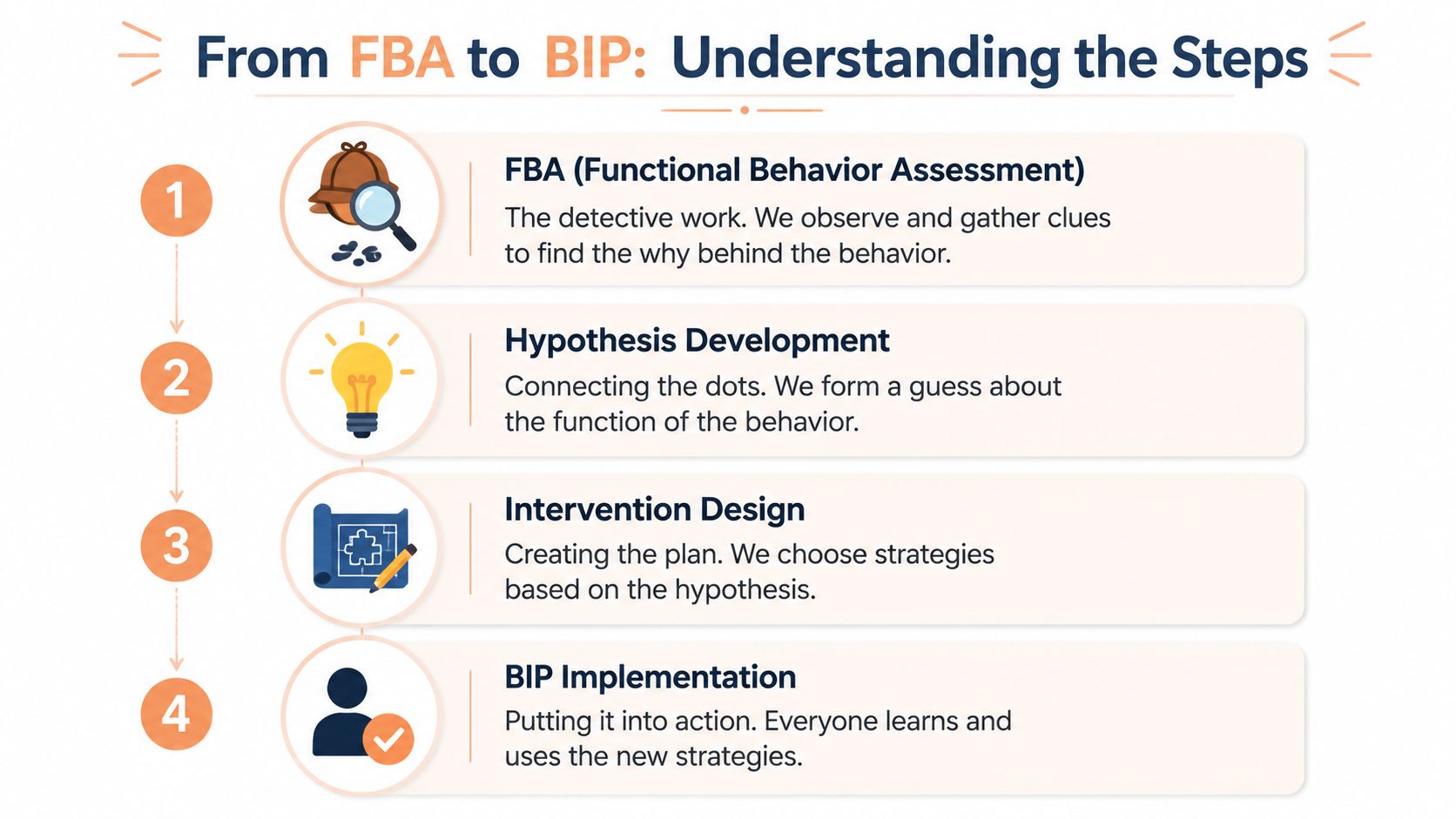
A child flips over a desk when math work begins. One adult may see defiance, while another notices that the worksheet is difficult and the demand ends afterward. A functional behavior assessment, or FBA, helps the team examine that sequence before choosing an intervention.
An FBA gathers information about what happens before a behavior, what the behavior looks like, and what follows it. The team compares those observations with family and teacher reports, records, and the child's communication, abilities, learning history, and environment. The goal is a working hypothesis about the behavior's likely function.
Step one identifies the pattern
The team may interview the teacher and family, review records, observe math instruction, and collect ABC information:
- Antecedent: The teacher presents an independent worksheet.
- Behavior: The child flips the desk.
- Consequence: The worksheet is removed, the child leaves the activity, or an adult provides extended support.
One observation cannot establish the reason for a behavior. The team looks for repeated patterns across relevant situations. Parents can use the IRIS Center's FBA guidance to understand why a useful assessment should connect triggers, observable behavior, likely function, and replacement skills.
Step two turns observation into a hypothesis
If desk flipping repeatedly follows difficult math demands and the task then ends, the team may hypothesize that the behavior helps the child escape or delay a difficult task. That explanation is grounded in observation and guides teaching. It does not assign blame or make assumptions about the child's character.
The team can then adjust the demand and teach a safer response. Options might include reducing the amount of work at one time, offering a choice between activities, using a visual schedule, and teaching the child to hand over a break card or gesture for “help” or “break.” Adults respond to that communication and gradually build participation in manageable work.
Step three builds the plan around the function
A BIP should show how the FBA findings become daily actions. Directions such as “redirect” or “use positive reinforcement” leave too many decisions to individual staff members. A well-connected plan specifies what adults should do, when they should do it, what skill they will teach, and how they will respond when the behavior occurs.
If escaping work appears to maintain the behavior, the replacement response needs to provide an appropriate way to request assistance, a pause, or adjusted support. Families can also review what to expect during your first ABA assessment when comparing an ABA assessment with a school-based process. The same quality question applies in either setting: do the observations lead to individualized teaching and consistent implementation?
Positive behavior support developed through research and policy work, including applied demonstrations at the University of Oregon during the 1980s, as described in the National Technical Assistance Center on PBIS history. After the 1997 IDEA amendments, Congress authorized a national PBIS center to disseminate evidence-based practices. By 2025, the center reported providing direct professional development and technical assistance to more than 16,000 schools. This broader support system can help schools implement an individual BIP with greater consistency.
Key Components Every Strong Behavior Intervention Plan Includes
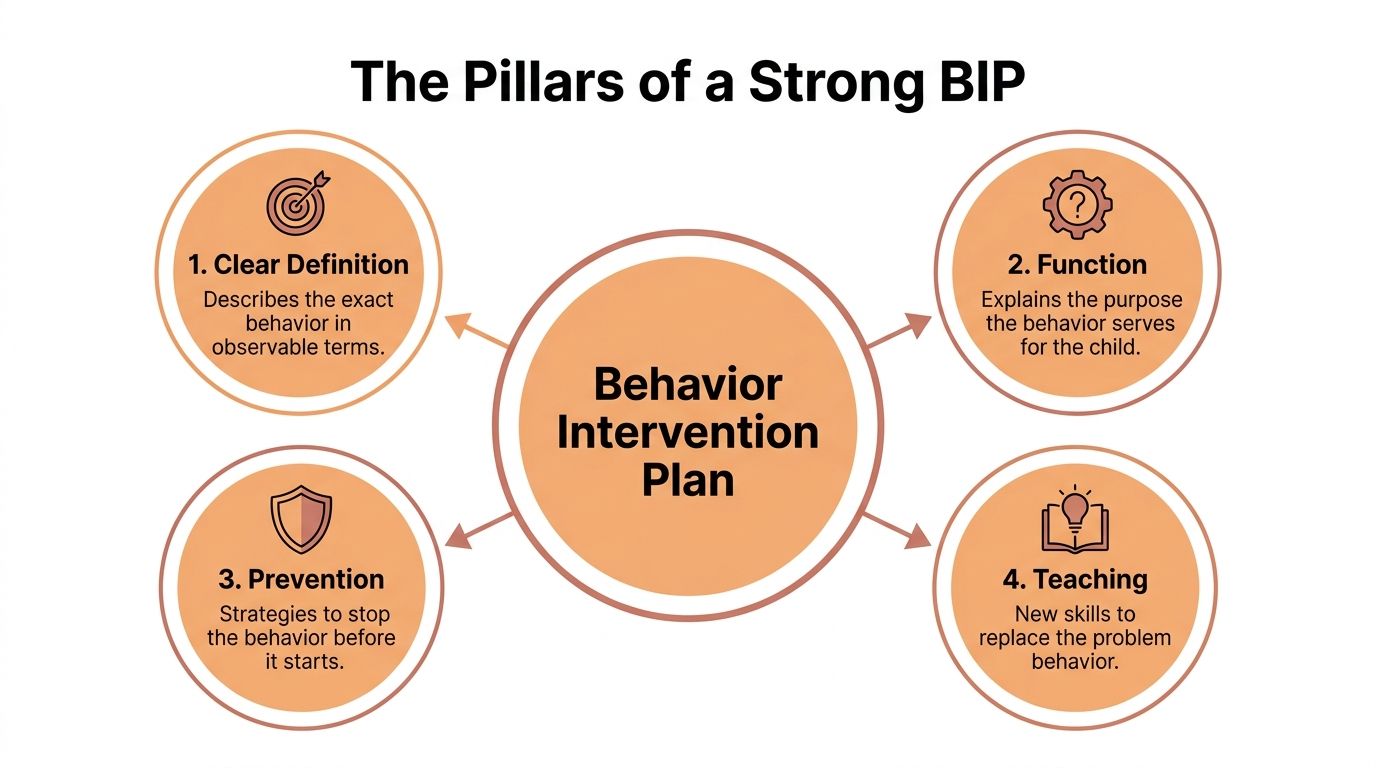
A strong BIP should read like one connected explanation, not a collection of unrelated classroom tactics. A review of BIP quality identified 11 core components, including the target behavior, hypothesized function, goals, antecedents, prevention strategies, replacement behaviors, teaching interventions, consequence strategies, and data collection methods. You can read the review of core BIP components for the full research-backed framework.
A clear description of the target behavior
“Acting out” is too vague. A useful definition describes exactly what an observer would see, such as “hitting a peer with an open hand” or “leaving the assigned classroom area without permission.” It should make it possible for different adults to recognize the same behavior and record it consistently.
The plan may also describe the behavior's frequency, duration, or intensity, depending on what matters for the child's safety and learning. A goal should be meaningful, observable, and connected to participation, communication, independence, or another practical outcome.
A function that guides every decision
The function is the reason the behavior continues, based on the FBA hypothesis. Common examples include gaining attention, escaping a demand, accessing an item or activity, or meeting a sensory or regulation need.
The function matters because the same behavior can serve different purposes for different children. A child who cries at the dinner table might be avoiding a texture, seeking adult help, communicating discomfort, or trying to access a preferred food. The plan should not assume that one response fits every child.
Prevention before the behavior begins
Antecedent strategies change conditions that make the behavior more likely. A BIP might include a visual schedule, an adjusted seating arrangement, shorter instructions, transition warnings, predictable choices, reduced noise, or access to communication supports.
These changes aren't about lowering expectations. They make the environment easier to understand and give the child a clearer path to success.
Replacement skills and direct teaching
A replacement behavior is a skill that meets the same need in a more appropriate way. A child who throws materials to escape a task might learn to request a break. A child who calls out for attention might practice raising a hand or using a visual signal.
The plan should explain how adults will model, prompt, practice, and reinforce the skill. It should account for the child's communication style, including speech, gestures, sign language, pictures, or AAC.
Reinforcement and responses
Reinforcement means making an appropriate behavior worthwhile by following it with something meaningful to the child. The plan should specify what adults will reinforce, how quickly they'll respond, and what happens as the child becomes more independent.
Consequence strategies describe the adult response when the target behavior occurs. They should protect safety, avoid accidentally rewarding the behavior, and return attention to teaching the replacement skill. If a safety response or crisis protocol is needed, it must be clear, respectful, and consistent with the child's educational and care-team requirements.
A plan is coherent when the prevention strategy, replacement skill, reinforcement, and adult response all address the same functional need.
Finally, the BIP needs a data collection method. The team may track how often a behavior occurs, how long it lasts, or how intense it is, along with use of the replacement skill. Guidance from state and PBIS implementation materials stresses that responsible staff, practical implementation details, and early review of data are essential. Some guidance recommends examining data after about two weeks of collection to decide whether adjustments are needed.
For parents exploring reinforcement strategies, noncontingent reinforcement in ABA can offer useful background. Your child's own team should determine which strategies are appropriate for the individual situation.
School BIPs Versus ABA Treatment Plans
A school-based BIP and an ABA treatment plan may use similar behavior principles, but they aren't interchangeable documents. A school BIP is designed around access to education, classroom participation, transitions, and safety within the school environment. An ABA treatment plan may address communication, social interaction, daily living, independence, and behavior across home, community, school, or clinical settings.
| Feature | School-Based BIP | ABA Treatment Plan |
|---|---|---|
| Primary setting | School routines, classrooms, transportation, recess, and transitions | Home, clinic, community, and sometimes school environments |
| Main purpose | Reduce barriers to learning and participation | Address individualized developmental and functional goals across settings |
| Typical contributors | Teachers, special educators, school psychologists, administrators, parents, and related-service staff | ABA clinicians, behavior technicians, parents, caregivers, and other providers |
| Behavior targets | Behaviors affecting education, peers, staff, or school safety | Behaviors and skills selected for the child's broader treatment needs |
| Data collection | Classroom or school-based observations and records | Data collected during treatment routines and agreed-upon settings |
| Coordination | Connected to the IEP and school responsibilities | Connected to the clinical plan, family priorities, and treatment goals |
A child might have a school BIP addressing leaving the classroom during transitions while an ABA plan focuses on requesting help, emotional regulation, or completing daily routines at home. The plans can support each other when the adults agree on shared language and compatible responses.
School support may be especially useful when teams coordinate classroom participation, communication, and peer interaction. ABA in schools provides additional context for how school-based support can fit alongside educational planning.
Questions that improve coordination
Ask both teams to clarify the target behavior, the replacement skill, the prompts they'll use, and what reinforcement looks like. Share relevant observations from home, but protect your child's privacy and ask providers to communicate through appropriate consent-based channels.
Avoid copying a school plan directly into an ABA plan, or the reverse. Instead, look for a shared functional understanding while allowing each team to adapt strategies to its setting, staffing, schedule, and responsibilities.
How to Tell If Your Child's BIP Is Uniquely Tailored
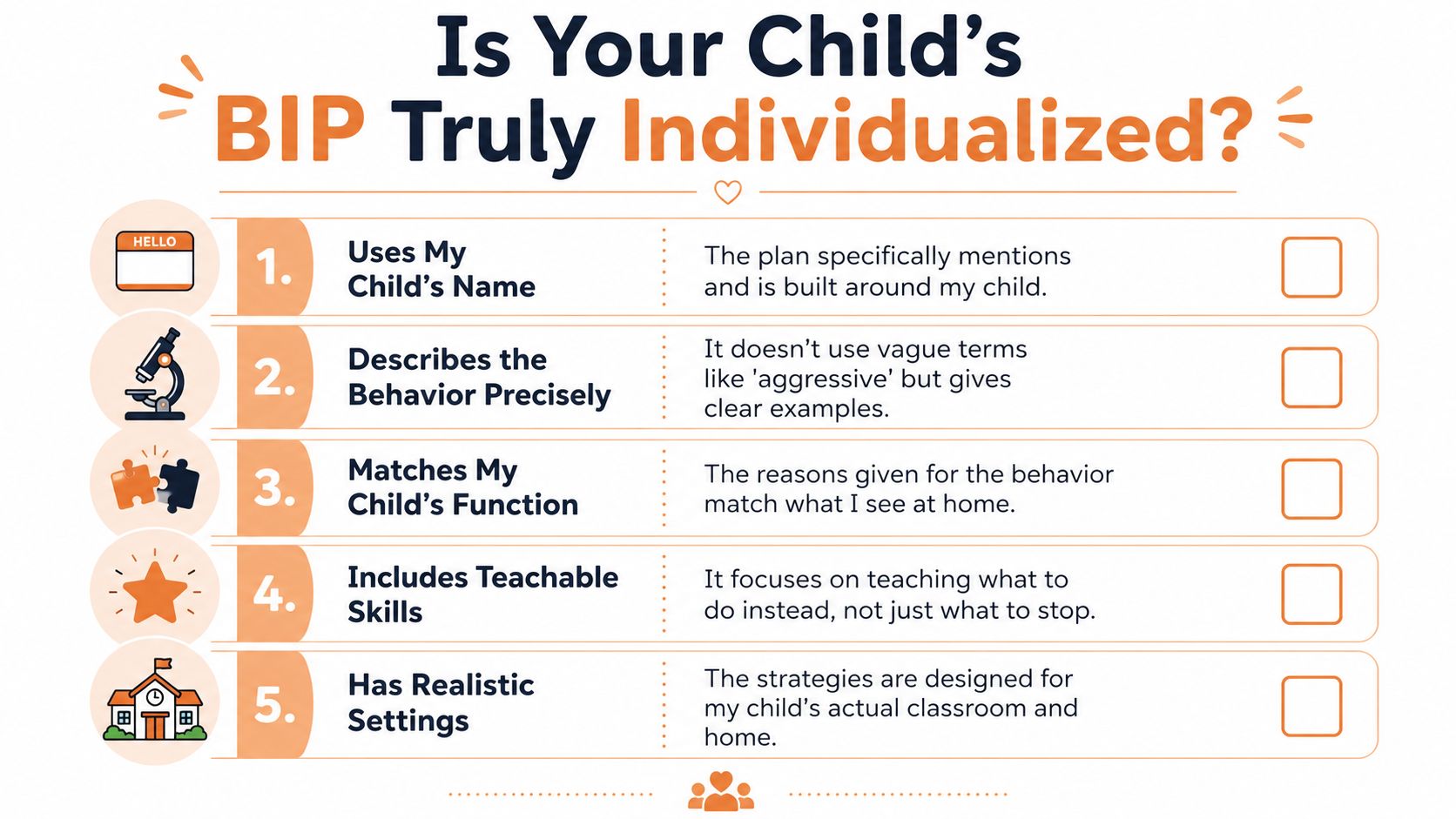
A plan can have polished headings and still miss the details of your child's day. A well-designed BIP describes what happens, where it occurs, what the behavior may communicate, and which replacement skills fit your child's abilities and routines.
Look for evidence of your child's actual experience
A strong plan names relevant routines and describes behavior in observable language. “Noncompliance” leaves too much room for interpretation. “Pushes the worksheet away, places both hands under the desk, and does not begin the assigned activity after an instruction” gives adults behavior they can recognize and measure.
Review whether the plan reflects your child's communication abilities, interests, sensory preferences, strengths, and known triggers. A visual schedule may help one child prepare for a transition. Another child may need an AAC message, movement opportunity, shorter verbal directions, or a quieter work area. These details show that the team built the plan around the child rather than around a standard template.
Compare the hypothesis with what you see
Ask whether the proposed function matches patterns at home and school. For example, a plan may describe attention as the likely function, while the behavior occurs mainly after difficult instructions and stops when work is removed. That pattern calls for a closer review of the hypothesis with the team.
The replacement skill should be equally specific. “Use appropriate communication” does not tell adults what to teach or reinforce. The plan should identify whether your child will hand over a break card, point to “help,” sign, use a device, or say a short phrase. It should also explain how adults will prompt and practice that response.
Ask in the meeting: “What will every adult do before the behavior, when the replacement skill appears, and if the target behavior occurs?”
Check implementation quality
A carefully written plan cannot help if staff have not seen it or respond differently. Ask who trains staff, where the current version is stored, which settings it covers, who records information, and when the team will review implementation.
Consider the less predictable parts of the day, including arrival, lunch, recess, transportation, and unstructured activities. A usable BIP gives adults guidance for these moments. Consistency means the team follows the same reasoning and responds predictably and respectfully, while still adapting to the setting and your child's needs.
Partnering With Your Care Team to Monitor Progress
A BIP should remain a living document. The team collects information, reviews whether the plan is being implemented, and adjusts strategies when the child's needs or circumstances change. Progress may appear first as a child using a replacement skill with a prompt, then using it independently, then carrying it into a new setting.
A simple home observation note can help. Record the routine, what happened before, what your child communicated or did, what adults tried, and what happened afterward. You don't need to turn family life into a laboratory. A few clear observations can help the school or ABA team see patterns that aren't visible during the school day.
Celebrate practical gains. Your child might ask for help before pushing materials away, move through a transition with a visual cue, or return to an activity after requesting a break. Those moments show growing communication and coping, even when the original behavior hasn't disappeared.
If progress stalls, ask the team to review both the data and implementation. The hypothesis may need updating, the replacement skill may be too difficult, reinforcement may no longer be meaningful, or adults may need additional coaching. You can request an FBA review or a BIP revision through the appropriate school or clinical process, and your care coordinator can help organize questions and communication across providers.
Parents are essential members of this team. Your knowledge of your child's routines, preferences, communication, and strengths helps turn a written plan into practical support.
Friendly ABA Premier provides individualized ABA therapy, parent coaching, social skills development, and school support across Connecticut, Georgia, Maryland, Massachusetts, North Carolina, South Carolina, Virginia, and Washington. If you'd like help understanding a BIP, coordinating with your child's team, or building consistent strategies across home and school, visit Friendly ABA Premier to connect with the team.
Our Latest Insights
















Experience ABA Therapy with a More Personalized Level of Support
Discover how FriendlyABA Premier combines evidence-based ABA therapy with dedicated coordination, proactive communication, and individualized family support.