

Semi Verbal Autism: What It Means and How to Help
Understand semi verbal autism in children, from key characteristics to evidence-based interventions and AAC options. Practical guidance


At snack time, your child reaches toward the cup. You offer water, then milk, then juice. They push each one away, make a sound, and reach again. For a moment, neither of you knows whether the problem is the drink, the cup, the temperature, or the difficulty of explaining it.
Families experience versions of this scene at breakfast, in preschool, on the playground, and during the ride home. A child may use a few words one day and rely mostly on gestures, sounds, or an AAC device the next. That inconsistency can leave parents wondering whether their child understands, wants to communicate, or is overwhelmed.
Semi verbal autism describes a communication profile, not a measure of intelligence, effort, or potential. A child may understand much more than they can say and may already be communicating through pointing, leading an adult by the hand, facial expressions, signs, pictures, or speech-generating technology. The most helpful support begins by noticing the message, then finding a dependable way for the child to send it.
Table of Contents
- A Familiar Moment for Many Families
- Expressive speech
- Receptive understanding
- Intentional communication
- Motor planning
- Questions for a speech-language pathologist
- Questions for an ABA program
- Signs a program may not be a good fit
A Familiar Moment for Many Families
Your child sits at the table and notices the banana on the counter. They look at it, look at you, and make a short sound. You ask, “Banana?” They smile, reach, and perhaps repeat part of the word. Later, when you ask what they want, the same child may not answer at all.
That difference can feel confusing. Parents often see clear signs of understanding during familiar routines. Their child follows a direction, finds a favorite toy, laughs at a familiar game, or anticipates the next step in a song. Yet spoken language may remain limited, inconsistent, or difficult to access when the child is tired, excited, or under pressure.
A child in this position isn't refusing to communicate. They may be using every available route to make themselves understood. A reach toward the cup, a caregiver's hand being pulled toward the pantry, a tap on a picture, or a repeated sound can carry a specific meaning.
Start with the message, not the method. Communication doesn't have to sound like a sentence to be meaningful.
The phrase “semi verbal” is commonly used by families and professionals to describe children who use some spoken language but depend on other communication methods as well. Some children speak in single words or short phrases. Others use speech for familiar requests but switch to gestures, pictures, signs, writing, or AAC in more demanding situations.
There isn't one semi verbal profile. One child may understand directions but struggle to produce words. Another may have words but rarely initiate. A third may know exactly what they want to say but have difficulty coordinating the mouth movements needed for speech. Those differences matter because the right support should match the underlying skill, not just the number of words a child uses.
What Semi Verbal Autism Really Means
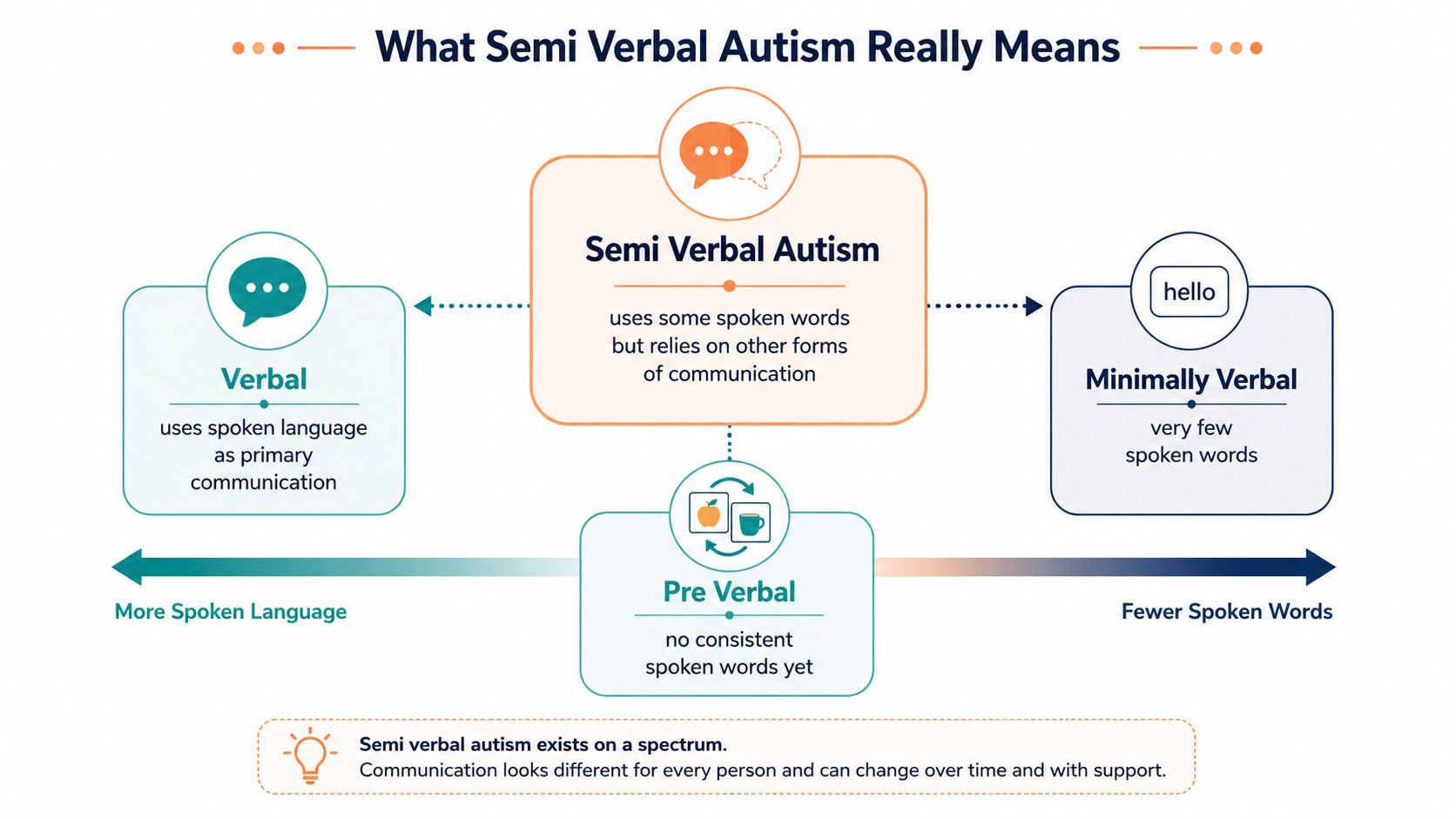
“Verbal” and “nonverbal” can sound like fixed categories, but communication changes across people, settings, energy levels, and tasks. Semi verbal autism sits within that broader range. A child may use spoken words as one communication channel while relying on gestures, visuals, or augmentative and alternative communication, or AAC, to complete the message.
A useful way to understand the profile is to separate four skills:
Expressive speech
This means the words and sounds a child produces. A child might say “car,” “more,” or “go,” yet find it hard to combine words or use them outside familiar routines. Expressive speech is only one part of communication.
Receptive understanding
This is what a child understands when someone speaks, gestures, or shows a visual. Many children with limited speech understand more than they can express, which can make daily communication feel especially frustrating. The communication support guide from Friendly ABA Premier also emphasizes looking beyond spoken output when planning support.
Intentional communication
Intentional communication is a purposeful attempt to send a message. Pointing to a snack, handing over a toy, looking between a person and an object, or selecting a symbol can all show intent. The key question is not only, “Did the child speak?” but also, “Did the child try to make something known?”
Motor planning
Speech requires the brain, breath, voice, lips, tongue, and jaw to coordinate in sequence. A child can have an idea and still struggle to turn that idea into a clear sound. Think of a car with fuel in the tank but a gear that won't shift. The desire and knowledge may be present, while the movement system needs specialized assessment and practice.
Another analogy is a radio. A child may receive language clearly but transmit only fragments or static. That gap doesn't tell you how much the child understands.
“Minimally verbal” generally refers to very limited spoken language, while “pre verbal” describes a child who hasn't yet developed consistent spoken words. These descriptions overlap, and families should use them carefully because a child's communication can develop and change. The important distinction is that limited speech doesn't eliminate the need for rich language, choice, connection, and independence.
How a Good Assessment Looks at Communication
A parent may see a child use a word during play, then hear little or nothing during a formal session. A useful assessment explains that difference by observing communication across play, transitions, meals, instruction, and moments when a preferred item is unavailable. It examines the skills underneath speech, including expressive language, receptive understanding, intentional communication, and motor planning.
Research commonly uses fewer than 30 functional words as a benchmark for describing a child as minimally verbal. That figure describes spoken output at a point in time. The assessment should also examine how the child uses words, gestures, symbols, and other signals spontaneously across settings. Research on minimally verbal autism supports measuring spontaneous words, gesture initiation, communication attempts, and generalization beyond the therapy room, as discussed in this peer-reviewed review of intervention design.
What the evaluator should observe
Ask the team to examine whether your child:
- Uses words or sounds without prompting.
- Points, reaches, gives, looks, signs, or leads someone to communicate.
- Starts an interaction rather than only answering questions.
- Understands familiar and new directions, choices, and visual information.
- Combines communication methods when speech does not carry the whole message.
- Shows signs that speech motor planning needs further evaluation.
A speech-language pathologist with experience in autism and AAC should have a central role. Depending on the child's needs, the team may also include an occupational therapist, educators, behavior analysts, and caregivers who can describe communication at home and school. Families can review what a first evaluation may involve in this guide to a first ABA assessment.
| Skill Area | What It Tells the Team |
|---|---|
| Spontaneous words | Whether speech appears naturally or mainly after prompting |
| Word attempts and sounds | Which speech patterns may be emerging |
| Gestures and pointing | How the child communicates when words are unavailable |
| Initiations and responses | Whether the child starts communication and how they answer others |
| Receptive understanding | What the child understands from speech, gestures, and visuals |
| Motor planning | Whether speech coordination may affect production |
| AAC use | Which symbols, systems, or devices support reliable communication |
| Generalization | Whether skills appear at home, school, and in the community |
Bring short home videos when available, along with current sounds, words, gestures, favorite activities, and common frustration moments. Ask, “What does my child understand?”, “How do they initiate?”, “What communication works when speech is unavailable?”, and “How will we measure progress outside therapy?” A clear baseline helps the team choose goals and track progress over time.
Evidence Based Approaches That Build Communication
Families often hear about several intervention options, and the names can blur together. The strongest plan is usually individualized and blended, with spoken language supported rather than treated as the only acceptable outcome.
| Approach | What It Focuses On | Best Fit When |
|---|---|---|
| Naturalistic developmental behavioral interventions, including ESDM and PRT | Communication inside play, shared attention, motivation, and everyday interaction | A child learns best through engaging activities and natural routines |
| Structured ABA | Breaking communication into teachable steps, practicing them across settings, and using data to adjust support | A child benefits from clear teaching sequences and consistent practice |
| Speech-language therapy | Speech production, language, articulation, and possible motor-planning needs | The child needs specialized evaluation or treatment for speech and language |
| AAC | Pictures, symbols, signs, writing, or speech-generating devices that supplement or replace speech | Spoken language isn't reliable enough for daily needs or more complex messages |
Naturalistic approaches might build a request for “open” into a toy routine. A structured ABA program might teach the child to select “help” on a communication board, then practice that skill with snacks, dressing, and classroom materials. Speech-language therapy may work on sound sequences or motor planning while the child continues using AAC to communicate immediately.
The important comparison isn't “speech or AAC.” It's whether the child has a reliable way to communicate now while the team supports future speech development. In the Cochrane review of communication interventions for minimally verbal autistic children, verbal and AAC interventions produced immediate improvements for some children, while sustained gains weren't consistent for most participants. That uncertainty calls for careful monitoring, not abandonment of communication support.
AAC isn't a failure to speak, and it doesn't mean the team has given up on speech. ASHA describes AAC as including gestures, pictorial supports, and speech-generating devices, and cites a national U.S. survey in which 18.2% of students who need communication support use AAC. The source breaks that figure into 6.9% using gestures, 6.5% using pictorial supports, and 4.8% using speech-generating devices in its AAC practice portal.
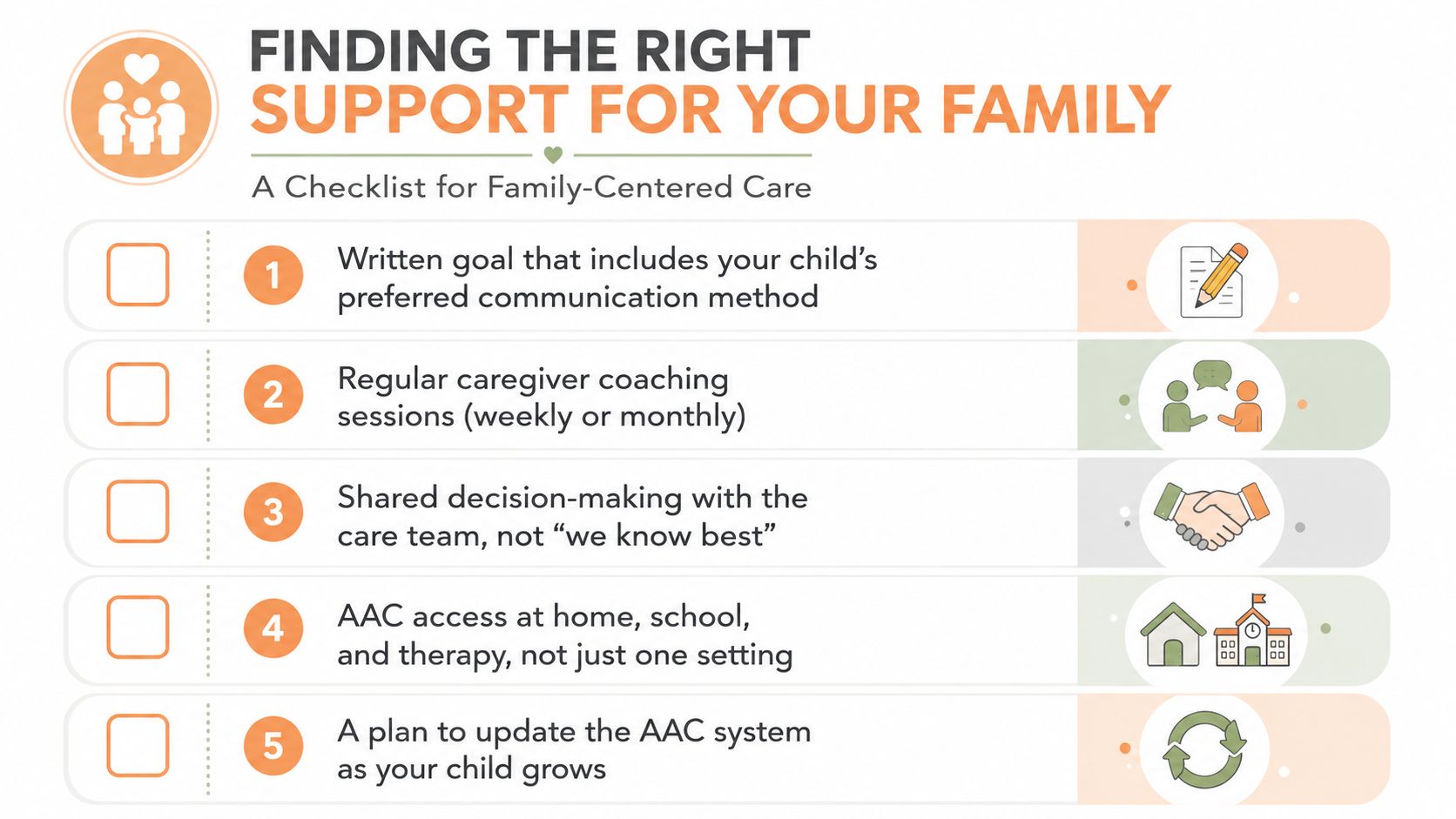
Quality care has a visible baseline, functional goals, caregiver coaching, and respect for assent. A goal might be “request help during dressing” rather than “increase compliance,” or “comment during shared play” rather than “produce more speech.” The child should have opportunities to communicate something they want to say.
Everyday Routines That Support Speech and AAC
Communication practice works best when it belongs to the day instead of feeling like a separate drill. Your therapist can help you choose a small target for each routine, model it, and watch you try it without turning every interaction into a test.
Mealtime
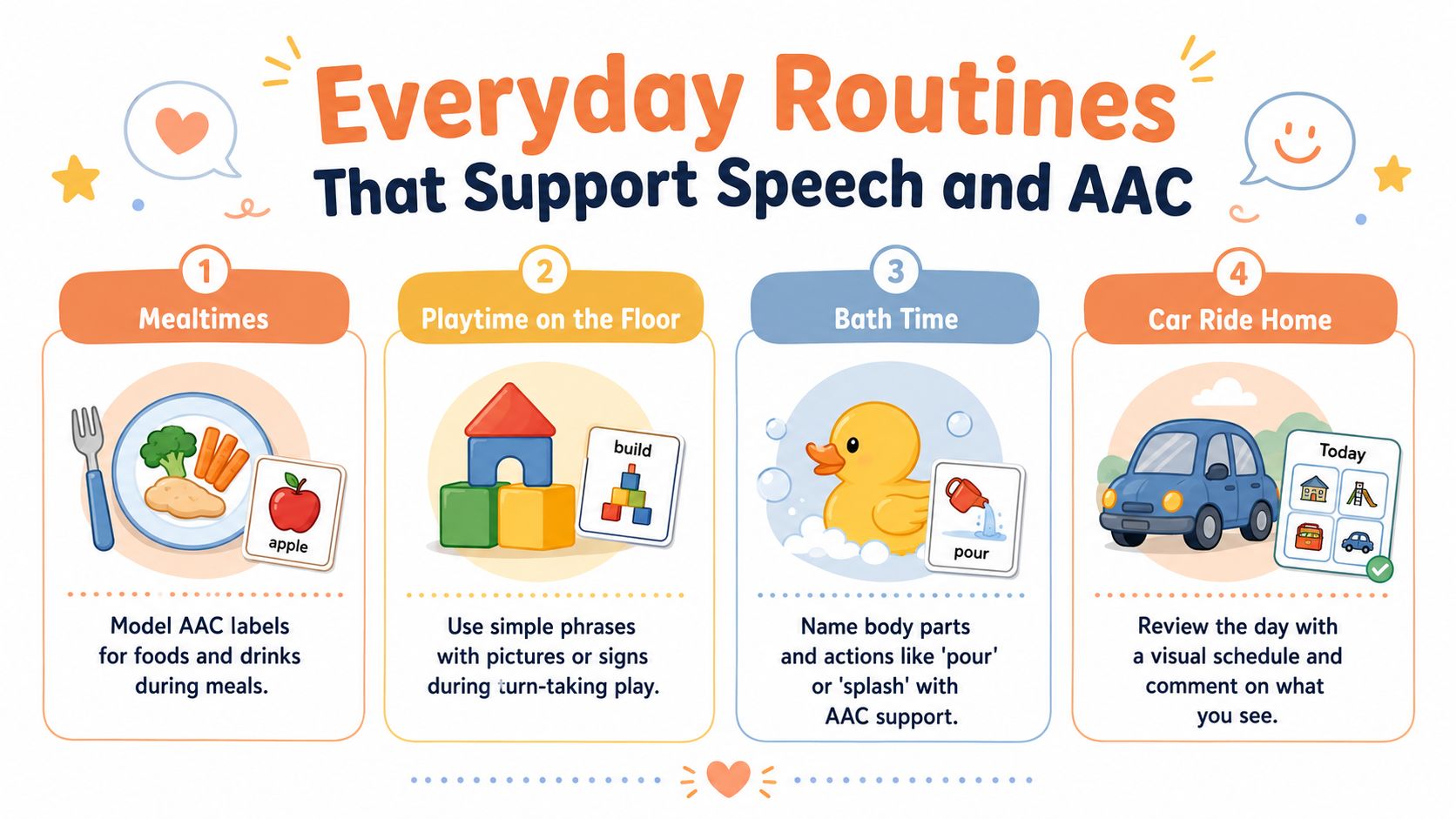
Keep the communication system within reach. Model words or symbols such as “more,” “drink,” “finished,” or the names of available foods while you serve the meal. Pause briefly after modeling, then accept a look, reach, sound, point, sign, or symbol selection as a meaningful response.
The skill is requesting and making choices. Don't hold food back until your child speaks. Communication should help them access the meal, not create unnecessary pressure.
Play on the floor
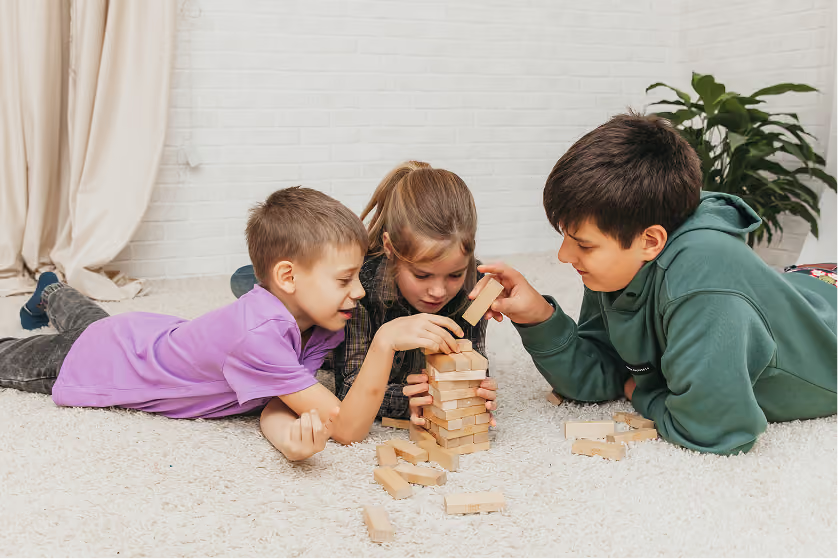
Follow your child's interest at the toy bin. If they choose blocks, model “build,” “more,” “turn,” or “fall” while taking one step behind their play instead of directing every move. During turn-taking, use a simple phrase, gesture, sign, or AAC selection, then wait for the child to show whether they want another turn.
This routine supports joint attention, initiation, commenting, and flexible interaction. Shared enjoyment matters as much as the word itself.
Bath time
Baths offer repeated actions and clear vocabulary. Model “pour,” “splash,” “in,” “out,” and body-part names on a low-tech board or device. You can comment on what your child is already doing rather than asking a series of questions.
The ride home
A car ride can be a lower-pressure time for reviewing the day. Use a visual schedule or photos to talk about school, the playground, lunch, or something visible outside the window. If your child is tired, model a comment without requiring an answer.
Short practice embedded across routines gives the child many meaningful chances to communicate. Keep the AAC system available in the kitchen, play area, car, school, and community. The everyday communication guide from Friendly ABA Premier offers another routine-based way to think about this partnership.
Setting Realistic Expectations for Progress
More weekly therapy hours don't automatically produce more spoken words. A 2026 Drexel-led study reported that after early evidence-based intervention, roughly two-thirds of previously non-speaking children used single words and about half developed more complex language, while the study found that duration of intervention, rather than intensity, was associated with outcomes. Those findings are described in the Drexel study report.
That doesn't mean intensity is irrelevant or that every child will follow the same path. It means families should ask how long a plan has been in place, how consistently skills are practiced, and whether the child is receiving meaningful opportunities to communicate. Skills compound through repeated experiences, and speech motor plans may need time to become easier and more stable.
Progress can look like a child moving from pulling you toward the pantry to handing you a picture. It can mean using “help” instead of dropping a toy, choosing between two activities, or commenting during a game. Spoken words matter, but they aren't the only meaningful outcome.
A better progress question: “Is my child communicating more independently and successfully across daily life?”
Review progress over broader windows rather than judging every difficult day. A team should compare the baseline with current performance, look at spontaneous communication, and check whether skills appear with different people and in different places. If progress is slow, the answer may be to adjust the teaching method, AAC system, goals, or environment.
Families can also use the research benchmark of fewer than 30 functional words to ask whether their child needs more focused support, while remembering that benchmark categories don't define an individual child's future. Earlier reviews found limited evidence that speech or AAC interventions reliably create durable gains for many minimally verbal children, so responsible providers should offer hope without promising a particular timeline.
Finding the Right Support for Your Family
Access to AAC isn't equal for every family. One study found that 64% of white, non-Hispanic families of minimally verbal children currently had an AAC device, compared with 30% of families from minority groups. The same study found that 55% of minority families reported no prior knowledge of AAC devices, compared with 12% of white families, as reported by Children's Hospital Los Angeles.
Those differences can reflect awareness, referrals, evaluation pathways, cost, language access, insurance processes, and provider availability. A family shouldn't have to already know the word AAC to receive information about communication options.
Questions for a speech-language pathologist
Ask how the clinician will assess understanding, initiation, gestures, speech production, and AAC. Find out whether the child can use the system across home and school, who will program new vocabulary, and how the clinician will support speech without making speech the price of participation.
Questions for an ABA program
Ask how the program defines functional communication and what data the team records. You might ask:
- Baseline data: What will you measure before treatment starts?
- Caregiver coaching: How will I learn to use the same communication strategies at home?
- AAC access: Will my child have access to AAC during therapy, transitions, play, and challenging moments?
- Assent and choice: How will my child's preferences and signals be respected?
- Coordination: How will the behavior analyst communicate with the speech-language pathologist and school?
- Progress reviews: When will we review trends and decide whether goals need to change?
A practical workflow recommends reviewing behavior data weekly, or according to the schedule written in the treatment plan, checking whether the current 5-day trend is improving, and setting a specific review date for adjustments. The treatment design checklist describes that process. The exact schedule should be individualized, but families deserve to know when the team will look at the data and what happens if acquisition is slow.
Signs a program may not be a good fit
Be cautious if a provider discourages AAC, treats gestures as meaningless, insists on speech before honoring a request, or promises rapid spoken-language outcomes. A strong team won't claim to know a child's ceiling after a brief observation. They'll explain what they see, identify what remains uncertain, and invite caregivers into decisions.
Family-centered care includes proactive communication, individualized treatment planning, and a dedicated person who can help coordinate questions across clinicians, school staff, and home routines. It should feel like a partnership, not a handoff.
Friendly ABA Premier offers home-based ABA therapy, social skills development, school support, parent coaching, individualized treatment planning, regular progress check-ins, and a dedicated care coordinator across Connecticut, Georgia, Maryland, Massachusetts, North Carolina, South Carolina, Virginia, and Washington. To discuss communication goals and how a coordinated plan could fit your child's daily routines, visit Friendly ABA Premier and schedule a consultation with the team.
Our Latest Insights














Experience ABA Therapy with a More Personalized Level of Support
Discover how FriendlyABA Premier combines evidence-based ABA therapy with dedicated coordination, proactive communication, and individualized family support.