


Parent Teacher Communication Examples: 8 Templates
Use these parent teacher communication examples for ABA and school support, including emails, meeting agendas, progress notes, and conversation scripts.


You want your child's teacher and ABA team working toward the same goal, but the blank email screen makes that feel harder than it should. How much detail belongs in the message? Should you mention a difficult morning, a new skill, a transition that went smoothly, or all of it?
The most useful parent teacher communication examples are specific, respectful, strengths-based, and centered on observable routines. Asking for help, moving between activities, joining play, following directions, and participating in class give adults something concrete to notice and support. A message doesn't need to sound clinical to be useful.
The eight templates below follow the family-school-ABA journey, from an early progress check-in to transition planning. Adapt the wording to your child's communication preferences, individual goals, family priorities, and school context. Your ABA and school teams can help you decide which details, strategies, and follow-up plan fit your child's care plan.
Table of Contents
- 1. Initial Progress Check-In Email 30 Days Post-Start
- 2. Behavioral Concern Phone Script Addressing a New Challenge
- 3. Monthly Progress Summary Note for Busy Parents
- 4. School Partnership Introduction Email for the Teacher or IEP Team
- 5. Parent Coaching Preparation Meeting Agenda for Skills Transfer
- 6. Quarterly Family Touchpoint Meeting for Progress and Planning
- 7. Difficult Conversation Email for Sensitive Changes
- 8. Family Transition and Graduation Meeting Script
- 8-Point Parent-Teacher Communication Comparison
- Turn Templates Into a Consistent Family-School Partnership
1. Initial Progress Check-In Email 30 Days Post-Start
The first month of ABA therapy can feel full of questions. Your child may be getting comfortable with new people, routines, and expectations, while you're still learning how sessions work. A personal check-in helps the family feel connected before concerns have time to build.
Subject: How [Child's Name] Is Settling In, We'd Love to Hear From You
Hi [Parent Name],
We wanted to check in after our first month working with [Child's Name]. We've noticed [he/she/they] is becoming more comfortable during sessions and staying engaged during [specific activity]. Many families find the first few weeks uncertain, so we'd love to hear what you're noticing at home, even if the change seems small.
Have you noticed any shifts during [routine, such as getting dressed, mealtime, play, or transitions]? Is there a moment you'd like us to understand better?
Our next check-in is scheduled for [date]. You can reach me at [direct contact method], and I'll respond by [timeframe]. We're looking forward to connecting then.
Warmly,
[Care Coordinator Name]
The message works because it shares an observable moment instead of making a broad statement such as “therapy is going well.” It also asks open-ended questions, which gives parents room to share a new gesture, a smoother bedtime transition, or a challenge that appears only at home.
Send the email from the assigned care coordinator rather than a generic inbox. Include one or two specific therapy observations, a direct contact method, and the date of the next conversation. A calendar reminder helps the team keep the follow-up consistent.
For more ideas about making communication easier across care settings, explore ways to improve access to better communication. A dedicated coordinator can help connect parent observations with therapist updates, rather than leaving the family to repeat the same information to each person.

2. Behavioral Concern Phone Script Addressing a New Challenge
A new behavior concern can make parents fear that something has gone wrong. A phone conversation should lower that pressure without minimizing what the team has observed. The purpose is to understand the pattern and agree on a reasonable next step.
Start with connection before discussing the concern.
“Hi [Parent Name], how's your week been? I wanted to touch base about something we've observed this week. [Child's Name] has been showing more frustration during transitions between activities. We've noticed it during [specific routine], and I'd like to understand what might be contributing to it. Have you seen anything similar at home?”
The phrase “we've noticed” keeps the focus on an observation rather than defining the child. You can then explain the situation in plain language: “As children learn new skills or become more aware of what they want, transitions can bring up stronger reactions. Let's look at what happens before the frustration, what [Child's Name] does, and what helps afterward.”
In ABA, this kind of review is often called looking at what happens before, during, and after a behavior. It doesn't mean blaming the child or the parent. It helps adults identify whether a warning, visual choice, shorter transition, communication prompt, or break might be worth discussing with the care team.
Keep the conversation focused:
- Ask first: “What have you noticed before the frustration starts?”
- Offer a small plan: Discuss two or three practical strategies that fit the home routine.
- Set a follow-up: “Let's check in again on [day] to see what you're noticing.”
Avoid presenting a long list of techniques during a stressful call. The family needs clarity, not a flood of instructions. Parent observations should directly inform the next step, and the plan should be reviewed rather than treated as permanent.
For background on teaching useful skills through supportive practice, see behavioral skill training. If the concern includes safety risks, sudden changes, or substantial distress, contact the child's clinical and medical care teams for individualized guidance.
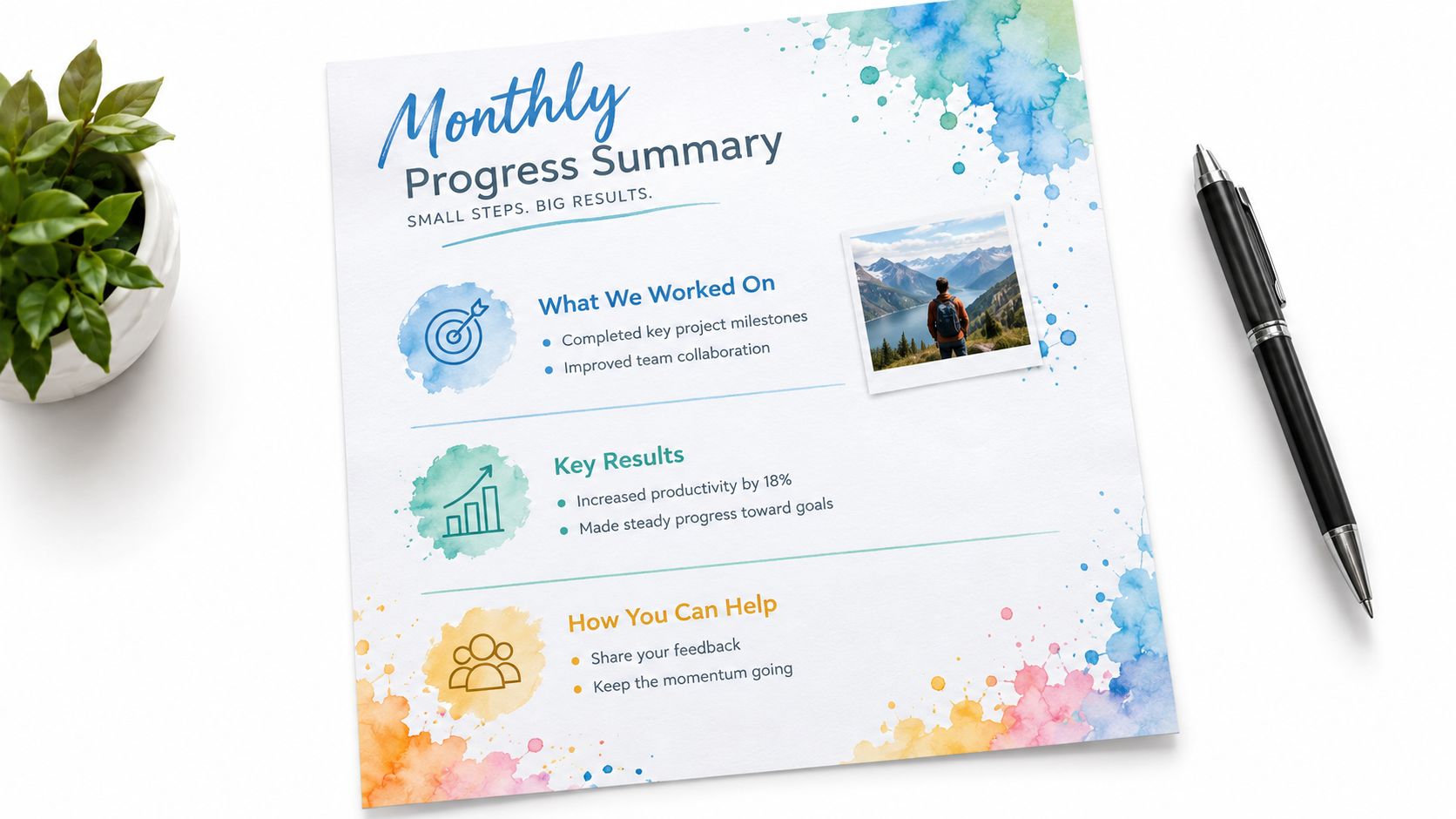
3. Monthly Progress Summary Note for Busy Parents
Some families need a quick written snapshot they can read between work, school pickup, and dinner. A monthly progress summary should make the important information easy to find without turning therapy into a long report.
[Child's Name]’s Weekly Wins, Week of [Date]
What We Worked On
- Asking for help: Practiced using a word, gesture, picture, or device during play.
- Taking turns: Used a simple turn-taking routine during blocks or a game.
- Staying with an activity: Practiced remaining engaged during a short structured task.
What We Noticed
[Child's Name] stayed engaged longer during [activity] and used [specific communication method] to ask for more [item or activity]. We also noticed that a brief warning helped make the transition to [next activity] smoother.
How You Can Help at Home
Try a simple turn-taking game, such as passing blocks back and forth or singing a familiar song, for a short period after dinner. Stop while it's still going well and share what you noticed with the team.
The best summaries choose a few meaningful observations instead of listing every target addressed during therapy. Use the child's name, familiar routines, and plain language. Photos or drawings can make the note feel personal, but only include them with the family's permission and according to privacy expectations.
A useful progress note answers three questions: What did we practice? What did we learn? What can the family try next?
Send the summary on a predictable day when possible. Add a response prompt such as, “What did you notice this week?” That question turns a report into a conversation. A care coordinator can also connect home observations to therapy notes, for example, “The therapist heard that you practiced turn-taking during dinner. That information helped us plan today's activity.”
4. School Partnership Introduction Email for the Teacher or IEP Team
The first message to a teacher should respect the school's expertise and make collaboration easy. A teacher doesn't need a lengthy clinical history in an introduction email. They need to know who you are, what the child is practicing, and how to share useful classroom observations.
Subject: Introduction, [Child's Name]’s ABA Therapy and School Partnership
Hi [Teacher Name],
I'm [Care Coordinator Name] with FriendlyABA Premier. We've started working with [Child's Name] and [his/her/their] family at home on goals such as following multi-step directions and building social connections. We'd love to learn what's going well in your classroom and where [Child's Name] may benefit from additional support.
For example, if [Child's Name] is practicing asking for help, we can reinforce that same communication skill at home. Would you be open to a brief monthly check-in? We're happy to work around your schedule and keep it practical.
Thank you for everything you do for [Child's Name]. We're glad to partner with you.
Warmly,
[Name and Contact Information]
Use observable language such as “asks for help during writing” or “needs support moving from recess to class.” Avoid labels that don't tell the teacher what to notice or do. Ask what already works in the classroom before suggesting a home strategy.
A short handout can explain how the family is reinforcing a school skill at home, but it should support the teacher's knowledge, not replace it. Confirm the appropriate consent and school communication procedures before sharing therapy information. If an IEP meeting is involved, the family can ask the school team how outside providers may participate.
FriendlyABA Premier describes ABA support in school collaboration through coordinated communication among families, clinicians, and school staff. You can learn more about ABA therapy in schools and consider whether a scheduled check-in would help everyone use consistent language.

5. Parent Coaching Preparation Meeting Agenda for Skills Transfer
Parent coaching is most useful when it begins with the family's real routine. A parent shouldn't have to prepare a perfect success story. One smooth moment and one difficult moment can give the clinician enough information to make the session practical.
Pre-meeting email
Hi [Parent Name],
We're looking forward to working with you on [specific skill, such as mealtime routines] on [day]. Before we meet, please think about one moment this week when mealtime felt smooth and one when it felt chaotic. Bring both examples. We're learning together, and those details will help us choose a strategy that fits your family.
See you [day and time],
[Care Coordinator Name]
Meeting agenda
- Welcome and check-in: Review the two examples and clarify the family's priority.
- Short demonstration: Watch the strategy in action.
- Clinician demonstration: The clinician models the approach with [Child's Name].
- Parent practice: The parent tries the strategy while receiving supportive coaching.
- Take-home plan: Choose a few brief practice opportunities and schedule follow-up.
Focus on one skill per session. During practice, the clinician should coach the parent with specific feedback, such as, “I liked how you waited for him to respond. That gave him space to think.” This is more useful than saying “good job” without explaining what worked.
A one-page handout with photos or simple drawings can be easier to use than dense paragraphs. The family might choose three brief practice sessions that fit naturally into the week, rather than adding an unrealistic daily assignment. Schedule the follow-up before the meeting ends so the parent knows when the team will review what happened.
Parent coaching should feel like shared problem solving, not a test of parenting. The family's routines, culture, time, and priorities matter when deciding whether a strategy is realistic.
6. Quarterly Family Touchpoint Meeting for Progress and Planning
A quarterly meeting gives the family and clinical team a dedicated time to review the larger picture. It shouldn't feel like a performance evaluation. The focus is whether the current plan still reflects the child's needs, strengths, and daily life.
[Child's Name]’s Quarterly Progress Review, [Date]
Celebrating wins: Begin with what the team and family have noticed. A win might be a new way to request help, more participation in a game, a smoother morning routine, or increased independence with a daily task.
Reviewing individual goals: Use simple graphs or examples, then explain what the information means in ordinary language. Data can show patterns, but parents add context that a session cannot capture.
Hearing family concerns: Ask, “What's working well?” “What feels difficult?” and “What would you most like to see next?” Home observations are important information, especially when a skill appears differently across settings.
Planning ahead: Discuss possible adjustments, new priorities, school coordination, and support the family may need. Leave several minutes for questions that don't fit neatly into the agenda.
Send a short survey or question prompt before the meeting, with a phone or written option for families who can't attend in the usual format. Families should receive a plain-language summary afterward that identifies decisions, responsibilities, and the next follow-up.
If the child has an IEP, IDEA requires the IEP to explain how progress toward annual goals will be measured and when periodic progress reports will be provided to parents. The IRIS Center's explanation of IEP progress reporting notes the common practice of aligning reports with the school's reporting calendar, though families should confirm the schedule in their child's IEP and with the school team.
A coordinated care model can help keep the meeting connected to therapy, home, and school rather than treating each setting as separate.
7. Difficult Conversation Email for Sensitive Changes
Sensitive news deserves personal contact, clear facts, and a next step. Whether the issue involves an insurance denial, a therapy plateau, a change in service frequency, or another plan adjustment, silence creates more uncertainty than an honest update.
Subject: Update on [Child's Name]’s Coverage and Next Steps
Hi [Parent Name],
I'm reaching out with an update about [Child's Name]’s coverage through [Insurance Company]. We learned that the plan is limiting therapy to [X hours/month], down from [Y]. I know this may feel disappointing and stressful.
Here's what we're doing next. I'm appealing the decision with [Insurance Company] using [specific documentation or evidence]. While that process is underway, the clinical team will review the plan and prioritize [most important current goal]. We'll explain any proposed changes before they take effect.
[Child's Name]’s therapist remains [same therapist, if applicable], and our commitment to coordinated support hasn't changed. Are you available for a call on [day and time] so we can discuss the details and your questions?
Warmly,
[Care Coordinator Name]
Don't write “insurance won't pay” when the actual issue is a coverage limitation or denial. Name the problem accurately, explain what the team is doing, and state what will remain stable. If the team doesn't yet know an answer, say so and give a date for the next update.
A phone call or meeting should be offered in the same message. The care coordinator can help the family understand documentation, appeal steps, and clinical options, while the family's concerns should shape the conversation. Coverage decisions and treatment changes require individualized review with the appropriate insurance and clinical teams.
8. Family Transition and Graduation Meeting Script
A step-down or discharge conversation should start before the final session. Families may feel proud, uncertain, relieved, or sad, sometimes all at once. Naming those emotions makes room for an honest transition plan.
Opening
“[Child's Name], we want to start by recognizing the work you and your family have done. When we began, one important goal was [goal]. Now [Child's Name] is [specific observable achievement], such as asking for help during a routine, joining a preferred play activity, or completing part of a daily task with less support.”
Planning the next chapter
Review what the child can do more independently, what prompts or supports still help, and which adults will continue reinforcing the skill. A personalized skills checklist and troubleshooting guide can show the family what to do if a familiar challenge returns.
Closing
“It makes sense to feel uncertain about this change. We'll review your questions, the support plan, and who to contact if you need guidance. We're excited about the next chapter and want the transition to feel prepared rather than sudden.”
Schedule the discharge meeting at least two to four weeks before the final session. Bring printed materials, explain any future booster-session option without framing it as failure, and offer a follow-up call two to four weeks after discharge if that fits the care plan. Set honest communication boundaries. “You can reach out anytime” should be paired with a realistic response expectation, such as, “I may not respond the same day, but I will respond.”
Transition planning should include school and other relevant providers when appropriate. The goal isn't to promise that every challenge has disappeared. It's to leave the family with clear skills, practical supports, and a connected plan for the next setting.

8-Point Parent-Teacher Communication Comparison
| Item | Implementation Complexity 🔄 | Resource Requirements ⚡ | Expected Outcomes ⭐ / 📊 | Ideal Use Cases 💡 | Key Advantages ⭐ |
|---|---|---|---|---|---|
| Initial Progress Check-In Email (30 Days Post-Start) | Low, template + brief personalization 🔄 | Low, coordinator time; light clinical oversight ⚡ | Early trust-building; reduces parent anxiety ⭐⭐ 📊 | 1-month post-start check-in for new families 💡 | Promotes partnership; customizable; predictable touchpoint ⭐ |
| Behavioral Concern Phone Script (Addressing a New Challenge) | Moderate, structured script + tone training 🔄 | Moderate, therapist time; requires role-play training ⚡ | Converts alarm into collaboration; reduces drop-out risk ⭐⭐ 📊 | New or escalating behaviors needing quick family contact 💡 | Preserves relationship; consistent messaging across staff ⭐ |
| Monthly Progress Summary Note (Therapy Snapshot for Busy Parents) | Moderate, template with individualized content 🔄 | Moderate, recurring coordinator effort; template saves time ⚡ | Scannable updates; builds longitudinal record ⭐⭐ 📊 | Monthly updates for time‑pressed parents; ongoing engagement 💡 | Digestible, actionable summary that reinforces home practice ⭐ |
| School Partnership Introduction Email (First Contact with Teacher/IEP Team) | Low, concise, personalized outreach 🔄 | Low, one-off coordinator outreach + occasional follow-up ⚡ | Better home‑school alignment; teacher buy‑in ⭐ 📊 | Onboarding school‑age children within first 2–3 weeks 💡 | Prevents silos; seeds collaboration and shared goals ⭐ |
| Parent Coaching Preparation Meeting Agenda (Proactive Skills Transfer) | High, structured agenda, hands‑on practice 🔄 | High, clinician time, prep, follow‑up materials ⚡ | Increased skill generalization; empowered parents ⭐⭐⭐ 📊 | Focused parent coaching sessions for skill transfer 💡 | Shifts parents to active teachers; durable behavior change ⭐ |
| Quarterly Family Touchpoint Meeting Agenda (Celebrating Progress & Adjusting Course) | High, multi‑member coordination; data prep 🔄 | High, survey, data visuals, team meeting time ⚡ | Transparent progress review; collaborative planning ⭐⭐ 📊 | Formal quarterly reviews for planning/adjustment 💡 | Prevents “black box”; builds accountability and trust ⭐ |
| Difficult Conversation Email (Insurance Denial, Therapy Plateau, Service Change) | Moderate, careful wording; supervisory review recommended 🔄 | Moderate, clinical + admin input; prompt follow‑up required ⚡ | Reduces shock; preserves trust; guides next steps ⭐⭐ 📊 | Sensitive updates (coverage limits, plateaus, service changes) 💡 | Transparent advocacy; clear next steps and escalation path ⭐ |
| Family Transition & Graduation Meeting Script (Preparing for Discharge or Step‑Down) | High, emotionally skilled facilitation 🔄 | High, team meeting, printed/packaged resources ⚡ | Positive transition; maintenance of gains; lowers relapse risk ⭐⭐⭐ 📊 | Discharge, step‑down, or transition planning 💡 | Celebrates success; provides maintenance plan and re‑entry options ⭐ |
Turn Templates Into a Consistent Family-School Partnership
You don't need to use all eight messages. Choose the example that matches your immediate need. If your child just started therapy, begin with a progress check-in. If a new challenge is affecting transitions, use the phone script. If school and home are working on the same communication skill, adapt the introduction email and suggest a brief, realistic check-in.
Personalize every template with observable details. “She had a hard day” gives the reader very little to act on. “She cried when cleanup began and then used her picture card after a visual warning” helps the teacher, parent, and ABA team discuss what happened before the response, what support was available, and what to try next.
Agree on a follow-up before ending the conversation. That might be a phone call, a short email, a scheduled school meeting, or a progress review. A message without a next step can leave everyone well intentioned but disconnected. A message with a clear owner and follow-up date turns communication into coordinated support.
The right cadence depends on the child and the setting. In one study of parent-teacher contact preferences for students with autism, 98% of parents preferred monthly communication, while teachers were divided between monthly and weekly meetings, with 50.9% preferring monthly meetings and 49.1% preferring weekly meetings. Those findings show why families and teachers should agree on a rhythm rather than assume that one schedule works for everyone. You can review the study through this PubMed record on parent-teacher communication preferences.
The channel matters too. Use a brief message for a routine observation, a phone call for a sensitive concern, and a meeting when several people need to make a shared plan. Protect privacy, follow school procedures, and make sure the people communicating have the appropriate consent to exchange information.
Strong communication also includes positive information. If parents hear from school or therapy only when something is difficult, each message can feel threatening. A quick note about a successful transition, a new request for help, or a moment of shared play builds a fuller picture of the child and gives adults more strengths to reinforce.
Most importantly, these templates should never replace individualized guidance. Your child's communication style, sensory needs, learning history, family routines, school environment, and care plan all affect what a useful message looks like. Coordinate with the ABA and school teams when you're deciding how to respond to a behavior change, request classroom data, adjust a goal, or plan a transition.
Friendly ABA Premier's support model includes individualized treatment planning, a dedicated family care coordinator, scheduled progress conversations, home-based ABA therapy, parent coaching, social skills development, and school support. Families can use that coordination to keep important observations connected across home, therapy, and school, instead of managing each conversation alone.
Friendly ABA Premier offers home-based ABA therapy, parent coaching, social skills development, school support, and dedicated family care coordination across Connecticut, Georgia, Maryland, Massachusetts, North Carolina, South Carolina, Virginia, and Washington. Visit Friendly ABA Premier to talk with the team about personalized communication and care support for your family.
Our Latest Insights











































Experience ABA Therapy with a More Personalized Level of Support
Discover how FriendlyABA Premier combines evidence-based ABA therapy with dedicated coordination, proactive communication, and individualized family support.