

7 ABA Treatment Plan Examples for Families
Review 7 ABA treatment plan examples with goals, data collection, progress notes, and parent-friendly tips for understanding individualized care.

You've just received an ABA treatment plan, and the page is full of terms such as baseline, mastery criteria, prompting, generalization, and progress monitoring. You may be wondering whether the document describes your child as an individual or just fills in a standard template.
The ABA treatment plan examples below are educational models, not diagnoses or individualized medical advice. They show how a thoughtful plan can connect a child's strengths and family priorities with observable goals, measurable objectives, data collection, progress notes, caregiver collaboration, and scheduled adjustments.
A strong plan should fit the child, the family's routines, and the settings where skills matter most. It may address communication during snack, peer participation at school, dressing before breakfast, or transitions between preferred and non-preferred activities. It should also make it clear who will communicate updates, how caregivers can participate, and when the team will review the data.
That family partnership matters. Friendly ABA Premier's model includes individualized planning, proactive communication, scheduled progress check-ins, and a dedicated care coordinator who helps connect clinical recommendations with everyday life. Use the examples as conversation starters with your child's care team, not as a substitute for an assessment or clinical recommendation.
Table of Contents
1. Communication and Language Development Plan
A communication plan starts with the child's current way of expressing needs and interests. That might include spoken words, gestures, pictures, signs, or an augmentative and alternative communication system. The plan should build from what already works while creating more opportunities to communicate during routines that feel meaningful.
For example, a young child might practice requesting “more” during snack, then use the same request at meals and during a favorite play activity. The therapist could record whether the request was independent, prompted, or not made, then compare performance across routines. A child working on conversation might practice answering open-ended questions during bath time, car rides, or shared reading.
A published ABA plan example illustrates this structure with a functional communication target. The child independently requested in 2 of 10 observed opportunities across two prior sessions, with a 12-week target of 8 of 10 opportunities across two consecutive sessions and two settings. The plan also included a review every two weeks if independent responding remained below 50%, showing how a plan can define progress and identify when adjustments are needed. See the ABA treatment plan template with a measurable communication example for the full structure.

What the plan should record
A progress note might state the activity, communication opportunity, response type, prompt level, reinforcer, and whether the skill transferred to another setting. Caregivers can keep a simple list of new words, phrases, gestures, or communication attempts to discuss with the therapist.
- Use motivating routines: Practice with favorite toys, snacks, books, or songs.
- Pause before prompting: Give your child space to respond instead of answering immediately.
- Recognize approximations: “Ba” for “ball” can be a meaningful step toward clearer speech.
- Ask about a strategy sheet: A care coordinator can help organize communication prompts for the kitchen, bathroom, or car.
Parents can also ask: Which communication forms will the plan honor? How will prompts be faded? How will the team check that a skill transfers from therapy to home, school, and community routines? Families looking for practical ideas can explore ways to support better communication.
2. Social Skills and Peer Interaction Plan
Social participation can be difficult when a child understands a skill during one-on-one practice but can't yet use it during a noisy lunch period or fast-moving game. A useful plan breaks social participation into observable actions, such as approaching a peer, asking to join, waiting for a turn, responding to a comment, or using a coping strategy after losing.
A six-year-old who struggles during recess might practice turn-taking with a therapist and one peer before trying the same game with a larger group. The therapist could record whether the child joined independently, needed a verbal cue, or left the activity. At home, siblings or caregivers might repeat a short version of the game so the skill becomes familiar in more than one setting.

A gradual path into group activities
For a child who finds lunch socialization challenging, the plan might begin with video modeling, followed by practice joining a table with one or two familiar peers. Later, the team could support participation in a larger group. Progress notes should describe what happened, how much support was provided, the child's communication with peers, and what helped the interaction continue.
A child who shuts down after losing a game may need more than a rule such as “be a good sport.” The plan could teach emotion recognition, a break request, calming actions, and language for frustration. Practice might begin with a trusted adult, then move to a familiar peer and eventually a busier group.
Social goals should explain the purpose of an interaction, not force a child to perform a personality. The team can focus on access, communication, comfort, and participation while respecting the child's preferences.
Invite the teacher to share observations from recess, group work, and lunch. Parents can ask how the plan defines a successful interaction, how the child's comfort is monitored, and how the team will support generalization. The guide to helping children navigate social situations with confidence can help families prepare for that conversation.
3. Daily Living and Independence Skills Plan
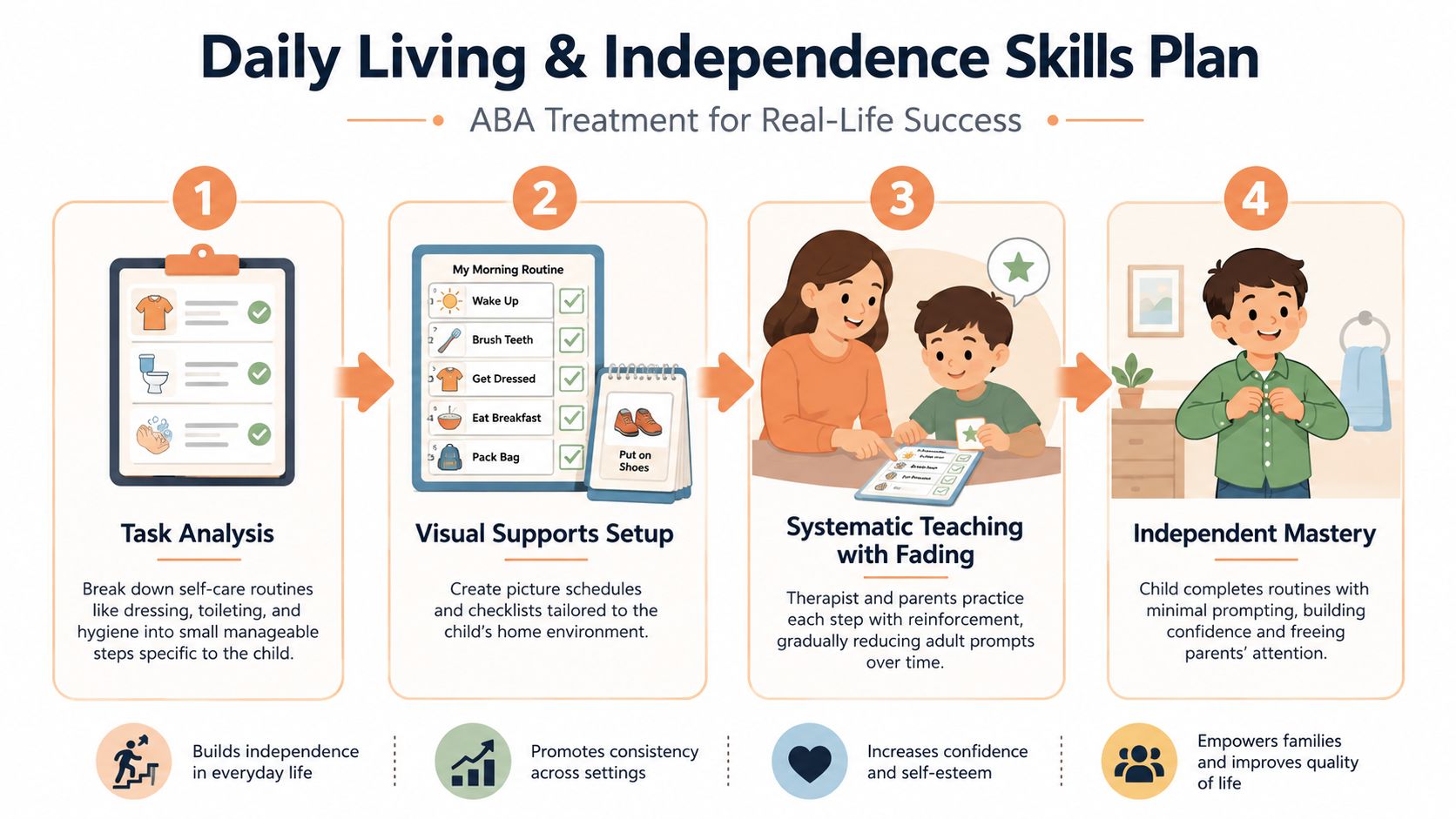
Daily living goals become easier to understand when a routine is separated into small, visible steps. Dressing, toileting, eating, hygiene, and household tasks can all be described in terms of what the child does, what help is needed, and how support will gradually decrease.
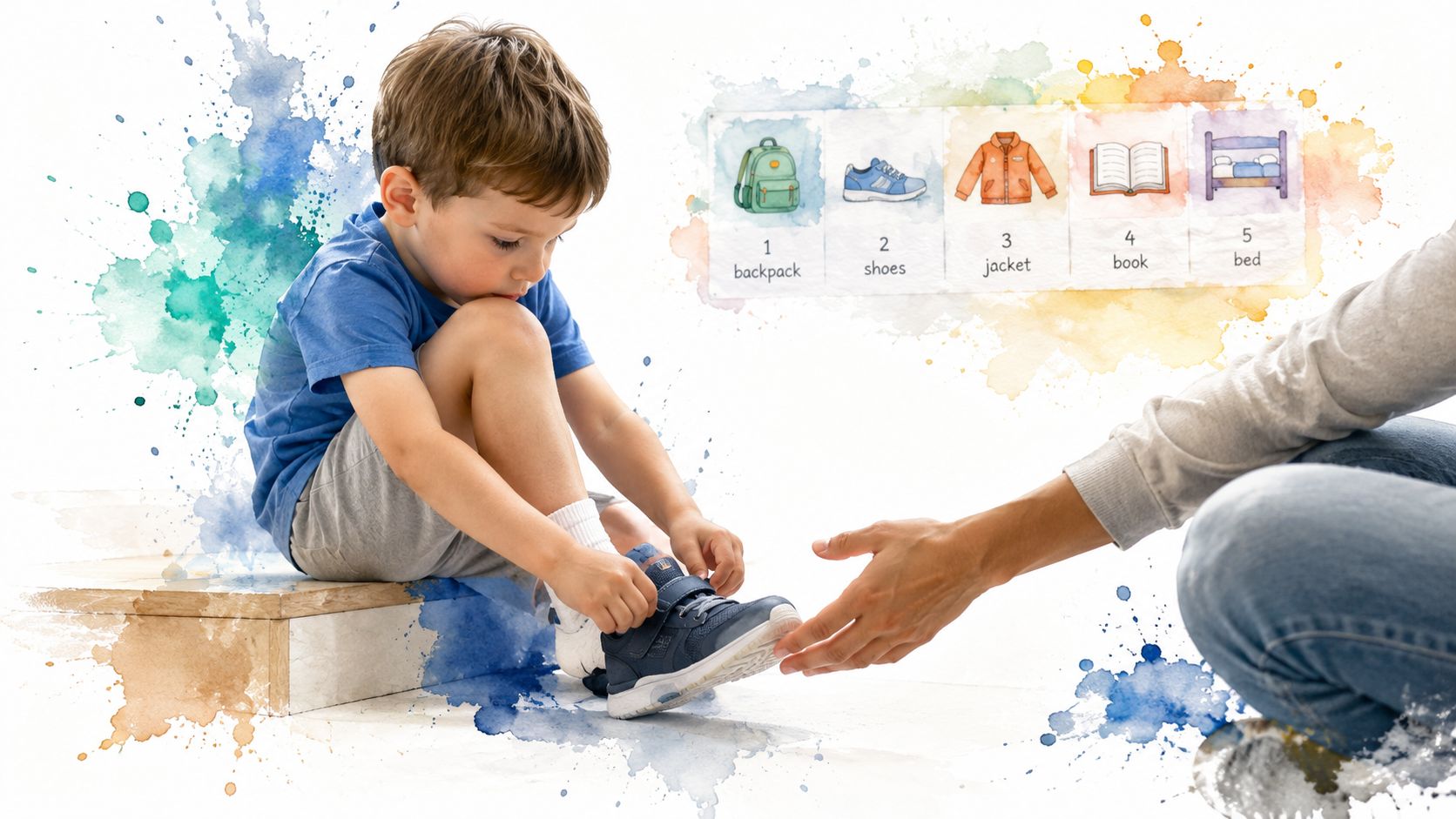
A plan for a five-year-old getting dressed might list underwear, shirt, pants, socks, and shoes as separate steps. A picture schedule could show the sequence, while the therapist and caregiver track which steps the child completes independently, which require a gesture or verbal reminder, and which need more direct assistance. The team can then adjust prompts rather than treating “getting dressed” as one all-or-nothing skill.
Turning routines into measurable practice
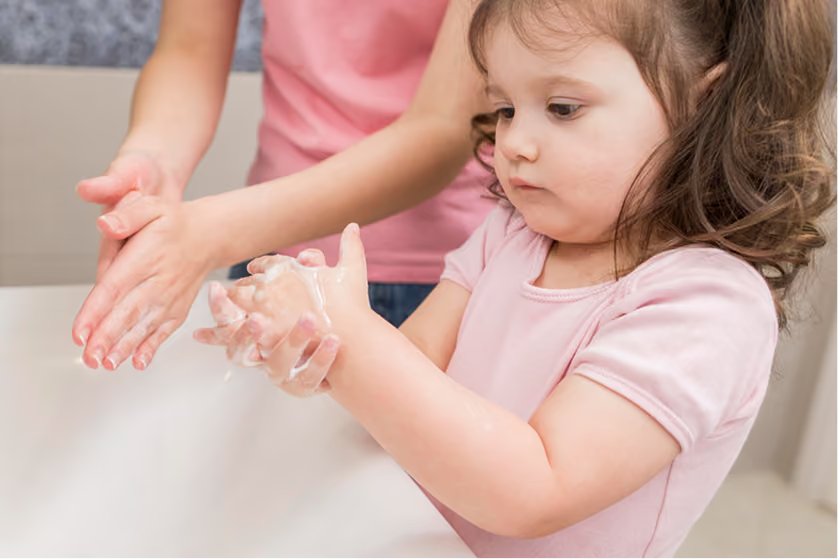
A toileting plan might document participation in sitting, wiping, flushing, and handwashing, with visual reminders used consistently in the bathroom. A mealtime plan could track self-feeding, drinking from a cup, and using a napkin during family meals. Progress notes should include the routine, the steps completed, the prompt level, the type of reinforcement, and whether the skill occurred with different caregivers.
Caregivers can make visual supports more relevant by using photographs of the child and the family's own bathroom, bedroom, or kitchen. Start with one routine, such as the morning routine or bedtime, so the plan remains manageable.
- Choose immediate reinforcement: A sticker after handwashing or a hug after dressing can make the connection clear.
- Celebrate partial independence: Completing one step without help is meaningful progress.
- Ask for reusable tools: Your therapist may provide a visual schedule that can be laminated and used every day.
- Discuss prompt fading: Ask exactly when and how adults should reduce reminders.
A parent might ask, Which step should we prioritize first? What counts as independent? How will the team make sure the skill transfers from therapy to the actual family routine? These questions help turn a sample plan into a practical support for daily life.
4. Challenging Behavior Reduction and Replacement Skills Plan
A behavior plan should look beyond the behavior's appearance and examine what happens before and after it. A functional behavior assessment, or FBA, helps the team study patterns and form a working understanding of what the behavior may communicate or accomplish. The plan should then teach a replacement response that meets the same need in a safer, more useful way.
Suppose a child hits when asked to stop playing. If the assessment suggests that the hitting helps the child escape a demand, the plan might teach “break please” or “five more minutes,” supported by a visual timer. Progress data could include the number of transition opportunities, independent break requests, prompts used, and instances of hitting. The team should also document how adults respond, because consistent follow-through matters.
A child who screams during transitions might receive advance notice through a timer or song, a choice about the next step, and immediate praise for moving calmly. A child who refuses homework might learn to raise a hand for help while the work is divided into smaller portions. The plan can reinforce effort and communication, not only completed answers.
What parents can observe at home
Families don't need complicated records to provide useful information. Note the activity, what happened immediately before, what the child did, how adults responded, and what happened afterward. These observations can help the team refine prevention strategies and replacement skills.
- Look for patterns: Time, place, people, and task demands can reveal common triggers.
- Reinforce communication quickly: Respond warmly when your child asks for help or a break, even if the request is not perfect.
- Keep responses calm: A predictable adult response gives the child clearer information.
- Ask about safety: Aggression, self-injury, or running away requires individualized professional guidance.
Questions for the care team include: What function are we assessing? What replacement skill will be taught? How will we measure whether the replacement is working? What should caregivers do if the behavior becomes more intense or creates a safety concern?
5. School Success and Classroom Participation Plan
A classroom plan needs to account for noise, group instructions, peer expectations, transitions, and changing academic demands. A child may follow directions in a quiet therapy setting but need different supports during math, circle time, partner work, or the move from one classroom activity to another.
For a second grader who shuts down during math, the plan might divide assignments into smaller portions, preview similar problems at home, and provide a break card. Data could show how often the child begins work, requests help, completes a portion, or uses the break appropriately. Progress notes should include the classroom context, the support provided, the child's response, and the teacher's observations.
A first grader who misses group instructions might use a visual schedule and watch peers as models. A fourth grader who struggles with partner work could practice listening and turn-taking with a familiar peer before receiving coaching during classroom collaboration.
Keep school support usable
A one-page strategy sheet can help adults stay consistent. It might state, “When a multi-step direction is given, use the visual cue and ask the child to repeat the first step,” rather than presenting a long document that's difficult to use during a busy school day.
Parents can ask the teacher what's already working before suggesting new strategies. They can also practice related skills at home, such as following directions, waiting, packing materials, or moving between activities.
- Share specific wins: Tell your child, “Your teacher said you raised your hand today.”
- Respect teacher time: Keep communication brief, concrete, and solution-focused.
- Coordinate roles: Clarify whether the therapist will observe, consult, model, or communicate through the caregiver.
- Review generalization: Ask whether the child uses the skill with different teachers, subjects, and peers.
A school plan should support participation without making the child feel singled out. Families can learn more about ABA support in schools and bring questions about classroom coordination to their care team.
6. Parent Coaching and Family Empowerment Plan
Parent coaching makes the caregiver an active partner in the child's learning. Instead of receiving general instructions, the parent practices a specific strategy during a real routine while the therapist observes, models, and offers feedback.
A coaching session might focus on specific praise. The therapist could demonstrate, “You used great words to ask for help,” rather than a broad “Good job.” The parent then practices during snack while the therapist explains timing, wording, and how to respond to communication attempts. Progress notes can record the strategy practiced, the caregiver's level of independence, feedback provided, and the next practice step.
Another module might help a parent recognize approximations, gestures, or changes in body language during play. Evening coaching could focus on noticing early signs of frustration, preparing for transitions, and using calming supports before a meltdown becomes more difficult to manage.
Build strategies into real family life
The best coaching plan accounts for the caregiver's schedule, confidence, culture, and available support. A strategy that works in a clinic but cannot be used during a rushed morning needs adjustment.
- Ask for the reason: Understanding why a strategy works makes it easier to use naturally.
- Practice during calm moments: Introduce new skills before the hardest routine.
- Request written reminders: A brief handout or video can help between sessions.
- Share barriers openly: The team can adapt a plan when a routine isn't realistic.
- Notice caregiver progress: Learning new skills takes effort, and your own improvement matters.
A parent-training model described in a published study involved 24 weeks of parent training. Compared with a parent-education control group, the ABA group showed a 5.7-point improvement in the Vineland-II Daily Living domain versus no change, with the gain maintained 24 weeks later. The Socialization domain also improved by 5.9 points versus 3.1 points, and reduced disruptive behavior was linked to better daily living outcomes. These findings describe one specific model, not a guarantee for every child or family, so caregivers should discuss fit with their clinical team. The published parent-training study provides the details.
7. Transition Support and Change Readiness Plan
Transitions include more than moving from play to cleanup. They can involve a new classroom, a substitute teacher, a different therapy schedule, a new sibling, or changing expectations at home. A transition plan prepares the child ahead of time with predictable information, practice, and coping tools.
For a kindergarten transition, the team might arrange visits to the classroom, introductions to the teacher, hallway walks, and short periods sitting at a desk. A social story could use photographs of the actual school. At home, the child might practice lining up, carrying a backpack, waiting, and moving through the morning routine.
A mid-year classroom change could include visits to the new room and practice with the teacher's instructional style. The family can tell the new teacher which familiar routines, seating choices, or preferred activities help the child feel comfortable. Progress notes should describe what was practiced, the child's response, supports used, and what needs to happen next.
Plan early and review afterward
When possible, start preparing 4 to 8 weeks before a transition. Use photos and videos of the new setting, read social stories repeatedly, and practice calming strategies before the change occurs. The child may show more distress during a transition, so the team should monitor patterns and provide support rather than treating every difficult moment as failure.
A discharge or step-down plan should also be specific. It may gradually reduce therapist support, coach caregivers to use strategies independently, and identify whether follow-up or booster sessions could be appropriate. Families should ask what criteria guide the transition, how independence will be measured, and who they can contact if new concerns arise.
A transition plan should answer one practical question: “What will help my child participate in the next setting with increasing confidence and support?”
7-Point ABA Treatment Plan Comparison
| Plan | Implementation Complexity 🔄 | Resource Requirements ⚡ | Expected Outcomes ⭐📊 | Ideal Use Cases | Key Advantages 💡 |
|---|---|---|---|---|---|
| Communication & Language Development Plan | Moderate, assessment + weekly adjustments 🔄 | Moderate, SLP coordination, care coordinator, family practice ⚡ | ⭐ Improved expressive/receptive language; 📊 measurable vocabulary & conversation gains | Minimally verbal children, late talkers, emerging social communication | Builds real‑life communication in natural routines; consistent family coaching 💡 |
| Social Skills & Peer Interaction Plan | High, in‑context coaching, school/community coordination 🔄 | High, therapist time in peer settings, school coordination ⚡ | ⭐ Increased social competence; 📊 improved peer participation and reduced isolation | School‑aged children (K–6) struggling with friendships or group participation | Real peer practice with therapist support; video modeling and role‑play 💡 |
| Daily Living & Independence Skills Plan | Moderate, task analysis + systematic fading 🔄 | Moderate, visuals, caregiver consistency, practice time ⚡ | ⭐ Greater independence in self‑care; 📊 fewer routine conflicts and caregiver burden | Children of all ages needing dressing, toileting, hygiene, routines | Practical visual supports and stepwise teaching that generalize across settings 💡 |
| Challenging Behavior Reduction & Replacement Skills Plan | High, FBA, data collection, crisis planning 🔄 | High, consistent caregiver implementation, regular data review ⚡ | ⭐ Root‑cause reduction of challenging behavior; 📊 fewer incidents and improved safety | Children with tantrums, aggression, self‑injury, escape or persistent noncompliance | Functional approach teaching replacement skills; consistent cross‑setting plan 💡 |
| School Success & Classroom Participation Plan | High, classroom observation + teacher collaboration 🔄 | Moderate‑High, therapist consultation/visits, teacher time ⚡ | ⭐ Improved classroom engagement and teacher relationships; 📊 increased on‑task behavior | K–12 students who do better in therapy than in classroom or struggle academically/socially at school | Direct classroom strategies and teacher‑friendly supports for real‑time application 💡 |
| Parent Coaching & Family Empowerment Plan | Moderate, structured training + real‑time feedback 🔄 | Low‑Moderate, coaching sessions, parent practice time ⚡ | ⭐ Multiplied therapy impact and sustainability; 📊 broader generalization across routines | Any caregiver wanting to amplify progress, reduce dependency on formal therapy | Builds caregiver skillset, strengthens parent‑child interaction, long‑term sustainability 💡 |
| Transition Support & Change Readiness Plan | Moderate, advance planning, gradual exposure, social stories 🔄 | Moderate, preparation time, materials, coordinator involvement ⚡ | ⭐ Faster adaptation to change; 📊 fewer regressions, absences, or crises | Children facing major changes (new school/classroom, sibling, therapy discharge) | Proactive, photo‑based social stories and rehearsals to reduce anxiety 💡 |
Turning a Sample Plan Into a Helpful Conversation
Your child's treatment plan won't look exactly like these examples, and it shouldn't. Goals depend on the child's strengths, communication style, priorities, assessment findings, family routines, and the settings where support is needed. The useful comparison isn't whether the wording matches. It's whether the document gives your family a clear, respectful way to understand and support progress.
Start by looking for a connection between each goal and everyday life. A communication goal should matter during meals, play, school, or community activities. An independence goal should describe a routine your child experiences. A behavior-replacement goal should teach a response that gives your child a practical way to communicate, cope, or participate.
A clear plan should also explain how progress will be observed and recorded. Guidance for ABA documentation emphasizes baseline measurements, operationally defined behaviors, progress data or graphs, and a summary and interpretation of the data, so families can see whether a goal is moving forward or needs adjustment. Review the ABA assessment and treatment-plan guidance on data and graphs with your care team if those sections are difficult to interpret.
Use these questions during a treatment-plan meeting:
- Everyday purpose: What strength or daily priority does each goal support?
- Clear measurement: What exactly will the team observe and record?
- Progress notes: What will the notes explain about prompts, independence, context, and barriers?
- Review timing: When will the team examine the data and decide whether to continue, revise, or replace a goal?
- Caregiver participation: What can we practice at home, and what training or materials will we receive?
- Communication roles: Who coordinates updates with school staff, other providers, and our family?
- Generalization: How will the team check that a skill transfers across home, school, community, and daily routines?
- Transition planning: What criteria will guide reduced support, discharge, or a change in services?
The field has become more standardized in recent decades. A 2022 review found that 61% of the reviewed publications were from 2010 to 2020, compared with 30% from 2000 to 2009; the earliest study identified dated to 1977, and the most recent included publication dated to 2020. This history helps explain why modern plans often emphasize measurable goals, caregiver involvement, ongoing review, service intensity, and discharge criteria. The overview of ABA treatment-plan components and field development provides additional context.
Individualization should be visible in the document. Medicaid guidance highlights baseline data, functionally relevant goals for the child and caregiver, separate caregiver-training documentation, service intensity, reassessment timing, and a transition plan rather than open-ended authorization. You can review the Medicaid ABA services toolkit when preparing questions for your provider.
A strong plan is not a promise of a specific outcome. It's a shared working document that changes as your child learns, your family provides feedback, and the team understands more about what supports participation. If the plan feels generic, hard to follow, or disconnected from home and school, ask for a conversation about how it can become more practical.
Friendly ABA Premier offers home-based ABA therapy, social skills development, school support, and parent coaching across Connecticut, Georgia, Maryland, Massachusetts, North Carolina, South Carolina, Virginia, and Washington. Families can ask how individualized treatment planning, a dedicated care coordinator, and proactive progress communication would fit their needs.
Friendly ABA Premier can help families connect individualized ABA treatment planning with communication, daily living, social, school, and transition goals. Visit Friendly ABA Premier to learn about available services, discuss parent coaching and care coordination, and schedule a consultation with the team.
Our Latest Insights






















Experience ABA Therapy with a More Personalized Level of Support
Discover how FriendlyABA Premier combines evidence-based ABA therapy with dedicated coordination, proactive communication, and individualized family support.