

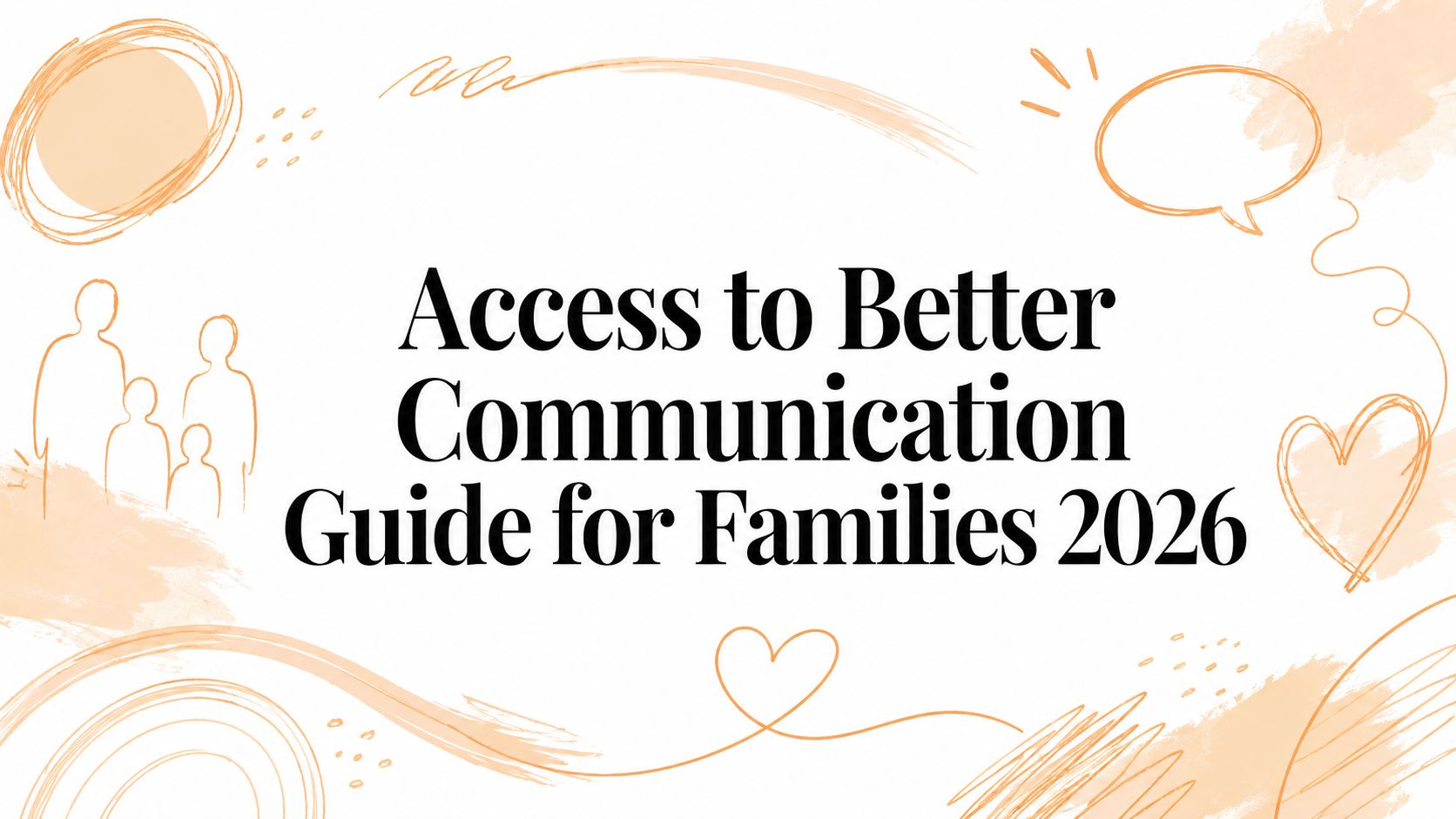
Access to Better Communication Guide for Families 2026
Unlock stronger connections with our guide to access to better communication for families and support teams.

Dinner is on the table, your child wants something, and the message gets stuck somewhere between a point, a sound, and a look at your face. Maybe it's juice, maybe it's a toy, maybe it's a break from broccoli, but the bigger feeling is the same, you can tell your child is trying, and you're trying too.
That's where access to better communication starts, not with perfect speech, but with more chances to be understood. Families often come looking for “more words,” when what they really need is a way to make home, school, and therapy easier to manage, one routine at a time.

Table of Contents
- Introduction to Access to Better Communication at Home
- Ability and access are not the same thing
- What gets in the way
Introduction to Access to Better Communication at Home
A lot of parents first notice the problem at ordinary moments. Your child reaches for cereal, pulls your hand toward the fridge, or melts down when you guess wrong, and suddenly the day feels harder than it should.
That doesn't mean communication isn't there. It often means the communication is getting blocked by timing, stress, unclear expectations, or a tool the child hasn't learned to use yet.
A warm, practical way to think about this is simple, access means your child has a real path to being understood. Sometimes that path is spoken words, and sometimes it's a picture, a gesture, a device, or an adult who slows down enough to notice the first attempt.
Practical rule: if your child can show you what they need in one routine, that's a meaningful communication opening, even if the words aren't there yet.
Families often feel overwhelmed because they're told to “work on communication” without being shown what to look for at breakfast, during play, or on the way out the door. This guide focuses on those everyday openings, and on how a care team can help you build more of them without turning family life into therapy homework.
The good news is that communication support doesn't have to be complicated to matter. When caregivers, therapists, and teachers use the same simple tools and the same plain language, children get more chances to succeed, and parents spend less time guessing.
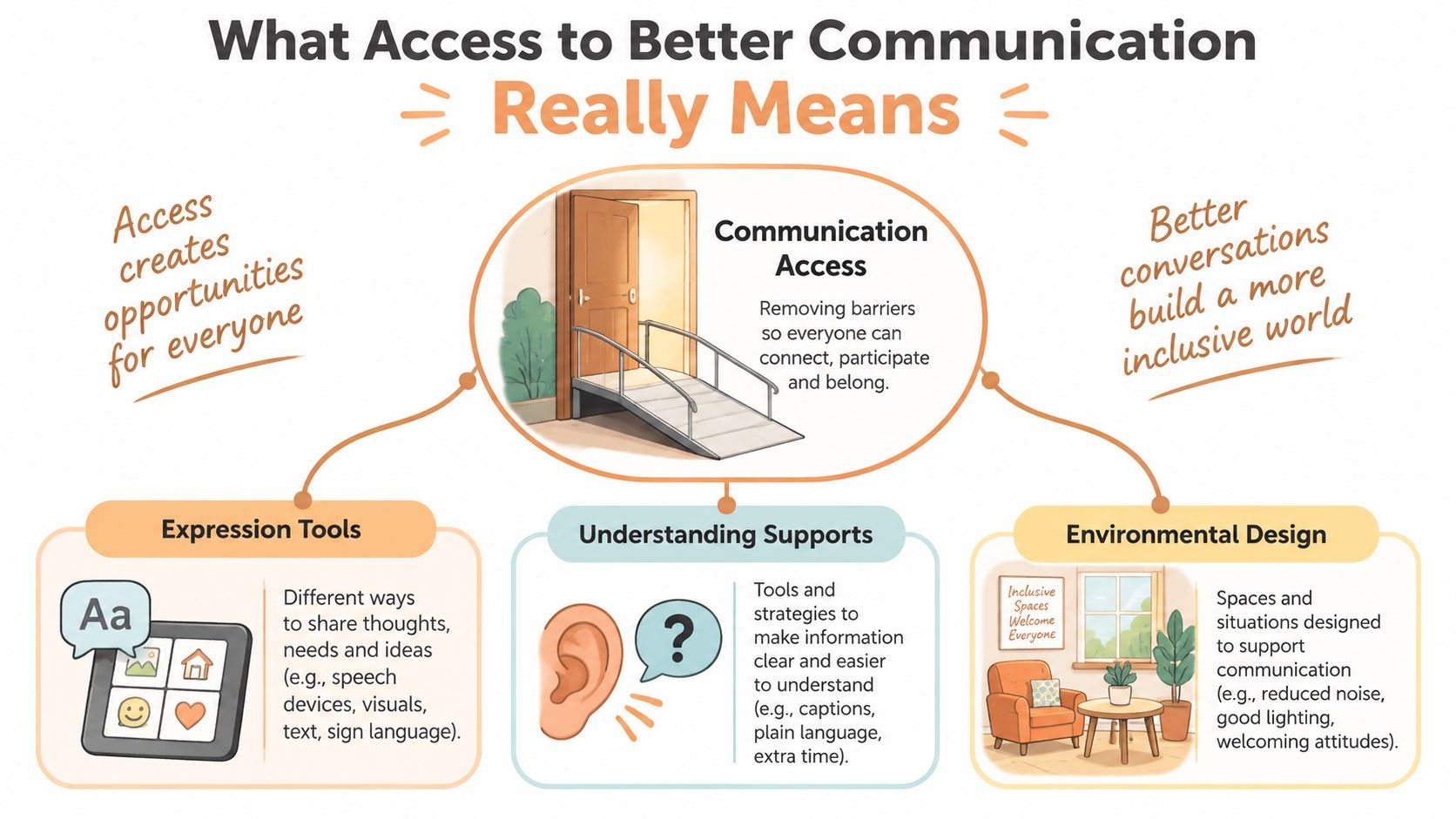
What Access to Better Communication Really Means
Communication access works best when there are several ways in. A child may use speech, a picture, a gesture, a device, or an adult who notices the first attempt and responds before the moment slips away.
Ability and access are not the same thing
A child may understand much more than they can say. Another child may use a few words at home but go quiet at school because the setting feels too fast, too noisy, or too unpredictable.
That is why it helps to separate skill from access. Skill is what a child can do on their own. Access is whether the environment, tools, and adults around them make it possible to use that skill when it counts.
If a child can point at the juice but no one notices, the communication attempt got lost. If a child has a picture card, a device, or a clear routine and someone responds right away, the same child has a much better chance of being understood.
Communication improves when adults treat every reasonable attempt as meaningful, not just perfect speech.
What gets in the way
Access can break down in small ways. The child is tired. The room is loud. The adult asks too many questions. The expectation changes halfway through the day. Or the child has a strong idea but no easy way to show it yet.
Environmental design helps with those barriers. A quiet choice board on the counter, a visual schedule by the door, or a predictable pause before a transition can do a lot of work for a child who is still learning.
The same idea applies to support tools. AAC tools, from pictures and signs to speech-generating devices, help bridge the gap when a child needs another path to communicate. A 2025 systematic review found caregiver-implemented AAC interventions were effective and efficient for improving communication outcomes in children with intellectual or developmental disabilities, and a 2025 online caregiver-training study found asynchronous AAC training could improve caregiver strategy use during shared book reading, according to PubMed.
The point is not more screen time or more devices. It is creating dependable access points at home, school, and therapy so the child has more chances to be understood in ordinary moments.
Key Supports That Improve Communication Access
Different supports do different jobs, and families usually get the best results when they're combined thoughtfully instead of treated like competing choices. A child may need responsive adult interaction, speech-language support, AAC, and classroom adjustments at the same time.
What each support does in daily life
Here's the useful distinction. ABA communication strategies often focus on how adults respond, wait, prompt, and reinforce attempts so communication becomes easier to use in real life. Speech therapy may focus more directly on language, sound production, understanding, or the mechanics of expressing ideas.
AAC helps when a child needs another path to communicate now, not later. That can look like a few picture choices for snacks, a laminated “help” card, or a device that speaks for the child when words are hard to find.
Environmental supports matter too. In practice, that may mean putting choices where the child can see them, giving extra wait time, or using the same visual routine at home and school so the child doesn't have to relearn everything from scratch each day.
Comparing the options side by side
| Support Type | What It Looks Like Day to Day | Best For |
|---|---|---|
| Responsive ABA strategies | Adults model short language, wait for a response, and respond to attempts instead of only perfect words | Children who need more chances to initiate and be noticed |
| Speech-language collaboration | Therapists and families target understanding, expression, and functional language goals together | Children with uneven receptive and expressive skills |
| AAC tools | Pictures, signs, boards, or speech-generating devices used during meals, play, and transitions | Children who need a clearer route to communicate now |
| Environmental accommodations | Visual schedules, choice boards, first-then supports, and simpler routines across settings | Children who do better when the world feels more predictable |
The scale of need is bigger than many families realize. In 2024, 5.5 billion people were online, representing 68% of the world's population, and by 2025 the ITU estimated about 6.0 billion people, or 74% of the global population, were using the Internet, while 2.2 billion remained offline (ITU report). That kind of growth helps explain why families often expect communication to happen through screens, phones, and digital tools, but the need is broader than device access.
A child can benefit from a strong support plan even without much screen time. The right mix depends on what helps them get understood during breakfast, homework, play, and bedtime, not on whether one approach sounds more advanced than another.
How Caregiver Coaching Builds Everyday Communication
Caregiver coaching works best when it feels like partnership, not a lecture. The adult does not need to become a therapist, and the therapist should not act like the only expert in the room.
The coaching literature describes this as an interactive partnership between a practitioner and a caregiver, aimed at helping the caregiver support the child in everyday family and community routines, and it identifies five core elements, authentic routines, collaborative decisions, demonstration, in-vivo feedback, and reflection/problem solving, according to the coaching review.
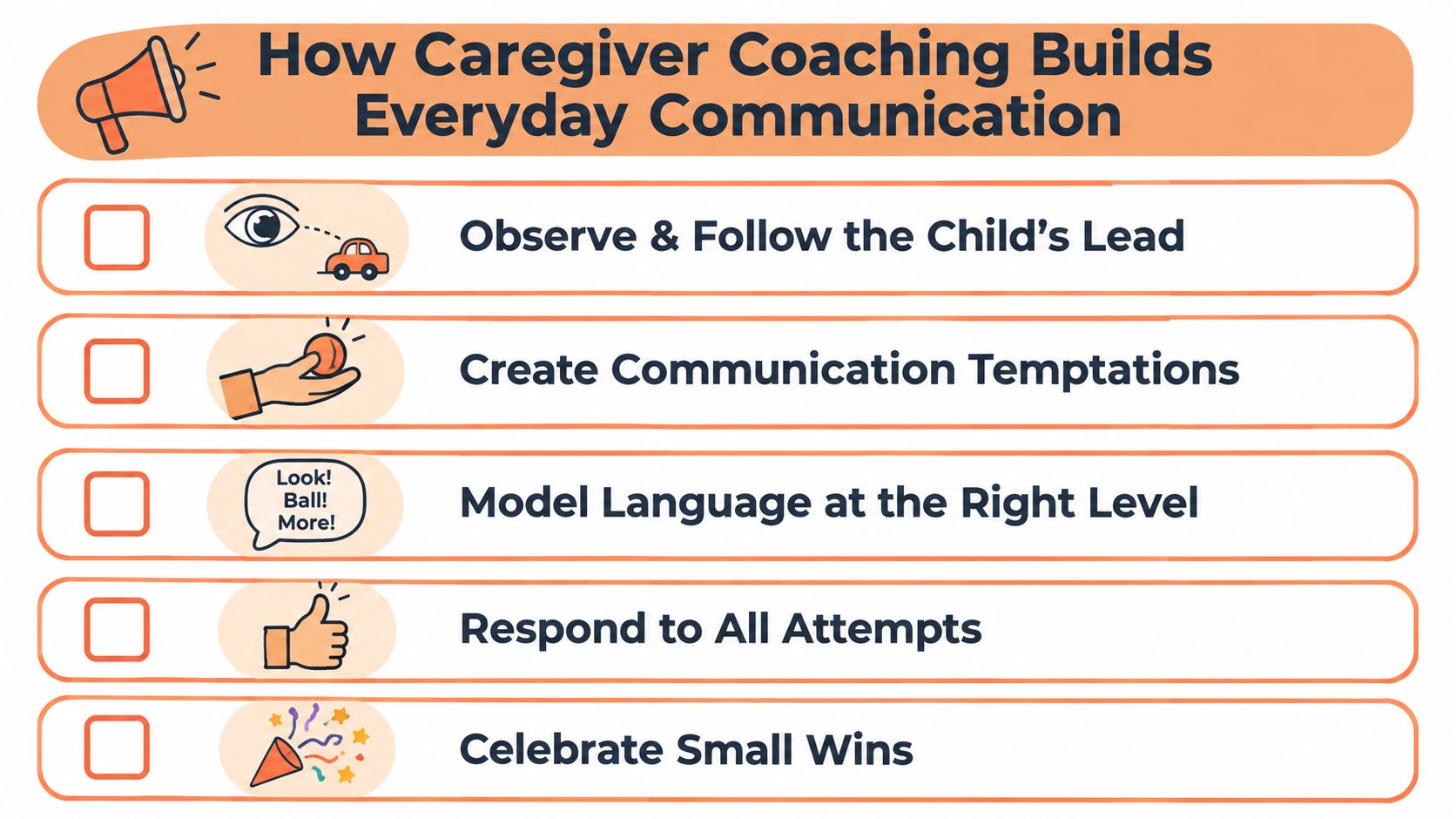
Five coaching moves families can use right away
- Observe and follow your child's lead: If your child reaches for blocks, start there instead of switching the game to something you picked.
- Create communication temptations: Put the bubbles out of reach, then pause so your child has a reason to ask, point, sign, or look toward you.
- Model language at the right level: Say “more bubbles” or “help please” instead of long explanations.
- Respond to all attempts: A glance, a point, a sound, or a picture all count as real communication work.
- Celebrate small wins: If your child used a card once at breakfast, that's worth noticing without turning it into a huge lesson.
Morning routines are a good place to start because they repeat every day. A child who struggles to get dressed might do better with a visual choice between two shirts and a simple pause while you wait for a response.
Grocery trips and bedtime can work the same way. At the store, you can hold up two snack options. At bedtime, you can use a picture for “one more story” or “lights out” so the routine feels less like a battle and more like a shared pattern.
Friendly ABA Premier's parent coaching support is one way families can build those routines with a clinician who stays focused on what happens at home, not just what happens in a session. You can learn more through Friendly ABA Premier's parent coaching page.
A helpful coaching habit: keep the language short, keep the pause long enough for your child to respond, and keep the praise specific.
That kind of coaching works because it's ongoing. Family-centered care depends on active listening, shared goals, and regular adaptation so the support stays useful as the child's needs shift.
Creating Consistent Access Across Home School and Therapy
Children do better when communication support travels with them. A picture card that works in therapy but disappears at home doesn't create much access, and a school routine that no one shares with caregivers can leave everyone guessing.
Keep the tools familiar
A shared visual schedule, a choice board, or a first-then strip can reduce confusion across settings when the same symbols and phrases are used in each place. That doesn't mean every adult says everything the same way, but it does mean the child doesn't have to relearn the system every time they change rooms.
A simple shared communication dictionary helps too. Families and providers can agree on what “more,” “break,” “help,” or “all done” looks like, so responses stay steady instead of depending on who happens to be nearby.
Make updates clear enough to use
Families asking for better communication often want faster, clearer, more actionable updates from the care team, not just more therapy time. A qualitative study in Hong Kong found telehealth family-centered therapy increased caregiver involvement and helped transfer goals into daily life, while broader reviews found telehealth improves access, convenience, and timeliness of care across autism services, according to this 2025 study.
That fits what many parents already feel. If a therapist says, “He used the picture for snack once, and here's what made that easier,” that's more useful than a vague “He did well today.”
For families who want school coordination alongside home support, Friendly ABA Premier's school support services can fit into that same kind of aligned planning. The point is not more meetings, it's clearer handoffs between the adults around the child.
The best communication plans are the ones teachers, parents, and therapists can actually repeat on a busy Tuesday.
Short daily notes help. So do quick check-ins after a new routine starts, especially when the child is learning to use the same tool in different places. The more consistent the access points, the less effort it takes for the child to be understood.
Everyday Examples That Show Better Access in Action
At breakfast, a parent places two cups on the counter and a small picture board beside the cereal. The child points, the adult waits, and the child taps “juice,” which is enough to end the guessing game and start the day calmly.
At recess, a teacher has practiced a simple turn-taking cue with a child who wants to join a game. The child shows the “my turn” card, and a peer leaves space in the line without needing a long explanation.
During a school transition, a student who usually freezes at cleanup time uses a first-then strip that says “first pencils, then music.” The adult doesn't argue, the timer doesn't become the focus, and the child moves with less stress because the expectation is visible.
Building communication skills in everyday moments usually looks like this, small changes that make success easier to repeat. When those moments are handled well, children often become more willing to try again, and adults gain a clearer sense of what works.
The biggest shift is often not dramatic. It's the quiet move from guessing to understanding, from power struggles to a predictable routine, from “I don't know what you need” to “I know how to help you tell me.”
Moving Forward With Confidence and Support
Better communication access doesn't mean every hard moment disappears. It means your child gets more chances to be understood, and you get a clearer path for helping them succeed in the routines you already live every day.
Start with one routine, use one consistent tool, and keep the adults around your child on the same page. Progress may look different from child to child, but clear, repeatable access points can make home, school, and therapy feel more connected and less overwhelming.
If you're looking for a care team that builds communication support into home routines, school collaboration, and parent coaching, Friendly ABA Premier can help you think through the next step with your family's goals in mind. Visit Friendly ABA Premier to connect with a team that values individualized planning, proactive updates, and real partnership with caregivers.
Our Latest Insights


























Experience ABA Therapy with a More Personalized Level of Support
Discover how FriendlyABA Premier combines evidence-based ABA therapy with dedicated coordination, proactive communication, and individualized family support.