


ABA Therapy Provider Guide to Choosing the Right Fit
Compare any aba therapy provider with confidence. Learn what to ask, how to evaluate care, insurance, and family support before you choose.


You may be sitting at the kitchen table with a referral in one hand and a dozen browser tabs open in the other. One provider mentions home-based care, another talks about a center, and your insurance company gives you a different set of instructions. You want support for your child, but you also want a team that listens, communicates clearly, and respects your family's routines.
Choosing an ABA therapy provider is less about finding the closest available service and more about finding a workable partnership. The right fit should connect clinical knowledge with everyday life, from getting dressed and eating breakfast to playing with siblings and participating at school.
Use this guide as a comparison tool during calls, tours, and insurance conversations. It focuses on care coordination, qualifications, individualized planning, setting, communication, coverage, and family support, then ends with a practical scorecard you can use when two providers appear similar.
Table of Contents
- Care coordination and communication
- Qualifications and supervision
- Individualized planning and progress review
- Family coaching and school collaboration
- Insurance and access
- Ask about personalization
- Ask about people and supervision
- Ask about family participation
- Ask about progress and concerns
Finding the Right ABA Therapy Provider for Your Family
ABA, or applied behavior analysis, became a formal field in 1968, when the Journal of Applied Behavior Analysis launched as a dedicated scientific platform. Autism-focused work appeared earlier, in 1964, and Dr. Ole Ivar Lovaas helped establish ABA as an autism treatment approach during the 1960s. His 1987 study reported that 90% of children receiving intensive ABA showed significant improvement compared with a control group, a milestone discussed in the history of applied behavior analysis.
That history helps explain why ABA providers emphasize observable goals, structured teaching, and progress data. It doesn't mean every provider or every plan should look the same. Your child's communication style, interests, sensory preferences, daily schedule, and family priorities should shape the way services are delivered.
Start with the partnership
A strong provider should make you feel included from the first conversation. Someone should explain who will oversee your child's plan, how questions are handled, when progress is reviewed, and what happens if a strategy isn't working.
A dedicated care coordinator can also reduce the practical burden. This person may help organize scheduling, communicate with the clinical team, clarify next steps, and keep insurance tasks from becoming your responsibility alone. Those details matter when appointments, school meetings, work schedules, and family routines already compete for your attention.
Practical rule: Choose the provider that can explain the care journey in language your family understands, not simply the provider that promises the fastest start.
The CDC's latest U.S. autism surveillance estimate is about 1 in 31 children age 8, or 3.2%, based on ADDM Network data released in 2025. That is different from the older 1-in-36 estimate many families still recognize, and it helps explain why access, staffing, scheduling, and continuity are important parts of provider choice. The information is available through the CDC autism data and resources.
| What to compare | Questions to consider |
|---|---|
| Care coordination | Is there one clear contact for scheduling and family questions? |
| Clinical oversight | Who designs and reviews the treatment plan? |
| Personalization | Are goals based on your child's strengths and daily needs? |
| Setting | Would home, center, hybrid, or school-supported care be practical? |
| Family support | Does the provider include caregiver coaching and school collaboration? |
| Access | Is the provider in network, and can services fit your schedule? |
Keep notes during every call. A provider that welcomes detailed questions and responds thoughtfully is giving you useful information about the partnership you may have later.
What an ABA Therapy Provider Does and How Care Is Personalized
An ABA therapy provider helps children build meaningful skills through planned teaching, practice, encouragement, and ongoing review. The focus may include communication, play, social interaction, daily routines, independence, or behaviors that interfere with learning and participation.
The work should begin with understanding your child, not assigning a standard package of goals. A behavior analyst gathers information through assessment, caregiver conversations, observation, and skill review. The resulting plan should describe specific goals, the proposed treatment approach, caregiver support, and how progress will be evaluated, as outlined in clinical guidance on applied behavior analysis.
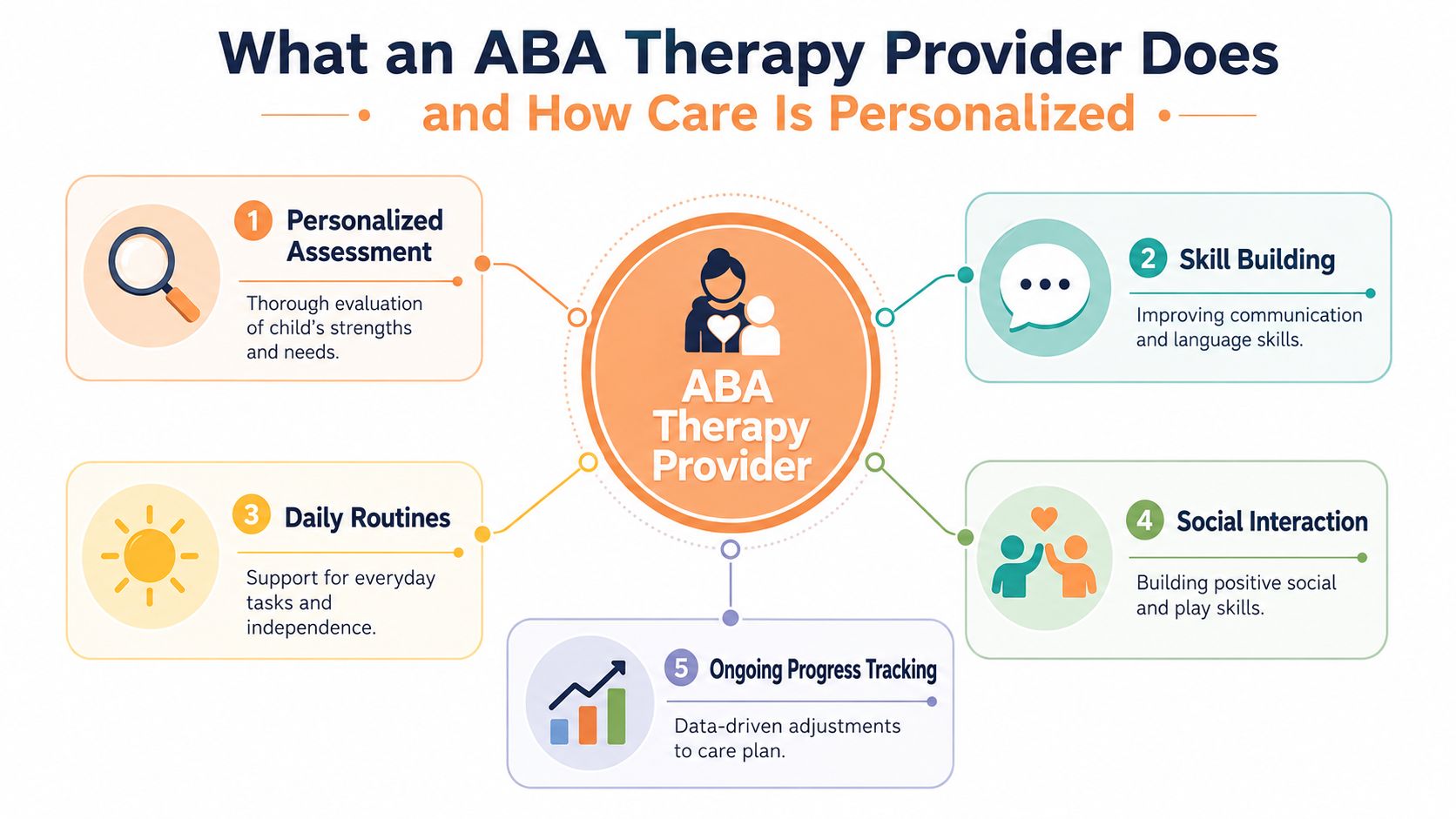
From assessment to everyday learning
Suppose your child reaches for a snack but struggles to ask for it. The team might identify a communication goal, practice it during a real snack routine, and use a preferred food or activity as encouragement. Later, the same skill could be practiced during play, at school, or in the community so communication isn't limited to one table or one therapist.
At mealtime, an individualized plan might support tolerating a new food near the plate, using a utensil, requesting help, or staying involved in a family routine. During play, the team might work on taking turns, choosing an activity, or responding when another child joins. For school routines, goals might include following a visual schedule, asking for a break, transitioning between activities, or participating in group instruction.
A quality provider reviews data frequently and adjusts protocols when the child's response suggests a change is needed. Data shouldn't replace your knowledge of your child. It should give the team another way to notice patterns, discuss progress, and make informed adjustments.
The people around your child matter
The behavior analyst typically oversees the plan, while direct-care team members practice skills with your child. Caregivers should receive clear explanations and hands-on coaching, not just reports after sessions end. The team may show you how to support a request during breakfast, encourage turn-taking during a board game, or make a transition to school more predictable.
Learn more about this family-centered process through Friendly ABA Premier's approach to individualized care. The most useful plan is one that can travel with your child across people, places, and routines.
Comparing Care Settings and Support Models That Matter Most
The best setting depends on what your child is practicing and where those skills need to be used. Home-based ABA can make daily routines the teaching environment. Center-based care may offer structured activities and social opportunities. A hybrid model can combine both, while school-supported care brings the team into classroom routines and teacher collaboration.
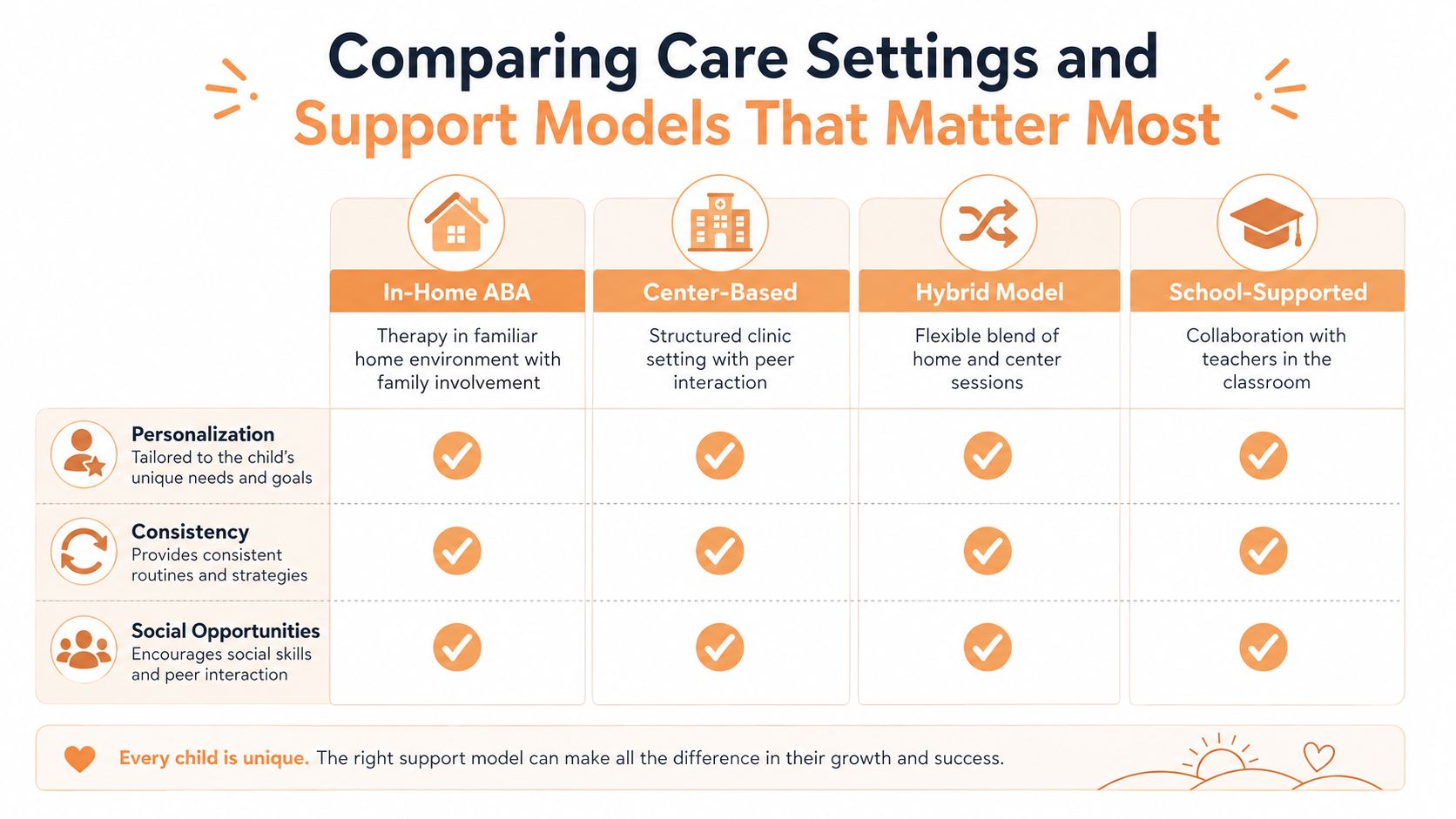
| Support model | Often fits families who want | Questions to ask |
|---|---|---|
| In-home ABA | Practice with dressing, meals, play, siblings, and transitions | Can sessions work around family routines and privacy needs? |
| Center-based ABA | A predictable learning environment and opportunities for peer interaction | How does the center support individual goals and sensory needs? |
| Hybrid ABA | Flexibility across home and clinic environments | How will the team keep goals and communication consistent? |
| School-supported ABA | Help with classroom participation, teacher communication, and peer routines | How will the provider collaborate with the school and follow school policies? |
Match the setting to the skill
If your main concern is getting through the morning routine, in-home support may allow the team to see what happens between waking up and leaving the house. The provider can help break the routine into manageable steps and coach caregivers in the moment.
A center may be useful when your child needs practice with structured group activities or social play. Families considering this model can review center-based ABA therapy and ask how the provider supports movement between structured learning and natural interaction.
Hybrid care can be practical when skills need to generalize across environments. A child might practice requesting help at home, then use the same communication skill during a center activity. School-supported services can help align goals with classroom participation, although collaboration requires communication with educators and attention to the school's rules.
The strongest setting is the one that helps your child use meaningful skills with the people and routines that matter most.
No setting is automatically better. Ask whether the provider can explain how goals will carry from therapy into family life, school, play, and community activities.
How to Evaluate an ABA Therapy Provider on What Really Counts
Credentials matter, but they are only one part of quality. A provider can have qualified clinicians and still leave families confused, disconnected, or unsure how care is progressing. Evaluate the full experience, including how the team plans, communicates, adapts, and supports the people who know your child best.
Care coordination and communication
Look for one dependable point of contact, scheduled check-ins, and clear instructions about whom to call. Ask what happens when a session needs to be changed, a concern arises, or school requests information.
A reassuring answer identifies a person and a process. “Your care coordinator will contact you, document the concern, and connect you with the supervising clinician” is more useful than “Our team communicates regularly.”
Qualifications and supervision
Ask who oversees your child's plan and how direct-care staff receive supervision. The behavior analyst should be able to explain their role in assessment, goal development, data review, and protocol changes in plain language.
You don't need to memorize every credential. You do need to know who is clinically responsible, who works directly with your child, and how the team maintains consistency when staff change.
Individualized planning and progress review
A personalized plan should reflect your child's strengths, interests, communication methods, and daily needs. Goals might involve asking for help, joining a sibling's game, tolerating a change in routine, or completing part of a bedtime task.
The National Autism Data Registry information describes longitudinal benchmarks across process, structure, cost, and outcome measures, including 9 quality measures for ABA services and outcomes collected across 13 assessment tools in 4 categories. You don't need a provider to use every measure. Ask which tools are relevant to your child and how the results will influence care.
Family coaching and school collaboration
Caregiver training should be practical. You might practice prompting a request during snack, supporting a transition away from a favorite toy, or responding when your child communicates “not now.”
Ask whether the provider communicates with teachers and related professionals when appropriate and with your permission. A plan that works only during therapy sessions may be harder for your child to use elsewhere.
Insurance and access
Confirm network status, authorization responsibilities, available settings, scheduling options, and what happens if staffing changes. Some providers offer evening or weekend availability, while others have more limited hours. Ask directly rather than assuming.
| Evaluation Criteria | What to Look For | Provider A Notes | Provider B Notes |
|---|---|---|---|
| Care coordination | Named contact, proactive updates, clear escalation process | ||
| Clinical oversight | Qualified behavior analyst and understandable supervision plan | ||
| Individualized care | Goals tied to strengths, routines, communication, and priorities | ||
| Family and school partnership | Hands-on coaching and collaboration with consent | ||
| Insurance and access | Network confirmation, authorization support, realistic scheduling |
Use a simple note such as “clear,” “unclear,” or “needs follow-up.” The provider that communicates about limitations may be a better fit than one that gives polished but vague answers.
Essential Questions to Ask Before You Choose
Bring questions to every consultation, even if the provider has a helpful website. A conversation shows whether the team can listen to your family, explain care without jargon, and respond to concerns without becoming defensive.
Ask about personalization
- “How will you learn what my child enjoys, communicates, and finds difficult?” A thoughtful answer should mention assessment, observation, caregiver input, and your child's interests.
- “Who helps choose the goals?” You should hear that caregivers and the clinical team work together, with goals connected to meaningful daily life.
- “Can goals change if they aren't useful or comfortable for my child?” A responsive provider treats feedback and signs of distress as information, not an inconvenience.
Listen for strengths-based language. A team that talks only about stopping behaviors may not be showing you the full picture. Ask how the provider will build communication, independence, play, participation, and self-advocacy.
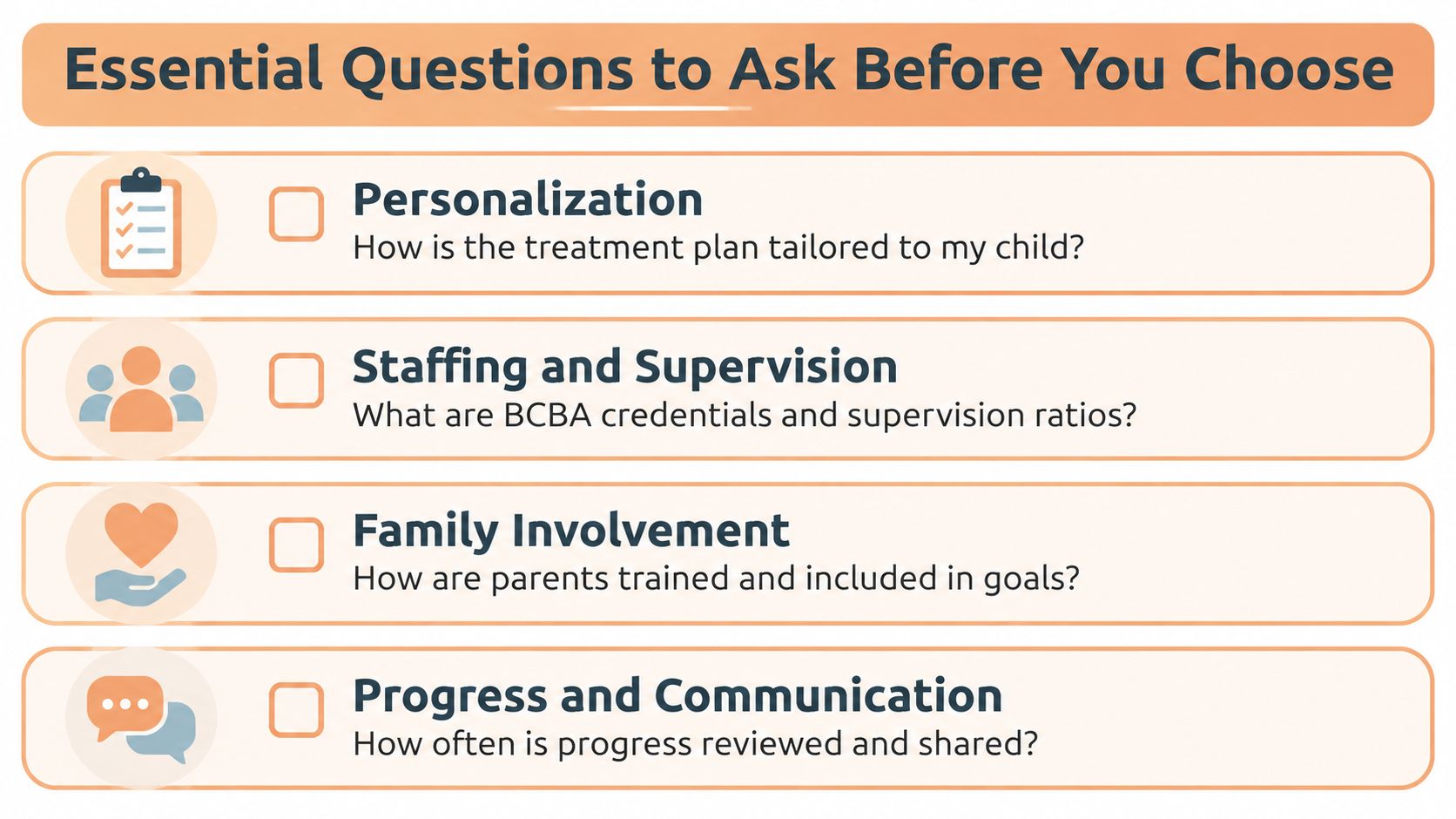
Ask about people and supervision
- “Who will oversee the plan, and who will work with my child each day?” You should leave knowing the team structure and the best contact for clinical questions.
- “How often will supervision occur?” The provider should explain how staff are observed, coached, and updated when a strategy changes.
- “What happens if my child doesn't connect with a team member?” Look for a plan that allows relationship-building and thoughtful adjustments.
Ask about family participation
- “How often will parent coaching happen?” Ask whether coaching takes place during real routines, such as meals, play, dressing, or homework preparation.
- “How will you include our priorities and cultural routines?” The answer should make room for your family's values, schedule, language, and preferences.
- “How will you coordinate with school?” Clarify consent, communication methods, and whether the provider can support classroom goals.
Ask about progress and concerns
- “How will progress be measured and shared?” Request examples of the type of update you'll receive and how often you'll discuss it.
- “What should I do if I disagree with a goal or notice a new concern?” A healthy partnership includes a clear route for questions and revisions.
- “How do you plan transitions?” Ask about changes in staff, settings, school schedules, and eventual reduction or ending of services.
Write down not only the answers but also how the provider responds. You're evaluating respect, patience, transparency, and follow-through.
Understanding Insurance Coverage and Getting Started Without Delays
After your family chooses a provider, care usually begins with several administrative steps. The provider may verify benefits, confirm network status, request prior authorization, complete an assessment, submit a treatment plan, and prepare documents for later reauthorization. Ask who owns each task, so a missing form does not delay services.
Insurance rules differ by state and plan. Maryland requires prior authorization and an evaluation by a qualified health care professional before ABA can begin, while Washington directs families to contact managed care plans to identify in-network providers. These examples, described in the Maryland ABA Provider Manual, show why a general statement about coverage may not answer your family's question.
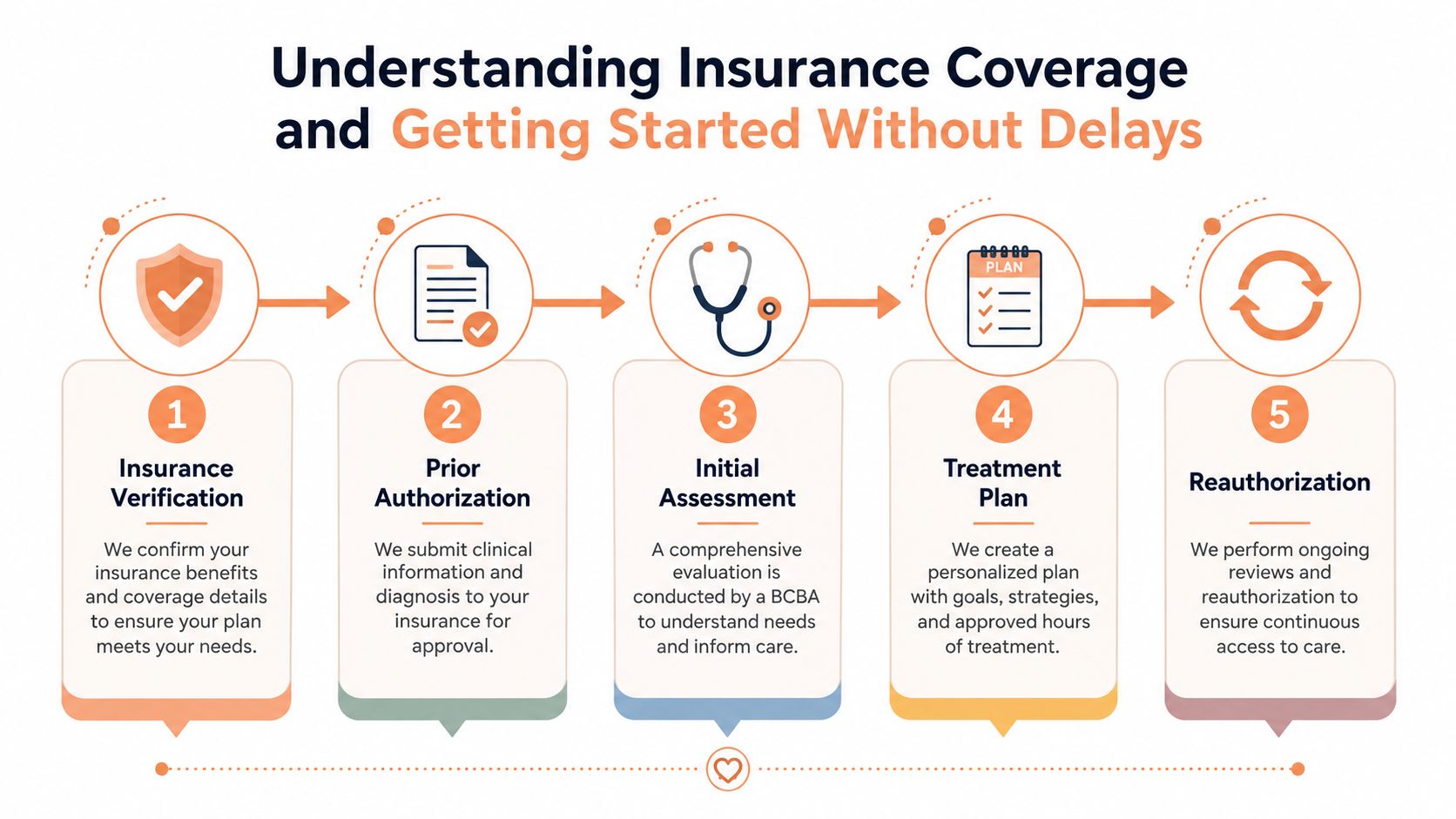
The documents support the request
Medicaid guidance says prior authorization requests should include the ABA assessment, treatment plan, and a form summarizing recent behavior, severity, and other therapies already tried. Reauthorization requests should document measurable progress and caregiver training or engagement, according to the Medicaid ABA services toolkit.
You do not have to track every detail alone. Ask which records the provider will request, which documents you must supply, how missing information will be reported, and who will contact the plan. A care coordinator can organize paperwork, clarify the next step, and help identify where an application has paused.
Confirm practical access before enrolling
Check whether the provider is in network for your exact plan, rather than relying only on the insurer's name. Confirm the proposed setting, schedule, transportation needs, cancellation policy, and availability for school or caregiver meetings. For a clearer view of financial questions, review this guide to understanding ABA therapy costs and coverage.
Treatment intensity should match the child and the family's capacity. Expert guidance summarized through BHCOE resources on ABA treatment intensity notes that many studies define high intensity as 15 to 20 hours per week, while lower-intensity programs are often 10 to 12 hours per week. The same review states that 10 to 20 hours weekly may produce positive outcomes for many autistic individuals, while children with profound autism or high support needs may require 30 to 40 hours per week for stronger gains. These ranges are not a prescription. The behavior analyst and family should decide together, considering routines such as meals, play, sleep, and school.
Ask whether evening or weekend appointments are available and whether virtual or hybrid options exist. A workable schedule helps the plan fit the whole household.
Making Your Confident Choice and Next Steps With Support
You don't need to find a flawless provider. You need a team that understands your child, explains its decisions, welcomes your input, and can support skills across the places your child lives and learns.
Before choosing, review these questions:
- Personal fit: Did the team ask about strengths, interests, communication, sensory needs, and family priorities?
- Clinical clarity: Do you know who oversees the plan and how progress will be reviewed?
- Daily usefulness: Will goals connect to meals, play, self-care, school, or community routines?
- Family partnership: Will you receive hands-on coaching and understandable updates?
- Setting match: Does home, center, hybrid, or school-supported care fit your child's needs and your schedule?
- Access plan: Is the provider in network, and will someone help with authorization and scheduling?
- Responsiveness: Did the team answer concerns directly and describe how changes are handled?
For first-time care seekers, start with a consultation and ask the questions in this guide. For those changing providers, write down what worked, what didn't, and what you want the next team to do differently. If home-based support is your priority, ask how the provider will use real routines as learning opportunities. For school-aged children, ask how the team will coordinate with educators and support participation without treating school as separate from care.
Personalized treatment, a dedicated coordinator, scheduled progress conversations, and proactive communication can simplify the process. Discuss your child's needs with the care team before making a final decision, and give yourself permission to choose the partnership that feels clear, respectful, and practical.
Friendly ABA Premier offers individualized home-based ABA therapy, social skills development, school support, and parent coaching across Connecticut, Georgia, Maryland, Massachusetts, North Carolina, South Carolina, Virginia, and Washington. Visit Friendly ABA Premier to learn how a dedicated family care coordinator and proactive communication can support your provider search, then schedule a consultation to discuss your child's routines and goals.
Our Latest Insights







































Experience ABA Therapy with a More Personalized Level of Support
Discover how FriendlyABA Premier combines evidence-based ABA therapy with dedicated coordination, proactive communication, and individualized family support.