

Parent Training Autism: A Reassuring Guide for Families
Discover what parent training autism involves, expected outcomes, and tips for choosing the right program for your family in 2026.


You've just finished dinner, but you're still thinking about what happened at the table. Your child cried when the food changed, pushed the plate away, and became so overwhelmed during the transition that the rest of the evening felt impossible. You may have a clinician's number open on your phone and one quiet question in your mind: Will anyone teach me what to do during the next hard moment?
That's where parent training for autism can help. It adds a caregiver-focused layer to a child's broader support plan, so useful strategies can move from a clinic or therapy session into meals, play, bedtime, school preparation, and community routines. Parent training isn't about blaming you for difficult moments, and it isn't a replacement for direct therapy. It's coaching designed around the life your family is living.
Table of Contents
- Early sessions focus on fit
- Middle sessions build caregiver confidence
- Later sessions support independence
- Questions about the training model
- Questions about progress and communication
- Questions about coordination
A Relatable Moment Before the First Session
At the kitchen table, you replay the meltdown from earlier. You remember the warning signs, but you're not sure which sign mattered most or what you could have done differently without making the situation worse. Your child may have made progress with a therapist, yet home still feels unpredictable because the people and routines are different.
That gap is common. A child can practice communication, waiting, flexibility, or daily living skills with a clinician and still need support using those skills during a rushed morning or a noisy grocery trip. The parent is often left carrying the most important part of the day without clear, practical guidance.
Parent training exists for that reason. A clinician watches how a challenge unfolds, helps you understand what may be contributing to it, and practices a response with you. The focus might be preventing a difficult transition, teaching your child a way to request a break, or reinforcing a small step toward independence.
A useful starting point: parent training should make the next routine clearer, not make you feel responsible for producing instant change.
Your first conversation with a provider may include questions about the child's needs, family routines, and what happens during difficult moments. If you're unsure what an initial ABA process involves, this guide to what to expect during your first ABA assessment can help you prepare.
The right support respects your energy, culture, schedule, and priorities. It also recognizes that progress often depends on small interactions repeated during ordinary days, not on asking a family to become a therapy team overnight.
What Parent Training for Autism Actually Means
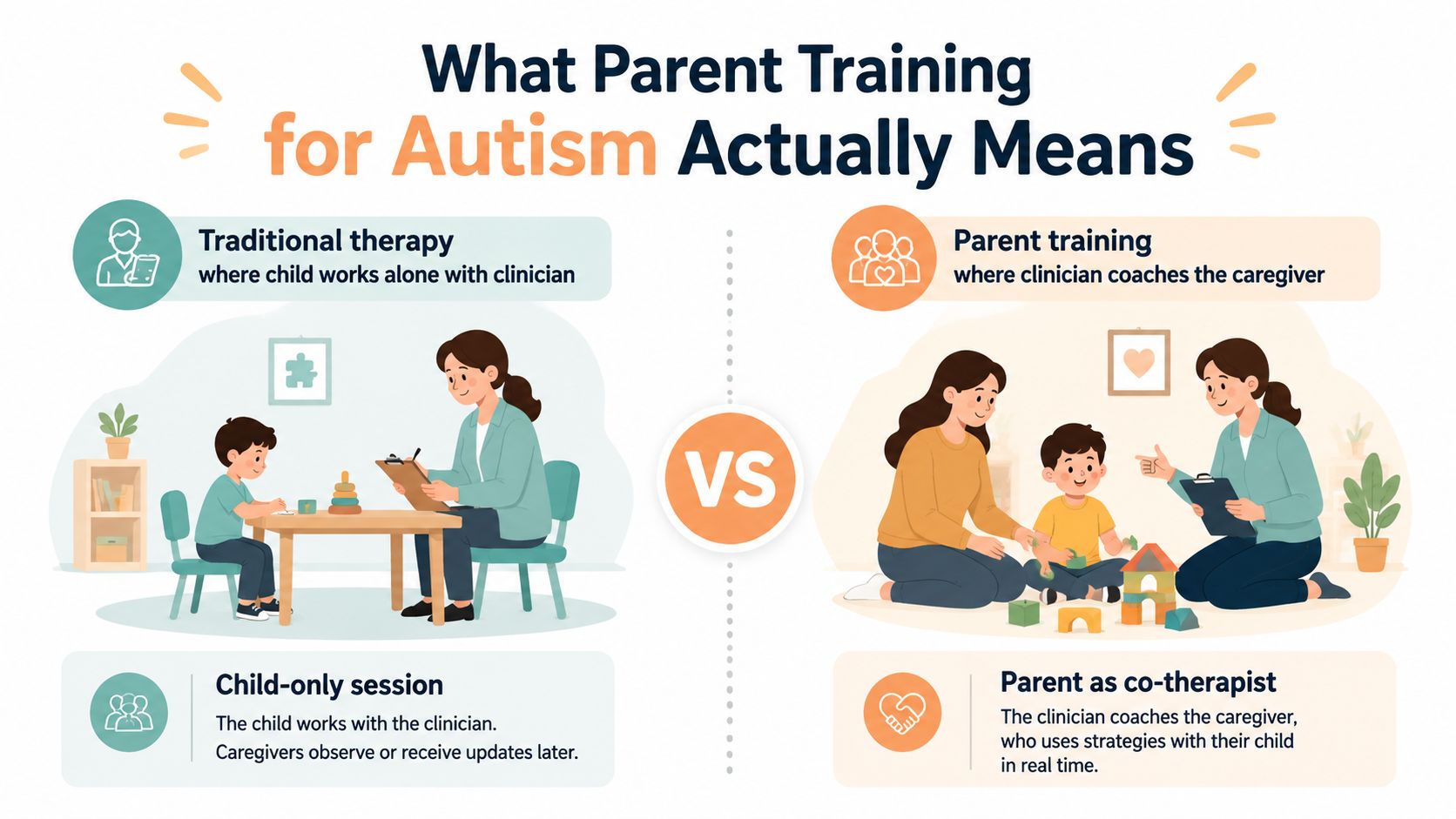
Parent training is a structured process in which a clinician coaches a caregiver to use specific strategies with a child between visits. The coach may be a Board Certified Behavior Analyst, often called a BCBA, or another qualified member of the treatment team working under an appropriate clinical plan.
The clinician might demonstrate a strategy, explain why it may help, watch you try it, and offer feedback. This hands-on approach is different from receiving a list of instructions and being expected to figure everything out alone.
Parent training and direct therapy serve different roles
During direct ABA therapy, the clinician or therapist works directly with the child. They may teach communication, play, social interaction, safety, or daily living skills while collecting information about the child's responses.
During parent training, the caregiver becomes the active learner. You may practice how to give a clear direction, arrange the environment before a transition, reinforce a useful request, or respond consistently when a child refuses a task. The two services can work together. Parent training doesn't automatically replace direct hours, and direct therapy doesn't remove the need to help skills carry over at home.
Sessions may happen in the home, clinic, community, or through telehealth, depending on the family's needs and the provider's model. A home session can reveal details that aren't visible elsewhere, such as the distance between the bedroom and bathroom, the way siblings affect a routine, or what happens when dinner is already late.
A broader plan may also include school collaboration, speech or occupational therapy, direct ABA services, and support for daily living or social skills. A clear explanation of how these pieces fit together is part of understanding ABA therapy and what every parent should know.
The strongest programs don't hand every family the same script. They identify one or two meaningful routines, teach strategies in plain language, and adjust the plan when a recommendation doesn't fit the child or the household.
The Core Goals of a Parent Training Program
Parent training can address many priorities, but three goal areas appear often in family-centered ABA plans. Each deserves a realistic explanation because the research isn't equally strong across every outcome.
Reducing disruptive behavior
The clearest research signal involves disruptive behavior, which can include severe tantrums, aggression, refusal, or other behavior that interrupts family routines. A meta-analysis of 8 randomized controlled trials involving 653 participants found a moderate effect favoring parent training, with a standardized mean difference of -0.59 and a 95% confidence interval from -0.88 to -0.30. The result was statistically significant, with p < 0.001. The findings also showed meaningful variation between programs and participants, so the result shouldn't be treated as a guarantee for every child (meta-analysis of parent training for disruptive behavior).
In everyday terms, a coach may help you prevent a predictable problem before it escalates. That could mean offering a visual warning before turning off a video, teaching a functional way to request help, reinforcing a calm transition, or changing how a demand is introduced.
Making daily routines more workable
A family may choose goals around meals, getting dressed, toothbrushing, sleep preparation, or leaving the house. These goals often involve breaking a routine into smaller steps and reinforcing participation rather than waiting for the entire task to go smoothly.
For example, bedtime training might begin with walking to the bathroom, then tolerating pajamas, then choosing a book. A parent and clinician can decide which step matters most right now and how to respond when the child pauses or refuses.
The research doesn't support promising that every routine will quickly become easy. It does support a practical reason for caregiver coaching: parents are present during the routines where skills need to work, so they can help practice happen in meaningful settings.
Carrying skills into everyday life
A child may request a preferred item in therapy but not at home. They may wait for a turn with a clinician but struggle when a sibling has the toy. Generalization means helping a skill travel across people, places, materials, and situations.
Caregiver practice makes that transfer possible. The parent can reinforce communication during snack, waiting during a board game, or flexible thinking when a preferred route to school changes. The clinician's job is to make the practice manageable and to watch whether the skill is useful outside the original teaching setting.
The practical test: a goal matters when it helps your child participate more comfortably and helps your family complete an important routine with less conflict.
What a Typical Training Cycle Looks Like
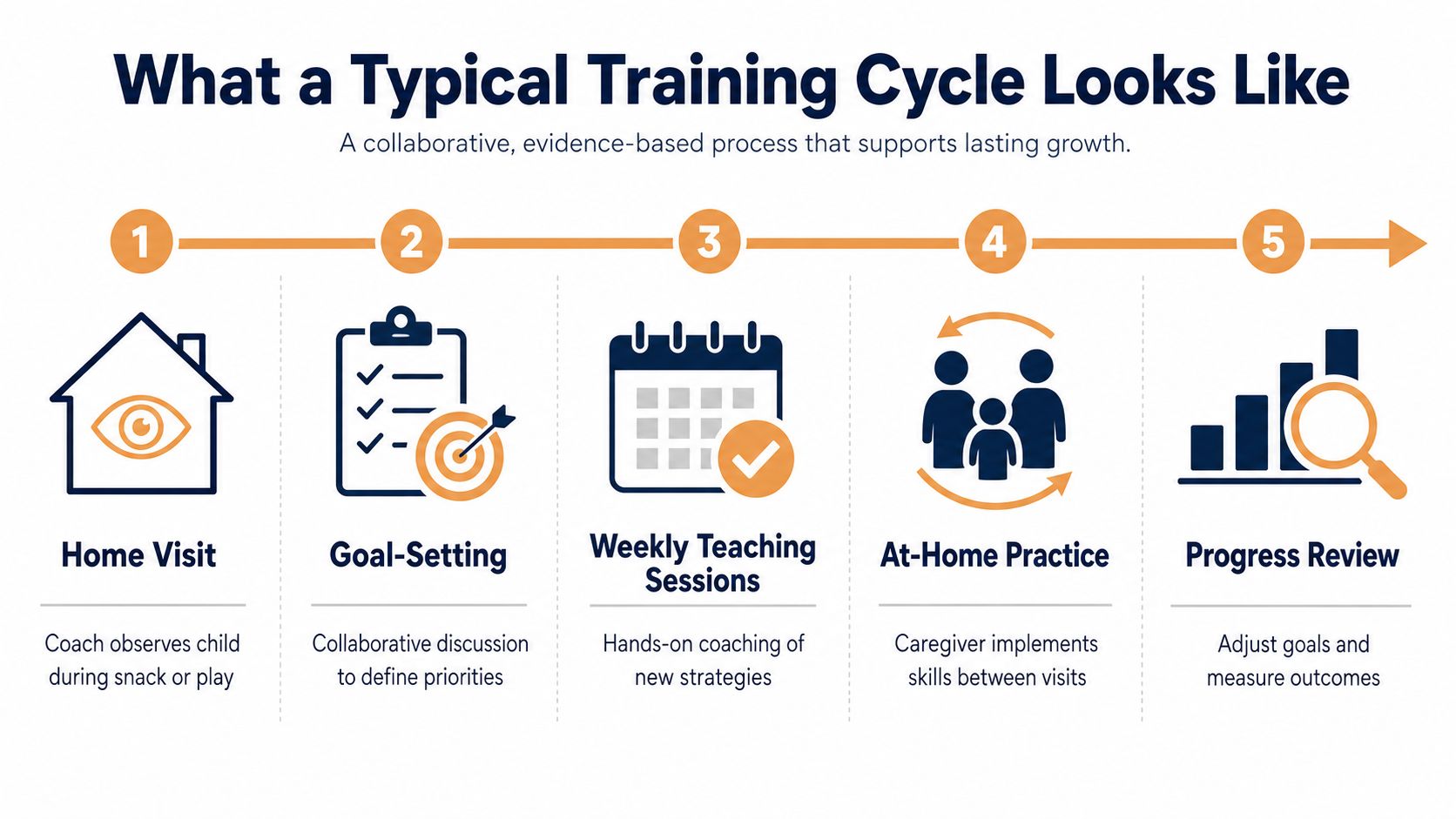
A training cycle often starts with observation rather than a lecture. A coach may watch snack or play, noting what happens before a difficult moment, how the child responds, and what the caregiver already does well.
Suppose cleanup becomes a daily battle. Instead of saying “make cleanup easier,” the parent and clinician might choose a smaller target, such as placing one toy in a bin after a short warning. The clinician can model the direction, show how to offer help, and practice a response that doesn't accidentally turn refusal into a longer negotiation.
Early sessions focus on fit
Early training usually includes a conversation about family priorities. One caregiver may care most about mealtimes, while another may need help with leaving the house or supporting a sibling relationship. The plan should account for the child's age, communication style, sensory needs, and the family's available time.
A coach may teach one strategy, observe the caregiver using it, and give immediate feedback. Some providers use video feedback when the family agrees and the technology is appropriate. Brief notes from home can also help, especially when they capture what happened before and after a behavior without requiring a parent to write a long report.
Middle sessions build caregiver confidence
As practice continues, the caregiver may lead more of the routine. During mealtime, that could mean offering a clear choice, waiting for a response, and reinforcing an appropriate request. During bedtime resistance, it could mean using the same short sequence each night and responding to protest according to the individualized plan.
A skill taught during turn-taking at home can be practiced later during sibling play or a grocery trip. The clinician helps adjust the strategy when the setting changes, because a plan that works in a quiet room may need modification in a crowded store.
The embedded video can offer another way to understand how coaching may look in practice.
Later sessions support independence
Over time, coaching may become less frequent or more focused on review. The clinician looks at progress, checks whether the strategy still fits, and decides whether to maintain, change, or fade support.
There isn't one correct pace. A family dealing with high stress may need smaller practice blocks and more troubleshooting. Another family may be ready to take the lead quickly. A respectful provider adjusts the cycle instead of treating a standard schedule as more important than the family's capacity.
What the Research Says About Real Outcomes
Research on parent-mediated autism interventions points to measurable but generally modest gains, not a universal transformation across every developmental area. An earlier review of 19 randomized clinical trials found average effects ranging from Hedges' g of 0.18 for communication-language to 0.27 for socialization, with an overall average of 0.23 (review of parent-mediated interventions).
A later meta-analysis reviewed 30 randomized controlled trials involving 1,934 participants. It found a clinically relevant improvement in parent-rated adaptive functioning, with a standardized mean difference of 0.28, and a moderate-certainty effect on disruptive behavior, with an SMD of 0.55 (2021 meta-analysis of parent-mediated interventions). These findings support parent training as a useful part of care, especially when the plan targets everyday behavior and adaptive routines.
What appears most dependable
Parent-child interaction is another meaningful area. A systematic review of early parent-mediated intervention included 17 studies from six countries and 919 children with ASD. It found improvements in shared attention, with an SMD of 0.41, and parent synchrony, with an SMD of 0.90 (international review of parent-mediated early intervention).
That means coaching may help a parent notice a child's cues, respond more effectively, and create more opportunities for shared engagement. It doesn't mean every family will see the same changes, and it doesn't mean interaction improvements automatically resolve every challenge.
| Outcome area | Research support | Realistic expectation |
|---|---|---|
| Disruptive behavior | Strongest and most consistent signal | A well-fitted plan may make difficult moments safer and more manageable |
| Parent-child interaction | Supported across international research | Coaching may improve shared attention and responsive interaction |
| Adaptive functioning | Clinically relevant but modest effect | Daily living progress may occur through repeated routine practice |
| Core autism characteristics | Mixed or unclear | Don't expect parent training alone to change autism characteristics |
| Caregiver burden | Not the same as confidence or stress | More knowledge may not automatically make responsibilities feel lighter |
Families often ask whether training will produce broad language gains, a dramatic school-readiness leap, eliminate all challenging behavior, or reduce the need for direct therapy. Current evidence doesn't justify promising those outcomes from parent training alone. A 2026 systematic review found no clear benefit for child autism characteristics, adaptive functioning, language, or parental stress, while finding benefits for child behavior problems and parent sensitivity or synchronicity (2026 systematic review of parent-mediated interventions).
Confidence also needs careful interpretation. A 2025 randomized controlled trial found significant gains in self-efficacy, perceived stress, and family well-being, but no significant change in caregiver burden (2025 randomized controlled trial on caregiver outcomes). Parent training may give you better tools without removing every demand from your day.
How to Choose the Right Program for Your Family
A provider's name and credentials matter, but they're only part of the decision. The person coaching you must be able to explain strategies clearly, listen without judgment, and adapt recommendations to your home rather than expecting your family to imitate a clinic.
Bring questions to the intake call. You're evaluating the relationship as much as the curriculum.
Questions about the training model
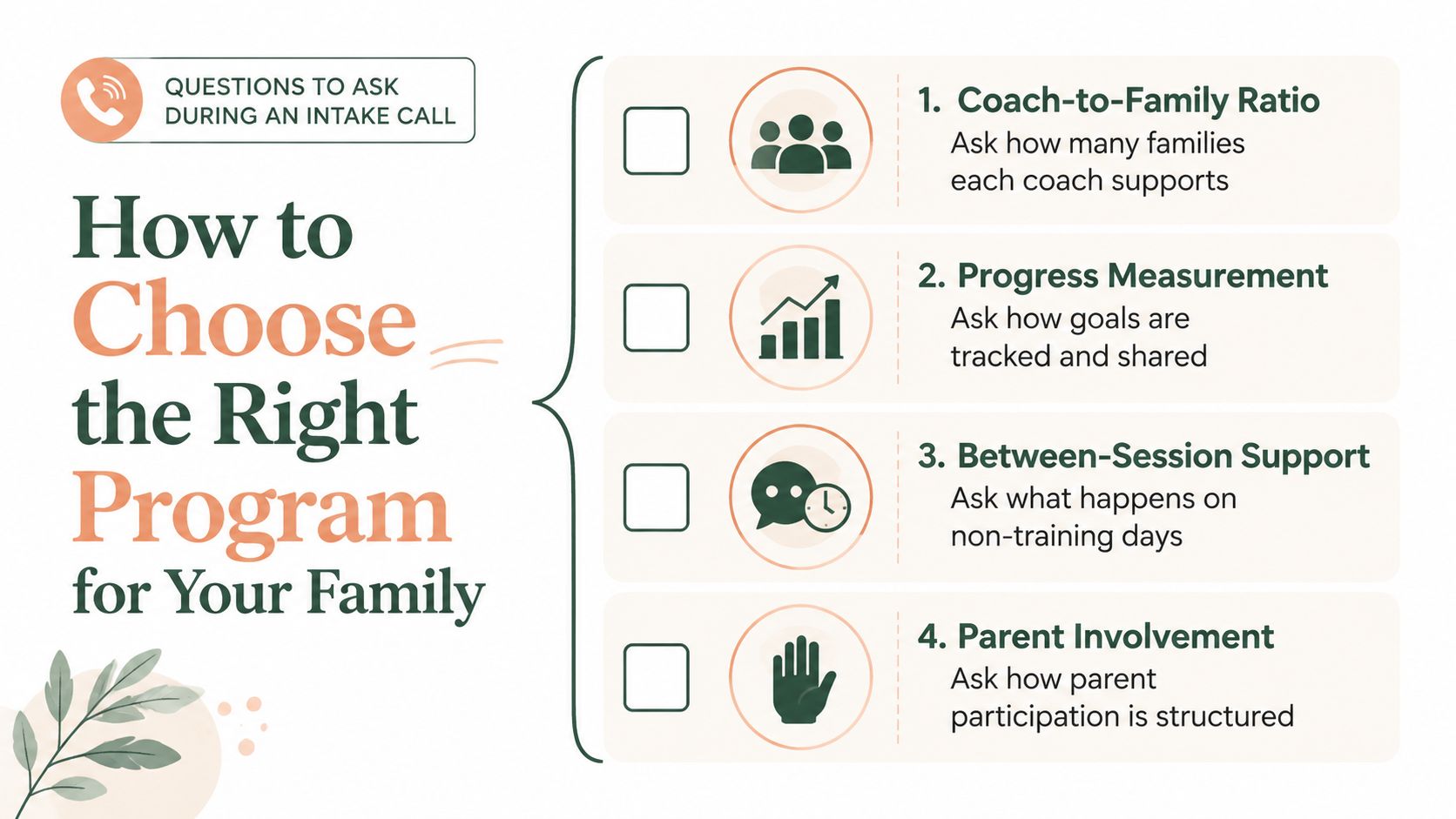
Ask how many families each coach supports, how sessions are delivered, and whether the provider can observe real routines such as dinner, play, the car, or getting ready for school. A program that only discusses home life abstractly may miss the details that make a routine difficult.
Ask whether the plan is manualized, flexible, or a combination. A structured curriculum can provide consistency, while flexibility allows the clinician to respect family language, culture, household expectations, and the child's individual strengths.
Questions about progress and communication
Ask how goals are selected and measured. You should understand what the team is tracking, how information is shared, and how often the plan is reviewed.
Also ask what happens between sessions. Will you have a way to send a question, request clarification, or report that a strategy isn't working? Proactive communication can prevent a small concern from becoming a major source of frustration.
Questions about coordination
If your child receives direct ABA, speech therapy, occupational therapy, school support, or other services, ask how the parent-training clinician coordinates with that team. Conflicting instructions can make implementation harder for everyone.
Look for a plan that names the caregiver's role without treating the parent as unpaid staff. A good coach should explain the reason behind a strategy, invite feedback, and help scale practice to what you can realistically do.
Families exploring a more individualized model can review Friendly ABA Premier's parent coaching service alongside other local options. The useful comparison points are the same: individualized goals, clear communication, coordination, and a plan for adjusting or fading support.
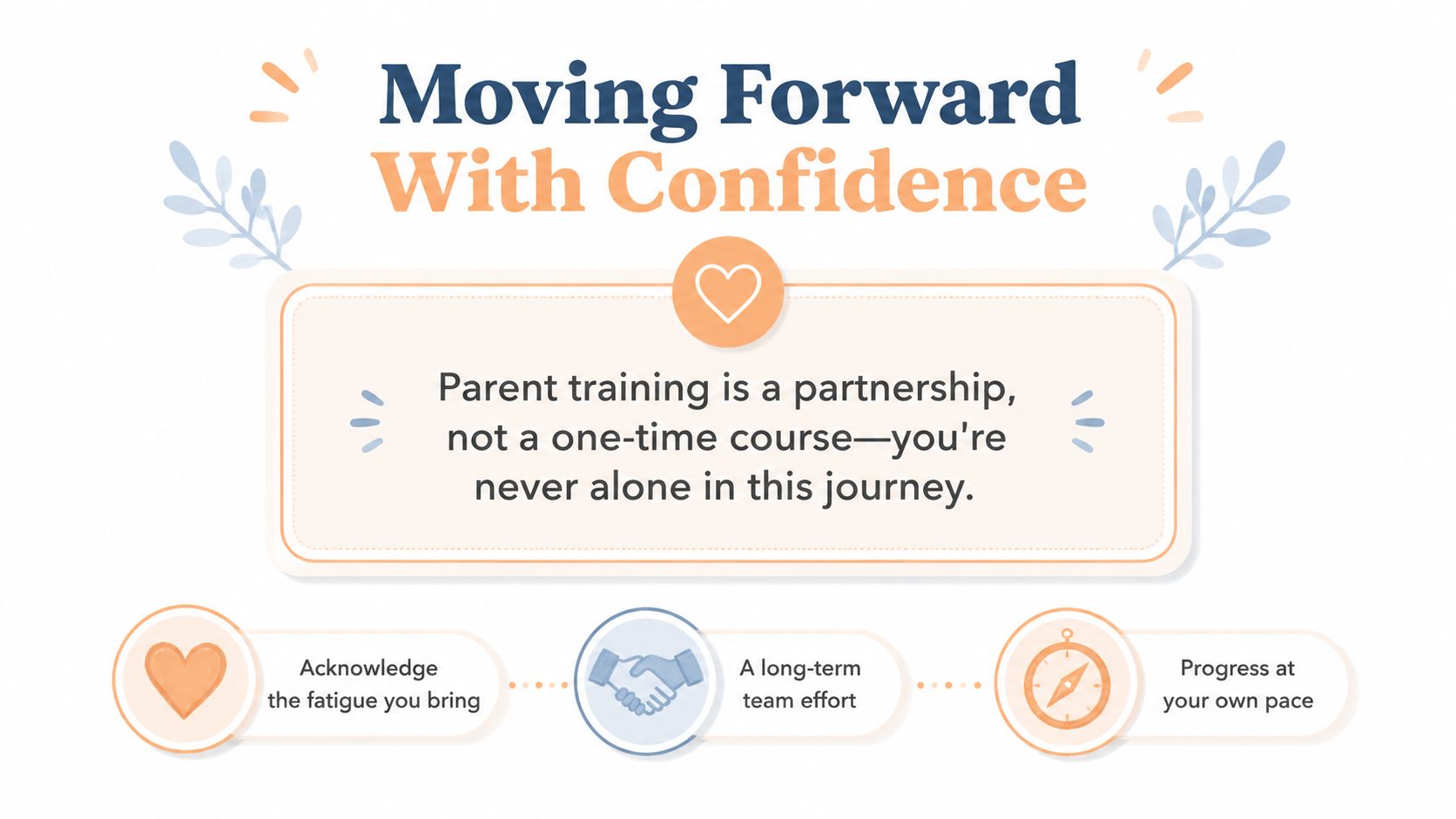
Moving Forward With Confidence
By the time you sit down for a first parent-training conversation, you may already be tired. You may have spent weeks coordinating appointments, answering questions from school, and trying to keep ordinary routines moving. You don't need a program that adds pressure without adding practical help.
The clearest expectations are also the kindest. Parent training has its strongest support for reducing disruptive behavior and improving parent-child interaction. It may support adaptive routines, but it isn't a promise of broad developmental catch-up, a cure, or a complete end to challenging behavior.
Fit matters just as much. Look for a clinician who respects your family's routines, communicates proactively, welcomes questions, and adjusts the plan when your child or household needs something different. A dedicated care coordinator and regular progress conversations can make it easier to know who to contact and what happens next.
Caregiver practice matters, too, but practice doesn't have to mean turning every hour into therapy. One clear request at breakfast, one supported transition before school, or one short turn-taking game can become meaningful when the strategy fits and the team helps you use it consistently.
Choose two or three programs to contact, then ask one specific question about how they would approach a routine that matters to your family. You'll learn a great deal from whether the response feels thoughtful, understandable, and collaborative.
Friendly ABA Premier offers individualized ABA services, home-based support, school support, social skills development, and parent coaching for families across Connecticut, Georgia, Maryland, Massachusetts, North Carolina, South Carolina, Virginia, and Washington. If you're looking for practical guidance that connects your child's therapy goals to everyday routines, visit Friendly ABA Premier to explore services or schedule a consultation.
Our Latest Insights









































Experience ABA Therapy with a More Personalized Level of Support
Discover how FriendlyABA Premier combines evidence-based ABA therapy with dedicated coordination, proactive communication, and individualized family support.