


How to Do ABA Therapy at Home: A Caregiver's Guide
Learn how to do ABA therapy at home with practical strategies for setting up sessions, choosing targets, and tracking progress in everyday routines.


You've got juice on the counter, a child who wants it, and a familiar moment of uncertainty. Your child may point, pull your hand, use a picture, or say part of a word. Then the morning rush continues, and you're left wondering whether you should turn that moment into therapy or just get everyone out the door.
Home ABA can fit inside real family life. It isn't about making your kitchen look like a clinic or requiring you to become a behavior analyst overnight. Applied Behavior Analysis uses careful observation, small teachable steps, reinforcement, and practice to support useful skills such as communication, play, self-care, and participation in routines. Professional guidance matters, especially when a child's needs are complex, but caregivers can make meaningful learning opportunities part of ordinary days.
Parent-mediated ABA-style interventions have been studied in randomized trials for years. A 2017 meta-analysis of 19 randomized controlled trials involving children ages 1 to 6 found small but measurable benefits across core developmental areas, with weighted Hedges' g values ranging from 0.18 for communication-language to 0.27 for socialization, and an average of 0.23 across domains. The authors also found that outcomes didn't differ significantly by treatment dose or by whether parent training was compared with usual care or an active control.
The practical message is reassuring: you don't need perfect sessions. You need a manageable plan, a meaningful skill, and support that helps the plan survive breakfast, school mornings, sibling noise, schedule changes, and tired evenings.
Table of Contents
What Home ABA Really Looks Like Day to Day
At breakfast, your child reaches toward the refrigerator. You pause instead of guessing, hold up the juice, and wait. Your child points to the cup, hands you a picture, signs, or says “juice.” You respond right away and label the request: “Juice. You asked for juice.” That small exchange can support communication without interrupting the rhythm of the morning.
A few minutes later, toothbrushing becomes another learning opportunity. Your child may pick up the toothbrush, tolerate toothpaste, or complete one part of the routine with less help. You might use a visual cue, offer a choice between two toothbrushes, or reinforce an attempt with a favorite song. The work happens in the routine, not apart from it.
Beyond the clinic table
Many parents first imagine ABA as a therapist and child sitting at a table, practicing repeated responses with carefully arranged materials. Structured teaching can be useful, but home-based ABA also brings goals into snack time, floor play, bath time, dressing, and transitions.
A caregiver might help a child request a turn with a toy during play, follow a direction while putting laundry away, or use a replacement communication response when a preferred activity ends. Practice is often brief and repeated across natural moments rather than forced into one long block.
A useful shift: Don't ask, “When can I do therapy?” Ask, “Where does this skill naturally belong in our day?”
The historical foundation for home ABA reaches back to the early 1960s and 1970s, when early behavior-therapy programs for autistic children appeared in the United States. Later work developed into Early Intensive Behavioral Intervention, often associated with the Lovaas method. A review of parent-implemented interventions describes how this history helped shape modern home ABA, with emphasis on caregiver training, consistent reinforcement, and generalizing skills beyond a therapy session.
You don't need a certification to begin using a team-approved strategy. You do need clear coaching, a target that makes sense for your child, and permission to keep family life feeling like family life.
Setting Up Short Practice Sessions at Home
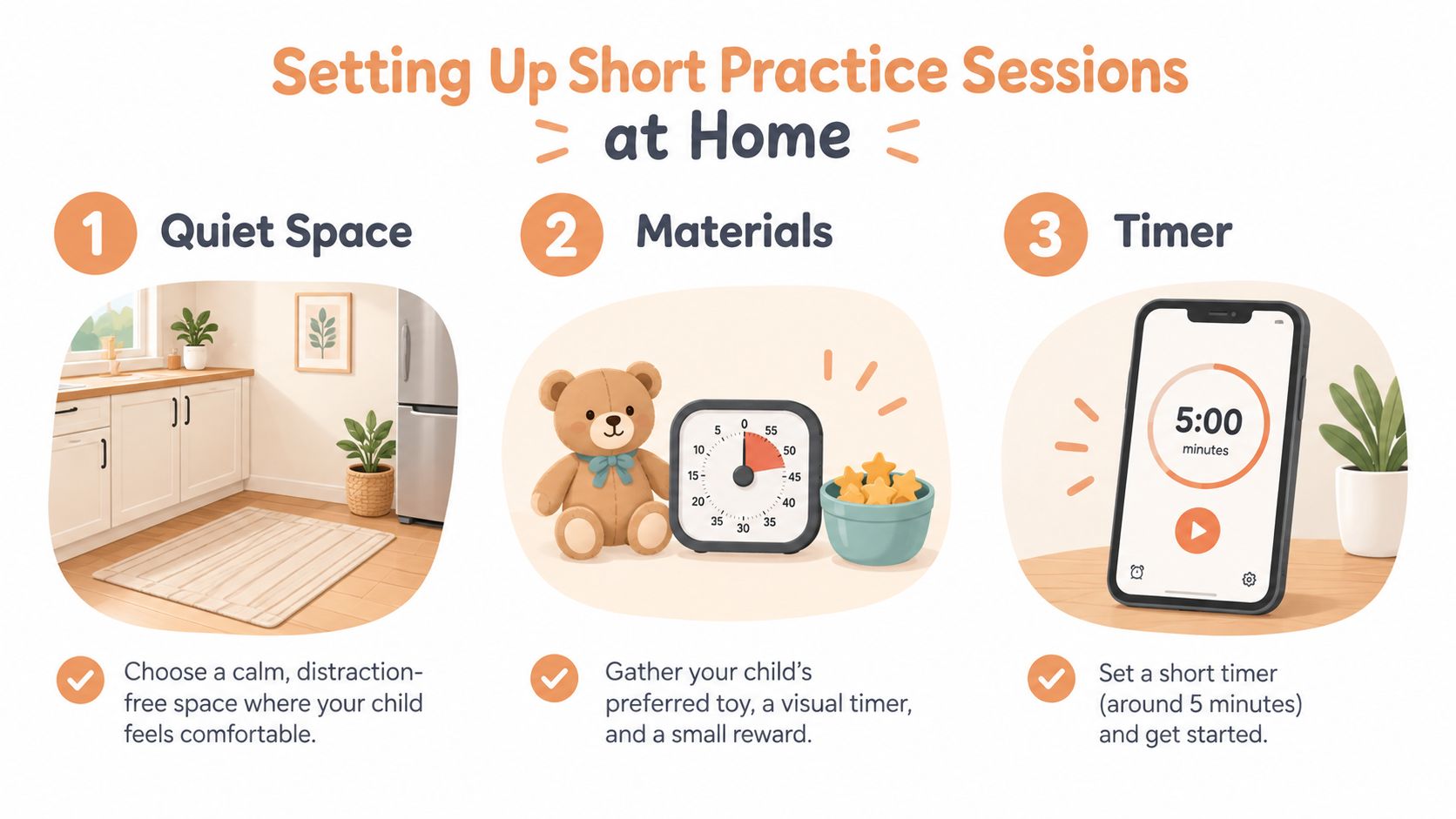
A good home practice space doesn't need special equipment. Choose a low-distraction area, such as a quiet kitchen corner, a living-room rug, or a small table away from background screens. Keep two or three materials nearby, perhaps a preferred toy, a visual schedule card, and a small snack if food is an appropriate reinforcer for your child.
Start when your child is calm, reasonably rested, and fed. Sit at or below eye level, keep your voice relaxed, and remove unnecessary demands from the environment. The purpose is to make participation feel predictable and safe, not staged.
Build a repeatable rhythm
A short practice block might last 5 to 15 minutes, depending on your child's age, regulation, and clinical plan. Two or three brief opportunities during the day often feel more manageable than one extended activity, but your child's care team should help determine what's appropriate.
Use a consistent opening cue. You could play a short song, start a visual timer, or say, “Let's play a game.” Finish with a clear closing cue, such as “All done,” followed by a preferred activity or a transition your child understands.
A simple setup might look like this:
- Quiet space: Clear one small area and turn off nearby screens.
- Materials: Place the target item, a visual support, and a possible reinforcer within reach.
- Practice cue: Use the same phrase, song, or timer each time.
- Flexible ending: Stop while your child is still participating successfully, or follow the plan from your clinician if regulation changes.
For plain-language guidance on building a teachable routine, you can also review behavioral skill training. A parent coach can help adapt the space, materials, prompts, and timing to your child's preferences and your home layout.
Choosing One Skill to Start With
Start with a daily problem that matters to your family, then describe the action you want to see. “Improves communication” is too broad to guide a tired parent at the snack table. “Hands a picture card to ask for crackers” gives you something observable and teachable.
Write down a short list of moments that regularly disrupt the day. Mealtime frustration, difficulty requesting a toy, trouble following the hand-washing routine, and resistance during transitions are all possible starting points. Don't choose every concern at once. Select one skill that can be practiced naturally and could give your child a little more independence.
Turn a concern into a teachable action
Consider these examples:
- Instead of “be more independent,” try completes two steps of hand washing with prompts.
- Instead of “participate in circle time,” try sits near the activity for one minute.
- Instead of “help with chores,” try matches clean socks by color or pattern.
- Instead of “use language,” try hands over a card, points, signs, or says a taught request for a preferred item.
The best first target is small enough to practice repeatedly without exhausting either of you. It should also be meaningful. If your child loves bubbles, requesting bubbles may create more motivation than practicing a random word. If mornings are difficult, a dressing step may be more useful than a skill that only appears occasionally.
Start with one door into independence, not the whole hallway.
Your BCBA or care coordinator can help refine the wording. That precision matters later, because everyone needs to agree on what counts as an independent response, which prompts are allowed, and what information should be recorded.
A target can change as you learn more. If your child reaches the goal quickly, the team might make the step slightly more complex. If the skill stalls, the team may simplify it, change the prompt, adjust the reinforcer, or choose a different routine. Progress isn't a test of your parenting. It's information that helps the team individualize the next step.
Using Reinforcement That Actually Works
Reinforcement means that something your child values follows a behavior and makes that behavior more likely to happen again. It isn't the same as bribery. Bribery usually means offering something reactively to stop a problem; reinforcement is planned, immediate, and connected to a skill you're teaching.
Your child decides what's reinforcing, not a chart, another parent, or a therapist's assumption. One child may work eagerly for bubbles. Another may respond better to a favorite song, a few minutes with a preferred toy, a sensory activity, or enthusiastic social attention.
Find motivation through observation
In a calm moment, offer a few options and watch what your child chooses, returns to, or keeps engaging with. Repeat this kind of preference check across two days because interests can change with hunger, fatigue, novelty, and access.
Reinforcers may include:
- Primary reinforcers: Foods, drinks, or sensory experiences that meet immediate physical or sensory preferences.
- Activity reinforcers: Bubbles, a favorite song, a short game, screen access when included in the child's plan, or time with a preferred toy.
- Social reinforcers: Specific praise, a high-five, a smile, or shared excitement, when your child enjoys those responses.
If the target is requesting crackers, you might show the crackers, wait for the taught request, and provide the crackers immediately after the response. If the target is hand washing, you might reinforce completion with a favorite song or a short preferred activity, depending on what your child finds motivating and what your team recommends.
Timing and clarity matter. Pair the reward with specific language such as, “You handed me the card for crackers,” rather than relying only on “good job.” This helps your child connect the response with the outcome.
Reinforcement can be scheduled in different ways as a skill becomes stronger. The examples of schedules of reinforcement can help explain why a team may begin with frequent reinforcement and later adjust it. Ask your clinician before changing a plan, especially if food, safety, severe distress, or aggressive behavior is involved.
Tracking Progress Without the Paperwork Overwhelm
Data collection doesn't have to become a second job. A sticky note on the refrigerator, a notes app, or a simple tally sheet can help you capture what happened while the memory is fresh. Aim for a quick entry rather than a perfect record.
For example, you might write, “Asked for juice independently at breakfast,” or tally whether your child completed the first hand-washing step with no prompt, a verbal prompt, or physical help. Over time, these small notes show patterns that are hard to notice during a busy day.
Use the ABC frame in everyday language
ABC stands for Antecedent, Behavior, and Consequence:
- Antecedent: What happened immediately before? A toy was put away, the child was asked to wash hands, or a snack was visible.
- Behavior: What did your child do? Point, hand over a card, leave the area, cry, wait, or follow the direction.
- Consequence: What happened afterward? The request was honored, an adult offered help, the demand paused, or the child received a preferred activity.
You're not judging the behavior. You're looking for context. If independent requests happen most often when choices are visible, that detail can guide the next plan. If hand washing breaks down after a rushed transition, the team may recommend a visual cue or an earlier warning.
| Target Skill | Quick Log Method | What to Note |
|---|---|---|
| Requesting during meals | Tally independent requests | What your child requested and which communication method they used |
| Hand washing | Record prompt level | Which step needed help and what happened before the routine |
| Transitioning from play | Mark successful transitions | Warning used, preferred item offered, and whether the child moved safely |
| Matching socks | Note completed matches | Materials used, level of help, and whether interest lasted |
A 2024 home and telehealth parent-training review describes measurable short-term gains in parent-led ABA when goals are behavior-specific and tracked regularly. It also highlights an important quality issue: one study reported content fidelity of 90-100% and average participation fidelity of 94%, but only 34% of sessions were formally checked for fidelity. Those figures underline why occasional coaching and review matter. Notes help your care team catch drift before a strategy becomes confusing or inconsistent.
Carrying Skills Into Everyday Routines
A skill practiced on the living-room rug has to travel. Your child may learn to request a preferred item during a planned activity, but the meaningful test is whether that communication appears at breakfast, during play with a sibling, or when you're preparing to leave the house.
Choose two or three predictable routines for the same target. If the skill is requesting, your child might request cereal in the morning, a toy after school, and bubbles before bath. If the skill is following a two-step direction, you might practice “put shoes away, then wash hands” after coming home and “put pajamas on, then choose a book” at bedtime.
A skill can have a natural home
Parent coaching should connect the clinical goal to the moments your family already has. A coach might demonstrate a prompt, watch you practice, and help you decide when to wait, when to offer a visual, and when to reinforce an attempt. Research on caregiver coaching found that instruction, role play, and coaching or supervision through in-person or virtual home visits were critical to caregiver success, with reviewed studies reporting gains in social skills, language and communication, and reduction of problem behaviors in the caregiver-coaching review.
A dedicated care coordinator can help keep the plan usable when the routine changes. A new caregiver may join the household, school may alter the afternoon schedule, or a child may plateau. Instead of asking each adult to improvise, the coordinator can support shared language, check progress, and bring questions back to the clinical team.
A sample day might look like this:
- Breakfast: Your child requests cereal using the agreed communication response.
- Getting dressed: You offer the same response opportunity when choosing a shirt.
- Afternoon play: Your child requests a turn with a preferred toy.
- Bedtime: You honor a request for a book or song after the routine step is complete.
The wording and prompts should stay consistent enough to be recognizable, while the routines remain natural. For more ideas about making communication part of ordinary interactions, explore building communication skills in everyday moments.
The short video below offers another visual way to think about learning across daily routines.
A recent review of parent-mediated telehealth training found that therapist-assisted formats support parent learning better than fully self-directed formats, while self-directed programs may help families who complete them fully. That distinction matters. Generalization usually needs more than a handout. It needs check-ins, practice, feedback, and adjustments that fit the actual home.
Staying Consistent and Avoiding Burnout
Home ABA can be tiring because caregiving is already full. You may skip a practice opportunity when work runs late, feel guilty after a difficult transition, or lose confidence when a skill stops improving. None of those moments means you've failed or that your child can't learn.
Consistency doesn't mean repeating the plan rigidly under every condition. It means creating a version of the plan that your family can return to. A care coordinator and parent coach can help you lower the burden, simplify the data, change the target, or problem-solve around schedule conflicts before exhaustion takes over.
Make the plan smaller than your stress
Try a weekly planning routine that takes place when you can think clearly. Choose the target routines, place the visual supports where they'll be used, and decide which caregiver will lead each opportunity. If one adult always carries the plan, the family loses flexibility and that caregiver is more likely to feel alone.
Practical supports include:
- Batch planning: Decide during the weekend which routines will include practice.
- Visible reminders: Keep the visual schedule or target card where caregivers naturally look.
- Shared responsibility: Let another trusted caregiver practice the same response with coaching.
- Planned breaks: Protect periods when no one is expected to teach, track, or correct.
- Small celebrations: Notice an independent request, a calmer transition, or a new attempt.
A sustainable plan is better than a perfect plan that nobody can maintain.
Professional support can make consistency safer and more realistic. One randomized parent-training trial used 11 core sessions, 2 optional sessions, 2 telephone boosters, and 2 home visits, while parent education alone included 12 core sessions and 1 home visit without teaching behavior-management strategies, as described in the published clinical trial. Another telehealth ABA parent-training study used six 1-hour didactic sessions, with a short spoken quiz at the end of each session to check understanding in its training protocol.
Some virtual programs expect substantial preparation before parents implement strategies. One program required parents to complete at least 40 hours of ABA training and pass an Initial Competency Assessment before treatment. That doesn't mean every family needs the same structure. It shows why caregivers should receive individualized instruction rather than being handed a list of techniques and left alone.
A hybrid approach may also suit some families. A recent hybrid telehealth parent-mediated program reported statistically significant improvements in child behavior and parent stress, with acceptable adherence and satisfaction. The review evidence remains promising rather than conclusive, and larger, higher-quality trials are still needed. Ask your care team what combination of live coaching, asynchronous materials, home visits, and progress check-ins fits your family.
Asking for help is part of responsible caregiving, not a sign of failure. Friendly ABA Premier offers home-based ABA therapy, parent coaching, individualized treatment planning, dedicated care coordination, and scheduled progress check-ins across Connecticut, Georgia, Maryland, Massachusetts, North Carolina, South Carolina, Virginia, and Washington. Visit Friendly ABA Premier to talk with a team about building a practical home plan that supports your child and the people caring for them.
Our Latest Insights





























Experience ABA Therapy with a More Personalized Level of Support
Discover how FriendlyABA Premier combines evidence-based ABA therapy with dedicated coordination, proactive communication, and individualized family support.