


7 Schedules of Reinforcement Examples for Families
Explore 7 schedules of reinforcement examples with everyday scenarios, expected effects, and practical tips for supporting children at home and school.

You're trying to get through a real moment, maybe your child needs to finish a morning routine, ask for help instead of melting down, or stay with a game long enough to enjoy it. In ABA, reinforcement means the thing that makes a behavior more likely to happen again, and a schedule of reinforcement explains when that encouragement shows up. Some schedules depend on how many times a behavior happens, some depend on time, and others are built to reduce a behavior or replace it with a better one. The good news is that there isn't one universal best choice. The right plan should fit your child's strengths, communication style, interests, and daily routines, with guidance from your care team and regular check-ins that keep everyone aligned.
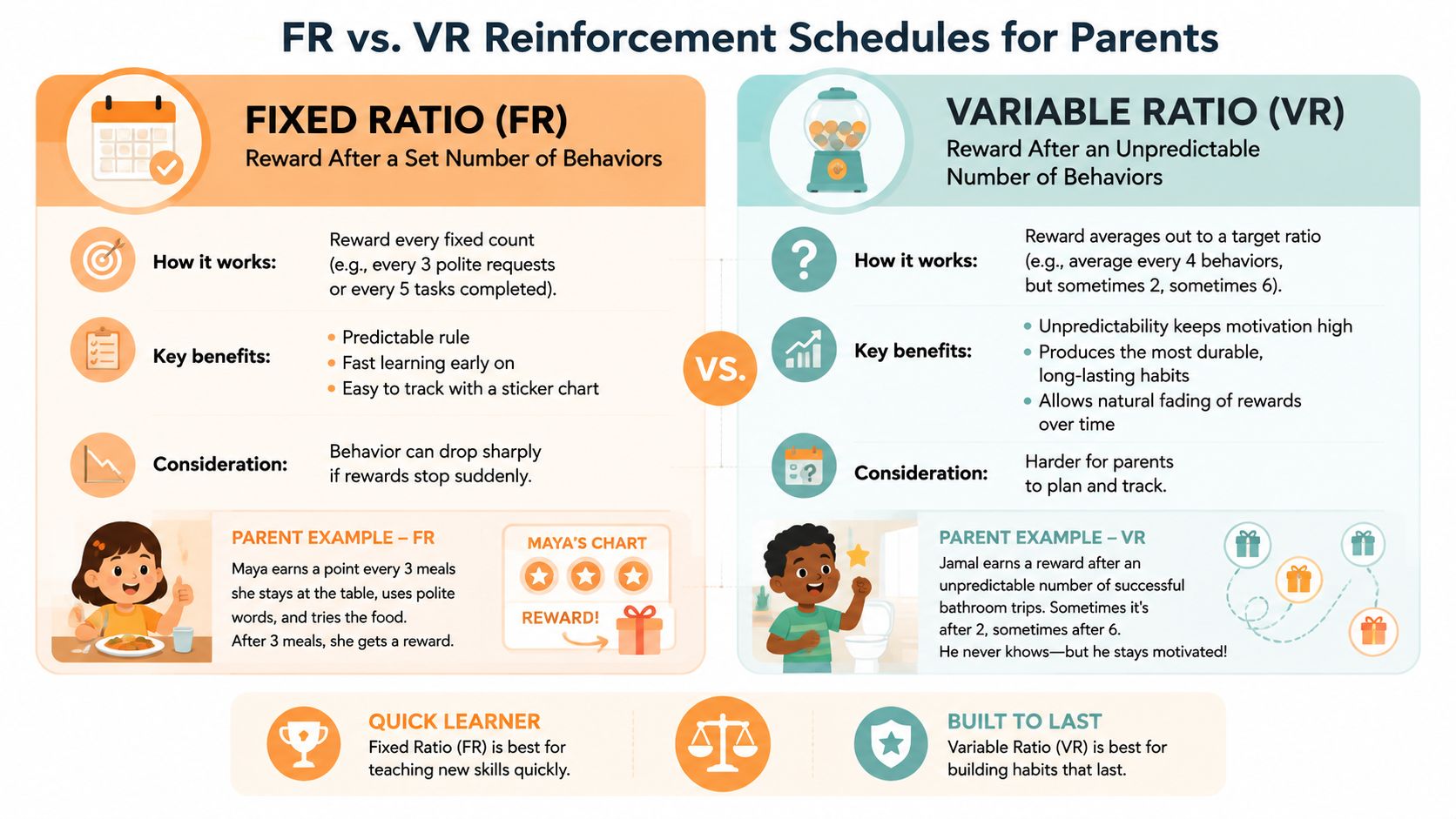
Table of Contents
1. Fixed Ratio Is a Set Number of Behaviors
A fixed ratio schedule gives reinforcement after a set number of responses. In plain terms, your child learns, “When I do this many times, I earn the reward.” That predictability can feel reassuring for families because the rule is simple to explain and simple to track. It also gives children a clear path to success, especially when a skill is still new.
A home example is a toddler learning to say “please.” You might praise and reward every second polite request. A school-aged child could earn a point after every four hand raises during class, and a teen might get a reward after completing five daily chores without reminders. The number is what matters.
Start with a smaller ratio, then build slowly.
The ABA literature describes fixed ratio as reinforcement after a set number of responses, and one common example is FR 5, where reinforcement comes after every fifth response (schedules of reinforcement overview). Everyday routines can make that pattern easier to see. A child might earn M&Ms after reading five pages or TV time after folding ten clothing items (fixed-ratio examples in everyday routines).
A fixed ratio schedule can be a helpful starting point when families want a behavior to feel clear and doable. It works well when the child understands the goal, the count is easy to follow, and the reward comes soon enough to connect the action with the outcome. Care teams often begin with a ratio that feels manageable, then adjust it as the child builds confidence and skill. That kind of support keeps the plan matched to the child instead of turning it into a rigid formula.
A few family-friendly ways to make fixed ratio work:
- Use a visible tracker: A sticker chart or token board helps your child see progress.
- Keep rewards immediate: Early on, quick feedback usually helps the behavior connect to the payoff.
- Pair praise with the reward: Say exactly what earned it, such as, “You asked so politely, that's one point.”
For a broader overview of how ABA programs are explained to families, Friendly ABA Premier can help frame the big picture.
2. Variable Ratio Keeps the Pattern Unpredictable
A variable ratio schedule still depends on how many times a behavior happens, but the exact count changes. Your child doesn't know whether reinforcement is coming after two responses, five responses, or somewhere in between. That uncertainty can keep motivation high because the effort stays active, not passive.
Think of a child learning to start play with peers. You might reward after an average of five social initiations, sometimes after three, sometimes after seven. A student finishing homework could earn reinforcement after an average of four assignments, while a child working on frustration tolerance might be reinforced after several calm responses to disappointment. The schedule stays response-based, but the pattern is less obvious.
Why Families Often Use It Later
Variable ratio tends to make behaviors more durable once they're already established. The 2021 meta-analysis of 35 single-case intervention studies with 78 individuals with intellectual and developmental disabilities found that multiple schedules of reinforcement produced an overall large effect for appropriate communicative behavior and an overall moderate effect for challenging behavior, and response prompts moderated outcomes for communication (meta-analysis on multiple schedules). That matters because many programs first teach a behavior with a predictable pattern, then thin reinforcement in a more natural way.
A study comparing fixed-ratio and variable-ratio schedules in five students in an adjustment class for deaf children found better visual attention, less disruptive behavior, and more math completed per minute during the variable-ratio condition, even though the average reinforcement rate stayed the same (comparative study of fixed and variable ratio).
Reinforcement doesn't have to be predictable to be kind. It just has to be clear enough that your child can stay successful.
A simple visible tally can help parents keep the average honest. Without that, variable ratio can drift and stop working the way it should. It's best used after the skill already feels solid under a fixed ratio pattern.
3. Fixed Interval Rewards One Good Behavior in a Set Time
A fixed interval schedule is based on time rather than a response count. Your child receives reinforcement when the desired behavior happens at least once within a planned window. If the window lasts 10 minutes, the reward comes at the end, provided the behavior occurred during that period.
This approach can fit familiar home and school routines. During a lesson, a child might earn reinforcement for raising their hand at least once within the planned period. At home, a teen could receive a reward for completing one morning task without reminders during the agreed window. In a social group, a child might earn reinforcement for joining the activity at least once before it ends.
Time Can Help With Staying Power
Fixed interval schedules encourage participation across a period instead of rapid repetition at the beginning. The basic distinction is clear: fixed interval schedules depend on time, while fixed ratio schedules depend on responses. Guidance on thinning ABA reinforcement schedules also describes the value of cues, multiple schedules, and gradual fading, which can help children handle longer waits while keeping their skills strong (schedule thinning and visual supports).
A visual timer can make the waiting period easier to understand, especially for younger children. It gives the child a visible cue that the window is progressing and shows when reinforcement may be available. If effort appears only near the end, shorten the interval or ask the care team how to adjust it.
Try a simple home version:
- During homework: “If you stay with your worksheet while the timer runs, you'll earn a break.”
- During dinner: “If you stay at the table and try one bite during this window, you can choose a bedtime story.”
- During playgroup: “If you join in at least once before the timer ends, you get your token.”
Start with a window your child can reasonably manage. Reinforce small successes, then lengthen the time gradually with guidance from the family and care team. This structure can support attention without turning every routine into a battle.
4. Variable Interval Rewards Good Behavior at Unpredictable Times
A variable interval schedule delivers reinforcement after changing periods of time. Your child may receive a check-in after a short wait, then after a longer one, without knowing exactly when it will happen. The behavior still needs to be occurring when the check-in arrives. This pattern can support steady engagement because attention is not limited to one predictable moment.
For example, a parent might briefly check a child's independent reading and offer praise if the child is still focused. A teacher could use changing check-in times during a lesson to notice appropriate attention. At home, a teen who is working through homework might earn a short break when a planned check-in finds them using the agreed routine. If the teen disagrees with a family rule, the parent can reinforce a polite response such as, “I disagree. Can we discuss this?”
Keep the Check-Ins Light and Clear
Plan the intervals before the routine begins. A written sequence or phone reminder helps adults follow the same pattern, while brief check-ins keep the child's attention on the activity rather than on watching the clock. The schedule should feel like a quiet signal, not a test.
Variable interval reinforcement follows unpredictable time intervals that average toward a planned target, while the behavior must occur during the check-in (time-based schedule definitions). In daily life, this can help a skill continue during reading, classroom work, or community activities where exact timing is difficult to control.
Try these supports:
- Write the intervals down: Record the planned pattern so caregivers and teachers can stay consistent.
- Keep check-ins brief: A quick observation and specific praise may be enough.
- Start smaller: Choose an average interval the child can manage successfully.
- Praise what you saw: “You stayed with your book while I was away. Nice work.”
If the child waits passively or loses focus, shorten the average interval and consult the care team. Families can gradually adjust the schedule as the skill becomes steadier.

5. DRL Rewards Fewer Instances of a Behavior
Differential reinforcement of low rates, or DRL, reinforces a behavior when it happens less often than before. This approach fits behaviors that do not need to disappear immediately, but do need to occur less frequently over time. Families can recognize gradual progress instead of waiting for perfect performance.
For example, a child with frequent outbursts might receive reinforcement for staying under a daily number that is slightly below their usual pattern. A teen who asks repetitive questions could work toward fewer questions each day. A child who needs many chore reminders might earn reinforcement for completing the routine with fewer prompts.
Use Thresholds the Child Can Reach
Choose a starting goal the child has a reasonable chance of meeting. If the behavior occurs many times each day, set the first threshold just below the current pattern. Once the child meets that goal consistently over several days, lower the threshold gradually. The process is like lowering the height of a step only after the child is comfortable climbing it.
A functional-analysis paper comparing continuous and intermittent reinforcement found that schedule effects were participant-specific. For one participant, intermittent reinforcement reduced problem behavior while continuous reinforcement increased it in one condition. Another participant remained low and stable across both phases (participant-specific schedule effects). This supports testing a DRL plan in the child's usual setting rather than assuming one schedule will work for every learner.
Make the goal visible and easy to discuss:
- Track the daily count: A simple chart can show whether the behavior is moving toward the agreed threshold.
- Praise the change: “You asked for help four times today, fewer than yesterday.”
- Keep feedback calm: The child should experience the plan as encouragement, not surveillance.
- Coordinate across settings: Parents, teachers, and the care team can agree on the same definition, threshold, and reinforcement.
DRL can also fit home routines when adults provide reinforcement without requiring a response first. This ABA explanation of noncontingent reinforcement and related routines offers related context for matching reinforcement to the child and setting. If the threshold creates frustration or progress stalls, adjust the goal with guidance from the care team. Small, steady reductions can build a workable path forward.
6. DRO Rewards Not Doing a Specific Behavior
A child who blurts out during homework, a student who interrupts during circle time, or a sibling who keeps tapping a parent's arm during dinner can all work on DRO, short for differential reinforcement of other behavior. The plan gives reinforcement for a set period when the unwanted behavior does not happen. In plain terms, it helps families notice the calm moments already happening in the day.
That makes DRO a good fit for behaviors such as hitting, blurting, or arguing, especially when adults want a clear, simple starting point. A child who hits when frustrated might earn reinforcement for 30 minutes without hitting while also learning calming skills. A student who blurts answers in class can work toward finishing a class period without blurting. A child who talks back during chores can earn reinforcement for completing the task without arguing.
Keep the Timer Honest and the Language Simple
DRO works best when everyone agrees on the one behavior to watch and the time period to watch it. The plan is not vague praise for “being good.” It is a specific arrangement, like agreeing to watch the stove until the timer rings, only here the focus is behavior.
A visual timer helps because it gives the child something concrete to follow. If the behavior happens, reset the timer calmly and without shame. That reset is a fresh start, not a sign the whole day is ruined.
Here is a simple home rhythm:
- Before starting: “We're working for 10 quiet minutes.”
- During the window: Keep your response calm and brief.
- After success: Name the behavior, then praise it.
Families often find that DRO feels more supportive when it is paired with teaching a replacement skill. A child who blurts can practice raising a hand. A child who hits can practice asking for space. A peer-reviewed review of differential reinforcement of other behavior describes it as one way to reduce problem behavior by reinforcing the absence of the target response, especially when adults keep the goal clear and consistent (differential reinforcement of other behavior review). Used this way, the schedule stays practical and encouraging.
7. DRA Rewards a Better Replacement Behavior
Differential reinforcement of alternative behavior, or DRA, rewards a specific better behavior that serves the same purpose as the unwanted one. If a child screams for attention, you reinforce them for asking politely instead. If a child grabs toys, you reinforce them for asking to play. This is often the most family-friendly approach because it teaches what to do, not just what to stop.
A teen who yells when disagreeing can be reinforced for saying, “I disagree,” calmly or asking, “Let's discuss this.” A child who cries to avoid a hard task can be reinforced for saying, “This is hard,” or “I need help.” The replacement behavior should meet the same need in a more workable way.
Teach the New Skill Before You Rely on It
Families sometimes expect the replacement behavior to appear on its own, but it usually needs direct teaching. Your child should hear the words, practice them, and see them rewarded often at first. That's where parent coaching and a coordinated team really help, because the same phrase can be practiced at home, in school, and in therapy.
A review of schedule thinning in autism notes that families often need more than simple examples of fixed or interval schedules, because the harder work is using cues and multiple schedules to preserve skill while reinforcement gets thinner (schedule thinning and visual schedules). A separate line of research also highlights that communication alternatives can be strengthened through structured schedules, which is why DRA fits well with everyday language goals (communication and alternative behavior support).
Best starting point: Make the alternative behavior easier to use than the old one, then reinforce it generously.
That may mean frequent praise, quick access to a favorite activity, or a simple token system at first. As the new behavior becomes more natural, the schedule can gradually shift to something less dense, often with guidance from your child's care team.
Comparison of 7 Reinforcement Schedules
| Schedule | Implementation Complexity (🔄) | Resource Requirements (⚡) | Expected Outcomes (📊 ⭐) | Ideal Use Cases (💡) | Key Advantages (⭐) |
|---|---|---|---|---|---|
| Fixed Ratio (FR) | Low 🔄, simple counting rule | Moderate, frequent rewards & tracking | Fast acquisition of discrete skills; risk of rapid decline if stopped. ⭐⭐⭐⭐ | Teaching new/countable skills (e.g., manners, chores) | Predictable, easy to track, motivates rapid practice |
| Variable Ratio (VR) | High 🔄🔄🔄, plan/tally variable rewards | Moderate → Low long-term, fewer rewards but needs tracking | Most durable, persistent behaviors; high resistance to extinction. ⭐⭐⭐⭐⭐ | Building long-term habits and persistence (e.g., social initiations) | Sustains motivation, allows reward fading, real-world-like reinforcement |
| Fixed Interval (FI) | Low–Medium 🔄🔄, timer-based simplicity | Low–Moderate, timer or visual clock needed | Encourages sustained effort within windows; prone to end-of-interval "scalloping." ⭐⭐⭐ | Transitions, group routines, short attention spans (e.g., waiting periods) | Teaches sustained attention, easy for groups, builds patience |
| Variable Interval (VI) | High 🔄🔄🔄, plan variable check-ins | Moderate–High, needs unpredictable monitoring | Strong, long-lasting engagement; reduces scalloping and maintains focus. ⭐⭐⭐⭐⭐ | Independent work, homework, classroom focus | Produces consistent effort, highly resistant to extinction |
| Differential Reinforcement of Low Rates (DRL) | Medium 🔄🔄, set and lower thresholds | Moderate, careful frequency tracking | Gradual reduction in behavior frequency; slow but steady change. ⭐⭐⭐ | Reducing high-frequency but non-dangerous behaviors (e.g., interruptions) | Positive, realistic progress goals; reduces frustration |
| Differential Reinforcement of Other Behavior (DRO) | Medium–High 🔄🔄🔄, timer windows & monitoring | High, continuous observation during intervals | Effective elimination of specific discrete behaviors when feasible. ⭐⭐⭐⭐ | Eliminating discrete unwanted acts (e.g., hitting, calling out) | Directly targets absence of behavior; builds impulse control |
| Differential Reinforcement of Alternative Behavior (DRA) | Medium–High 🔄🔄🔄, identify function and teach alt | Moderate–High, instruction plus reliable reinforcement | Reduces problem behavior while teaching functional replacements. ⭐⭐⭐⭐⭐ | Replacing problematic responses with communication or adaptive skills | Teaches usable alternatives, collaborative, reduces long-term stress |
Choosing a Schedule That Fits Your Child
The right schedule depends on what you're teaching and what your child needs right now. Predictable ratio schedules can support early skill practice because the rule is easy to understand and repeat. Interval schedules can help with sustained participation, especially when the goal is staying with a task, joining a group, or tolerating a routine for a set period of time. Differential reinforcement should match the behavior and the replacement skill carefully, because reducing one behavior without teaching another usually leaves families stuck.
Start with one small, observable goal. Maybe it's one polite request, one calm transition, one hand raise, or one short period of independent work. Track the pattern without judgment, use warm specific praise, and let the data tell you what's helping.
That's where an individualized partnership matters most. A dedicated care coordinator, regular progress conversations, and proactive communication can keep everyone aligned across home, school, and therapy so the plan stays realistic. If a behavior change involves safety, distress, or communication concerns, talk with your child's care team before changing the schedule on your own.
Small moments of progress matter. A child who waits a little longer, asks more clearly, or stays with a task one step longer is building something important, and that growth deserves steady, thoughtful support. When families and clinicians work together, reinforcement becomes less about rigid formulas and more about helping a child succeed in the routines that matter most.
Friendly ABA Premier provides personalized ABA therapy, parent coaching, school support, and social skills development for families who want a true partner in the process. If you're trying to choose between reinforcement schedules or want help tailoring a plan to your child's routines, visit Friendly ABA Premier to talk with a team that prioritizes clear communication, individualized support, and practical progress at home and school.
Our Latest Insights





































Experience ABA Therapy with a More Personalized Level of Support
Discover how FriendlyABA Premier combines evidence-based ABA therapy with dedicated coordination, proactive communication, and individualized family support.