


Escape Extinction ABA: What Parents Need to Know
Learn what escape extinction ABA is, when it's used, ethical safeguards, and alternative strategies. A reassuring guide for parents navigating ABA therapy.


If your child cries when homework starts, pushes a plate away at dinner, or bolts from toothbrushing time, you're probably not looking for a label, you're looking for a way to help without making the day feel harder for everyone. That's where escape extinction in ABA comes up, and it can sound a lot harsher than it seems when it's explained well. The primary question isn't, “How do we make the behavior stop?” It's, “What is the behavior telling us, and what support does your child need to succeed with less stress?”
For many families, the first surprise is that these moments often make sense from the child's point of view. If crying, refusing, or pushing materials away has repeatedly led to a break, the child has learned that behavior works to end the demand. A thoughtful ABA team looks at that pattern, then decides whether the child needs a different teaching plan, not just a stronger response.
Table of Contents
Understanding Why Children Try to Escape Demands
When a demand feels too big
A lot of parents know the pattern by heart. Homework comes out, and suddenly the chair tips back, tears start, or the child disappears under the table. Dinner can bring the same reaction, especially when the food is unfamiliar, the routine is long, or the child is already tired.
Those moments aren't best understood as “bad behavior.” They're often communication. The child has learned that a specific action, like crying, refusing, or leaving the room, has helped them get out of something that felt hard, uncomfortable, or confusing.
Practical rule: If a behavior reliably makes a demand go away, the behavior is being reinforced by escape.
Why the behavior keeps showing up
In ABA, this pattern is called escape-maintained behavior. It matters because the child isn't usually trying to create chaos, they're trying to reduce pressure in the only way that has worked for them so far. That can show up during schoolwork, dressing, bathing, mealtime, or any task that feels overwhelming.
A careful assessment looks for the reason behind the behavior before anyone changes the response. That's why ethical providers start with a functional behavior assessment, because if escape is the payoff, then the plan has to change the payoff, not just the child's feelings in the moment. A warm, skill-building approach often starts with communication support, which is one reason families may find it helpful to read about building communication skills in everyday moments.
What parents often want most is a calmer routine, not a power struggle. Understanding the function of the behavior helps move the conversation from blame to problem-solving. It also keeps the focus on teaching, which is where meaningful progress starts.
What Escape Extinction Actually Means in ABA Therapy
The before-and-after version
In plain language, escape extinction means the demand no longer ends because of the challenging behavior. If a child has learned that crying makes homework stop, escape extinction keeps homework in place while the team teaches a better way to ask for help, a break, or a short pause.
That's the key point. The behavior no longer works as a shortcut out of the task. The child still gets support, but the support comes through a different path.
It's not about forcing compliance. It's about stopping the accidental payoff that kept the behavior going.
What it looks like at home
At the kitchen table, this might mean a parent keeps one simple math problem on the page instead of removing the worksheet the moment refusal starts. During dressing, it might mean socks stay part of the routine, but the adult offers prompting, modeling, and a smaller step if the child is struggling.
This is not punishment. It's a change in reinforcement. The behavior no longer produces escape, so it loses power over time, especially when the child is also being taught an easier, more appropriate way to communicate.
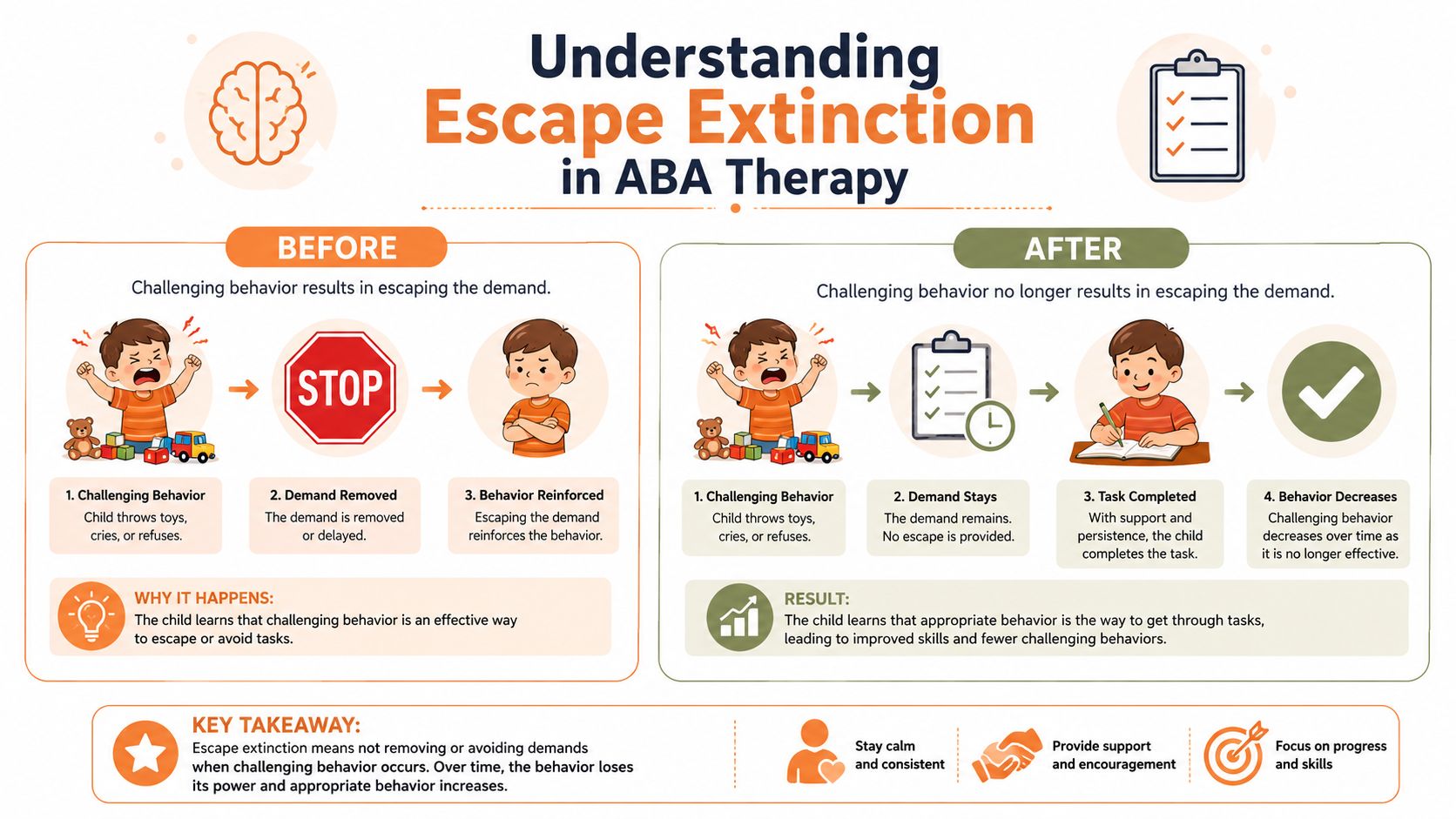
Ethical providers don't reach for this approach first. They use it only after an FBA shows that escape is the maintaining function. That matters, because if the behavior is driven by something else, like attention or access to a preferred item, the plan needs to match the actual reason the behavior is happening. For a broader overview of how ABA decisions should fit together, see understanding ABA therapy what every parent should know.
Preparing for the Extinction Burst
Why things can look worse before they look better
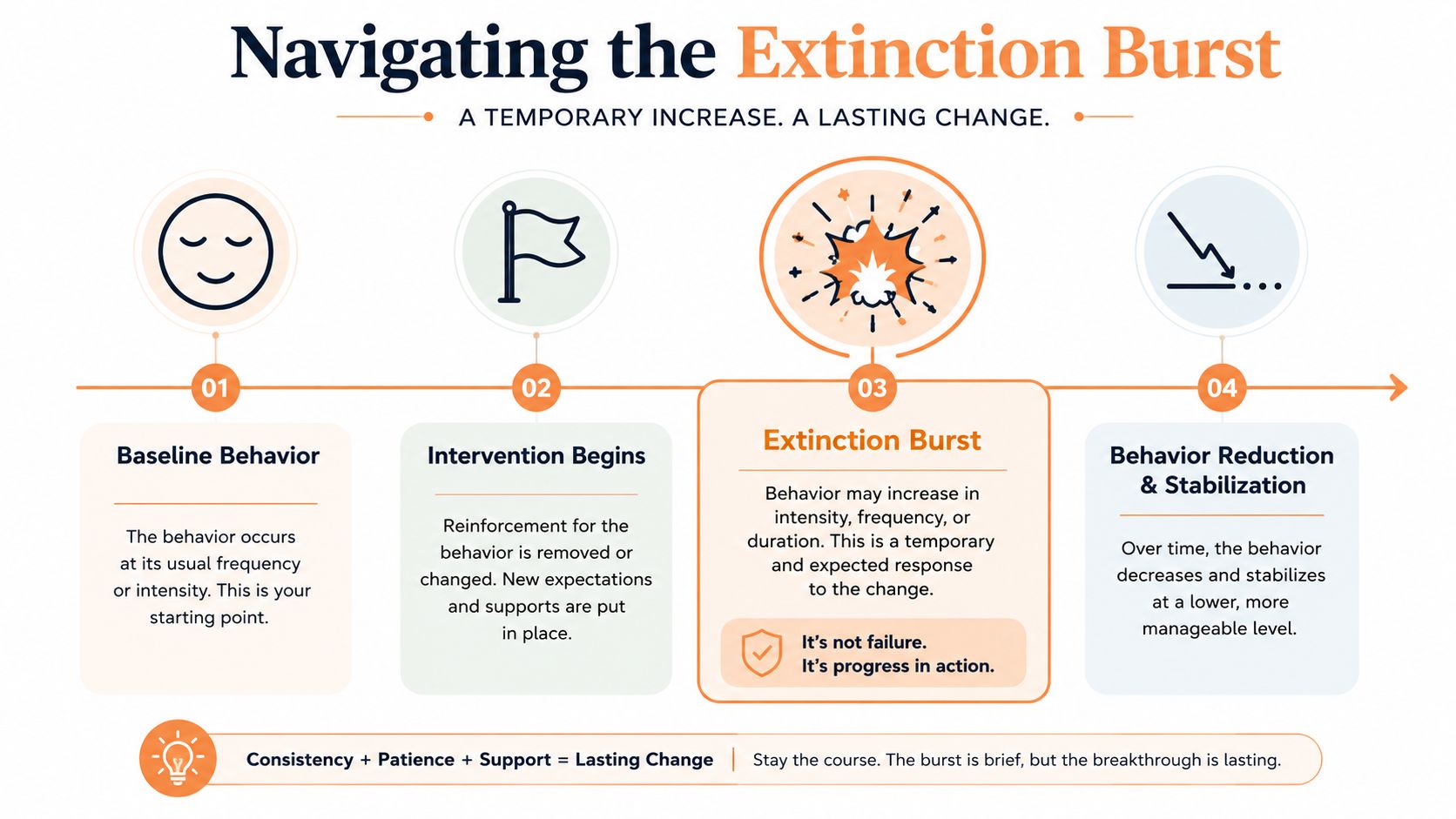
The hardest part of escape extinction for many families is the extinction burst. This is the brief period when a child may cry louder, protest longer, or show more intense behavior right after escape no longer works. Clinical guidance on extinction in ABA explains that this spike is a common response when the old pattern stops paying off, and families should be prepared for that possibility from the start (clinical guidance on extinction bursts).
Parents deserve a straightforward explanation before the plan begins. A burst does not automatically mean the intervention is wrong. More often, it means the child is testing whether the familiar escape route still works.
What the timeline can feel like
The timing can be unsettling, because the burst may appear in the first few sessions or even in the first few minutes after the change begins. Clinical guidance also notes that it often settles within about one to two weeks, with the strongest behavior usually showing up in the first few days (clinical guidance on extinction bursts). For parents, that early stretch can feel like the toughest part of the whole process, which is why clear preparation matters.
Ethical providers do more than warn families and hope for the best. They track behavior closely, make the task easier when the child needs that support, and pair the procedure with prompting and reinforcement so the child still has a path to success. That kind of planning helps keep the burst from becoming unsafe or impossible to sustain.
Families should also expect flexibility, not a fixed script. If distress climbs too high, or if the child is still learning a new way to ask for a break, the team should slow down, adjust the plan, and protect the child's wellbeing while keeping the treatment goal in view.
When Escape Extinction Is Not the Right First Step
Less restrictive options often come first
A lot of public ABA content makes escape extinction sound like the default. It shouldn't be. Independent ABA literature notes that antecedent strategies, differential reinforcement, and functional communication training can reduce escape-maintained behavior without escape extinction, and one review recommends trying antecedent modifications first, then adding escape extinction only if progress is insufficient and implementation fidelity is high (review on reducing escape without escape extinction).
That approach makes sense in real family life. If a task is too long, too hard, or too unclear, changing the setup can reduce distress before anyone needs to consider a more reactive procedure. A child who gets a shorter worksheet, a choice between two crayons, or a visual schedule may stay engaged without escalating in the first place.
How skill-building can replace escape
Functional communication training can teach a child to ask for a break instead of throwing materials or running away. That's a big shift, because it gives the child a socially acceptable way to get relief without losing the learning opportunity. For a related look at scheduled supports, parents may find noncontingent reinforcement in ABA helpful as a comparison point.
Here's the part parents should feel comfortable asking about, because it's an ethical question, not a difficult one. Has the team tried smaller steps, more choices, or visual supports first? If the answer is no, escape extinction probably shouldn't be the starting point.
A good program doesn't rush to the most restrictive option. It uses the least intrusive strategy that can still teach the child what to do instead of escape-based behavior.
Ethical Safeguards Every Family Should Expect
What safe implementation looks like
Escape extinction can only be discussed responsibly when the team is watching the child's wellbeing closely. That means continuous data collection on frequency, duration, and intensity, plus reinforcement for replacement behaviors and active teaching of an appropriate break request. It also means the plan should be supervised and adjusted by a qualified BCBA, not left to guesswork.
Recent professional conversation also emphasizes client assent and treating noncompliance as communication, not just defiance. That shift matters because a child's resistance can be a sign that the task is too difficult, the environment feels overwhelming, or the teaching approach needs to change.
Ask this directly: How will you know the plan is helping my child, and what will you change if distress rises?
Questions families can bring to the table
- Was an FBA completed? The team should be able to explain why escape is the function they identified.
- What alternatives were tried first? Parents deserve to know whether task changes, choices, or communication training came before extinction.
- How will replacement skills be taught? A child should learn what to do instead of only being told what not to do.
- What safety checks are in place? Families should hear how the team will respond if the child becomes overwhelmed or escalates.
- How is dignity protected? The program should prioritize calm, predictable support over confrontation.

If a provider can't answer those questions clearly, that's useful information. A thoughtful team welcomes them, because informed parents make better partners and safer plans.
Alternative Strategies That Build Skills Without Extinction
Comparing the main options
Many families are relieved to hear that ABA has more than one path forward. The right strategy depends on what the child is trying to communicate, how hard the task feels, and what supports best fit the family's routine. Some children need a lot of help with structure; others need help with communication first.
| Strategy | How It Works | Everyday Example |
|---|---|---|
| Antecedent modification | Changes the task before behavior starts | A parent offers two choices for the order of homework tasks |
| Task modification | Makes the demand more manageable | The therapist starts with two math problems instead of ten |
| Differential reinforcement | Reinforces the replacement behavior | The child gets praise and a break after asking appropriately |
| Functional communication training | Teaches a socially acceptable request | The child says, “Break please,” instead of crying |
| Noncontingent reinforcement | Schedules access before problem behavior starts | A brief planned break is offered during a long work period |
How these strategies show up in real life
At the kitchen table, a visual schedule can help a child see what happens next, which lowers uncertainty. In the classroom, a teacher might build in short breaks after focused work so the child doesn't have to escalate to get relief.
Choice matters too. When a child can pick between two pencils, two tasks, or two starting points, the demand often feels more doable.
These options don't replace careful planning, they strengthen it. The more a team understands the function of the behavior, the more likely they are to choose a support that teaches flexibility instead of just endurance.
Partnering With Your Care Team on Behavior Support
The questions that lead to a better plan
Parents don't need to become behavior analysts to have a strong voice in the process. They do need a team that explains its reasoning clearly and listens when something isn't working at home. That's especially important when a child's behavior is tied to escape, because the plan affects daily routines that matter to the whole family.
A good conversation usually starts with four simple questions. Was the behavior assessed with an FBA? What supports were tried before considering escape extinction? How will the team teach a replacement skill? How will progress and distress be tracked?
Best practice: Ask for the plan in plain language, then ask how it will look during breakfast, homework, and bedtime.
Quality ABA feels like a partnership, not a set of instructions handed over at pickup. For families in Connecticut, Georgia, Maryland, Massachusetts, North Carolina, South Carolina, Virginia, or Washington, a care team can also coordinate home, school, and parent coaching so everyone is working from the same playbook. Friendly ABA Premier offers individualized ABA therapy with a dedicated care coordinator, scheduled progress check-ins, and proactive communication, and those supports can make it easier to keep behavior plans consistent across settings.
If you're trying to understand whether escape extinction in ABA belongs in your child's plan, Friendly ABA Premier can help you think through the options with care and clarity. Their team builds individualized support around communication, daily routines, school needs, and parent coaching, so your questions are part of the process. Visit Friendly ABA Premier to start a conversation about your child's needs and the kind of support your family wants at home and beyond.
Our Latest Insights









































Experience ABA Therapy with a More Personalized Level of Support
Discover how FriendlyABA Premier combines evidence-based ABA therapy with dedicated coordination, proactive communication, and individualized family support.