

Initial Competency Assessment What Families Should Expect
Learn what an initial competency assessment in ABA involves, what it measures, and how results shape your child's personalized treatment plan.


You're sitting in the reception area for your child's first ABA appointment, holding a folder of questions you weren't sure how to ask. You may be wondering whether your child will be expected to perform on command, whether someone will judge your parenting, or whether one difficult moment could define the entire evaluation. Those worries are understandable.
An initial competency assessment should feel less like a high-pressure test and more like a careful conversation in action. Your clinician is learning how your child communicates, plays, learns, manages routines, and shows preferences. Your observations matter just as much as what happens during the appointment.

This guide explains what the assessment means, which skill areas clinicians may explore, how observation and play-based tools work, and how findings can become a personalized plan. It also addresses practical questions about the appointment, family preparation, and follow-up.
By the end, you should have a clearer picture of what to expect and a stronger sense of how to speak up for your child's strengths, comfort, and everyday priorities.
Table of Contents
- Communication and language
- Social interaction and play
- Daily living and independence
- Learning readiness and behavior as communication
Introduction What to Expect From Your First ABA Visit
A first ABA visit often begins with a period of observation. A child might stay close to a parent, inspect the room, move toward a favorite toy, or need time before responding to a new adult. None of those reactions means the visit is going poorly. They give the clinical team useful information about comfort, motivation, communication, and the best way to build trust.
The clinician may start with a conversation while your child explores nearby. You might talk about mealtimes, bedtime, school, play, communication, sensory preferences, and routines that feel easy or difficult. The discussion should make room for what your child already does well, not only for areas where your family wants additional support.
A welcoming first step
The phrase initial competency assessment can sound formal, but families usually experience it as a structured discovery process. The clinician may observe your child during play, offer simple activities, ask caregivers questions, and notice how your child responds to choices, transitions, directions, and social invitations.
You aren't expected to make your child act differently for the appointment. A child who communicates by pointing, leading an adult, using gestures, speaking, using a communication device, or combining several methods is still communicating. Your job is to share what those signals mean at home.
A helpful mindset: The assessment isn't a verdict about your child. It's information the team uses to decide how to support learning in ways that fit your family.
The appointment may include moments that look ordinary, such as choosing a snack, taking turns with blocks, or moving from one activity to another. Clinicians treat these everyday moments as meaningful because they show how skills work in real life, where therapy goals need to matter most.
Families should leave with opportunities to ask questions, clarify observations, and discuss what happens next. If a particular approach doesn't fit your child's comfort level or your household routine, say so. A genuine partnership begins when the care team listens before building a plan.
Understanding What an Initial Competency Assessment Really Is
Think of the assessment as a roadmap, not a label. A map doesn't decide where a family must go. It shows the starting point, identifies possible routes, and helps people choose a destination that matters to them. An assessment works similarly by showing how a child currently approaches communication, play, learning, and daily routines.
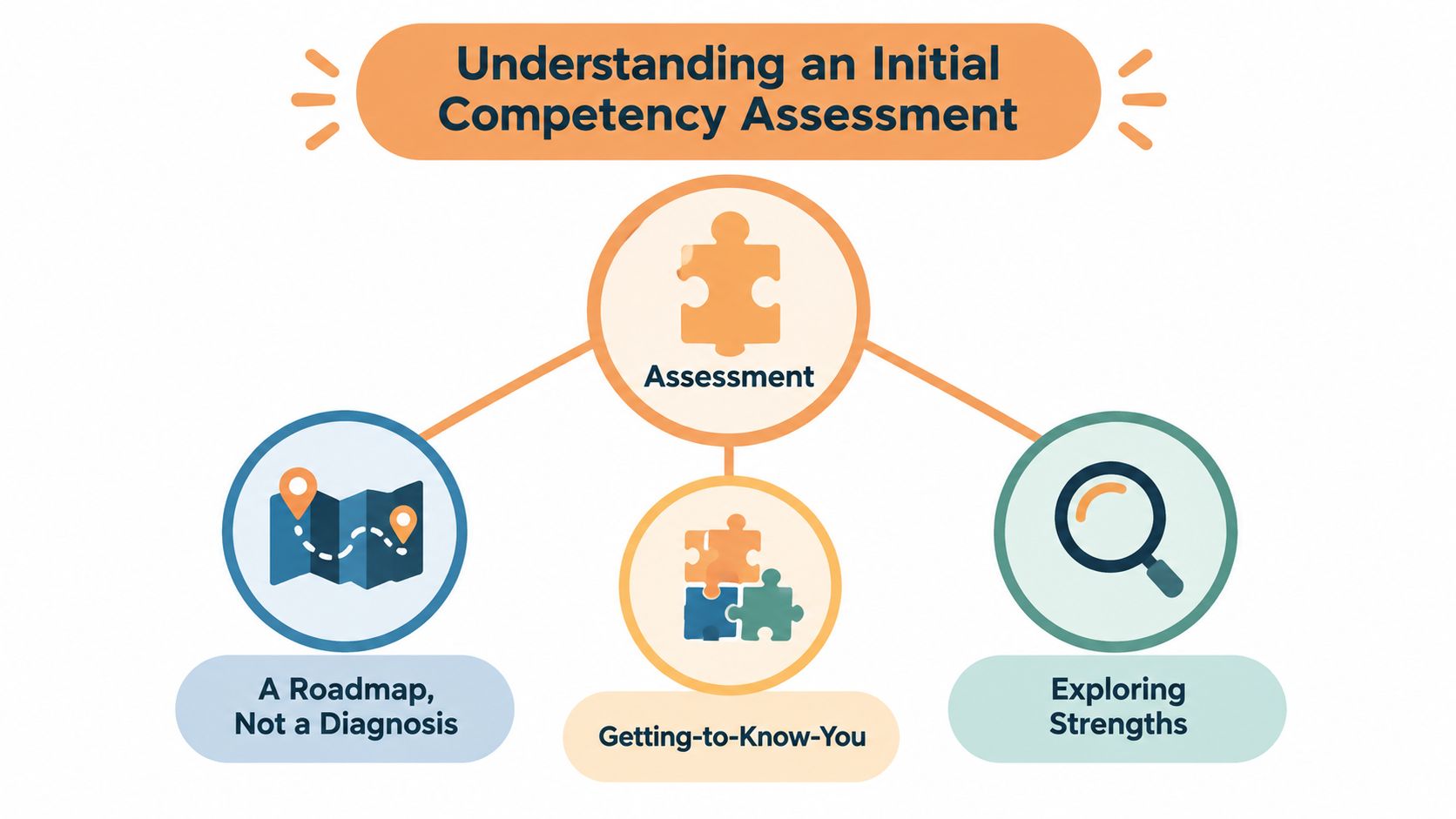
This process isn't the same as a medical evaluation, and it doesn't replace diagnostic care from an appropriately qualified professional. It also shouldn't reduce a child to a pass or fail result. Instead, the clinician gathers observations and family input to understand what helps the child participate, communicate, and learn.
What the clinician is trying to understand
A clinician may look at questions such as:
- Communication: How does your child request help, reject something, share interest, or respond to language?
- Social connection: Does your child seek interaction, tolerate shared play, imitate actions, or take turns?
- Learning: How does your child respond to a new activity, a visual cue, a model, or a gentle prompt?
- Daily routines: What happens during dressing, eating, toileting, bedtime, or leaving the house?
The clinician isn't looking only for skills that are already independent. They may also notice emerging abilities, preferred activities, successful supports, and situations where your child stays engaged for longer.
For example, a child who doesn't answer a spoken question may still show strong understanding by selecting the requested object or moving toward a familiar routine. A child who avoids a group game may participate comfortably in a one-to-one activity with clear turns. Those distinctions help the team choose teaching methods that respect the child's learning style.
A family's knowledge fills in what an appointment can't capture. You know which sounds, foods, toys, people, and routines help your child feel secure. You also know what a gesture means, which transitions are hardest, and what progress would make Tuesday morning easier. For a broader explanation of ABA foundations, families can review what parents should know about ABA therapy.
The assessment is most useful when clinicians and caregivers interpret the information together. It creates a shared starting point for meaningful goals rather than a one-size-fits-all list.
Key Skill Areas Your Clinician Will Explore Together
An initial competency assessment usually looks across several connected areas. A child may communicate well during a favorite game but need more support during a transition. Another child may show independence with dressing but find group play challenging. The clinician considers these patterns together instead of treating one moment as the whole picture.
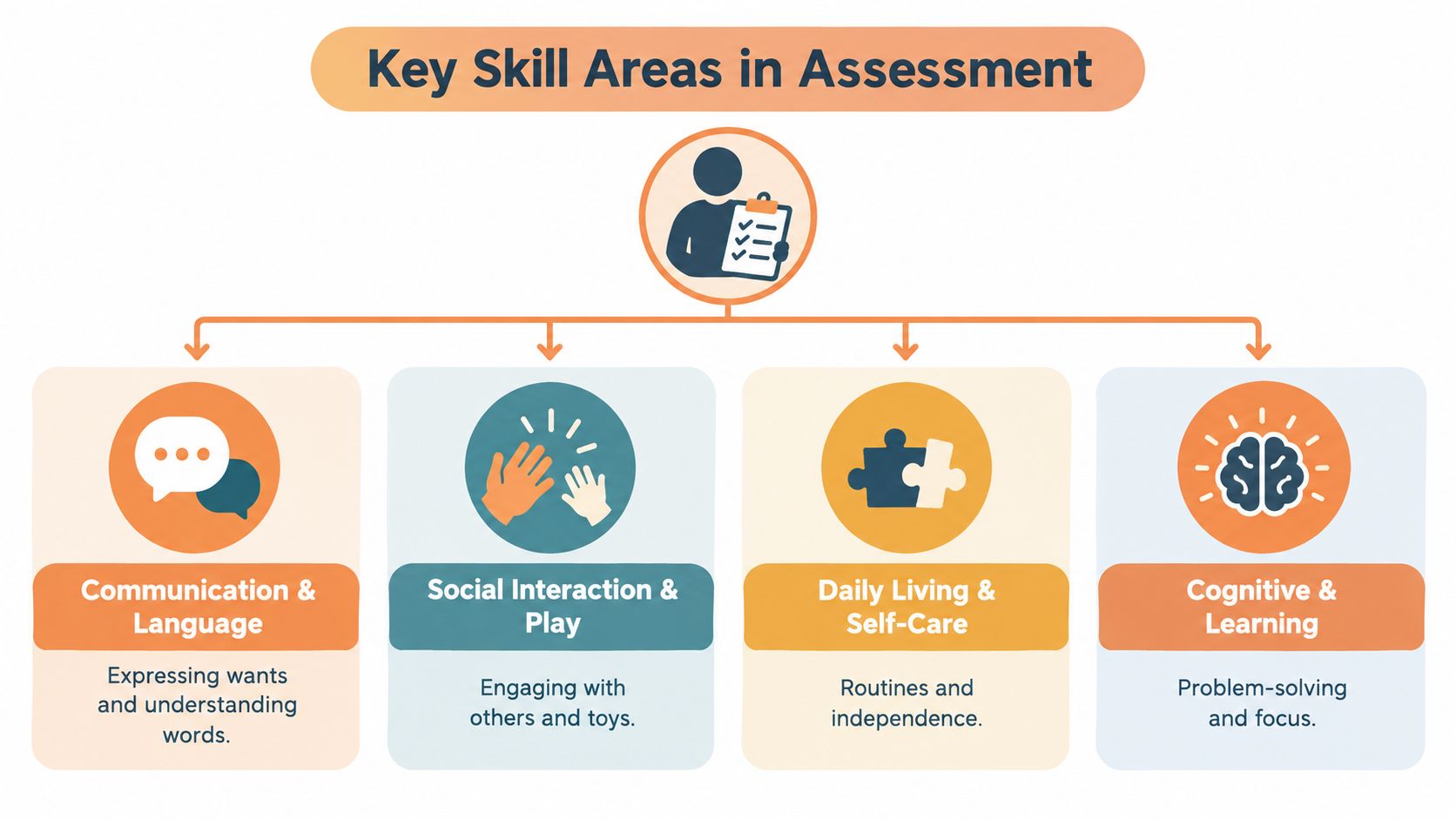
Communication and language
Communication includes much more than spoken words. A clinician may observe whether your child points to a preferred snack, brings an adult to a toy, uses signs, selects a picture, operates a communication device, imitates sounds, or follows familiar directions.
Suppose your child wants bubbles. The clinician might notice whether the child looks toward the container, reaches, gestures, vocalizes, or waits for help. Each response can guide a goal that supports clearer, more reliable communication.
Understanding language matters too. The team may observe responses to instructions such as “get your shoes,” choices such as “apple or cracker,” or comments during play. The clinician should account for processing time and avoid treating a delayed response as a lack of understanding.
Social interaction and play
Play reveals how a child explores materials and connects with people. The clinician may join a block activity, imitate the child's actions, offer a turn, or introduce a simple change. They might watch whether the child shares space, responds to a partner, copies an action, or communicates a wish to continue.
A child who prefers solitary play may still show social interest through bringing a toy to a caregiver or accepting help. These strengths can become starting points for expanding shared activities without forcing interaction before the child is ready.
Daily living and independence
Daily living skills include routines such as handwashing, eating, dressing, toileting, packing a school bag, and settling for bed. The team may ask which steps your child completes independently and where help is needed.
A bedtime routine might involve finding pajamas, changing clothes, placing dirty items in a basket, brushing teeth, and moving to the bedroom. The assessment helps identify a manageable starting step, perhaps following a visual sequence or completing one part of the routine with less assistance.
Learning readiness and behavior as communication
Clinicians may observe attention, imitation, following directions, moving between activities, and responding to reinforcement. They also consider what a child may be communicating through crying, dropping to the floor, pushing materials away, leaving an area, or repeating an action.
That doesn't mean every behavior has one simple explanation. Hunger, fatigue, pain, sensory discomfort, unclear expectations, and difficulty expressing a request can all matter. Caregiver context helps the clinician interpret what happened and plan respectful support.
How Clinicians Gather Information and Common Tools Explained
Clinicians use several lenses because no single activity can show the full child. Observation may happen during free play, a routine, or a transition. A caregiver interview adds history and context, while structured tasks help the clinician examine particular skills in a consistent way.
Play-based interaction can show how a child responds to shared attention, choices, prompts, and reinforcement. Structured activities might involve matching, imitation, requesting, or following a direction. These methods work together rather than competing with one another.
Two familiar assessment tools
VB-MAPP, the Verbal Behavior Milestones Assessment and Placement Program, focuses heavily on communication and related learning milestones. A session may include opportunities to request, label, respond to language, imitate, and participate in early learning tasks.
ABLLS-R, the Assessment of Basic Language and Learning Skills-Revised, covers a broad collection of language, learning, self-help, social, and classroom-related skills. A clinician may use it to organize information across daily routines and identify skills that can be taught in smaller steps.
The choice depends on the child, the referral question, the clinician's training, and the setting. A clinician may combine a formal tool with direct observation and caregiver information, especially when a child's abilities vary across people or environments.
| Tool | Primary Focus | What It Looks Like in Session |
|---|---|---|
| VB-MAPP | Communication, verbal behavior, social interaction, and early learning milestones | The clinician creates opportunities for requesting, imitation, responding, and engagement through play and structured activities |
| ABLLS-R | Language, learning, self-help, social, and classroom-related skills | The clinician reviews skill areas, observes routines, and may break larger tasks into teachable steps |
Why the tool doesn't define your child
A checklist can organize information, but it can't capture every preference, relationship, cultural routine, or emerging skill. A child may perform differently at home, school, and a clinic. Fatigue, unfamiliar materials, communication access, and sensory surroundings can also affect participation.
Good assessment practice uses clear criteria, consistent procedures, and enough evidence to support a defensible decision. Guidance from the U.S. Office of Personnel Management on assessment strategy explains reliability as confidence that score differences reflect real competency rather than random error, with standardization and monitoring helping improve measurement quality.
Families can ask how the clinician will combine tool results with observation and parent input. Parents who want to understand how practitioners learn and practice specific ABA procedures can also explore behavioral skills training.
How Assessment Results Shape Your Child's Personalized Plan
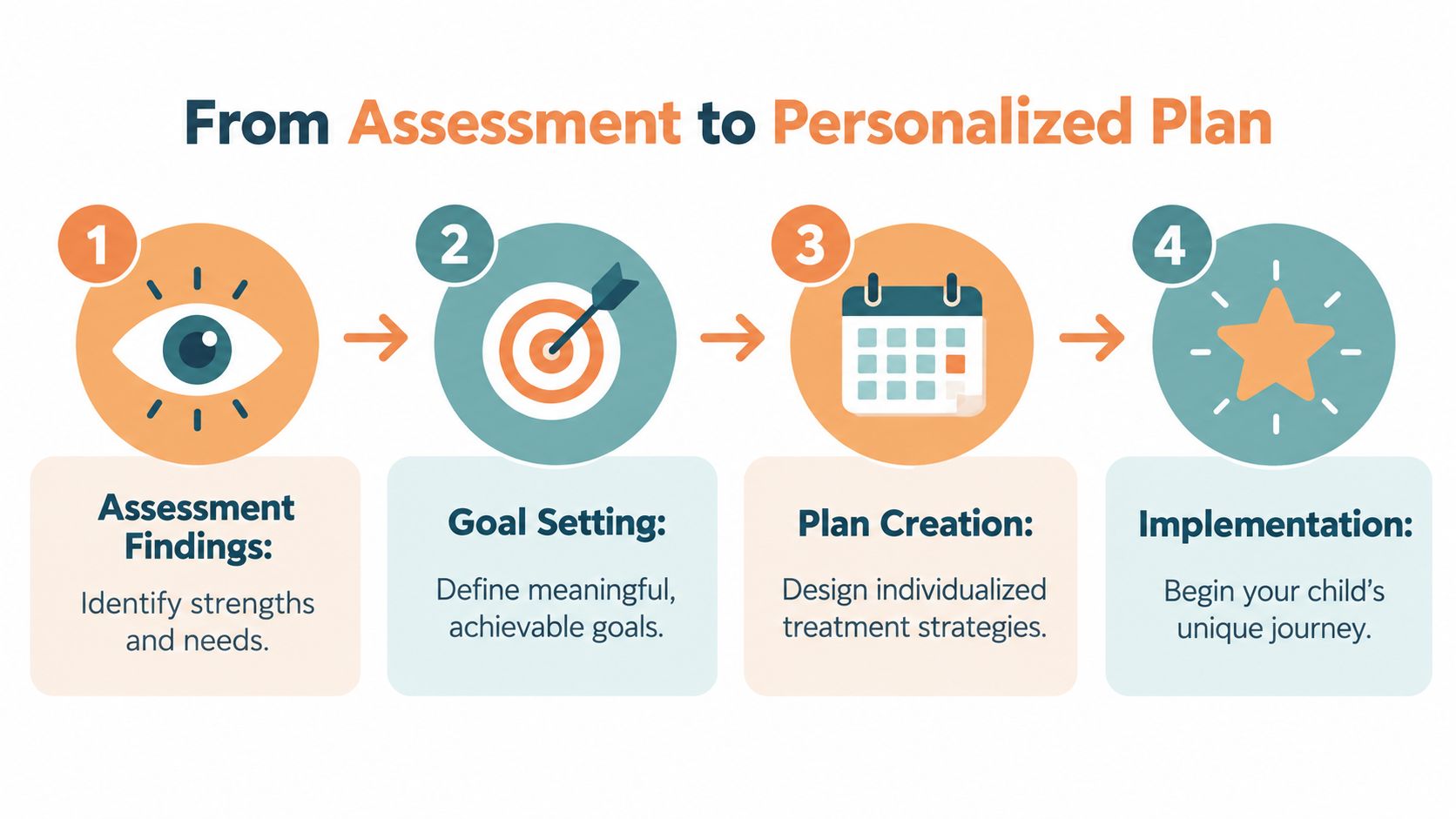
The most important part of an assessment is what happens after the observations. A list of scores or skills isn't useful by itself. The clinical team should translate findings into goals that connect with your child's real routines, relationships, school participation, and growing independence.
A clinician may begin with a strength your child already has. If your child reaches for a cup but doesn't yet request a drink consistently, the team might build on that action. If your child enjoys lining up cars, the activity could become a comfortable setting for turn-taking, requesting, or tolerating a small change.
From observation to meaningful goals
Results may help the team decide:
- Which skills deserve attention first because they affect safety, communication, or daily participation.
- What your child can already do independently and what requires a prompt.
- Which materials, people, reinforcers, visual supports, or routines encourage engagement.
- How to measure progress in observable terms, such as completing a routine step or making a clear request.
A strong goal is specific enough for caregivers and clinicians to recognize progress. “Improve communication” is broad. “Use an available communication method to request help during a snack routine” gives the team a clearer teaching target while leaving room to honor how your child communicates.
The plan should also reflect family priorities. One family may care most about smoother school drop-off. Another may prioritize mealtime participation, sibling play, dressing, or communicating discomfort. The clinician can help sequence goals so the plan remains achievable and relevant.
Keeping the plan responsive
Individualization doesn't end when the report is signed. Your child's interests, needs, schedule, and response to teaching can change. Regular communication gives caregivers a place to report what works at home and what feels difficult.
A dedicated care coordinator can help keep practical details connected to clinical care, including communication between the family and provider, scheduled progress check-ins, and questions about services. Friendly ABA Premier describes its model as combining individualized treatment planning with family coordination and proactive communication, an approach that can make it easier for parents to stay involved without carrying every administrative question alone.
Ask for the connection: “What did you observe, what goal does it support, and how will we know whether the plan is helping in daily life?”
A personalized plan should feel understandable. You should know the purpose of each goal, how the team will collect information, how parent coaching fits in, and when everyone will review the plan together.
What Families Can Expect on Assessment Day and How to Prepare
Assessment day may begin with a welcome from the clinical team and a caregiver conversation. While you talk, your child may play, watch, move around, or take a break. The clinician might join gently rather than asking for immediate performance.
A typical flow can include:
- Family conversation: Share routines, communication methods, preferences, sleep, eating, school experiences, and your main priorities.
- Natural observation: Let the clinician see how your child plays, requests, responds, transitions, and accepts help.
- Brief structured activities: Try simple tasks that match your child's age, interests, communication style, and comfort.
- Review and questions: Discuss initial impressions, possible goals, documentation, and the next conversation with the care team.
The exact length and format can vary by provider and child. Breaks, movement, repetition, and changes in activity are normal. A child doesn't need to sit still for the entire appointment to provide meaningful information.
Small preparations that help
Bring a comfort item if your child uses one. You can also bring a favorite toy, snack, communication device, visual support, or activity that helps your child engage.
Before the appointment, jot down a few examples:
- Communication: How does your child ask for something, say no, or seek help?
- Daily routines: Which steps of eating, dressing, bathing, or bedtime are independent?
- Preferences: What games, sounds, foods, people, or materials draw your child's interest?
- Challenges: When are transitions, waiting, or changes hardest, and what helps?
- Priorities: What would make home, school, or community routines more manageable?
Families in Connecticut, Georgia, Maryland, Massachusetts, North Carolina, South Carolina, Virginia, and Washington may have access to home-based options when clinically appropriate. A home setting can help the team see routines where support is most relevant. Learn more about in-home ABA therapy and ask your provider which setting fits your child and family.
You aren't being graded during the appointment. Your honest observations help the clinician avoid assumptions and create a plan that fits your child's actual life.
Questions to Ask and Confident Next Steps After the Assessment
When the assessment ends, you may receive a report, a verbal summary, or both. It's reasonable to ask the clinician to explain unfamiliar terms and show how each recommendation connects to something observed or shared by your family.
Consider asking:
- Goal selection: Which goals came from my family's priorities, and which came from observed learning needs?
- Starting point: What can my child do independently now, and where will teaching begin?
- Measurement: How will progress be recorded in language we can understand?
- Daily life: How will goals fit into meals, play, bedtime, school, or community routines?
- Parent coaching: What will we practice together, and how can we make it manageable at home?
- Communication: Who should we contact with questions, and how often will progress be reviewed?
- Flexibility: When will the team revisit goals if a strategy isn't fitting our child or routine?
A useful report should describe strengths as well as support needs. It should identify meaningful goals, explain teaching strategies in plain language, and clarify how the team will monitor progress. If the report feels too general, ask for examples. If a goal doesn't reflect your family's priorities, discuss alternatives with the care team.
Building an ongoing partnership
Progress often develops gradually, and children may show different responses across settings or days. That variability isn't a reason to abandon collaboration. It's a reason for caregivers and clinicians to share information, review what happened, and adjust support thoughtfully.
Ask your care team for individualized guidance about your child's needs, safety, communication, and daily routines. Families comparing providers can also ask whether they'll have a dedicated contact person, proactive updates, regular progress conversations, parent coaching, and a treatment plan that changes when the child's needs change.
The right assessment doesn't label a child. It helps the adults around that child notice strengths, choose useful next steps, and work from a shared understanding.
Friendly ABA Premier provides personalized ABA therapy, home-based support, social skills development, school support, and parent coaching across Connecticut, Georgia, Maryland, Massachusetts, North Carolina, South Carolina, Virginia, and Washington. Visit Friendly ABA Premier to schedule a consultation, discuss your child's assessment and care options, and learn whether insurance coverage may apply.
Our Latest Insights
























Experience ABA Therapy with a More Personalized Level of Support
Discover how FriendlyABA Premier combines evidence-based ABA therapy with dedicated coordination, proactive communication, and individualized family support.