

AAC and Autism: A Parent Guide to Communication Tools
Discover how AAC and autism support communication for nonverbal and verbal children. Learn types, benefits, and how to start with confidence.

A child points at a juice box. You offer water. They push it away, point again, and become more upset. By the third guess, everyone is tired, even though the child has been communicating clearly in the only way currently available to them.
Augmentative and alternative communication, or AAC, can give that message a more reliable path. It may involve gestures, signs, pictures, a communication board, or a speech-generating device. AAC isn't a last resort, and it doesn't require a child to stop using speech. It's an everyday participation tool that can help a child express needs, choices, feelings, ideas, and boundaries while spoken communication develops or alongside it.
Table of Contents
When Words Don't Come Easily
On a Tuesday evening, a parent may be trying to prepare dinner while their child stands nearby, pointing toward the counter. The parent names crackers, banana, and milk. None is right. The child pulls at the parent's hand, cries, or walks away. The difficult moment is not just about wanting a snack. It's about having something to say without a dependable way to say it.

AAC can make those moments easier to understand. A child might point to “juice,” sign “more,” select “different,” or use a device to say “help.” Each method gives adults information and gives the child more control over what happens next.
A communication tool, not a prediction
Some children use spoken words inconsistently. Others understand much more than they can express. Some communicate through sounds, movement, signs, pictures, or a combination of methods. AAC meets the child's current communication needs without deciding what their future must look like.
The American Speech-Language-Hearing Association's AAC guidance describes AAC as a broad category that can supplement speech, replace speech when needed, or provide a temporary bridge while communication develops. The U.S. National Research Council reported in 2001 that approximately one-third to one-half of children and adults with autism did not use speech functionally, which established an important rationale for communication systems beyond spoken language. More recent professional estimates indicate that approximately 25%–30% of Australian children with autism have limited speech skills and may benefit from AAC, including gestures, sign language, picture systems, communication books, and speech-generating devices.
Those figures describe population-level need, not an individual child's future. Autism is highly varied, and communication needs depend on receptive language, motor abilities, cognition, sensory preferences, and the demands of each environment.
Parents often begin searching for information after hearing terms such as “minimally speaking,” “nonspeaking,” or “semi-verbal.” These labels can be useful in some conversations, but they don't capture every child's abilities. A child may have a small spoken vocabulary and still communicate rich preferences through movement, gaze, play, or understanding.
A helpful starting point: Your child doesn't need to prove they are ready for communication support. Communication support helps children learn by giving their messages a way to work.
AAC can support a request for juice, but it can also support “hello,” “not that,” “I'm tired,” “look,” “help me,” or “I have an idea.” Families exploring semi-verbal autism and communication differences may find that the most useful question isn't “Will my child talk?” It's “How can my child communicate reliably in this moment, and how can we keep expanding that access?”
What AAC Actually Includes
AAC isn't one device or one app. Think of it as a toolbox with different ways to communicate. A child may use one method at breakfast, another at school, and a third when tired or overwhelmed.
Start with the simplest workable option
No-tech AAC uses the body. Gestures, pointing, facial expressions, eye gaze, and sign language can all communicate meaning without materials or batteries. A child might point to the door, wave goodbye, or sign “more” during a snack.
Low-tech AAC uses paper, objects, or printed symbols. A small choice board might show apple and crackers. A communication book can hold pages for food, people, activities, feelings, and classroom routines. Visual schedules help a child understand what will happen next, while picture exchange lets a child hand over a symbol to communicate a message.
Mid-tech AAC includes tools such as single-message buttons or recordable devices. A button might say “go” during a favorite movement game or “more” during bubbles. These tools can be useful when a child benefits from spoken output but needs a very simple access point.
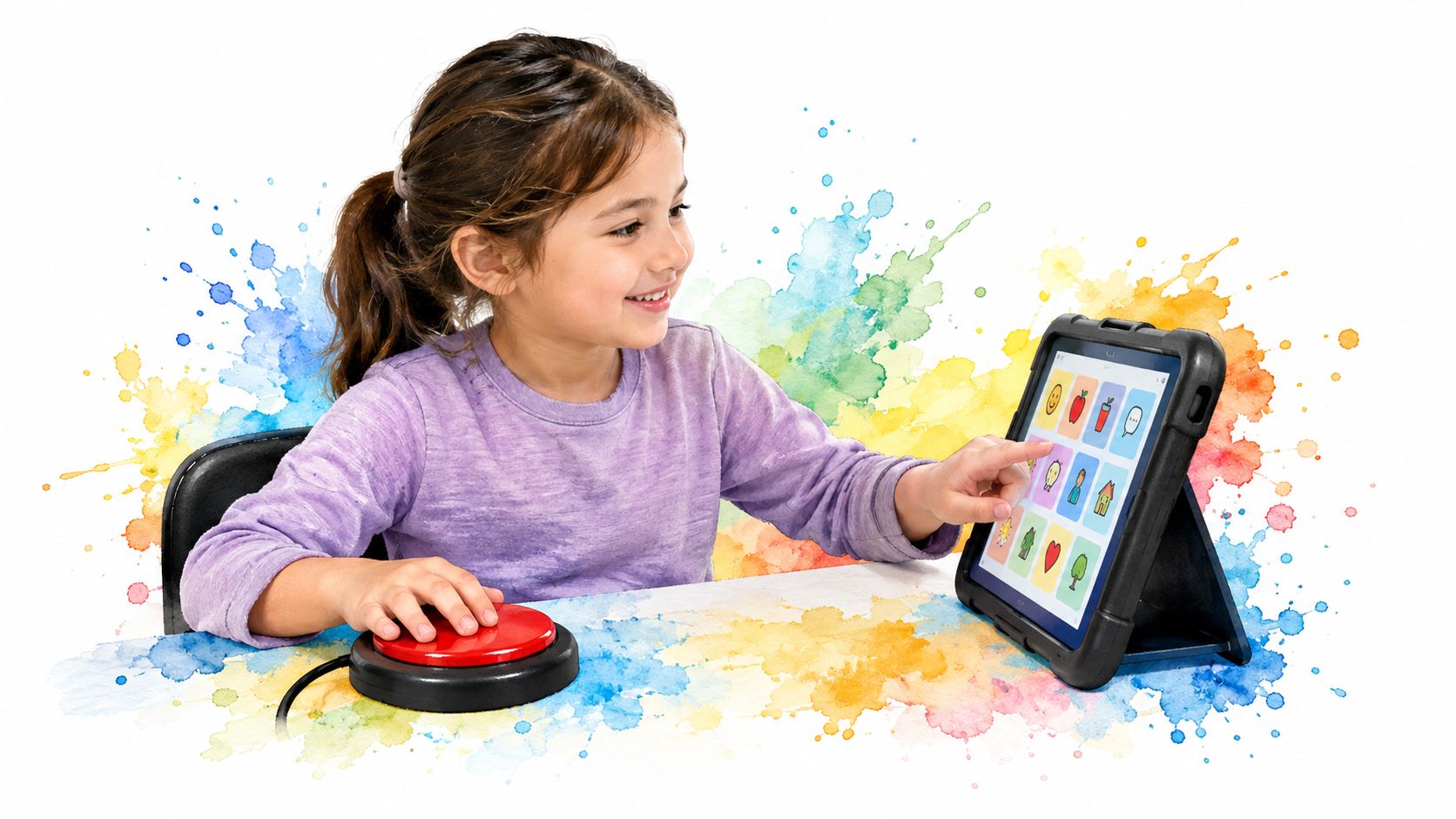
High-tech AAC includes speech-generating devices and tablets running communication software. A child selects symbols, words, or phrases, and the device produces spoken output. The system may support a single request at first and later expand to comments, questions, greetings, refusals, and longer messages.
| Category | Examples | Best fit when |
|---|---|---|
| No-tech | Gestures, pointing, signs, facial expression | A child can communicate through body movements or needs a method that is always available |
| Low-tech | Picture cards, communication boards, books, visual schedules | A portable, simple backup or a clear visual choice system is useful |
| Mid-tech | Single-message buttons, recordable devices | A child benefits from a limited set of spoken messages |
| High-tech | Speech-generating devices, tablet-based communication apps | A child needs broader vocabulary, flexible messages, or audible output |
Fit matters more than novelty
The right option depends on motor access, vision, language understanding, sensory preferences, attention, portability, and daily routines. A large device may be difficult to carry. A small symbol board may be hard to use if a child needs more vocabulary. A touchscreen may work well for one child but require an adapted switch or another access method for someone else.
A child may also use several forms together. They might point to a toy, sign “more,” and use a speech-generating device to say “play cars.” That isn't confusion or failure. It's multimodal communication, and it gives the child more than one route when one route isn't practical.
What the Research Really Shows
Parents deserve evidence that is encouraging without making promises. Research reviews generally find that AAC improves functional communication for many minimally speaking or nonspeaking autistic children, while evidence that AAC directly produces large speech gains is more limited. A systematic-review summary from Frontiers in Psychiatry reported improved AAC use and improved speech production among autistic participants, but AAC outcomes were higher than or equal to speech-production outcomes in all but one included study. More than half of the studies reported low effects on speech production.
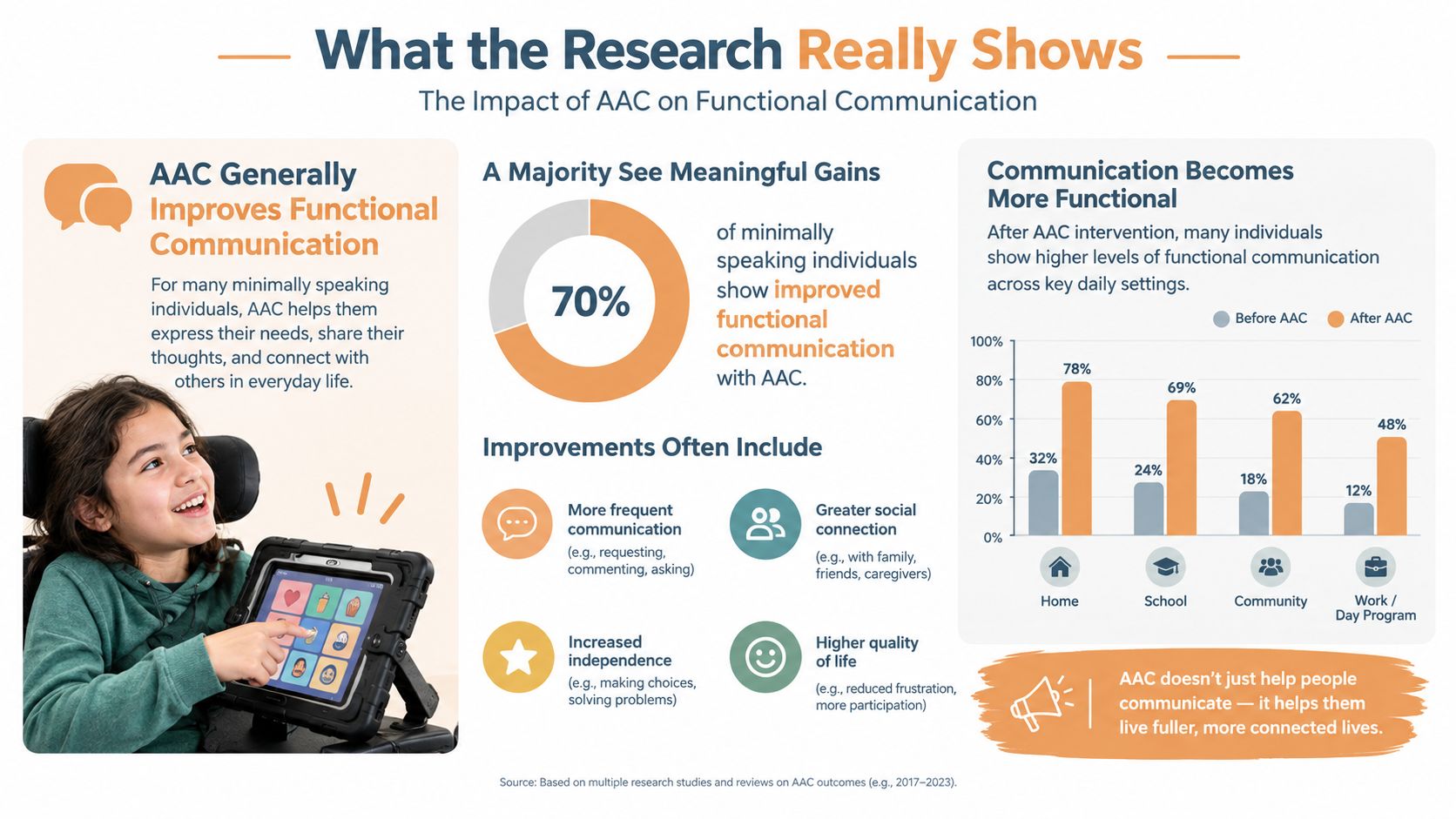
Another review found that a majority of participants experienced gains in communication outcomes such as speech output, requesting, gestures, eye contact, and communication turns. The evidence has limits, including small samples, varied study designs, and limited research quality. That means a careful provider should discuss possibilities and goals, not guarantee a specific number of words or a particular speech outcome.
Why systems go unused
Receiving a device is only the beginning. A 2024 multi-stakeholder review reported that approximately 30%–50% of AAC users abandon or substantially underuse their systems. This range points to a practical issue that product demonstrations often overlook. A system can be well designed and still remain unused if adults don't know how to model it, the vocabulary doesn't match the child's life, or the device stays in one therapy room.
Caregivers, teachers, and therapists need opportunities to use AAC across meals, play, dressing, schoolwork, transportation, and community activities. The child needs to see adults use the system without being tested every time. The vocabulary also needs to include more than preferred objects.
The device isn't the intervention by itself. Access, modeling, practice, useful vocabulary, and coordinated support determine whether AAC becomes part of everyday communication.
A systematic review summarized by ASHA's Evidence Maps found positive effects on requesting in 10 of 12 studies and broader communication skills in 7 of 10 studies involving autistic children. Generalization was positive in 8 of 9 studies, while maintenance was positive in 8 of 12 studies. The same summary noted small samples, limited intervention-specific evidence, and no eligible studies directly examining vocabulary outcomes.
These findings support a balanced plan. AAC can increase access to communication and participation, but success should be judged by what the child can do across real people and places, not only by what happens during a structured session.
How AAC Fits With ABA and Parent Coaching
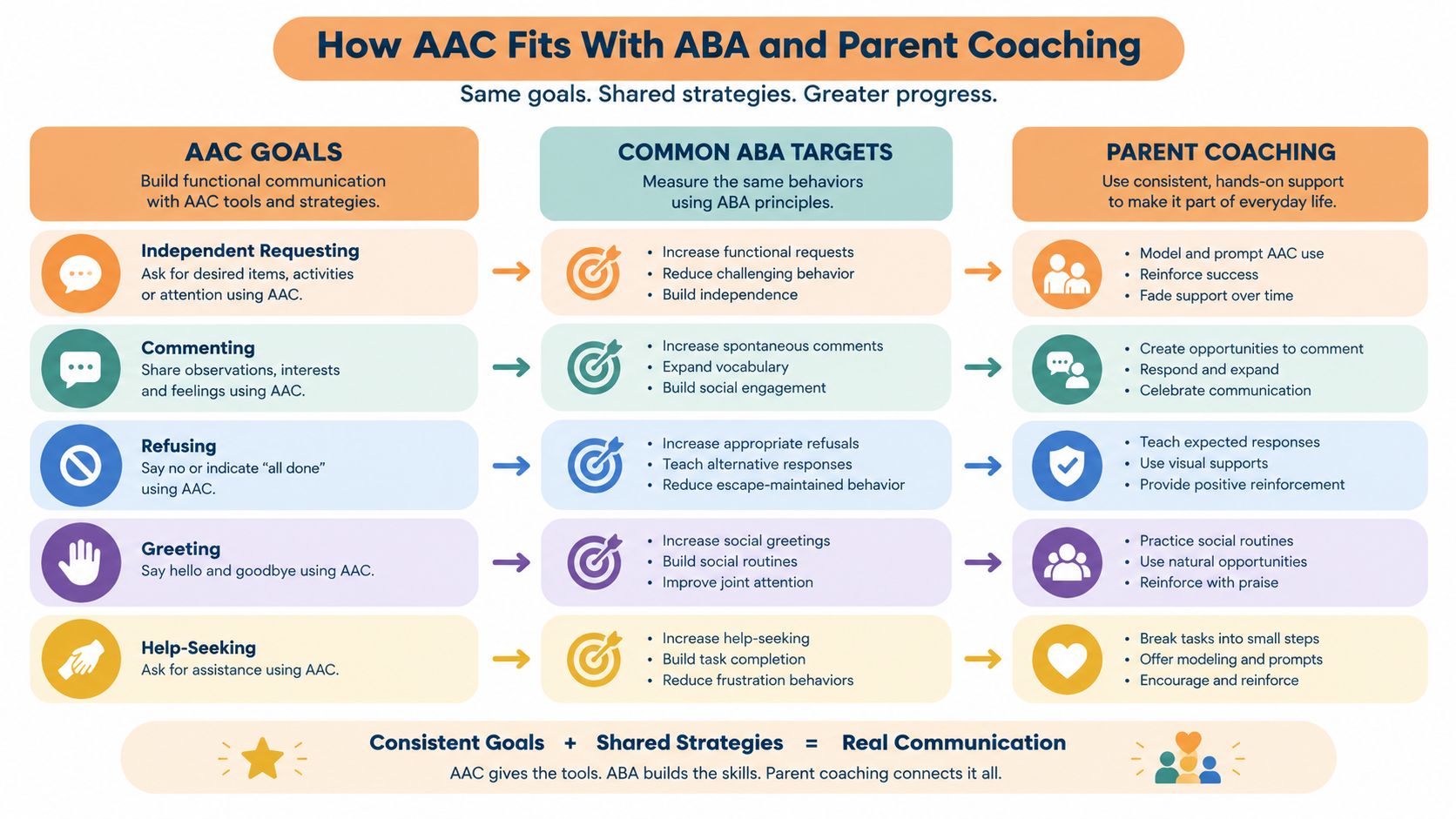
AAC goals can fit naturally into an individualized ABA plan when the focus stays on meaningful communication. A therapist might track whether a child independently requests help, comments during play, refuses an activity, greets a familiar person, or communicates a need for a break.
These goals are concrete without reducing communication to compliance. For example, “help” can be practiced when a child cannot open a container, while “stop” can be honored during an activity that feels uncomfortable. A child can learn that their message changes what adults do.
A morning routine in practice
Consider a school morning. The therapist or caregiver models “shoes,” “coat,” “wait,” and “ready” on the child's communication system. The adult doesn't repeatedly demand that the child copy each word. Instead, they use the symbols while speaking and pause naturally for the child to respond through speech, gesture, selection, or movement.
At breakfast, the child may choose between cereal and toast, request more, indicate “all done,” or ask for help opening a package. The adult records useful information such as whether the child initiated, how much prompting was needed, and whether the message was understood.
During the next check-in, the team can ask whether the same vocabulary works at home and school. A dedicated care coordinator can help keep communication among parents, clinicians, and educators organized so the child isn't learning one set of expectations in therapy and another everywhere else.
Measure access, not obedience
ABA terminology can sound technical, but the family question is simple: Can my child communicate more independently in situations that matter? A thoughtful plan may include:
- Independent requests: The child communicates for an item, activity, or continuation without waiting for an adult to guess.
- Comments: The child shares “fun,” “big,” “look,” or another message during play rather than only asking for something.
- Refusals: The child communicates “no,” “stop,” “not now,” or “different,” and adults respond respectfully.
- Help-seeking: The child indicates a problem instead of being expected to manage it on their own.
- Social messages: The child greets, responds, invites someone to play, or participates in a familiar routine.
Parent coaching keeps these skills alive between appointments. A family-centered parent coaching model can help adults practice the same communication opportunities during ordinary routines, with feedback that reflects the child's needs rather than a generic script.
Choosing a System Without the Pressure
Selecting AAC can feel like choosing expensive technology for a child who may not yet be able to tell you what works. Take the pressure off by treating the evaluation as a fit question, not a shopping contest.
Compare access and daily use
Start with how your child will physically access the system. Can they touch symbols accurately? Would a larger target, keyguard, adapted switch, or eye-gaze method be more practical? Motor fatigue matters. A method that works for a few minutes at a table may not work during a long school day or while moving through a grocery store.
Look at the visual and language demands as well. Some children need a small number of clear choices. Others need strong vocabulary that lets them create messages beyond prepared requests. Ask how vocabulary will be organized and updated as interests, schoolwork, relationships, and independence change.
Portability is another real-world test. The system needs to move between home, school, therapy, and the community. A low-tech backup can be valuable if a battery fails, a device is being repaired, or a child is not able to use the primary system comfortably.
The speech question
Many parents worry that AAC will replace speech or make a child less likely to speak. Available evidence doesn't support the concern that AAC prevents speech development. An ASHA evidence summary on speech-generating devices reported vocal-utterance improvement for 87% of participants across the reviewed studies, and no included study reported a decrease in spoken language when an SGD was part of treatment.
That finding still isn't a promise that every child will develop speech. The practical goal is immediate, reliable communication. Spoken words, gestures, signs, symbols, and device selections can work together, and the team should monitor both AAC independence and vocal changes.
Bring these questions to an SLP or ABA provider:
- Access: How will the team evaluate touch, switch, eye-gaze, positioning, and motor fatigue?
- Vocabulary: Will the system support requesting, commenting, refusing, greeting, questions, and literacy?
- Languages: Can it represent every language and dialect used by our family?
- Training: Who will teach caregivers, teachers, and peers to model the system?
- Portability: What is the backup plan for school, travel, charging, or repairs?
- Progress: How will we measure independent communication across people and settings?
Making AAC Work at Home and at School
The first weeks after receiving AAC often bring excitement, followed by uncertainty. Families may wonder whether they should ask the child to use the device, correct selections, or wait for a perfect message.
A more useful approach is aided language modeling. The adult talks while selecting a few relevant symbols on the child's system. During bubbles, you might say “more bubbles” and select “more.” During bath time, you might model “water,” “all done,” or “too hot.” The child isn't being tested. They're seeing how the system can carry meaning.
Build communication into routines that already happen:
- Meals: Model “more,” “different,” “drink,” “help,” and “all done.”
- Play: Use “go,” “stop,” “my turn,” “your turn,” “look,” and comments about the activity.
- Car rides: Model “music,” “quiet,” “arrive,” “wait,” or “I see it.”
- Dressing: Include “shirt,” “shoes,” “too tight,” “help,” and “ready.”
- Community outings: Make room for greetings, choices, questions, and requests for breaks.
A child may communicate through speech, signs, pointing, and AAC in the same interaction. Respond to the message rather than insisting on one channel. Communication practice in everyday moments is more likely to become useful when adults make space for communication without turning every routine into a lesson.
Include every family language
Multilingual families shouldn't have to choose between home language and school language. Vocabulary, social scripts, family names, songs, and culturally meaningful routines may need to appear in every language the child hears and uses.
An ASHA publication on culturally adapting caregiver-implemented AAC interventions explains that caregivers can support AAC effectively with appropriate training and coaching, while also identifying an urgent need for interventions aligned with families' cultural and linguistic preferences. Translating labels alone may not be enough. Families may need different words, dialects, scripts, literacy supports, and communication partners across settings.
Share a short vocabulary guide with teachers. Include the child's preferred words, ways to say no, important names, and the prompts that help without taking over. Ask the school team to offer the system throughout the day and to reduce prompts gradually, so the child can initiate with more partners instead of waiting for an adult cue.
Measuring What Truly Matters
A word count can be easy to record, but it doesn't tell the whole story. A child who says “juice” more often may still need support to refuse, ask for help, greet a peer, comment during play, or tell an adult that something hurts.
Progress can look like initiating with a new person, communicating in a noisy classroom, repairing a misunderstanding, staying engaged in a group activity, or choosing “no” and having that message respected. It can include improved comprehension, more independent choices, early literacy, storytelling, and participation in family routines.
Research summarized in ASHA's review of varied AAC communication functions describes emerging support for commenting, greeting, requesting an action, seeking information, and joining social routines. Requesting is important, but it's a starting point rather than the finish line.
Questions for progress check-ins
Ask the care team:
- Initiation: When does my child communicate without an adult prompt?
- Range: Can they request, comment, refuse, greet, ask questions, and seek help?
- Generalization: Does the skill appear at home, school, therapy, and in the community?
- Partners: Can familiar adults, teachers, and peers understand and respond?
- Independence: Are prompts being reduced carefully over time?
- Access: Is the system available, charged, updated, and easy to use?
- Literacy: How are reading, writing, and message-building being included?
- Family fit: Do the goals reflect our routines, relationships, languages, and values?
A coordinated team should treat these questions as a shared conversation. Meaningful communication won't look identical from child to child, and progress may appear first as a calmer refusal, a spontaneous comment, or a new attempt to connect.
Friendly ABA Premier offers individualized ABA therapy, parent coaching, school support, and social skills services for children across Connecticut, Georgia, Maryland, Massachusetts, North Carolina, South Carolina, Virginia, and Washington. If you're looking for coordinated support around AAC goals, communication routines, and family progress check-ins, visit Friendly ABA Premier to talk with the team.
Our Latest Insights



















Experience ABA Therapy with a More Personalized Level of Support
Discover how FriendlyABA Premier combines evidence-based ABA therapy with dedicated coordination, proactive communication, and individualized family support.