

Behavioral Cusp vs Pivotal Behavior: A Family Guide
Understand behavioral cusp vs pivotal behavior in ABA therapy. Learn how each impacts your child's development and how to prioritize targets

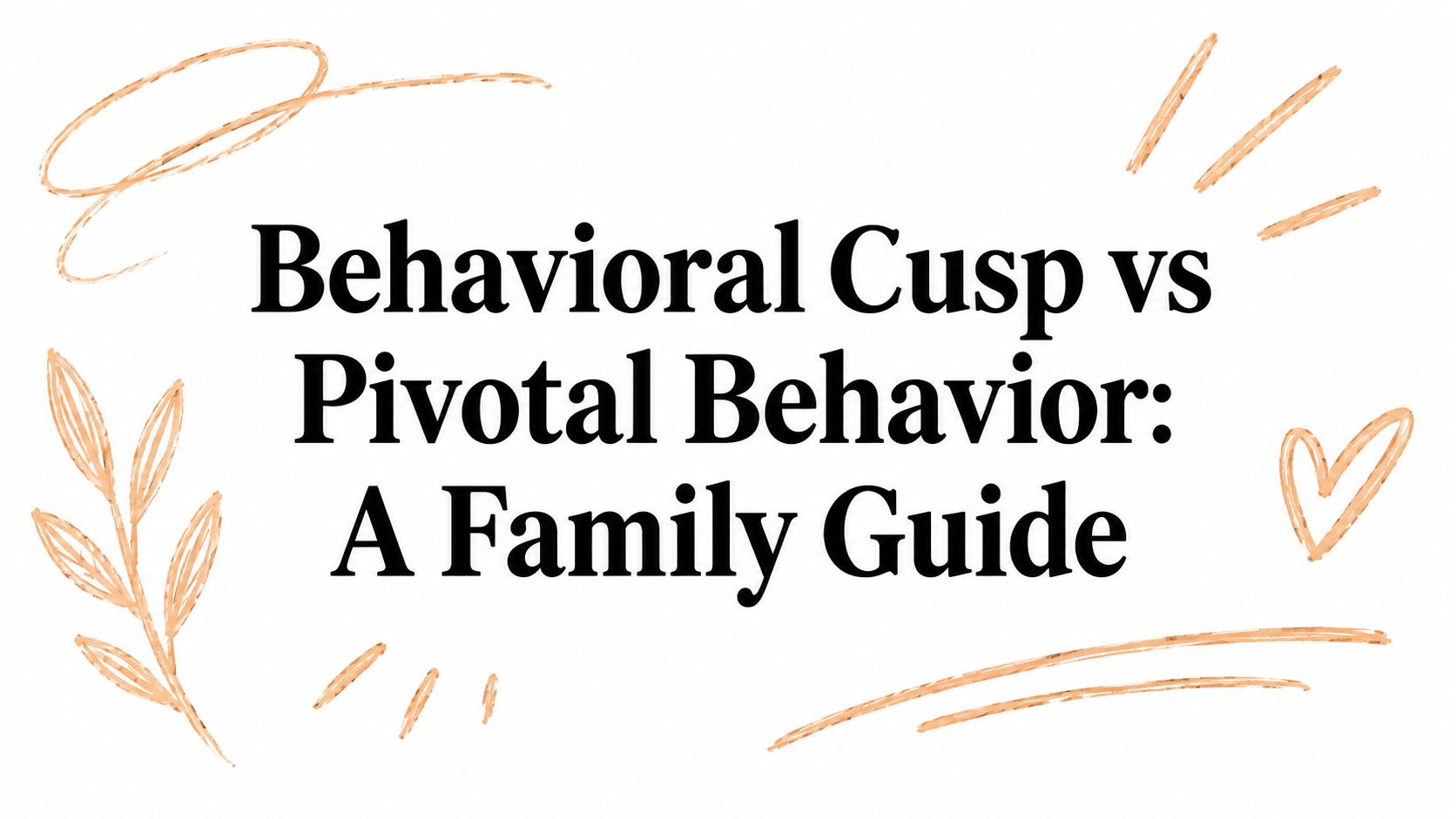
You're sitting at the kitchen table after a therapy session, looking at your child's goals and wondering why one skill was chosen over another. Should the team focus on requesting help, joining a game, following a classroom routine, or managing a transition? The answer may depend on whether the skill is being considered as a behavioral cusp, a key behavior, or both.
These terms can sound technical, but they describe a practical question: Could learning this skill open new opportunities, or help other skills develop too? Understanding the difference can make treatment planning feel less mysterious and help you have more confident conversations with your child's care team.
Table of Contents
- How does the team choose between a cusp-based goal and a goal focused on broader ripple effects?
- Can one skill fit both descriptions?
- What does collateral improvement look like?
- Should parents choose the goal category?
- How will progress be communicated?
- What if our child's environment changes?
Understanding Behavioral Cusps and Pivotal Behaviors
At breakfast, a child learns to request more cereal. Soon, that response may help them participate in meals, communicate during play, and seek assistance at school. In another family, a child begins showing a parent an interesting toy, creating more chances for shared attention and conversation. These everyday changes show why some goals deserve attention beyond the skill itself.
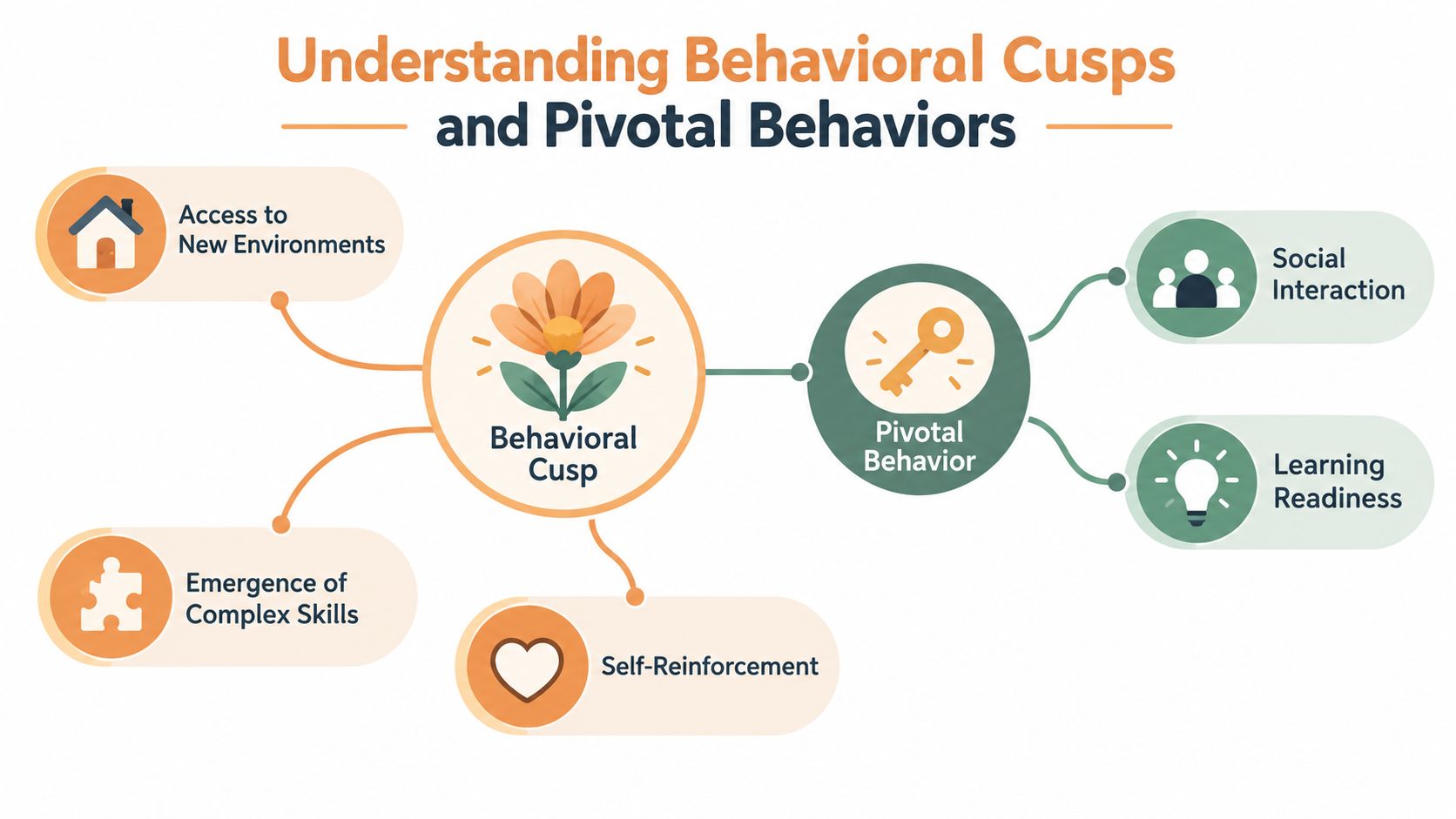
A behavioral cusp is a behavior change that brings someone into contact with environments, reinforcers, consequences, or learning opportunities that were previously unavailable. In plain language, it opens access to new parts of life. Walking independently illustrates the idea. Once a child can move without help, rooms, objects, people, and activities may become easier to reach.
A key behavior pattern works through a different mechanism. Changing one behavior may improve other adaptive behaviors that were not directly taught. A therapist might target one skill, while related gains appear in communication, social interaction, motivation, or readiness to learn.
A simple way to remember the difference
For a cusp, ask: “What new experiences can this skill make available?”
For a central skill shift, ask: “What other behaviors might improve because this skill changed?”
The labels are not a ranking system. A goal does not need to fit only one category, and families do not have to decide the terminology before therapy starts. Clinicians can use these ideas to compare possible goals and choose targets that match a child's routines, current barriers, and likely opportunities for practice.
A useful shortcut is to treat a behavioral cusp like an access point, while a key behavior that creates ripple effects spreads change into related skills. The practical question is which type of impact would help this child and family most right now.
Families new to ABA may also benefit from this plain-language overview of behavior analysis and ABA therapy. Bring the concepts into treatment discussions by asking how a goal could affect routines such as requesting a break, preparing for school, or joining play.
Where These Concepts Come From
The term behavioral cusp was introduced formally by Rosales-Ruiz and Baer in 1997. Their paper described a behavior change that brings a person into contact with new contingencies, creating effects that can reach well beyond the original skill. You can read their definition in the Rosales-Ruiz and Baer paper on behavioral cusps.
For families, this history matters because it explains why clinicians ask more than, “Can your child do the skill?” They also ask, “What might this skill let your child do next at home or school?” That question helps connect treatment goals to real routines, such as communicating during meals, joining classroom activities, or participating in play.
Rosales-Ruiz and Baer presented development as a sequence of behavior changes, with some changes being “essential to what can come next.” This perspective gave clinicians a reason to prioritize goals by their likely influence on future learning and daily participation, rather than by difficulty alone.
The later focus on pivotal-behavior research
Pivotal behavior became especially influential in autism intervention through the work of Koegel and colleagues. A 2013 systematic review identified four areas that research had examined: motivation, self-initiations, responding to multiple cues, and self-management, as reported in the review of pivotal response treatment and pivotal behaviors.
The review also connected this work with Pivotal Response Treatment, an intervention model intended to support improvements beyond the response taught directly. In practical planning, a clinician may therefore ask whether changing one important behavior could support related, untaught behaviors across everyday settings.
These traditions overlap, yet they guide attention in different directions. Behavioral cusp research asks what new settings, activities, or learning opportunities become available. Pivotal-behavior research asks whether broader changes may appear in other behaviors without teaching each one separately.
Why the history helps families
“Cusp” and “pivotal-behavior” are not merely two names for the same goal. Neither label guarantees a particular result. Instead, each offers a way to judge whether a possible target fits the child's current barriers, family routines, and opportunities for practice.
Key Differences Between Behavioral Cusps and Pivotal Behaviors
Both concepts describe behavior changes that affect more than the response taught directly. The clearest distinction is the outcome you want to examine: new access to the world, or related changes in other behaviors.
A behavioral cusp asks what becomes available after a skill is learned. A central-behavior focus asks what else may change because that skill has improved. The integrative review of behavioral cusps and pivotal behaviors describes this difference as environmental expansion compared with broader behavioral change.
| Feature | Behavioral Cusp | Pivotal-Behavior Focus |
|---|---|---|
| Main question | What new environments, reinforcers, or learning opportunities become available? | What other untaught behaviors may improve after this behavior changes? |
| Primary emphasis | Access and developmental pathways | Generalization and related improvement |
| Daily-life example | Learning to walk and reaching people, objects, and places that were previously unavailable | Improving self-initiation and seeing related gains in communication, social interaction, and learning |
| What clinicians observe | New participation, access, or contact with reinforcement | Changes across several adaptive behaviors without directly teaching each one |
| Planning lens | “Will this skill open an important door?” | “Could this skill create useful ripples?” |
The same target can invite different questions
Consider requesting help during a difficult classroom activity. Viewed as a behavioral cusp, the skill may give a child access to adult support, problem-solving, and continued participation instead of leaving the activity. Viewed through a keystone-behavior lens, the team may monitor related changes in communication, persistence, and self-management.
The target does not need to belong permanently to one category. Its classification depends partly on the question guiding assessment and treatment planning.
A 2022 integrative review concluded that the concepts are closely related and may fit within the same logical category because both involve behaviors with important developmental repercussions, while still differing in emphasis. For families and clinicians, this supports a flexible choice based on the child's priorities rather than a rigid either-or decision.
For families: Ask what the team expects the skill to make possible, not just what the skill is called.
A practical plan identifies the observable behavior, explains how progress will be measured, and connects the target with priorities at home, school, or in the community. For one child, the strongest reason to teach a skill may be the access it creates. For another, the team may focus on related improvements that appear across daily routines. The useful distinction is the one that leads to clearer goals and better decisions.
Real Examples Parents Can Recognize
A familiar example makes the behavioral cusp idea easier to see. A child who learns to walk can move toward a caregiver, explore another room, reach for a toy, and interact with objects or people that were previously out of reach. Learning to walk doesn't teach every later skill directly, but it changes the child's access to the world, as described in this example of walking as a behavioral cusp.

A similar pattern can appear in everyday ABA goals. Suppose a child learns to request a favorite snack using speech, a sign, or an AAC device. That response may open access to more communication partners, shared routines, choices, and opportunities to practice waiting or taking turns.
A pivotal example in play
Now consider self-initiation or joint attention. A child who begins bringing a toy to an adult, pointing toward something interesting, or starting a simple interaction may create more chances for communication and social learning.
The therapist may directly support the initiation, while the family notices changes in play, shared attention, requesting, and participation. Those related improvements are the kind of broader effect that makes self-initiation or joint attention a commonly cited critical-behavior example.
Not every child will show the same pattern. The team should look at what changes in the child's actual routines rather than assuming that a skill will automatically produce a particular result.
You can explore more everyday examples in this guide to target behaviors in ABA, then discuss which examples resemble your child's current needs.
The following video can provide another visual way to think about how a skill may affect opportunities and related behaviors:
The important question isn't whether a goal sounds impressive. It's whether the skill is meaningful for the child and whether the team can support it across real situations.
How These Ideas Shape ABA Treatment Planning
The difference becomes most useful when a team chooses goals. An individualized ABA plan should reflect the child's current routines, communication style, support needs, and family priorities. A skill that opens an important opportunity at school may not be the first priority for a family focused on mealtime or safe participation at home.
A cusp-based question might be, “Will this target give the child access to something important?” That could include requesting help during a classroom activity, tolerating a transition into a community setting, or navigating a familiar school routine.
A key question might be, “Could progress in this target support changes across several other behaviors?” The team may consider motivation, self-initiation, responding to multiple cues, or self-management when deciding whether a target could create useful generalization.
Context changes the value of a target
Recent conceptual work emphasizes that the importance of a cusp is situational rather than universal. A target can function as a powerful access point for one child or setting and have less immediate value in another, as discussed in this review of behavioral cusps and developmental change.
For example, requesting help may be especially valuable when a child is beginning school support. Tolerating transitions may matter most when daily routines are changing. Navigating classroom routines may become a priority when participation with peers and teachers is the family's immediate focus.
What collaborative planning can look like
A thoughtful team may:
- Start with the routine: Identify where the child wants more independence or participation.
- Define the target: Describe exactly what the child will do and what support is appropriate.
- Consider access: Ask which people, places, activities, or reinforcers the skill may make available.
- Watch for ripples: Track related changes without assuming they will occur automatically.
- Review with the family: Adjust priorities as home, school, or community circumstances change.
A functional behavior assessment can help the team understand what is happening around a behavior and how to choose responsive supports. Families can learn more about what a functional behavior assessment involves before discussing goals with their clinicians.
Questions to Ask Your ABA Care Team
You don't need to memorize clinical definitions to participate meaningfully in treatment planning. A good care team should explain why a target matters, how it fits the child's routines, and what information will show whether the plan needs adjustment.
Bring questions that connect therapy to everyday life. You might ask:
- What opportunity could this skill open? This helps clarify whether the goal is being considered as a behavioral cusp.
- What other changes might we watch for? The answer can show whether the team expects collateral improvements linked to a key behavior change.
- Why is this goal a priority right now? The best answer should connect to the child's present environment and family priorities.
- How will you define progress? Ask what the child will do, under which conditions, and with what level of support.
- Where will we practice it? A plan may need examples from home, school, playtime, meals, or community routines.
- How will you share updates? Families should know when progress will be reviewed and how communication will happen.

Ask the team to give a concrete example. “This goal may improve communication” is less helpful than an explanation tied to a routine, such as using a request during snack, then practicing that request with another caregiver.
Good communication is part of the intervention experience. Families should have room to ask questions, share observations, and request changes when the child's circumstances shift.
A dedicated care coordinator can also help families keep track of appointments, progress conversations, and communication among the people supporting the child. That kind of partnership makes it easier to connect therapy goals with life beyond the session.
Frequently Asked Questions About ABA Goals
How does the team choose between a cusp-based goal and a goal focused on broader ripple effects?
The choice should follow the family's immediate needs, the child's current routines, and the kind of change the team expects. For a family working on smooth morning school routines, learning to enter the classroom and find the right activity may open access to the school day. For a family preparing for playdates, self-initiation may receive priority because it can support more opportunities to join play. Ask which door or ripple matters most this month.
Can one skill fit both descriptions?
Yes. Requesting help, for example, may give a child access to support and continued participation while also relating to communication, coping, and self-management. The team should explain how it defines the skill and which changes it is watching for in daily life.
What does collateral improvement look like?
Collateral improvement occurs when a related behavior changes even though the therapist did not teach that exact behavior directly. After support for self-initiation, a child might participate more often in social interaction or communication opportunities. The team should record what happens rather than promise that every connected skill will improve.
Should parents choose the goal category?
Parents should not have to classify the goal alone. Your observations show which routines break down, which activities matter to your child, and where a new skill could make daily life easier. Share a recent example, such as difficulty joining siblings at dinner or asking for help during dressing. The clinician can combine that information with assessment findings and progress data.
How will progress be communicated?
Ask the team to explain the target in plain language, including what the child will do during familiar routines and how support will be tracked. Request examples from snack, dressing, school preparation, or community outings so the plan feels usable at home. Agree on when updates will be shared and who will answer questions.
What if our child's environment changes?
Treatment priorities may change when school begins, in-home ABA starts, parent coaching is added, or a new community routine becomes important. Tell the care team what has changed and which part of the day now causes difficulty. A goal that fit last month may need adjustment to remain practical.
Friendly ABA Premier offers personalized ABA therapy, home-based support, social skills development, school support, and parent coaching across Connecticut, Georgia, Maryland, Massachusetts, North Carolina, South Carolina, Virginia, and Washington. Talk with a dedicated care coordinator and clinical team about goals that fit your child's routines by visiting Friendly ABA Premier.
Our Latest Insights




















Experience ABA Therapy with a More Personalized Level of Support
Discover how FriendlyABA Premier combines evidence-based ABA therapy with dedicated coordination, proactive communication, and individualized family support.