

ABA Positive Reinforcement: A Parent’s Friendly Guide
Learn how ABA positive reinforcement helps children with autism grow. Discover types, examples, schedules, and practical tips for home and school.

You may be watching your child reach for a favorite toy, pause before asking for help, or complete part of a morning routine with a little encouragement. In those small moments, you may wonder whether praise, a preferred activity, or a reward is helping, or whether you're trying to get through the day. Understanding ABA positive reinforcement can make these interactions feel clearer and more purposeful.
Positive reinforcement isn't about bribing a child or expecting perfect compliance. It's about noticing a meaningful skill, responding in a way your child values, and helping that skill become easier to use again. The most effective approach is personal, respectful, and built with your family's care team.
Table of Contents
What Is ABA Positive Reinforcement
Your child reaches toward a favorite snack, then uses a word, gesture, picture, or device to request it. You respond right away by offering the snack and acknowledging the communication. That moment teaches an important lesson: communicating a need can work.
In ABA, positive reinforcement means delivering a valued consequence after a behavior so that the behavior becomes more likely to happen again. The consequence could be access to a toy, help with a task, a favorite activity, enthusiastic attention, or something else your child enjoys. The key is what happens afterward. If the behavior increases over time, the consequence is functioning as reinforcement. Vanderbilt's ABA and autism guidance explains that reinforcement is individualized because what motivates one child may not motivate another.

Reinforcement is more than praise
Many parents understandably think of reinforcement as saying “good job.” Praise can be useful, especially when it's warm and meaningful to your child, but it isn't automatically reinforcing. Some children enjoy high-fives or smiles. Others prefer a short turn with a favorite car, access to music, help opening a container, or a break from a difficult activity.
That's why an ABA team watches your child's responses rather than assuming a particular reward will work. If praise doesn't increase the skill, the team may try another consequence. The purpose isn't to make every interaction transactional. It's to create enough success and motivation that learning feels possible.
A simple way to recognize it
Look for three parts:
- A behavior: your child asks for help, waits, imitates an action, or begins a routine.
- A valued consequence: an adult responds with something your child wants or appreciates.
- A future change: your child becomes more likely to use that skill again.
A respectful plan also includes choice, breaks, communication, and goals that matter in daily life. Positive reinforcement should help your child express needs and build independence, not erase personality or force a child to appear a certain way.
The Evidence Behind Positive Reinforcement
ABA's autism research roots reach back to the late 1960s, and early programs used mostly positive reinforcement within discrete trial therapy. Historical reviews describe that work as groundbreaking, while later evidence reviews have identified ABA-based interventions as established treatments for autism. Focused approaches, including functional communication training and noncontingent reinforcement, have also been identified as well-established empirically supported treatments in the Autism Science Foundation's evidence summary.
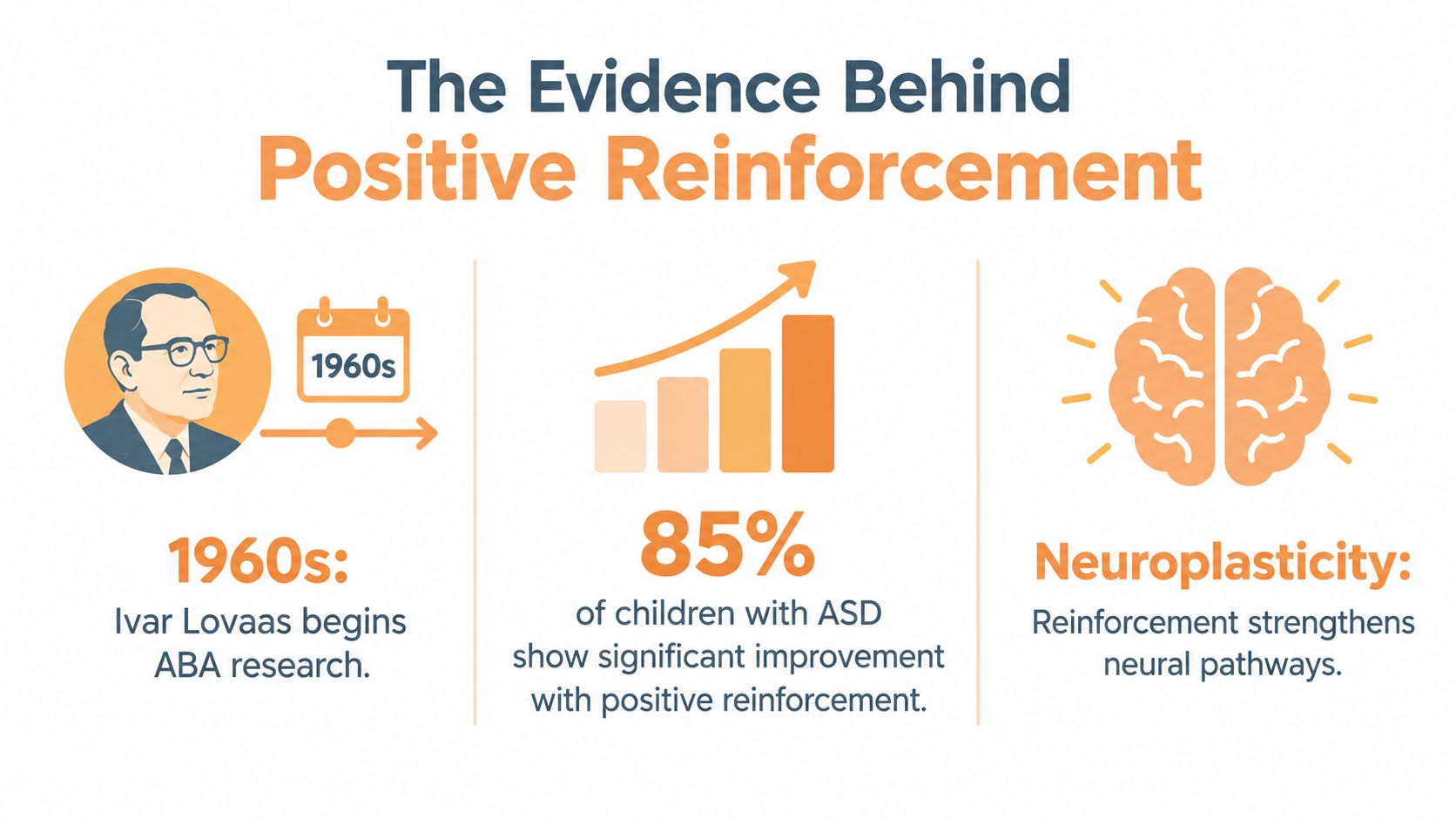
The research supports a hopeful but individualized interpretation. Evidence summaries report that intensive ABA programs typically involve 25 to 40 hours per week for 1 to 3 years, and more than 20 studies have found that long-term ABA can improve intellectual functioning, language, daily living skills, and social functioning for many children with autism. Those figures describe programs studied in particular contexts, not a prescription for every child. Your care team should consider your child's needs, family circumstances, goals, tolerance, and access to services.
What the evidence can and can't tell you
Research can show that reinforcement-based teaching supports skill development across groups of children. It can't predict exactly which reinforcer your child will prefer, how quickly a skill will develop, or which setting will be easiest. It also can't replace regular conversations with the clinicians who know your child.
A useful plan connects evidence to observation. Clinicians define a skill, choose a teaching strategy, track what happens, and adjust when the data don't show meaningful progress. Families should be able to understand what the team is teaching, why the goal matters, and how progress will be discussed.
A reassuring question to ask: “How will we know this plan is helping my child use the skill more independently?”
That question keeps the focus on functional progress rather than on completing isolated exercises. It also opens space to discuss communication, comfort, self-advocacy, and whether a skill transfers to home, school, and community routines.
Types of Reinforcement and When to Use Them
Reinforcement can look different from one child to another and from one goal to the next. A clinician might use social attention during play, access to a preferred activity after a difficult routine, or a natural consequence that directly meets a request.
Social reinforcement includes a smile, shared excitement, a high-five, or specific encouragement. It works best when your child enjoys social attention and when the response feels genuine.
Tangible reinforcement involves a preferred object, such as a toy or sensory item. Teams should use it thoughtfully, connect it to a clearly defined skill, and avoid assuming that a favorite item will remain motivating forever.
Activity-based reinforcement gives access to something enjoyable, such as a short play routine, music, or a movement activity. This can fit naturally into home and school routines because the reward is an activity rather than an object.
Token systems
A token economy uses three parts: a target behavior, a token earned after that behavior, and a backup reinforcer that the learner can exchange for tokens later. Because the token can be delivered immediately without interrupting an activity, the system can support behavior across settings and over a longer period. This ABA resource on token economies describes these core mechanics.
For example, a child might earn a token for placing a lunch item in a bag, then exchange tokens for a chosen activity. The team first defines the target behavior, teaches how the system works, and selects an exchange rate the child can understand. One token economy guide from Vanderbilt Kennedy Center describes starting with about three to five tokens per exchange and increasing gradually to build waiting skills.
Reinforcement schedules
At first, a team may reinforce a new behavior frequently so the connection is easy to understand. As the behavior becomes more consistent, reinforcement may occur less often or follow a varied pattern. You can read examples of these changes in this guide to schedules of reinforcement.
The goal isn't to remove encouragement suddenly. It's to help the skill remain useful while your child experiences natural outcomes, such as getting help after asking, finishing a preferred activity after a routine, or receiving positive attention during shared play.
Positive Reinforcement in Everyday Life
Positive reinforcement often happens in ordinary moments, not only at a therapy table. A child asks for a spoon at mealtime, and an adult hands it over immediately. A child places one piece of food on the plate, and the family responds warmly before continuing the meal. The natural result makes communication and participation more meaningful.

Small moments across the day
During play, your child might hand you a toy to request a turn. You take the turn, return the toy, and celebrate the shared interaction. At school, a student might raise a hand, point to a choice, or remain with a group activity for a short period, followed by access to a preferred classroom activity.
In the community, a child could practice holding a caregiver's hand near a parking area, waiting briefly before entering a store, or using a break card when the environment feels overwhelming. The reinforcement might be a chosen song in the car, a quiet pause, or the opportunity to select the next errand step.
The exact response depends on the child and the purpose of the skill. A care team can help distinguish between reinforcing communication, supporting safety, encouraging independence, and unintentionally rewarding distress.
Evidence syntheses offer context for these practical applications. One scoping review of 770 study records reported improvement in 63% to 88% of records, depending on the outcome measure, while a separate review of 27 peer-reviewed ABA studies found that all included studies reduced targeted problem behaviors after intervention. The review is available through this evidence synthesis on reinforcement-based ABA procedures.
A reinforcement plan should still be function-based, consistent across relevant settings, and paired with parent training so skills can generalize beyond therapy sessions.
How Parents Can Support Reinforcement at Home
Parents don't need to recreate a therapy session in the living room. Your most valuable role is to share what your child enjoys, notice useful skills in everyday routines, and practice agreed strategies with support from the care team.
Start with one routine, such as getting dressed, washing hands, preparing a snack, or leaving for school. Choose a behavior that matters to your family, describe it clearly, and respond promptly when your child attempts it. A small success, such as handing over a shirt or pointing to the next step, deserves attention because it gives the team information about what helps.
Use observation instead of guesswork
A preferred item is only a reinforcer if the behavior becomes more likely afterward. Guidance on ABA reinforcement procedures emphasizes that practitioners should verify this through observation rather than assume that praise, food, or a toy will work.
You can bring simple observations to your child's clinician:
- Notice the attempt: What did your child do immediately before receiving the preferred outcome?
- Watch the response: Did your child try the skill again later?
- Check the context: Did the same consequence work at home, during therapy, and at school?
- Share changes: Has interest in the item, activity, or social response shifted?
Build consistency with partnership
Parent coaching should feel practical, not like an exam. A clinician can demonstrate a strategy during a real routine, let you try it, and help you adjust the timing or wording. You can find additional family-focused ideas in these ABA tips for parents.
A dedicated care coordinator can also help keep communication organized between caregivers, clinicians, and school staff. Proactive check-ins make it easier to discuss what is working, what feels difficult, and whether goals still match your family's priorities. Consistency doesn't mean every adult responds identically. It means the important parts of the plan are understandable and realistic across the places your child spends time.
Family practice matters: Choose strategies you can use during real life, not only strategies that look manageable in a therapy session.
Why Personalized Care Makes a Difference
A reinforcement plan should fit the child in front of you. One child may work toward more time with a favorite activity, while another may value adult attention, movement, quiet, or immediate help with a task. Individualized care begins by learning those preferences instead of applying the same reward system to everyone.
Personalization also changes which goals receive attention. Families and clinicians can prioritize communication, choice-making, self-advocacy, daily living skills, social connection, or school participation. A goal is more meaningful when it improves a child's access to people, activities, and decisions that matter in daily life.
Autonomy belongs in the plan
Many parents ask whether reinforcement can support independence and emotional wellbeing, or whether therapy might become too focused on compliance. Recent academic discussion describes potential benefits in autonomy, wellbeing, language, adaptive skills, and social behavior, while also noting that long-term evidence is mixed and outcomes can vary in social engagement and emotional regulation. This recent review presents that more nuanced picture.
That means parents should feel comfortable asking whether a goal teaches a useful skill, whether their child can communicate refusal or request a break, and whether the skill is transferring beyond therapy. Regular progress conversations help the team make those decisions together.
Parent coaching and training can make the plan easier to use at home. At Friendly ABA Premier, a dedicated care coordinator, individualized treatment planning, scheduled check-ins, and proactive communication are designed to keep families involved rather than waiting for concerns to surface. This kind of partnership helps clinicians respond to the child's changing interests and the family's changing needs.
Practical Takeaways for Parents
Keep the central idea simple: positive reinforcement connects a meaningful behavior with a meaningful outcome. Your child's response tells you whether the consequence is actually motivating.
Try these steps:
- Choose one useful skill: Focus on a routine your child needs at home, school, or in the community.
- Respond quickly: Deliver the agreed consequence soon after the behavior so the connection is clear. ABA practice guidance explains why timing matters.
- Watch for repetition: If the skill doesn't increase, tell the care team and reconsider the reinforcer.
- Protect autonomy: Include choices, communication, breaks, and goals that support independence.
- Share what you observe: Your family's daily experience is essential clinical information.
You don't have to figure out the right approach alone. Ask your child's BCBA or care coordinator to show you how reinforcement fits into one routine and how progress will be reviewed.
Friendly ABA Premier offers individualized ABA therapy, home-based support, social skills development, school support, and parent coaching across Connecticut, Georgia, Maryland, Massachusetts, North Carolina, South Carolina, Virginia, and Washington. Visit Friendly ABA Premier to speak with the team about a reinforcement plan built around your child's strengths, preferences, and everyday goals.
Our Latest Insights




















Experience ABA Therapy with a More Personalized Level of Support
Discover how FriendlyABA Premier combines evidence-based ABA therapy with dedicated coordination, proactive communication, and individualized family support.