


The Parent Coaching Model in ABA Therapy
Discover how the parent coaching model in ABA therapy empowers families. Learn about session structures, skill generalization, and tips to maximize progress.

A therapist may help your child ask for a snack, join a game, or move through bedtime with more ease. Then the session ends, you're back in the kitchen, and you're left wondering how to support that same skill without turning family life into another therapy appointment.
That feeling is common. The parent coaching model creates a bridge between clinical support and everyday routines, so parents and caregivers can use practical strategies during meals, play, dressing, school preparation, and community outings. You aren't expected to become a full-time therapist. You're learning a few helpful ways to make ordinary moments more predictable, communicative, and encouraging.
Table of Contents
Understanding the Parent Coaching Model
A bridge between therapy and home
Consider a child who practices requesting during a therapy session. In the clinic, the therapist may arrange favorite toys nearby, pause before handing one over, and help the child use a word, picture, gesture, or communication device. At home, the same child may reach for a snack, pull an adult toward the pantry, or become upset when the request isn't understood.
The difference doesn't mean the child failed to learn. The setting, materials, people, timing, and expectations all changed. Parent coaching helps the family recognize the same learning opportunity at home and respond in a consistent, supportive way.
A coach might sit with you during snack time and help you notice when to pause, how to offer a manageable choice, or how to acknowledge an attempt to communicate. The strategy should fit your child's current abilities and your family's routine. It shouldn't require you to stop everything or recreate a clinic room in your living room.
Partnership, not a parenting test
Parent coaching works best when the clinician respects what you already know about your child. You know which foods are acceptable at breakfast, which sounds make bath time difficult, what motivates your child to get dressed, and when everyone's energy is running low. That knowledge belongs at the center of treatment planning.
The coach brings behavioral expertise, but you bring lived experience. Together, you can choose a small goal, practice it in a natural setting, and adjust the approach when it doesn't fit.
A useful expectation: You're not being graded on perfect implementation. You're building confidence through supported practice.
Research supports the value of involving caregivers, while also showing why realistic expectations matter. A 2018 meta-analysis reviewed 19 randomized clinical trials involving children ages 1 to 6 and found a small average effect across outcome areas, with a weighted Hedges' g of 0.23. Domain-specific effects ranged from 0.18 for communication-language to 0.27 for socialization, and the evidence was rated moderate for autism symptom severity, communication-language, and cognition in the reported meta-analysis. Those findings describe measurable but modest average improvements, not a promise for any one child.
The heart of the model is simple. A loving parent receives practical support, uses it during real routines, and shares observations with the care team. Small wins, such as a calmer transition or a clearer request, become meaningful building blocks.
Core Components of Effective Caregiver Training
Strong caregiver training is more specific than general advice such as “be consistent” or “reinforce communication.” A useful session shows you what to do, gives you a chance to try it, and helps you understand what to adjust.
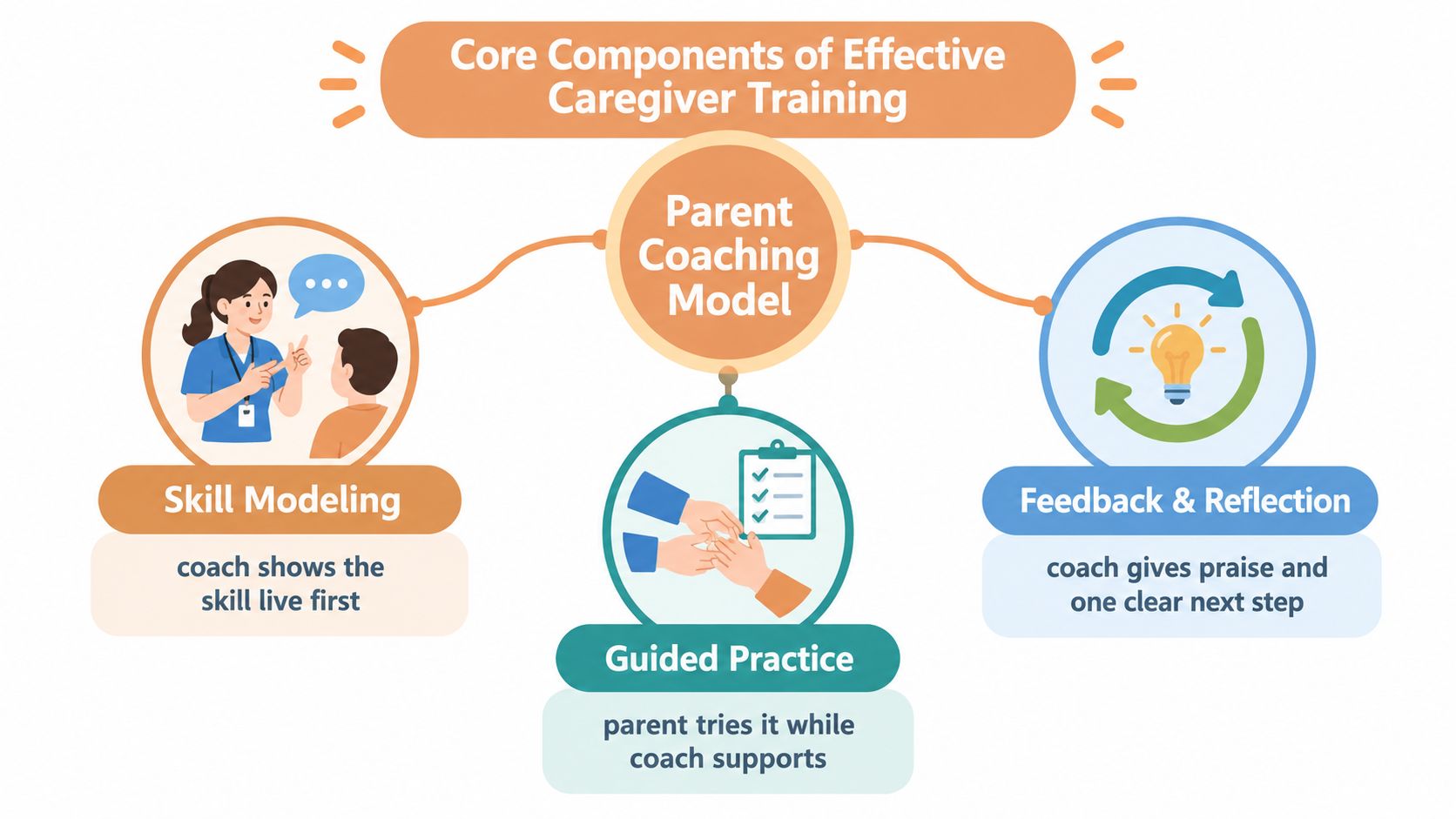
Skill modeling
First, the clinician demonstrates the strategy. Suppose the goal is helping your child request a break during a difficult homework routine. The coach may show how to present a simple choice, wait briefly, recognize an attempt, and honor an appropriate break request.
You're watching for the small details:
- Timing: When does the adult offer help or pause?
- Prompting: What level of assistance supports the child without taking over?
- Reinforcement: How does the adult respond when the child tries?
- Flexibility: What happens if the child is tired, distracted, or uninterested?
The point isn't to copy every movement perfectly. It's to see the strategy in context and understand why each step matters.
Guided practice
Next, you take the lead while the coach stays close. You might practice during a game, getting dressed, or preparing a snack. The coach can offer a quiet reminder, model a phrase, or help you change the setup so your child has a realistic opportunity to respond.
This resembles learning to cook a new recipe. Reading the instructions helps, but confidence grows when someone stands beside you, points out what the mixture should look like, and helps you recover if you add an ingredient too soon. You're developing judgment, not memorizing a script.
For families who want to understand how skill-building fits into ABA, behavioral skill training offers a related explanation of how demonstration, practice, and feedback can support learning.
Feedback and reflection
Feedback should be clear, respectful, and useful. A coach may point out that your child responded more quickly when you reduced the number of spoken instructions, then suggest one next step for the following practice opportunity.
Provider behavior matters here. In an early-intervention review, 25 sessions were coded, and the providers showed low overall use of coaching techniques, often relying on only a few elements such as collaboration and in vivo feedback. The finding reinforces an important principle from the provider practice review: effective coaching depends on specific and consistent behaviors, not broad encouragement alone.
A productive session ends with shared reflection. What felt easy? What felt awkward? What might work better during your actual morning routine? Those answers help the clinician individualize the plan instead of handing every family the same set of instructions.
How Coaching Helps Skills Transfer to Daily Life
At therapy, a child may request a favorite toy from one adult. At home, the same child may need to ask a sibling for a turn, request help at dinner, or communicate “all done” during a busy routine. A skill can be present in one setting and still need support in another. In ABA, this process is called generalization: using a learned skill with different people, materials, places, or routines, as shown in this example of generalization.
A therapy table offers clear materials and a therapist who is ready to respond. Home includes siblings, background noise, changing expectations, and several tasks happening at once. Parent coaching helps the family practice useful skills within those ordinary conditions, so the skill becomes part of daily life rather than something tied only to treatment.
Learning where the skill matters
The day already contains many natural practice opportunities:
- Mealtime: Requesting more food, choosing between two options, or indicating “all done.”
- Bath time: Following a short sequence, tolerating a transition, or asking for help.
- Play: Taking turns, sharing materials, imitating an action, or responding to a sibling.
- Community routines: Waiting briefly, staying near a caregiver, or communicating a need in a store.
- School preparation: Checking a visual schedule, gathering belongings, or asking for assistance.
A caregiver does not need to turn every moment into a lesson. Coaching helps the family notice when a useful opportunity appears and respond in a way that supports communication, independence, and participation. A request during breakfast or a brief wait before leaving can matter as much as a planned practice activity.
Research supports this practical focus. A 2021 systematic review and meta-analysis identified 30 randomized controlled trials with 1,934 participants. It found a clinically relevant effect on parent-rated adaptive functioning, measured with the Vineland Adaptive Behavior Scales, with a standard mean difference of 0.28. It also suggested a somewhat smaller effect on core autism symptoms, with an SMD of -0.35, as reported in the systematic review. These results highlight that daily functioning and parent-child interaction can improve even when symptom change is not the only or strongest outcome.
Why caregiver implementation matters
A clinic can introduce a skill, but children spend much of their time at home, school, and in the community. Caregivers who know how to support that skill across settings give the child more chances to practice, maintain, and use it independently.
A large RCT-based meta-analysis reported 51 effect sizes from 2,895 children and found moderate overall benefits for parent-implemented interventions, with an overall g of 0.553 and g of 0.47 in lower-bias studies. Gains were concentrated in positive behavior and social skills, reductions in maladaptive behavior, and language and communication. Improvements in adaptive behavior were smaller, as reported in the meta-analysis of parent-implemented interventions.
These findings do not promise that every routine will change quickly. They explain why coaching is a collaborative part of care, not a task added to an already full schedule. With support, families can turn familiar routines into repeated, manageable opportunities for learning.
What a Typical Coaching Session Looks Like
An in-home coaching session may feel more like a guided conversation and shared activity than a formal evaluation. The clinician works with your family's priorities, the child's interests, and the rhythm of the day.
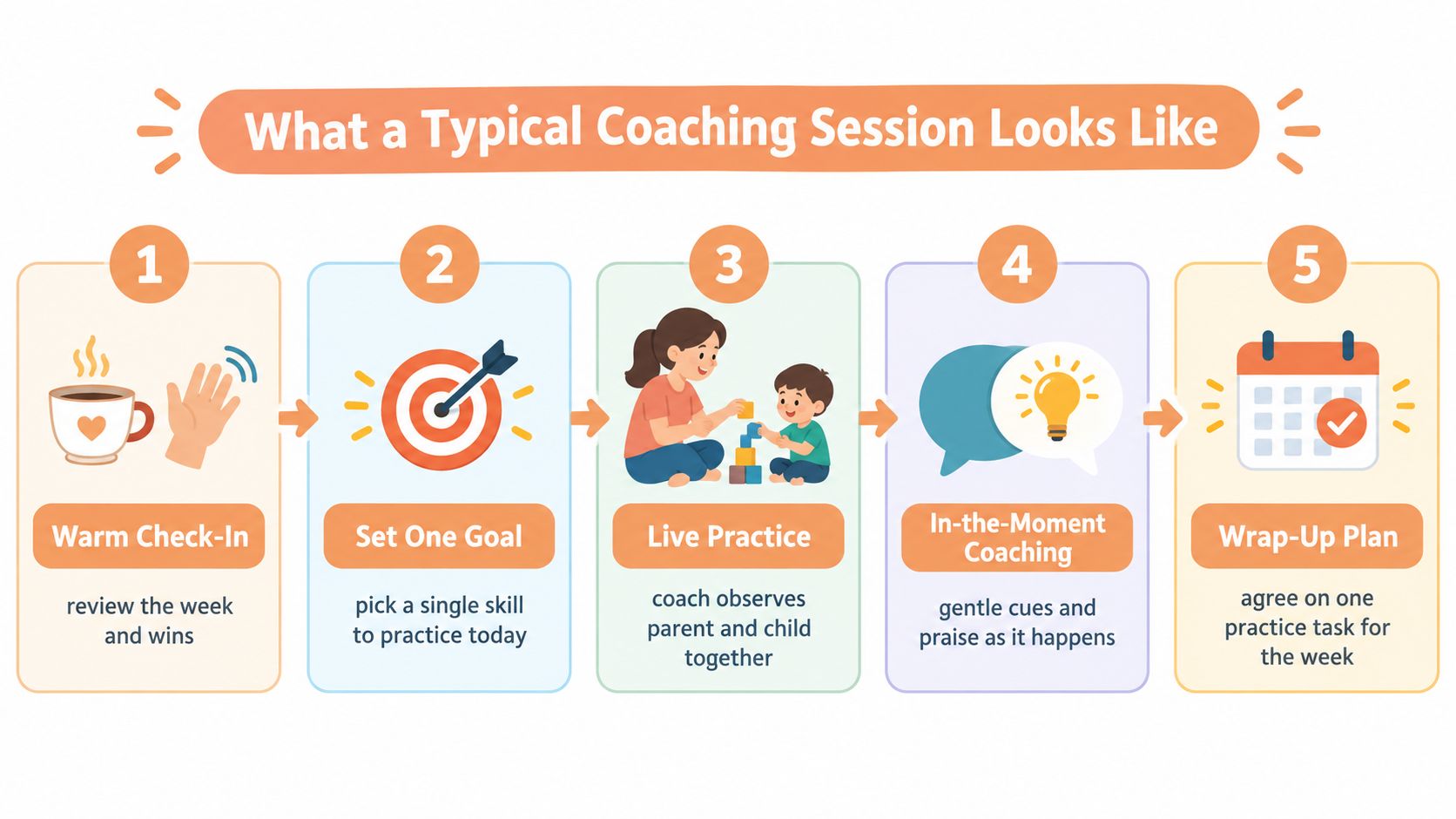
Starting with the family's week
The coach may begin by asking what went well, where the routine felt difficult, and whether anything changed at home or school. You might mention that your child requested help during breakfast but struggled to transition away from a tablet before bed.
That information guides the session. Rather than practicing a skill that feels disconnected from your current needs, you and the clinician choose one manageable priority.
Choosing one practical goal
The goal might be helping your child communicate “break” during a challenging activity. It might involve following a short bedtime sequence or waiting for a turn during a favorite game. One focused goal gives everyone a clearer way to notice progress without making the session feel overloaded.
The clinician may first model the strategy during play. Then you try it while the coach observes, offers a brief cue when needed, and highlights what your child responds to. If the approach creates frustration, the coach can help simplify the task or choose a better moment.
A randomized controlled study of Early Start Denver Model parent coaching involved 98 children and used 1 hour of daily parent training over 12 weeks. The study found better parent interaction skills and stronger child developmental gains across receptive and expressive communication, social capacity, imitation, cognition, play, motor skills, behavior, and personal independence in the published study. The findings support active caregiver participation, while individualized clinical guidance remains important.
Ending with a realistic plan
Before the session ends, the coach and parent identify what to practice between visits. The plan might be using the same communication prompt during snack, offering a visual sequence before bath, or creating one brief turn-taking opportunity during play.
The clinician may also explain how to record observations. Some families use a simple note on their phone, while others use structured ABA data sheets when the care team recommends them.
For families using telehealth, the structure can still include demonstration, practice, and feedback. A telehealth study involving 41 parents of children ages 2 to 18 reported significant improvement in social-communication skill domains after a 12-week intervention, with a Cohen's d effect size of .49, and found gains in some non-targeted areas such as behavioral rigidity in the study report.
Addressing Common Concerns About Family Stress
Many parents hear “parent coaching” and think, “I already have too much to do.” That concern deserves a direct answer. Coaching shouldn't be another standard to meet or evidence that you're parenting incorrectly.
The right approach starts with your family's capacity. If mornings are chaotic, a clinician may recommend practicing during a calmer routine rather than asking you to add a demanding home program before school. If a child is sick, a caregiver is exhausted, or the week has been unusually difficult, the plan can change.
Support without overpromising
Parent coaching can make routines feel more predictable by giving adults a shared response to common situations. It may help caregivers recognize what a child is communicating, offer choices more effectively, or break a difficult task into smaller steps. Those supports can be useful, but they don't guarantee that family stress will disappear.
A 2025 review noted that caregiver-led interventions often improve skills, knowledge, engagement, and self-efficacy. However, a summary of a 2021 meta-analysis reported only small average gains in confidence and mental health, with no pooled improvement in caregiver burden, family adjustment, physical health, or stress, as described in the review of caregiver-led interventions. Honest care makes room for both possibilities: coaching may provide practical help, and families may still need additional emotional, educational, or community support.
Coaching should make your next step clearer, not make you feel responsible for solving everything alone.
Including every caregiver
Families often wonder whether a parent coaching model is equally useful for fathers, grandparents, foster caregivers, and other adults who share daily responsibilities. The available evidence on fathers remains especially limited. A 2025 systematic review found only 5 eligible studies on father inclusion in parent-coaching interventions for young autistic children, with just 2 fathers represented across 94 parent-child dyads, according to the review presented by the Association for Behavior Analysis International.
That gap shouldn't be interpreted as a reason to exclude fathers or assume they won't benefit. It's a reason to invite each caregiver into the process and ask what participation looks like for them. One adult may practice during breakfast, another during evening play, and a grandparent may use the strategy during weekend visits.
Your care team should also listen when coaching feels burdensome. Adjusting the plan is part of partnership, not a sign that your family isn't committed.
Practical Tips to Maximize Your Coaching Experience
Parent coaching becomes more manageable when practice stays small, specific, and connected to routines you already have. You don't need a perfect week to make useful observations.
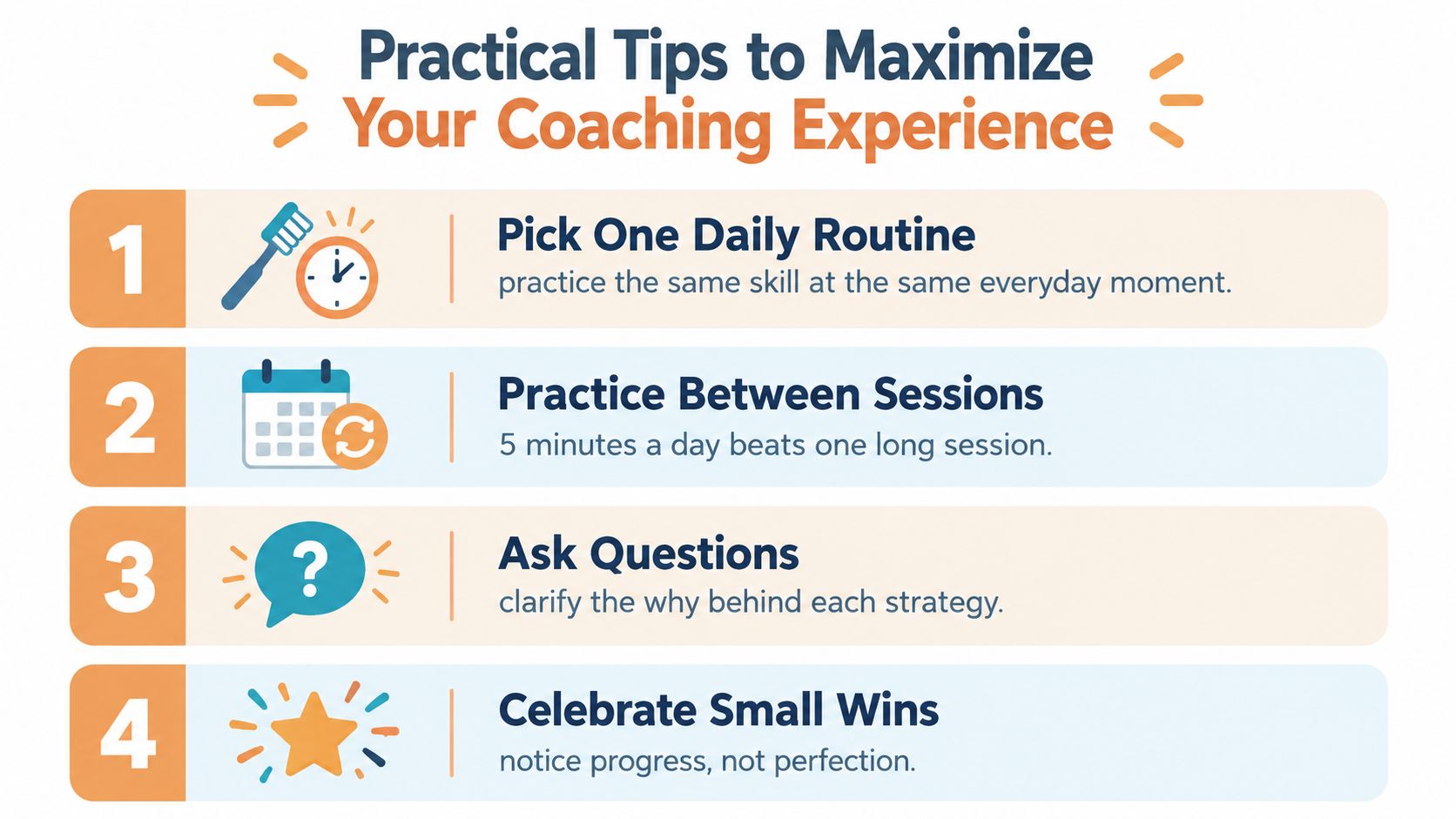
Pick one daily routine
Start with a moment that happens regularly, such as brushing teeth, putting on shoes, serving a snack, or beginning homework. A familiar routine gives you repeated opportunities to notice what your child can do and where support may help.
Choose one skill within that routine. For example, don't try to improve every part of bedtime at once. You might focus first on helping your child follow the first step of a visual sequence or request assistance with pajamas.
Practice briefly between sessions
Short practice can fit more easily into family life than a long, formal exercise. You might pause during play to offer a choice, create a turn-taking opportunity, or wait for a communication attempt before helping.
If practice repeatedly ends in distress, stop and share that information with the clinician. The team may need to change the prompt, reduce the demand, adjust the materials, or choose a different routine.
Ask why
You deserve to understand the purpose of a strategy. Ask questions such as:
- Goal: What skill are we building, and how will it help during daily life?
- Prompt: How much help should I provide, and how can I gradually reduce it?
- Response: What should I do if my child communicates in a different way?
- Adjustment: What signs tell us that this routine is too difficult right now?
Clear explanations make it easier to use a strategy consistently and to recognize when it needs individual modification. A supportive clinician won't dismiss questions as resistance.
Record what you notice
A simple note can capture the routine, what happened before the behavior, how your child responded, and what you tried. You don't need to write a clinical report. A sentence such as “asked for help after I showed the picture and waited” may be enough to guide the next conversation.
Celebrate progress that others might miss. A child who points instead of pulling, waits a little longer, accepts one step of a routine, or returns to play after a difficult moment is showing meaningful growth. Consistency matters, but perfection isn't the requirement.
Small-win practice: Notice one new attempt, one easier transition, or one moment of shared engagement, then tell the care team about it.
Building a True Partnership for Your Child's Growth
The parent coaching model works best when clinical knowledge and family knowledge meet in the middle. A clinician may understand reinforcement, prompting, communication supports, and behavior plans. A caregiver understands the child's interests, history, sensory preferences, relationships, and real schedule. Effective treatment uses both forms of knowledge.
That partnership should shape the goals. A family may prioritize requesting help during meals, participating in classroom routines, playing with siblings, or becoming more independent with dressing. Another family may need support around transitions, community safety, or communicating with school staff. An individualized plan respects those differences instead of treating every child or household as if they has the same needs.
What high-touch support can look like
A responsive provider makes communication part of care, not an afterthought. Families may benefit from:
- Individualized treatment planning: Goals reflect the child's abilities, preferences, routines, and family priorities.
- A dedicated care coordinator: One consistent point of contact helps the family understand next steps and coordinate questions.
- Proactive communication: The team shares updates, checks for barriers, and responds before small concerns become major frustrations.
- Regular progress conversations: Caregivers have a clear opportunity to review what's changing and what needs adjustment.
- Coordination across settings: Home, school, community, and clinical supports work from compatible priorities when appropriate.
These features don't remove the uncertainty that can come with a new diagnosis or a changing family routine. They can make the process easier to manage because you know who to contact, what the current priority is, and how your observations inform treatment.
You also don't have to accept a strategy that doesn't fit your family. Tell your care team when a goal feels unimportant, a routine is too demanding, or your child communicates progress in a way the plan hasn't captured. Asking for clarification is a sign of active participation.
Parent coaching isn't about placing therapy responsibility on parents. It's about helping the adults who know and love the child most use practical support during real life, with guidance from a qualified care team. The most meaningful gains may begin with an ordinary moment, a request at snack time, a calmer transition, or a child joining a family activity for a little longer.
Friendly ABA Premier offers home-based ABA therapy, social skills development, school support, and parent coaching across Connecticut, Georgia, Maryland, Massachusetts, North Carolina, South Carolina, Virginia, and Washington. If you're looking for individualized goals, a dedicated care coordinator, and proactive communication around everyday routines, visit Friendly ABA Premier to schedule a consultation or talk with the team about your family's needs.
Our Latest Insights














































Experience ABA Therapy with a More Personalized Level of Support
Discover how FriendlyABA Premier combines evidence-based ABA therapy with dedicated coordination, proactive communication, and individualized family support.