


Parent Coaching Services: A Family Guide
Discover how parent coaching services integrate with ABA therapy to build everyday skills. Learn what to expect, what to ask, and how to find the right fit.


You've just come home from an appointment with a notebook full of terms, goals, and recommendations. Your child is already managing a busy day, and you're wondering how any therapy strategy is supposed to fit between breakfast, school preparation, sibling needs, and bedtime. You want to help, but you don't want home to feel like another clinic.
Parent coaching services can connect professional guidance with the routines your family already lives. The right support doesn't ask you to become an amateur therapist. It helps you understand what your child is working on, practice a few useful strategies, and receive feedback so those strategies feel realistic and respectful.
Table of Contents
Moving From Overwhelm to Everyday Confidence
A parent might begin with a simple question: “What should I do when my child reaches for a snack but can't tell me which one they want?” The answer may involve offering a choice, waiting briefly, modeling a word or gesture, and responding warmly to an attempt. That sounds manageable when it's connected to snack time. It can feel much less manageable when it's buried under unfamiliar clinical language.
Coaching becomes practical here. A clinician might observe the routine, ask what usually happens, demonstrate one approach, and help you try it while your child is comfortable. The focus stays on a useful moment in your day, not on performing perfectly.
A helpful shift: Parent coaching isn't about adding therapy to every minute. It's about making ordinary moments more supportive and easier to understand.
High-quality coaching starts with your family's priorities. Perhaps mornings are difficult because getting dressed leads to frustration. Maybe your child communicates clearly during play but struggles to request help. You might want support with transitions, mealtimes, homework, community outings, or bedtime. These concerns give the care team a starting point for individualized goals.
Parent coaching also recognizes that caregivers have different schedules, strengths, and limits. A strategy that works beautifully for one household may be too complicated for another. A family-centered provider adapts the plan, checks whether it fits, and makes adjustments instead of treating difficulty as a lack of effort.
The process can build more than a child's skills. The structured chain of jointly setting goals, clinician modeling, and feedback is intended to change caregiver behavior first, then support child outcomes. Research connects this approach with gains in cognitive ability, social functioning, behavior, and adaptive skills, along with higher parental self-efficacy and treatment engagement in a review of parent coaching in autism early intervention.
You don't need to have every answer before coaching begins. You need a team willing to listen, explain the “why,” and help you find the next doable step.
What Parent Coaching Actually Involves
The phrase parent coaching can mean different things. Some services use it for informal advice, while clinical programs may use it for structured parent training in behavior management. That inconsistency can leave families unsure about who provides the service, which methods are used, how sessions are organized, and whether insurance covers them.
A useful distinction is structure. Evidence-based coaching generally follows a planned process rather than offering disconnected tips. The provider should be able to explain the goals, the intervention approach, the caregiver practice expected between sessions, and how progress will be reviewed.
The coaching cycle
A typical session may include four connected parts:
- Choose a shared goal. You and the clinician identify a routine that matters to your family, such as requesting a break during homework.
- Connect the goal to a strategy. The clinician explains what to do, when to do it, and what your child may communicate through words, gestures, pictures, or actions.
- Model the approach. The clinician demonstrates the strategy during play or a daily routine so you can see the timing and tone.
- Practice with feedback. You try the approach while the clinician offers supportive, real-time guidance. The team then discusses what felt natural and what needs changing.
This cycle matters because reading about a strategy isn't the same as using it during a rushed morning. Feedback helps you notice small details, such as whether you gave enough time for a response or whether the task had too many steps.
The parent coaching and training guide can help families compare coaching with more traditional parent-training language. Ask providers whether their approach is manualized, meaning it follows a defined protocol, while still allowing individualized adjustments.
In-person and virtual options
Coaching may happen in your home, in another setting, or through telehealth. Virtual delivery can be useful when transportation, scheduling, or local provider availability creates barriers. A study of early autism intervention found no statistically significant difference in coaching fidelity between in-person and tele-intervention sessions for measured strategies such as collaboration and using daily routines, suggesting telehealth can preserve fidelity in those areas in that study.
Coverage still depends on your plan, location, and provider arrangement. Before starting, ask for a clear explanation of eligible services, documentation, caregiver participation, authorizations, and any costs that may apply.
How Coaching Integrates With In-Home ABA Therapy
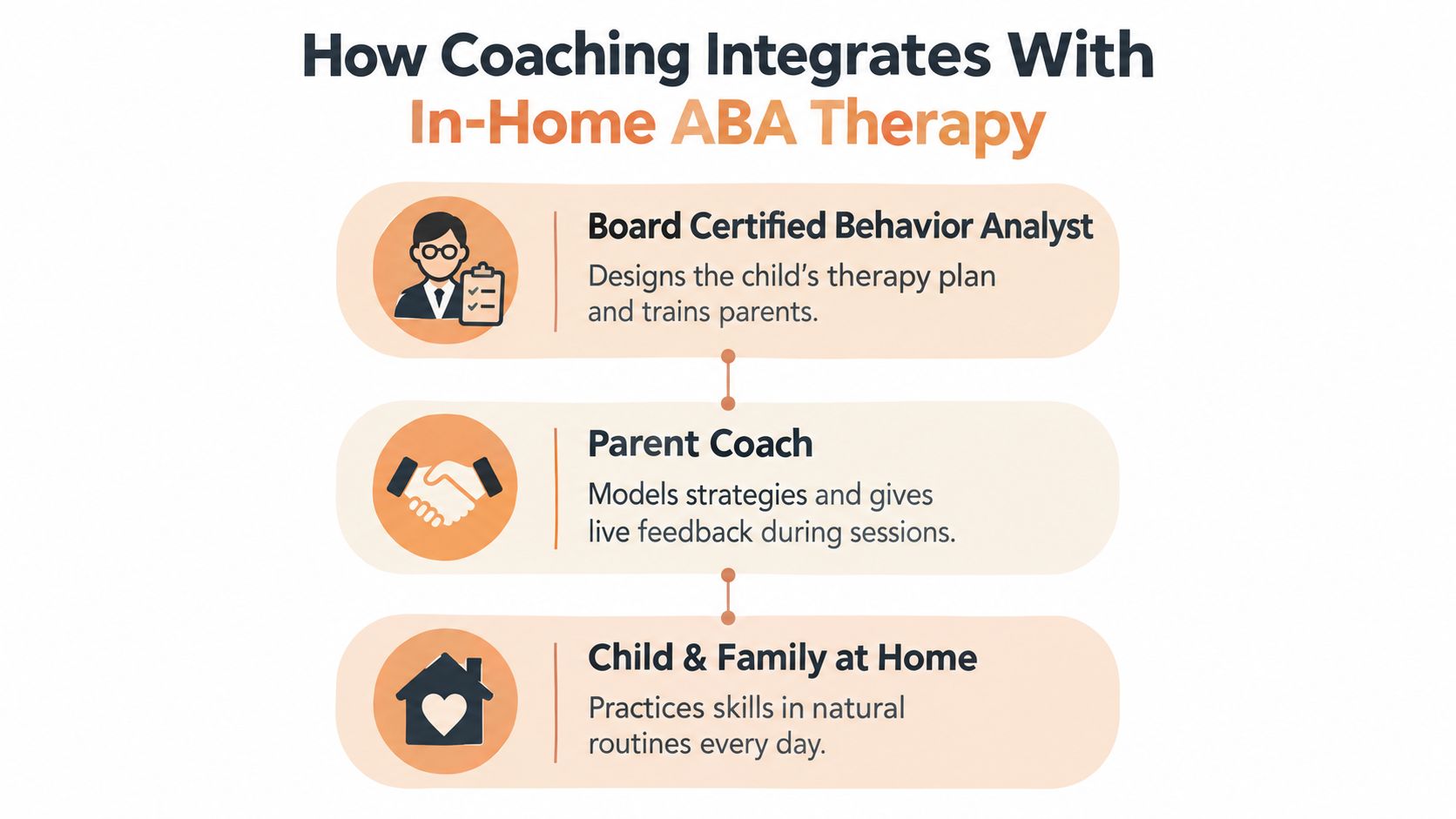
In-home ABA therapy works best as a coordinated service, not as a series of disconnected visits. The behavior analyst develops and oversees the treatment plan, the direct therapist works with your child on selected goals, and the parent coach helps translate those goals into everyday interactions. A dedicated care coordinator can connect the pieces so your questions and observations don't get lost.
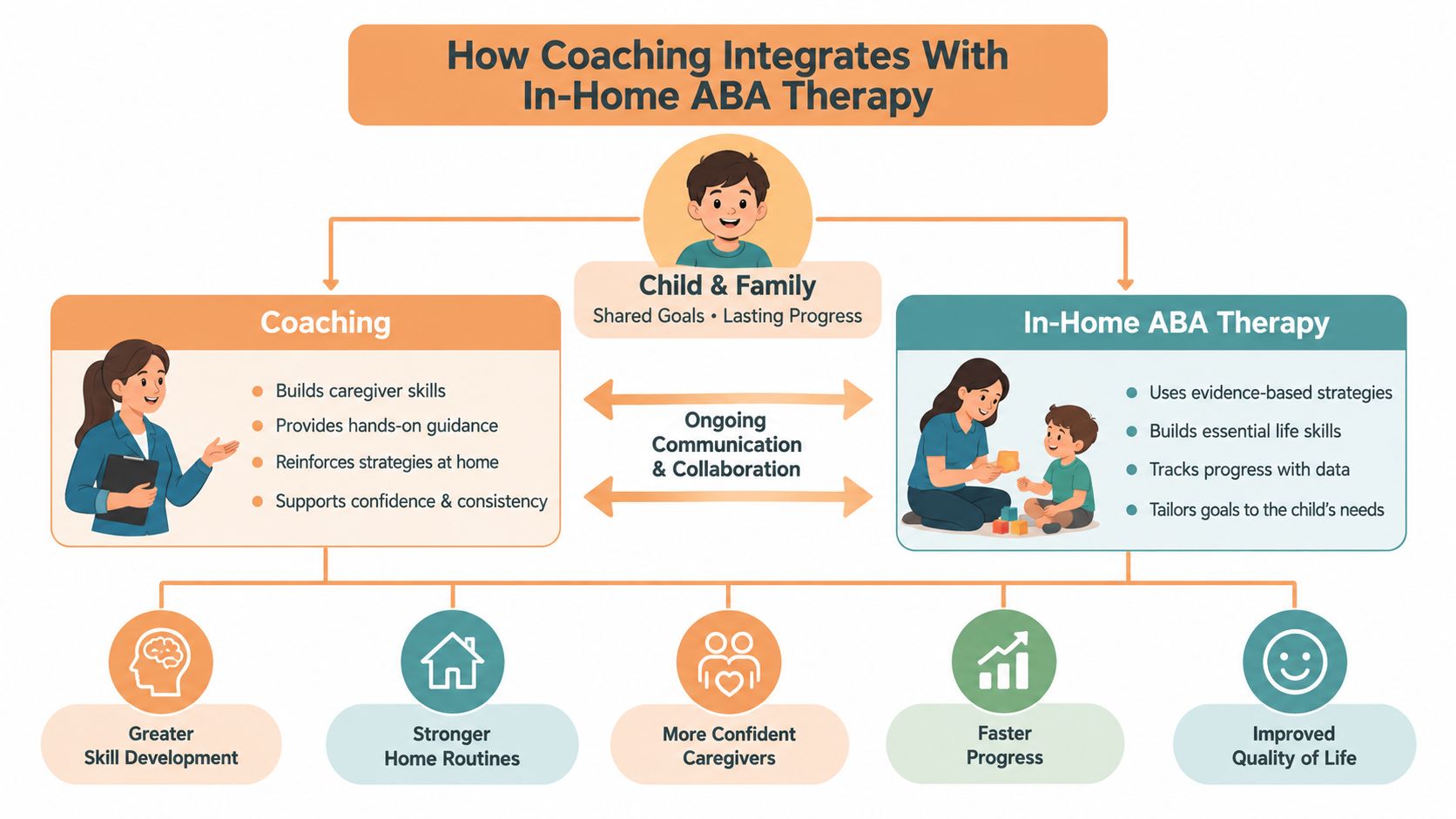
Consider a child practicing functional communication during a therapy visit. The therapist may work on requesting help with a preferred activity. During coaching, the parent and clinician can decide how that same skill might appear while opening a lunch container, choosing clothing, or asking for assistance with a toy.
Who does what
The supervising clinician designs goals, reviews data, and makes clinical decisions. Families should be able to ask how a goal connects to their child's needs and how the team will know whether the approach remains useful.
The direct therapist creates learning opportunities with the child. In a home setting, those opportunities can happen during play, routines, and transitions rather than only at a table.
The parent coach models strategies and watches you practice. Coaching should feel collaborative, with room to discuss what your child is communicating and what you can realistically repeat.
The care coordinator supports communication across the team. This person may help schedule check-ins, gather family feedback, clarify next steps, and make sure concerns reach the appropriate clinician.
That coordination is especially important when progress is uneven. A child may use a new request during therapy but not at the grocery store. Instead of labeling the skill as absent, the team can examine the setting, materials, prompts, timing, and motivation, then adjust the plan.
The in-home ABA therapy overview offers additional context about how services can fit into natural home routines.
A brief visual can help families see the relationship among these roles.
Look for proactive communication rather than waiting until a problem becomes urgent. A high-touch model includes scheduled progress conversations, individualized treatment planning, and a clear person to contact when a routine isn't working. That partnership helps families remain informed without requiring them to manage the entire care system alone.
Real-World Examples of Coaching in Daily Routines
A coaching strategy becomes meaningful when it helps with something your family really does. The same communication goal can look different at breakfast, during a favorite game, or while leaving the house.
At mealtime, a coach might help you offer two acceptable choices instead of asking an open-ended question. You could hold up yogurt and toast, wait for a word, gesture, picture, or reach, then acknowledge the choice and provide the selected item. The clinician may help you adjust the wait time, reduce unnecessary questions, or notice which form of communication your child uses most comfortably.

Small routines, meaningful practice
During play, the goal might involve shared attention. If your child loves a wind-up toy, you could pause before activating it, look toward your child, and respond to a glance, gesture, sound, or word. The coach can show you how to follow your child's interests instead of interrupting play with constant demands.
Transitions often need a different plan. Before leaving the playground, you might use a visual cue, give a predictable warning, offer a small choice about the next step, and practice a consistent way to request “more time” or “help.” The objective isn't to eliminate every difficult moment. It's to give your child and your family more ways to understand what comes next.
Homework can provide another opportunity. A coach may help break the assignment into manageable parts, identify when your child needs a break, and reinforce asking for assistance. The strategy should fit the child's learning style and the family's evening rhythm.
Natural environment teaching means learning opportunities occur in settings that matter to your child. That might include getting dressed, preparing a backpack, playing outside, or visiting a store. The guide to doing ABA therapy at home can support families who want to understand how home routines may become practice opportunities.
Keep the target small: One routine, one strategy, and one observable response are often easier to sustain than a long list of instructions.
Your coach should also help you decide when not to practice. Families need downtime, flexibility, and room for connection that isn't organized around a goal. A sustainable plan respects caregiver energy and treats your relationship with your child as central.
Evaluating Programs and Asking the Right Questions
A warm consultation is helpful, but families also need specific information. Parent coaching services should be clear about who provides coaching, how the clinician is supervised, what happens during sessions, and how the program measures progress.
Ask for examples. If a provider says coaching will improve communication, ask what that might look like during breakfast or play. If the provider mentions consistency, ask how the team will support you when a strategy doesn't fit your schedule.
| Question to Ask | What a Strong Answer Looks Like |
|---|---|
| Who will coach me? | The provider explains the coach's role, qualifications, clinical supervision, and relationship to the treatment team. |
| Is the approach structured? | The team describes an evidence-based or manualized protocol, while explaining how goals are individualized. |
| What happens in a session? | You receive a clear description of goal-setting, modeling, caregiver practice, feedback, and follow-up. |
| How is progress measured? | The provider identifies observable goals, explains how information is collected, and shares updates in language families can understand. |
| How will this fit our routines? | The coach asks about meals, sleep, school, play, transportation, caregiver availability, and priorities before recommending strategies. |
| What happens when a strategy isn't working? | The team reviews what happened, considers fidelity and context, and adjusts the plan without blaming the family. |
| Is telehealth available? | The provider explains technology needs, privacy, caregiver participation, and how virtual sessions differ from home visits. |
| What does insurance cover? | Staff explain authorizations, covered services, documentation, and questions to ask your insurance plan. |
Green flags and warning signs
Strong programs use specific language. They can explain the protocol, describe realistic outcomes, and tell you how your feedback changes the plan. They also discuss caregiver burden, because a strategy that requires more time or preparation than your household can manage won't be sustainable.
Be cautious about promises that guarantee a cure or a particular result. Also ask questions when a provider offers only broad statements such as “we'll teach you everything” without describing the session structure, supervision, progress measures, or billing process.
A dedicated care coordinator can make these details easier to manage. For example, Friendly ABA Premier pairs parent coaching with a family coordinator and clinical team, offering practical recommendations, progress conversations, and guidance matched to home routines. It's one model families may compare with other providers in their area.
Understanding the Evidence Behind Parent-Mediated Support
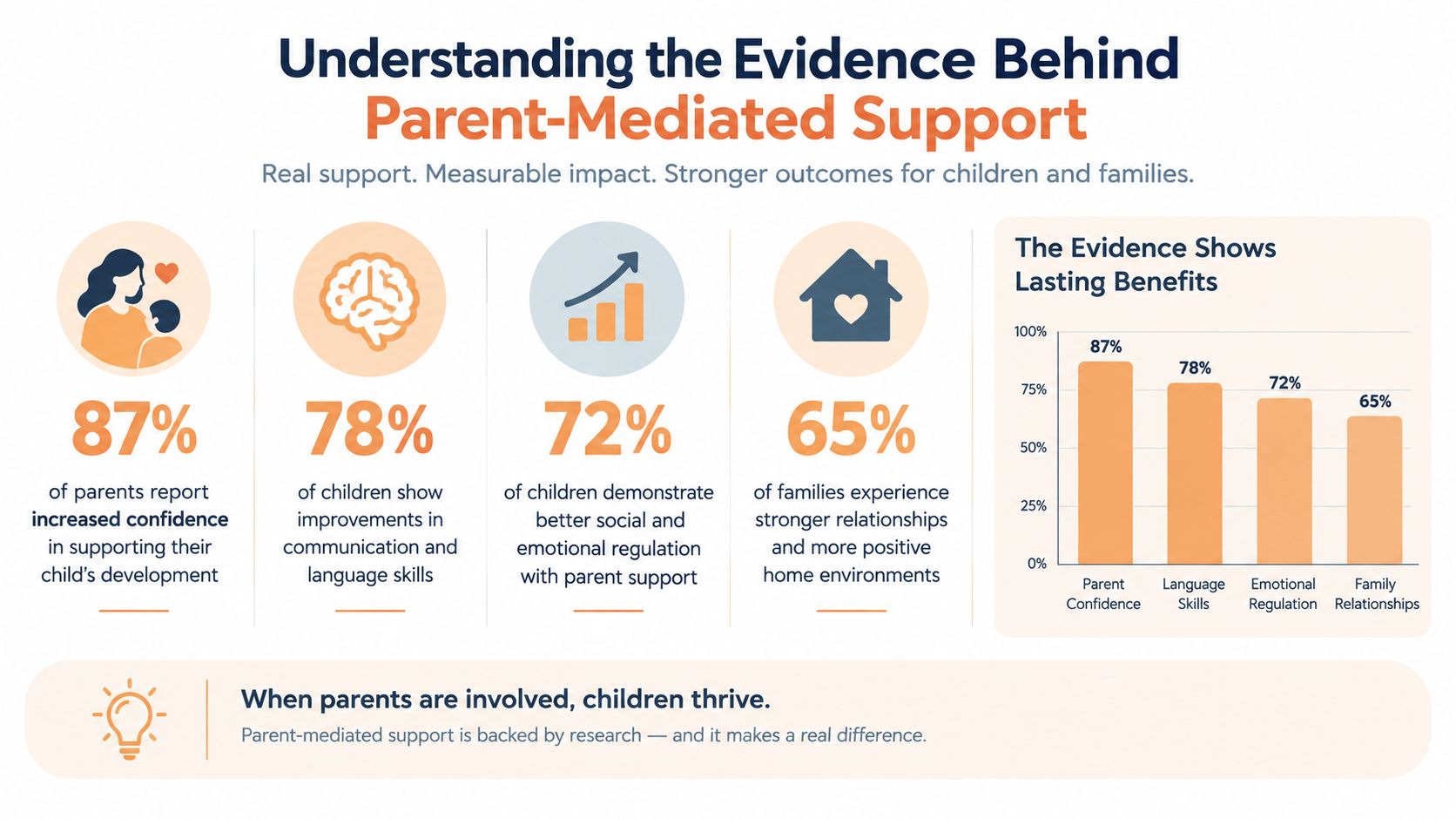
Parents deserve an honest answer to the question, “Does this help?” The evidence supports parent-mediated intervention as a useful approach, but findings vary by outcome, program, comparison group, and study quality. Coaching can support progress without promising that every child or family will experience the same change.
A 2022 meta-analysis pooled 51 effect sizes from randomized controlled trials involving 2,895 children. It found an overall benefit of g = 0.553, with lower-bias studies still showing positive effects at g = 0.47. Subgroup results included positive behavior and social skills at g = 0.603, language and communication at g = 0.545, maladaptive behavior at g = 0.519, and adaptive behavior or life skills at g = 0.239 in the published analysis.
Other reviews add important context. A 2018 meta-analysis of 19 randomized clinical trials involving children ages 1 to 6 found small average benefits across areas. Weighted Hedges' g ranged from 0.18 for communication-language to 0.27 for socialization, with an overall average of 0.23. The analysis also reported no significant differences by treatment dose and no significant difference between parent training and treatment as usual compared with active-control comparisons as reported in the PubMed record.
A 2021 systematic review and meta-analysis examined 30 randomized controlled trials with 1,934 participants. It found a clinically relevant improvement in parent-rated adaptive functioning on Vineland scales, with SMD 0.28 and a 95% confidence interval from -0.01 to 0.57, but no clinically relevant effect on clinician-rated functional level. It also found no identified effect on parent-rated core autism symptoms, parental well-being, or adverse effects in the review.
What the research means at home
A controlled randomized study of parental involvement in the Early Start Denver Model used a 12-week program with about one hour of daily parent training and reported improved parent interaction skills and stronger child developmental gains. A 2024 study also found that brief parent coaching in Pivotal Response Treatment improved parents' strategy use and children's responsiveness to language opportunities as summarized in the research report.
These findings support hopeful, measured expectations. Coaching may help families build communication, social participation, adaptive skills, and practical routines, but research hasn't established reliable long-term effects on quality of life for autistic children and families. Your care team should discuss durability, caregiver effort, fidelity, and which outcomes matter most to your household.
Taking the Next Step With Confidence
Choosing parent coaching services doesn't mean you've failed to support your child. It means you're looking for a clearer way to work together. The strongest programs respect your knowledge of your child, explain clinical decisions in plain language, and adapt strategies to the routines you can actually maintain.
Start with one concern that affects daily life. Write down what happens before, during, and after the difficult moment. Note what your child already does successfully, including gestures, sounds, words, movements, or ways of seeking connection. This information can help a provider understand strengths as well as support needs.
A manageable beginning
During an initial conversation, you can ask:
- What matters to our family: Can we begin with a routine we want to make easier?
- How we'll work together: Who will answer questions and communicate progress?
- What practice looks like: What would we try between sessions, and how much time might it take?
- How we'll measure change: Which observable skills will we track, and how often will we review them?
- What flexibility means: How will the plan change if our schedule, setting, or child's interests change?
You're also allowed to ask for time before making a decision. Compare providers based on communication, clinical clarity, caregiver respect, availability, insurance information, and whether the proposed plan feels appropriate for your child and household.
Progress may look like a clearer request, a smoother transition, more shared play, or a child finding a reliable way to ask for help. Those everyday wins deserve attention, even when development doesn't follow a straight line.
A dedicated care coordinator can help keep the process connected by organizing communication, gathering your observations, and making sure your priorities remain part of the plan. With individualized support, parent coaching can become a practical partnership rather than another source of pressure.
Friendly ABA Premier offers home-based ABA therapy, social skills development, school support, and parent coaching across Connecticut, Georgia, Maryland, Massachusetts, North Carolina, South Carolina, Virginia, and Washington. To discuss routines, insurance questions, and available support with a care team, visit Friendly ABA Premier and start with a consultation.
Our Latest Insights












































Experience ABA Therapy with a More Personalized Level of Support
Discover how FriendlyABA Premier combines evidence-based ABA therapy with dedicated coordination, proactive communication, and individualized family support.