

What Is ABA Services: A Parent-Friendly Guide
What Is ABA Services. Learn what ABA services are in plain language. Discover home-based therapy, social skills, school support, and parent coaching

ABA services are an individualized, measurement-based approach that teaches communication, social, daily-living, and school skills through structured support at home and beyond. For children aged 26–49 months, one 2023 umbrella review found immediate improvements associated with ABA in expressive language, social communication, social functioning, and daily-living skills, while also finding important limits in the available evidence, including no long-term follow-up data for ABA specifically. The American Speech-Language-Hearing Association summarizes those findings here.
You may be reading this after a pediatric appointment, a school conversation, or a late-night search on your phone. You've heard terms such as BCBA, RBT, functional assessment, and parent coaching, but you may still be wondering what happens in a home, classroom, or clinic.
ABA isn't a fixed package of hours or a single curriculum. It's a way of building useful skills around a child's strengths, preferences, communication style, and everyday routines, with families and clinicians reviewing progress together.
Table of Contents
A Morning at Home Where ABA Already Begins
At the kitchen table, your child reaches toward a favorite cup. You know what they want, but they haven't asked for it yet. You pause, offer a gentle cue, and wait. Maybe your child points, uses a picture, signs, speaks, or tries another form of communication. You respond to that attempt and hand over the cup.
That small exchange contains the working idea behind Applied Behavior Analysis, or ABA. A child practices a meaningful skill, receives support when needed, and experiences a useful result. Over time, the team observes what helps, adjusts the support, and looks for that skill to appear in other routines.
ABA services commonly address communication, social interaction, adaptive or daily-living skills, school participation, and caregiver implementation. They aren't intended to treat autism as a disease or promise a cure. Instead, they focus on observable goals that can make daily life more accessible and connected. The CDC's overview of behavioral approaches and ABA describes this emphasis on teaching useful behaviors, reducing behaviors that interfere with learning, and tracking progress through measurement.
The plan starts with your family's priorities
One family might want help with requesting assistance during meals. Another might prioritize getting dressed, joining a sibling's play, tolerating a classroom transition, or communicating discomfort. The starting point should come from what matters in the child's real life, not from a standard list selected before anyone meets them.
That's why home-based ABA can look different from one family to the next. A therapist may join playtime, use a favorite activity to practice turn-taking, or support a morning routine where it naturally occurs. Families who want practical examples can explore how ABA therapy can be supported at home, while remembering that individualized guidance should come from the child's care team.
A useful question: “Which everyday moment would feel easier or more meaningful if my child had one additional skill?”
You don't need to understand every clinical term before an assessment. You only need to bring your observations, your questions, and your sense of what your child enjoys and needs.
The Building Blocks Behind Every ABA Plan
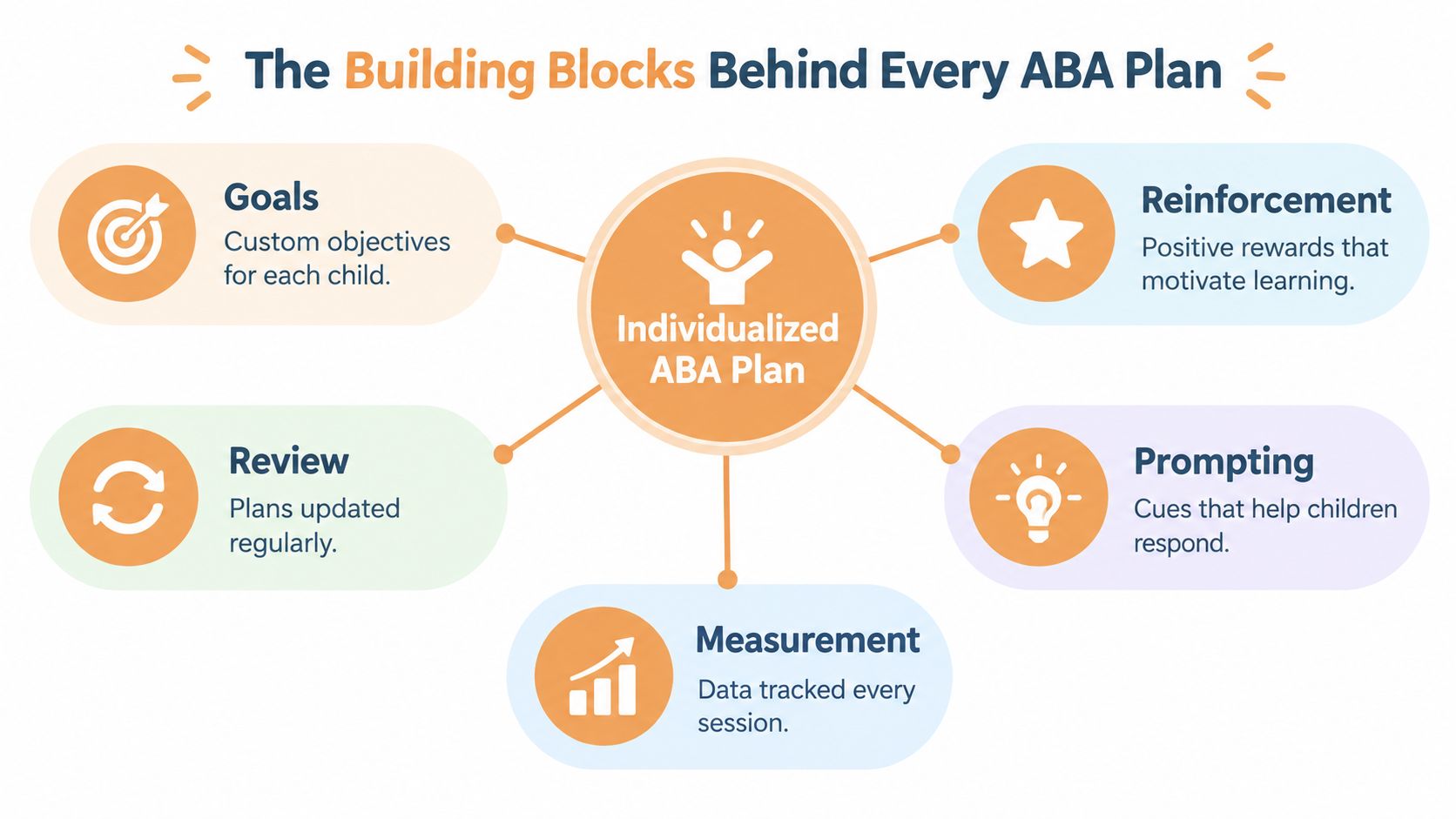
An ABA plan works best when it feels more like a shared map than a preset package. The clinician looks at a daily skill your family cares about, studies what happens before and after that moment, and then builds supports around real life. That structure matters because ABA is broader than one teaching style. The National Academies explains that 20 of the 28 focused evidence-based autism practices identified by NCAEP have an ABA origin, including parent-implemented, peer-based, and naturalistic interventions.
Five pieces families should recognize
Goals give everyone a clear target. A phrase like “improve communication” is too wide to guide a busy morning at home. “Request help during snack using speech, a sign, or an AAC device” is easier to picture, teach, and review with caregivers.
Reinforcement helps a new skill feel useful. If a child asks for a favorite toy and gets it right away, the request starts to make sense because it works. Families often worry this means bribery. In practice, it is closer to how all of us learn. We repeat actions that lead to something meaningful, especially when the connection is clear and respectful.
Prompting is short-term help, not a permanent crutch. A therapist might point to a picture, model a word, or show the first step in a routine. Then the team should plan how that help will fade so the child is doing more of the skill on their own.
Measurement keeps progress visible. The clinician may track how often a child asks for help, how many parts of a morning routine they complete independently, or how much support they still need. Those numbers describe performance in a specific activity. They are not a score of who a child is.
Review keeps the plan aligned with your family instead of forcing your family to fit the plan. If a strategy is not helping, the team should look at the results, listen to caregiver feedback, and adjust the goal, prompts, reinforcement, or setting. Outcomes can differ based on the child, the target skill, how the service is carried out, and how strong the research is for that approach.
Questions to ask a provider
Ask how each goal fits into routines your family already handles, and what work will fall to caregivers between sessions. Ask how progress will be explained in plain language, how often goals will be reviewed, and what happens if a target causes distress or stops matching your priorities.
Shared decision-making matters here. In the PLOS ONE study, a Canadian parent survey found that only 31.2% of respondents agreed that ABA goals aligned with their value systems, while 29.9% said ABA methods aligned with their values. Those findings are a useful reminder. A plan should be measurable, but it should also feel acceptable, realistic, and collaborative for the people living with it every day.
Services Families Actually Receive
A lot of families picture ABA as a therapist sitting at a table with flashcards for hours. Real services are usually more practical than that. They are built around the places your child already lives, learns, plays, and gets stuck, and they work best when everyone supporting the child is aiming at the same few priorities.
Home-based therapy
Home sessions often start with ordinary moments. A therapist might join your child on the floor during play, use a favorite toy to practice asking for help, or pause during a puzzle so your child can request the missing piece. The point is not to make home feel like a clinic. The point is to practice skills where they are needed.
That can include dressing, handwashing, mealtime, getting ready for bed, or moving from one activity to another. For many families, this is also where the partnership side of ABA becomes clear. A strategy may look simple when a clinician models it once. Using it during a rushed morning with siblings, work calls, and a child who is already tired is different. Good services account for that real caregiver workload.
Social skills development
Social learning can happen in small, low-pressure ways. A child may practice greeting someone, answering a question, sharing materials, waiting briefly, or asking to join an activity.
These goals should fit the child, not force the child into one narrow picture of what social behavior is supposed to look like. Some children communicate with speech, some with devices, some with shorter responses, and some need more time before joining in. ABA services should respect that.
School support
School support links therapy to classroom life. A clinician may coordinate with school staff around arrival, transitions, asking for assistance, participating in group activities, or handling peer interactions. That kind of coordination matters because children do not live in separate boxes called home, school, and therapy.
Autism identification is common enough that service planning often involves several adults at once, including families, educators, and clinicians, as described in CDC's surveillance report. The practical question for families is simple. How will these people stay on the same page?
Parent coaching
Parent coaching is a service, not an extra. A clinician might model how to support a request during snack, watch you try the same step, and then adjust it so it fits your routine and your values.
That matters because progress between visits often depends on what feels doable at home. Families should have room to ask questions, say when something is not working, and help choose goals that make daily life easier.
Look for connection: Ask how the provider shares goals, progress, and practical recommendations across the people supporting your child.
What the First Few Weeks Feel Like
The first visit usually begins with conversation, not a test your child has to pass. You'll likely describe communication, play, routines, strengths, preferences, challenges, and the moments when support already works. A clinician may observe your child during familiar activities and gather information for a functional assessment.

You can prepare by writing down a few routines that feel difficult and a few that already go well. Bring questions about communication methods, session settings, caregiver participation, school coordination, data sharing, and how the provider will respond if your child seems uncomfortable.
From observations to an initial plan
The clinician uses observations and caregiver input to define initial goals. A plan might focus on requesting help, following a morning-routine step, participating in a classroom transition, or joining a preferred play activity. The goal should be specific enough to observe and flexible enough to fit your child.
Early sessions often emphasize relationship-building. Your child may explore materials, play, watch the therapist, or participate briefly before longer teaching activities begin. That slower start can be valuable because trust and comfort affect learning.
What progress reviews sound like
A strong provider won't hand you a technical report. The team should explain what they're measuring, what the data suggest, and whether the strategy needs adjustment. You might hear, “Your child is requesting the cup more independently during breakfast, but still needs support when the routine changes.”
For a child who receives support across home, school, and community settings, the team should also ask whether a skill is appearing with different people and materials. The aim is not only success during a therapy session. It's useful participation in everyday life.
A short video can help families visualize how clinicians and caregivers may work together during treatment planning.
Feeling nervous at the beginning is common. You're learning new language while making decisions about your child. A responsive team should make room for uncertainty and explain the next step without making you feel rushed.
Insurance, Referrals, and the Paperwork Behind Services
Starting ABA often involves a referral, an evaluation, a treatment plan, prior authorization, and later progress reviews. The exact requirements depend on the insurer and state. A Louisiana Medicaid policy, for example, separates approval for a functional assessment and treatment-plan development from a later request for therapy services, illustrating why families may encounter more than one authorization stage. The Louisiana policy document provides that example.
Insurers may request diagnostic information, assessment results, measurable goals, requested services, progress reports, and documentation of caregiver training. Those requests help reviewers determine whether the proposed service is connected to identified needs, but they can still feel like a lot for a family already managing appointments and routines.
A practical division of responsibilities
| Step | Family, Care, Role | Provider Role |
|---|---|---|
| Referral and evaluation | Share records, observations, and priorities | Coordinate assessment and explain findings |
| Treatment planning | Review goals and provide consent or feedback | Write measurable, individualized goals |
| Authorization | Respond to requests for information when needed | Submit documentation and track status |
| Ongoing care | Attend agreed sessions and communicate changes | Collect data, review progress, and adjust care |
| Reauthorization | Share current concerns and priorities | Prepare progress reports and renewal materials |
Ask who will submit paperwork, who tracks renewal dates, and how you'll be told when an insurer requests changes. A dedicated care coordinator can reduce the number of calls and messages a parent must manage, especially when therapy overlaps with school, speech services, or other appointments.
Coverage questions can be confusing because “covered” doesn't always mean every service, setting, or hour is automatically approved. Families comparing plans may find it useful to review questions about underinsured insurance coverage, then confirm details directly with the insurer and provider.
Before enrolling, ask: “What paperwork will you handle, what will you need from me, and who will contact me before an authorization expires?”
Insurance should never determine the child's goals by itself. Clinical needs, family priorities, available resources, and the child's experience all belong in the conversation.
Why Parent Coaching Is a Core Service
Parent coaching is sometimes presented as an optional extra, but it's a formal ABA service. CPT code 97156 describes family adaptive behavior treatment guidance delivered face-to-face with a child's guardian or caregiver, with or without the child present, in 15-minute units. The Association for Behavior Analysis International's coding guidance describes this structure and notes that one major insurer's guidance specifies at least six parent or caregiver sessions every six months, with the first session within 30 calendar days of an initial or renewed treatment authorization.
That doesn't mean every family's plan follows the same rule. Insurance requirements differ, so your provider should confirm what applies to your plan. The larger point is that caregiver participation has a recognized place in treatment, rather than being an informal favor asked of parents.
Coaching should feel hands-on
During a session, a clinician might model how to prompt a request for help, practice a transition from play to cleanup, or support communication at mealtime. You then try the strategy while the clinician observes, offers feedback, and helps adapt it to your home.
A useful coaching session respects your time and capacity. It shouldn't assume that a caregiver can recreate a full therapy session after a long workday, nor should it leave you with vague instructions and no way to ask follow-up questions.
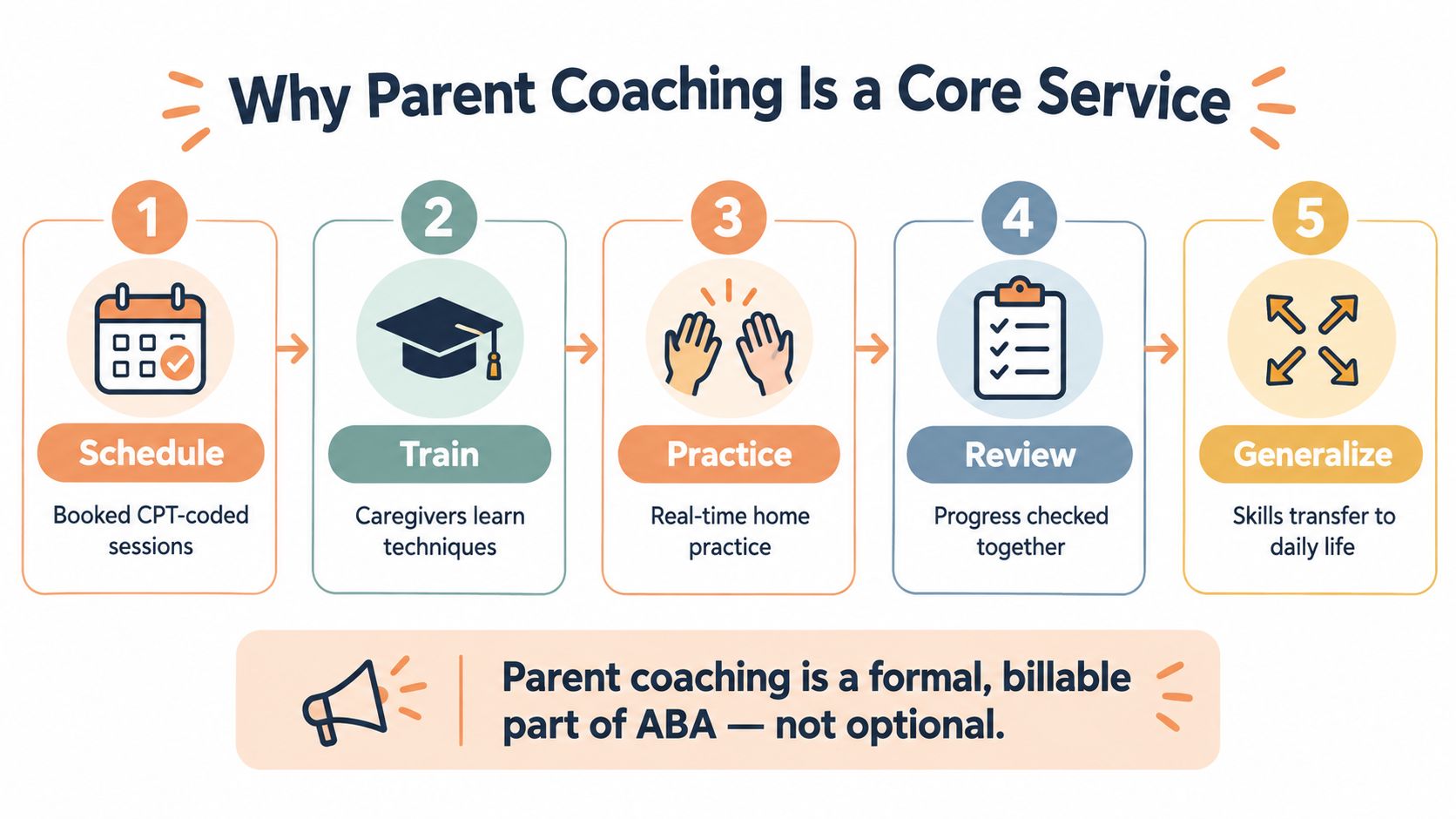
Ask how often coaching occurs, who attends, what you'll practice, and how recommendations are documented. You can also ask how the plan changes when a strategy doesn't fit your family's schedule. Parent coaching services should extend learning into daily routines while keeping the partnership manageable.
A 2025 qualitative study identified time constraints, financial demands, limited therapist interaction, access problems, stress, and burnout among parent concerns, as summarized in the Journal of Social and Educational Research article. Supportive coaching can help, but it shouldn't become another source of pressure.
A Partnership Approach to Getting Started
The start of ABA often looks less like choosing a fixed set of therapy hours and more like building a working relationship around your child's daily life. A strong plan reflects individualized goals, observable measurement, flexible teaching, and honest communication, but it also respects your family's values, energy, and routines. Your child is not fitting into a program. The service should fit your child and the people caring for them.
One helpful first step is simple. Write down two or three parts of the day that feel harder than they need to, such as getting dressed, leaving for school, or settling in for dinner. Then note what already goes well. Maybe your child asks for a favorite snack, enjoys music, or handles one transition better than another. That list gives the team a real starting point, and it helps you shape goals instead of receiving a generic set of recommendations.
As you talk with providers, ask clear questions. Who writes the treatment plan? How often is progress reviewed? What happens if a goal sounds right on paper but creates more stress at home? A good answer should include how caregivers take part, how skills are practiced across settings, and how communication happens when schedules, school demands, or family priorities change.
You also deserve support with the parts families rarely see discussed enough. Authorizations, scheduling, and caregiver follow-through all take time. Parent participation matters, but it should feel doable, not like a second full-time job.
Many families are starting this process, as noted earlier, which is one reason coordinated planning matters. Friendly ABA Premier provides home-based ABA therapy, social skills development, school support, and parent coaching in several states. Families who want to ask about individualized treatment planning and coordinated communication can visit Friendly ABA Premier.
Our Latest Insights













































Experience ABA Therapy with a More Personalized Level of Support
Discover how FriendlyABA Premier combines evidence-based ABA therapy with dedicated coordination, proactive communication, and individualized family support.