

What Are Successive Approximations in ABA Therapy
Discover what are successive approximations in ABA therapy and how this step-by-step shaping method helps children build communication and daily living skills.

You may already be using successive approximations without realizing it. Your child reaches toward a cup, makes a sound, or helps pull one sleeve onto a jacket, and you celebrate that step even though the whole skill isn't finished yet. That instinct, noticing effort and responding to progress, is at the heart of a gentle teaching approach used in Applied Behavior Analysis, or ABA.
The phrase successive approximations can sound technical, especially if you're meeting ABA terminology for the first time. In plain language, it means reinforcing responses that gradually get closer to a meaningful goal, rather than waiting for a child to perform the complete skill right away.
Table of Contents
- Understanding Successive Approximations in Everyday Life
- How Shaping and Differential Reinforcement Work Together
- Real World Examples of Building New Skills
- Start with an achievable response
- Notice readiness without rushing
Understanding Successive Approximations in Everyday Life
Think about learning to ride a bicycle. A child may begin by sitting on the seat, placing both hands on the handlebars, pushing with their feet, or balancing for a moment. A parent usually notices these early efforts and offers encouragement before expecting smooth riding across the sidewalk.
That same principle applies to tying shoes, washing hands, using a spoon, or asking for help. The adult identifies a reachable next step, supports the child while they practice, and celebrates progress toward the larger skill. The final goal still matters, but learning begins with what the child can do today.
In ABA, the final goal is sometimes called the terminal behavior. Successive approximations are the smaller responses that move toward it. A therapist might reinforce reaching for a preferred item before expecting a spoken request, or reinforce an attempt to put on a coat before expecting the child to complete the whole routine independently.
A practical definition: Successive approximations are meaningful steps that become progressively closer to a target skill.
Shaping is the broader teaching process. It involves reinforcing those closer and closer responses, so the child has a reason to keep practicing. The approach isn't about pretending that an incomplete response is the finished skill. It's about recognizing that the incomplete response may be the path to the finished skill.
The term can cause confusion because successive approximation is used in several fields. In mathematics, it describes refining an estimate step by step. In analog-to-digital conversion, it describes a bit-by-bit binary search. In ABA, it refers to shaping behavior by reinforcing responses that move closer to a terminal response, as explained in this overview of successive approximation across contexts.
The ABA meaning is especially relevant for children who are learning a skill that isn't yet part of their everyday repertoire. A child may understand what they want but not yet have a reliable way to communicate it. They may want to join play but not know how to enter the game. They may be willing to get dressed but find the sequence of steps overwhelming.
A thoughtful plan meets the child at their current ability. It makes the next step small enough to feel possible, while still pointing toward a useful goal. That balance helps learning feel like connection and discovery, not a test the child keeps failing.
How Shaping and Differential Reinforcement Work Together
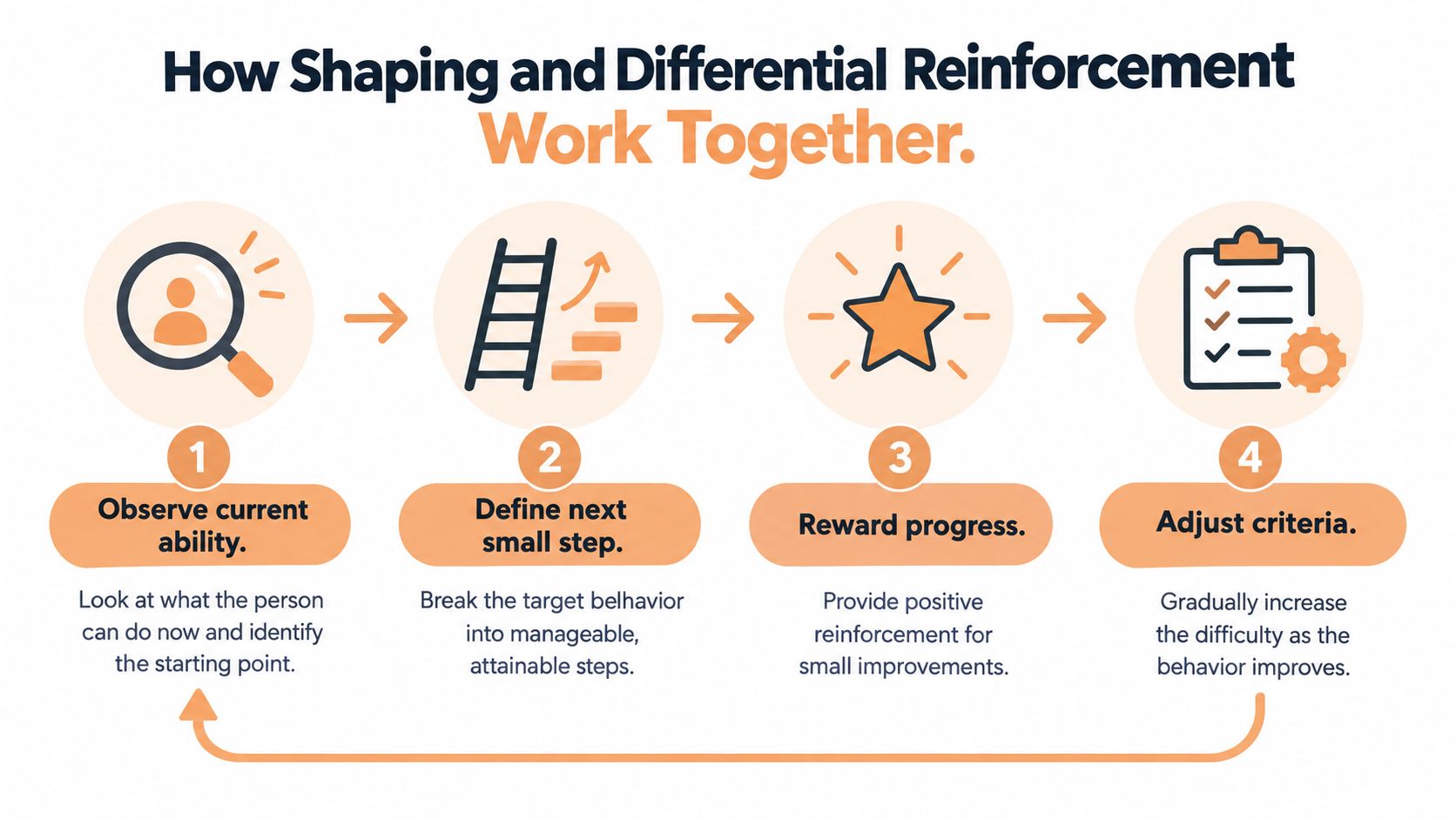
Shaping provides the direction, and differential reinforcement helps decide which responses receive encouragement as learning progresses. The word “differential” means that the team responds differently to different attempts. A response that is closer to the target receives reinforcement, while an older, less complete approximation may eventually stop receiving the same response.
Consider a child learning to ask for a favorite snack. At first, pointing may be the best available communication. Once the child consistently points, the therapist may look for a sound, word, or gesture that communicates the request more clearly. Later, the expectation may shift toward a short phrase.
This shift can feel confusing for parents. You might wonder, “Why was pointing celebrated yesterday, but today the therapist is waiting for a word?” The answer is that the earlier response helped establish communication. Once the child is ready for a closer approximation, the team adjusts the criterion so the skill can continue developing.
A helpful comparison is a video game with levels. A player may receive support for learning the controls at the first level. After those controls become familiar, the game introduces a new challenge. The earlier level wasn't pointless, and the new level isn't a punishment. The challenge changed because the player gained a skill.
The same logic can guide teaching at home:
- Observe the current response. What does your child already do to communicate or participate?
- Choose one reachable next step. The next approximation should be close enough to understand but not so difficult that the child is likely to give up.
- Reinforce genuine progress. Reinforcement could include access to a preferred item, praise, play, attention, or another meaningful response.
- Shift the criterion carefully. When the closer response becomes reliable, the care team can begin looking for the next step.
Differential reinforcement doesn't mean removing warmth or attention. It means making the teaching response more specific. The current approximation is reinforced until a closer approximation appears, and then reinforcement shifts toward that newer response, as described in this ABA glossary explanation of shaping.
Parents can also review how positive reinforcement works in ABA, especially if they're unsure whether encouragement, a preferred activity, or natural access to a desired item is meaningful for their child.
This process should remain individualized. One child may move quickly from a gesture to a word, while another may need more time with the gesture or an alternative communication system. The goal isn't to make every child follow the same ladder. It's to create a ladder that fits the child.
Here's a short visual explanation of the process:
Real World Examples of Building New Skills
Communication offers one of the clearest ways to see successive approximations in daily life. Imagine a child who reaches for a snack but doesn't yet use a phrase to request it. Rather than waiting for a complete sentence, the adult can respond to the child's current communication and create opportunities for the next small step.
The progression might look like this:
- The child says “more.” The adult responds meaningfully and models a slightly fuller phrase.
- The child attempts “want more.” That closer response receives enthusiastic recognition and access to the requested item when appropriate.
- The child tries “I want more.” The adult acknowledges the growing phrase and continues modeling.
- The child says “I want more, please.” The full request is now closer to the communication goal.
This sequence, including “more,” “want more,” “I want more,” and “I want more, please,” is a concrete example of reinforcing shorter responses as they become more complete, as illustrated in this ABA explanation of shaping a full sentence request.
The adult doesn't need to turn snack time into a formal lesson. A natural routine may provide enough motivation. The child wants the snack, the adult notices the communication attempt, and the interaction gives the child a reason to try again. A therapist can help the family decide how much prompting to provide and when to wait for an independent attempt.
“A small communication attempt is still communication.”
Approximations can also be meaningful when a child's speech sounds different from the adult model. A sound that resembles part of a word, a sign, a picture exchange, a device selection, or a gesture may all be considered in the child's individualized communication plan. The care team can help determine which responses to recognize and how to model the next step without placing unnecessary pressure on the child.
Shaping also supports daily living skills. For handwashing, an early approximation might involve walking to the sink. The next step could be turning on the water, wetting hands, adding soap, rubbing hands, rinsing, or drying. For putting on a jacket, a child might first pick up the jacket, then find the opening, place one arm inside, and pull it farther onto the body.
The order and pace will depend on the child. Some children may benefit from visual supports, modeling, or prompts. Others may need the routine shortened, the environment adjusted, or the reinforcer changed. A home-based therapist can observe what happens during the actual routine, rather than relying only on a practice activity at a table.
The most important question isn't whether the child completes the whole skill immediately. Ask instead, “What did my child do today that was a little closer?” That answer gives the family and clinician useful information for the next opportunity.
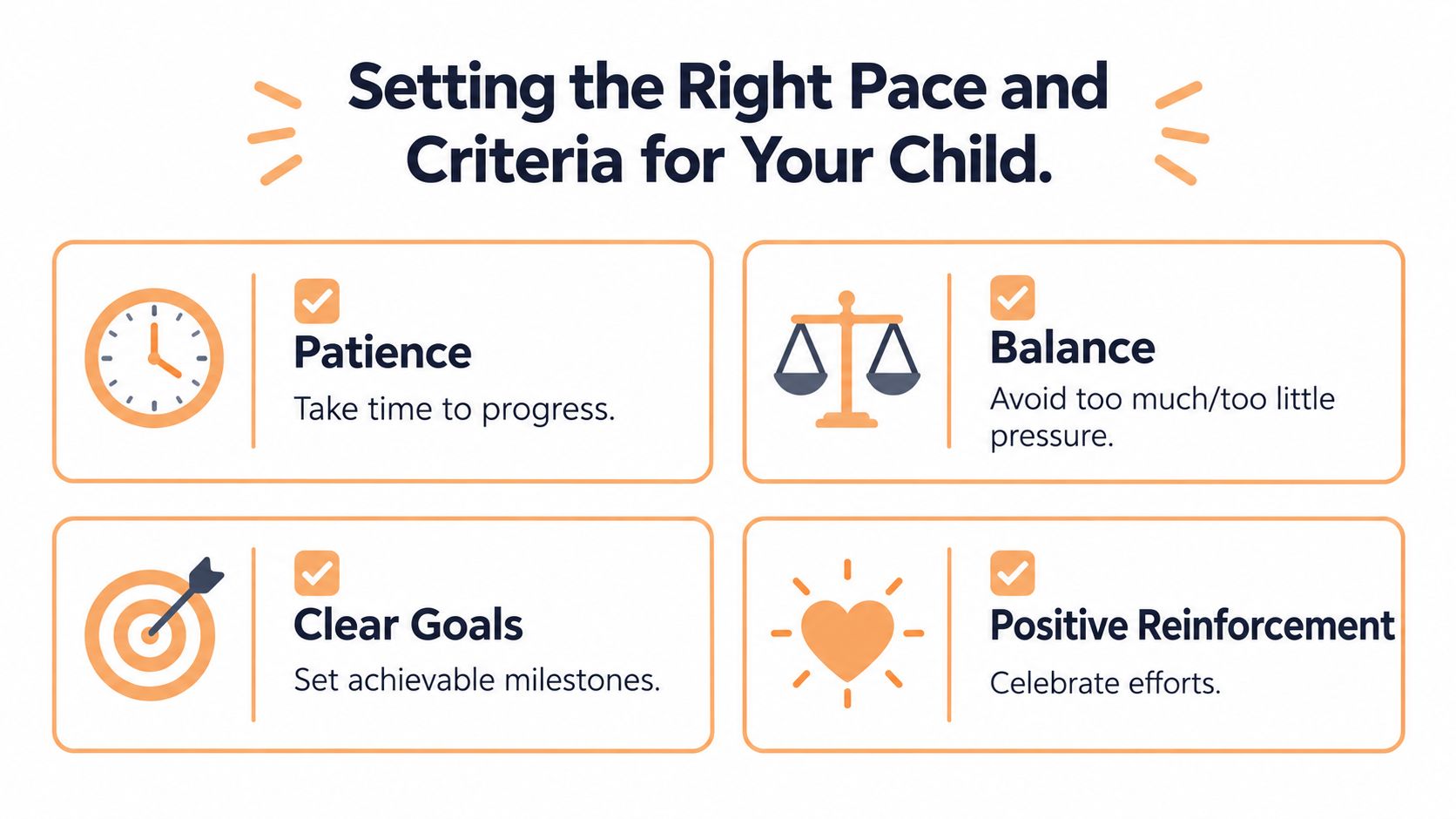
Setting the Right Pace and Criteria for Your Child
Parents often worry about choosing the wrong expectation. Should you wait longer? Should you ask for more? Is your child ready for the next step, or would a smaller step feel safer?
A good starting point is an action your child can already perform successfully. Successive approximations are particularly useful when a behavior isn't yet established because teaching begins with an easier behavior already in the child's repertoire, then raises the criterion gradually, as described in this explanation of the shaping process in ABA.
Start with an achievable response
Watch what happens before, during, and after the routine. If your child wants a drink, do they look toward the cup, reach, vocalize, bring you to the kitchen, use a picture, or select a button on a communication device? That existing response can guide the first approximation.
A useful next step should be:
- Observable: You can clearly see or hear what the child did.
- Meaningful: The response helps the child communicate, participate, or become more independent.
- Reachable: The child has a reasonable opportunity to succeed with the available support.
- Flexible: The plan can be adjusted when the child's needs or interests change.
Avoid making the next step so broad that nobody knows what counts. “Communicate better” isn't an approximation. “Touch the picture for crackers” or “place one arm into the sleeve” gives the adult and child a clearer starting point.
Notice readiness without rushing
Readiness doesn't require perfect performance. You might look for repeated attempts, growing interest, reduced support, or a response that appears in more than one routine. Your child may also show readiness by initiating the activity, staying engaged longer, or returning to try again after an error.
At the same time, frequent distress, avoidance, confusion, or loss of interest may signal that the step is too difficult, the reward isn't meaningful, or the routine needs a different approach. Those observations aren't failures. They're information.
A practical stopping rule asks whether the skill is functional and useful in daily life, not whether it looks perfect in every situation. For one goal, the team may decide that a response is good enough to meet the child's immediate need. Another goal may require more refinement for safety, independence, or successful participation at home and school. Questions about thresholds, error tolerance, and stalled progress should be discussed with the child's BCBA or therapy team.
Families can bring these observations to their care team through notes, short videos when appropriate, or structured records. ABA data sheets for tracking progress can help clinicians see patterns that are easy to miss during a busy week, such as when a child communicates more successfully before meals or participates more fully when choices are offered.
There's no prize for moving through approximations quickly. A pace that protects trust, engagement, and dignity is often more useful than a pace that looks impressive on paper.
Navigating Common Pitfalls and Learning Plateaus
Progress can pause even when a child is learning. A skill may appear during therapy but not yet during breakfast. A child may use a phrase one day and return to a gesture the next. These changes can be discouraging, but they don't automatically mean that the teaching plan has failed.
One common mistake is advancing the criterion before the child has enough practice with the current approximation. Another is removing reinforcement too quickly because the adult wants to encourage independence. A third is practicing only in one setting, which can make a skill harder to use with a different person, object, or routine.
When the next step feels too hard
If your child stops participating after the expectation changes, step back without treating that move as defeat. The earlier approximation may need to be reinforced again while the team makes the next step smaller.
For example, if a child was successfully saying “want more” but becomes upset when asked for “I want more,” the adult might return to “want more,” model the longer phrase without demanding it, and look for a partial attempt. The plan can move forward again when the child is comfortable.
When reinforcement loses its meaning
A reward only works as reinforcement if it matters to the child in that moment. A favorite toy may be motivating during one routine and uninteresting during another. Social praise may be meaningful for one child, while access to a preferred activity, sensory experience, or item may be more effective for another.
Ask what your child is trying to reach, avoid, continue, or communicate. Then share that information with the therapist. The team can help distinguish between a motivation issue, a task that is too difficult, an unclear prompt, or a communication response that needs to be honored differently.
When progress stalls
A plateau can be a period of practice and consolidation, but it can also show that the plan needs adjustment. The practical question is not only, “How do we push harder?” It's also, “What is making this step difficult right now?”
Technical guidance on shaping highlights the need to decide when a response is good enough, define acceptable error levels, and identify what to do if progress stalls, as outlined in this discussion of stopping rules in shaping.
Try reviewing:
- The step size: Is the jump from the current response to the next one too large?
- The setting: Does the child have the same support and motivation at home, school, and therapy?
- The response: Is the child communicating through a different form than the team expected?
- The consequence: Does the child receive a meaningful and timely response after trying?
- The emotional load: Is the routine happening when the child is tired, hungry, rushed, or overwhelmed?
A compassionate reset: Returning to an easier approximation can rebuild confidence and provide information about what your child needs next.
Regression-like changes also deserve a calm conversation with the care team, especially if they persist or affect safety, communication, or daily functioning. Parents don't need to solve the puzzle alone. Their observations are often the missing piece that helps clinicians make a respectful adjustment.
Partnering With Your Care Team for Lasting Growth
At breakfast, one adult may celebrate a point toward the snack cabinet, while another waits for spoken words. Both responses come from care, yet different expectations can leave a child unsure what will work. Successive approximations are easier to understand when the adults around the child agree on the goal, the current step, and the response that follows an attempt.
A coordinated plan agrees on the important details while leaving room for real life. Parents bring valuable information because they see patterns during meals, mornings, sibling play, community outings, and bedtime. Those ordinary moments show what supports a child and what makes a new skill harder to use.
Shaping involves reinforcing responses that gradually move toward a target behavior instead of waiting only for the finished skill, as explained in this overview of shaping in psychology). The definition becomes practical when the team connects it to a child's actual routines, interests, and ways of communicating.
A care coordinator can organize communication, schedule progress check-ins, and direct questions to the appropriate clinician. An individualized treatment plan can reflect the child's interests, communication style, sensory preferences, family routines, and participation priorities. Our parent coaching model can help caregivers practice the same approach during ordinary moments, so home remains a place for connection and learning rather than a second clinic.
Bring specific observations to team meetings:
- “She points to the snack cabinet before making a sound.”
- “He puts both hands into the sleeves when I hold the jacket open.”
- “She uses the picture at home but not yet at school.”
- “He tries again when I respond immediately, but walks away when the wait is longer.”
Small details help clinicians choose a realistic next approximation. They also show when a response is already functional and deserves to be honored while the team models a fuller version.
Friendly ABA Premier may combine home-based ABA therapy, parent coaching, school support, and social skills development with a dedicated care coordinator and family communication. Families can ask how a provider will tailor goals, share progress, and adjust the plan as a child's interests or needs change.
Your child's small steps show effort, communication, participation, and learning. A reach may become a gesture, then a word, picture, or device selection. With patient support, a partial routine can grow into a more independent one that respects the child in front of you.
Friendly ABA Premier offers personalized home-based ABA therapy, parent coaching, social skills support, and school support with individualized treatment planning and a dedicated care coordinator. Visit Friendly ABA Premier to schedule a consultation about building meaningful skills through supportive, carefully paced steps.
Our Latest Insights
































Experience ABA Therapy with a More Personalized Level of Support
Discover how FriendlyABA Premier combines evidence-based ABA therapy with dedicated coordination, proactive communication, and individualized family support.