


Care Coordination for Children: A Parent Guide
Discover how care coordination for children simplifies autism therapy. Learn what a dedicated coordinator does and how to choose the right ABA partner.


You're trying to keep track of a pediatrician's referral, a school meeting, insurance paperwork, and therapy appointments, all while helping your child manage everyday routines. Every professional may be caring and capable, yet you're still left carrying messages between them. That invisible workload can make an already uncertain time feel exhausting.
Care coordination for children adds a support layer around your family. Instead of expecting you to serve as the only messenger, planner, and problem-solver, a coordinated team helps connect clinical care, school support, home routines, and family priorities. For parents exploring ABA therapy for the first time, this structure can make the process clearer and more manageable.
Table of Contents
Why Care Coordination Matters for Your Family
A family may begin with one concern, such as difficulty communicating during mealtimes or becoming overwhelmed by changes at school. Soon, that concern touches several parts of life. A pediatrician may recommend an evaluation, an educator may suggest classroom supports, and an ABA provider may ask about routines at home. Insurance may require documents before services begin.
Without coordination, you may repeat the same history to each person, remember which form is still missing, and wonder whether the adults supporting your child are working toward the same goals. Even small gaps can create friction. A referral may sit unresolved, a school update may not reach the clinical team, or a schedule change may disrupt services before anyone has a chance to plan.
A helpful way to think about it: therapy is the visible service, while coordination is the structure that helps the service fit your child's real life.
The need is larger than many parents realize. In 2022, 66.7% of children who needed care coordination received it, while 28.6% of parents or guardians reported unmet coordination needs, according to the National Survey of Children's Health care-coordination benchmark. In practical terms, roughly one in three children needing coordination still didn't receive it.
That gap matters for children with developmental delays or autism because support often crosses home, school, medical, and therapeutic settings. Parents may be asked to manage communication among pediatricians, behavior analysts, therapists, teachers, and insurers while also helping their child learn and participate in daily activities.
What support can look like
A dedicated coordinator might help clarify who is responsible for a referral, organize updates for the family, prepare the team for a school routine change, or identify a barrier before it becomes a missed service. The coordinator doesn't replace your child's clinicians or make decisions for your family. Instead, they help the right people communicate and keep the plan connected to your priorities.
You're still the expert on your child. A strong coordination model means you don't have to be the entire infrastructure alone.
Defining Care Coordination in Everyday Terms
The American Academy of Pediatrics describes pediatric care coordination as patient- and family-centered, assessment-driven, team-based work that meets a child's needs while strengthening the family's caregiving abilities. The AAP definition includes medical, social, developmental, behavioral, educational, and financial needs, rather than treating each concern as a separate problem. You can read the American Academy of Pediatrics care-coordination resources for the formal framework.
In everyday language, coordination means helping the people around your child share information, agree on priorities, and follow through. It's more than booking appointments. A scheduler may find an available time, while a coordinator asks whether the appointment fits the family's schedule, whether the needed records are available, and what should happen afterward.
Four steps that make a plan useful
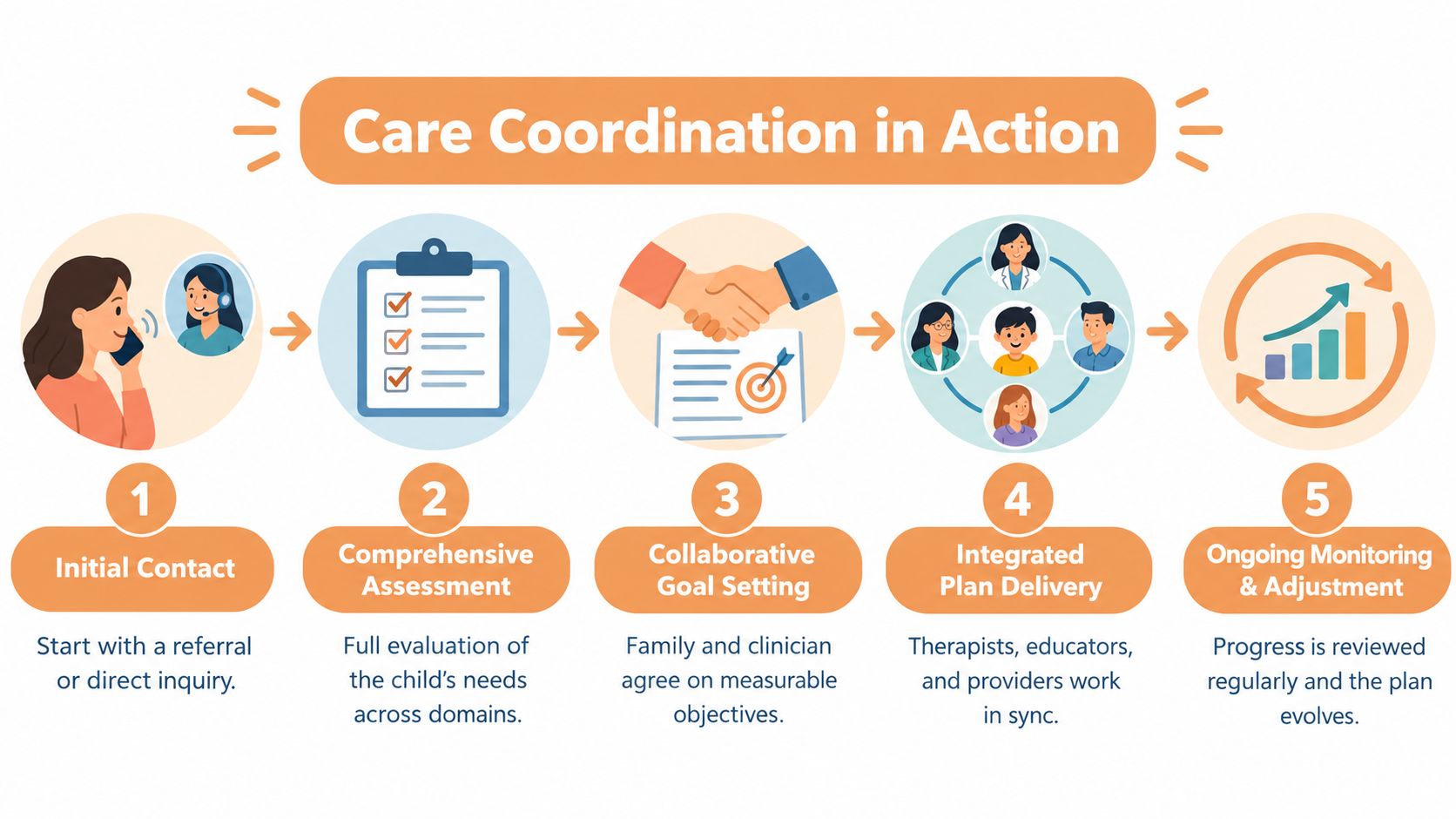
A practical care-planning process identified in an interdisciplinary pediatric care-coordination paper includes four connected steps:
Start with needs and strengths. The team learns what your child enjoys, what routines already work, and where support is needed. For example, a child may communicate clearly during play but need extra support when transitioning from play to getting dressed. The family's knowledge guides the assessment.
Build the care neighborhood. This can include parents, pediatricians, teachers, behavior analysts, speech or occupational therapists, and other people who support your child. The group doesn't need to involve every professional at every moment. It should include the people whose information or actions affect the current goal.
Create a shared plan. The team agrees on priorities in language everyone understands. A goal might focus on helping a child request a break during a challenging school routine, then practicing the same communication skill at home.
Put the plan into daily life. Each person understands their role, how updates will be shared, and when the team will review progress. The plan should work during real routines, such as snack time, getting on the bus, playing with siblings, or joining a classroom activity.
Coordination is an ongoing relationship
A shared plan shouldn't be treated as a document that disappears into a file. Your child's interests, communication style, school expectations, and family circumstances can change. Regular conversations help the team decide whether a goal remains useful or needs to be adjusted.
Consent and privacy also matter. Providers should explain what information they want to share, with whom, and for what purpose. You can ask questions before agreeing to communication among an ABA provider, school, physician, or other service.
This approach helps prevent a common misunderstanding. Care coordination doesn't mean every professional does the same work. It means each person understands the larger picture and contributes in a way that supports the child and family.
Standard Care vs Dedicated Care Coordination
The difference often becomes clearest when something changes. Suppose your child's school introduces a new classroom routine, and transitions become harder. In a fragmented model, you may need to tell the therapist, explain the classroom situation to the pediatrician, and ask the school whether anyone has reviewed the current therapy goals.
In a dedicated model, a family care coordinator can help organize the handoff. The coordinator may gather the relevant information, confirm what the family wants shared, and help the team discuss a consistent response. You still approve the plan, but you're not forced to rebuild the same conversation from the beginning.
| Feature | Standard Care Model | Dedicated Coordination Model |
|---|---|---|
| Main point of contact | Parents often contact each provider separately | A dedicated coordinator helps organize communication |
| Information sharing | Families may repeat history and updates | Relevant updates are gathered and shared with consent |
| Treatment planning | Goals can remain limited to one setting | Family, clinical, and educational priorities can be aligned |
| Schedule changes | Problems may be addressed after disruption occurs | The team can plan around known changes |
| Insurance barriers | Parents may manage follow-up alone | The coordinator helps clarify next steps and responsibilities |
| Progress updates | Reporting may vary by provider | The family receives a clearer rhythm of communication |
| Family role | Parents become the primary messengers | Parents remain decision-makers and partners |
This kind of support is especially useful when an insurance authorization is delayed or denied. A coordinator can help identify what information is missing, explain which person is handling the next step, and keep the family informed. That doesn't guarantee approval, but it can reduce uncertainty and prevent everyone from assuming someone else is following up.
The central hub matters
A dedicated coordinator serves as a practical hub, not as a replacement for clinical expertise. The behavior analyst remains responsible for clinical decisions within their role, educators guide classroom support, and medical professionals address health concerns. The coordinator helps these parts connect around the family's priorities.
The care coordination and case management overview can help families distinguish coordination from basic administrative assistance. The key question is whether the provider offers an intentional process for communication, planning, follow-up, and adjustment.
Ask yourself: if a school routine, appointment, or insurance decision changes tomorrow, who will help the team respond?
A high-touch model should answer that question clearly. It should also recognize that families have different schedules, communication preferences, cultural expectations, and levels of available support. Personalized coordination isn't about adding more meetings. It's about making the necessary communication more useful and less burdensome.
The Real-World Impact on Child and Family Life
Care coordination affects more than convenience. When professionals share information and families understand the plan, children may experience greater consistency across the places where they learn, play, and practice new skills. Parents can spend more energy participating in routines and less energy tracking disconnected tasks.
Evidence supports this broader connection. A multicenter randomized clinical trial involving 81 children with chronic noncomplex medical conditions found that care coordination significantly improved overall child quality of life, overall family quality of life, and family functioning 12 months after diagnosis. The JAMA Pediatrics clinical trial supports a causal pathway in which coordination can reduce fragmentation and improve outcomes for children and families.
The findings don't mean coordination guarantees a particular result for every child. They do show why families should view coordination as part of quality care, rather than as an optional courtesy.
Earlier answers can reduce uncertainty
Families often spend a long time wondering what to do after noticing developmental differences. They may wait for referrals, search for evaluations, compare providers, and try to understand insurance requirements. Navigation support can help keep those steps moving without promising a diagnosis or a specific treatment outcome.
A multisite randomized clinical trial of 249 children aged 15 to 27 months tested family navigation for autism. The intervention reduced the time to diagnostic ascertainment and increased the likelihood that children received a diagnosis within one year, as reported in JAMA Pediatrics. This offers a concrete example of how organized guidance can help families move from uncertainty toward clearer answers.
Once services begin, coordination can also influence how effectively a child's support system uses available care. In a pediatric accountable care organization case study, approximately 16,000 referrals were made for an estimated 12,000 children. Among a subset of 733 enrolled children, inpatient admissions, bed days, and 30-day readmissions decreased after enrollment, while roughly 80% of records indicated prevention of inappropriate service use, according to the pediatric care-coordination case study.
Family functioning belongs in the conversation
Parents often measure progress in moments that never appear on a therapy summary. A child may communicate a need during breakfast, tolerate a change in the morning routine, join a sibling's game, or participate more comfortably in a classroom activity. Coordination helps the team notice how skills carry across settings.
The national medical-home benchmark shows why this infrastructure remains unfinished. Using 2023-2024 data, only 45.5% of U.S. children met the full medical-home standard, which requires a personal doctor or nurse, a usual source for sick care, family-centered care, needed referrals, and effective coordination when needed. America's Health Rankings reports Vermont at 57.8% and Nevada at 35.6%, illustrating how uneven coordinated care can be across states.
For your family, the practical lesson is simple. Ask how a provider will connect therapy with home routines, school communication, medical information, and your own observations. Those connections can make the care experience more coherent, even though every child's path remains individual.
Questions to Ask When Choosing a Provider
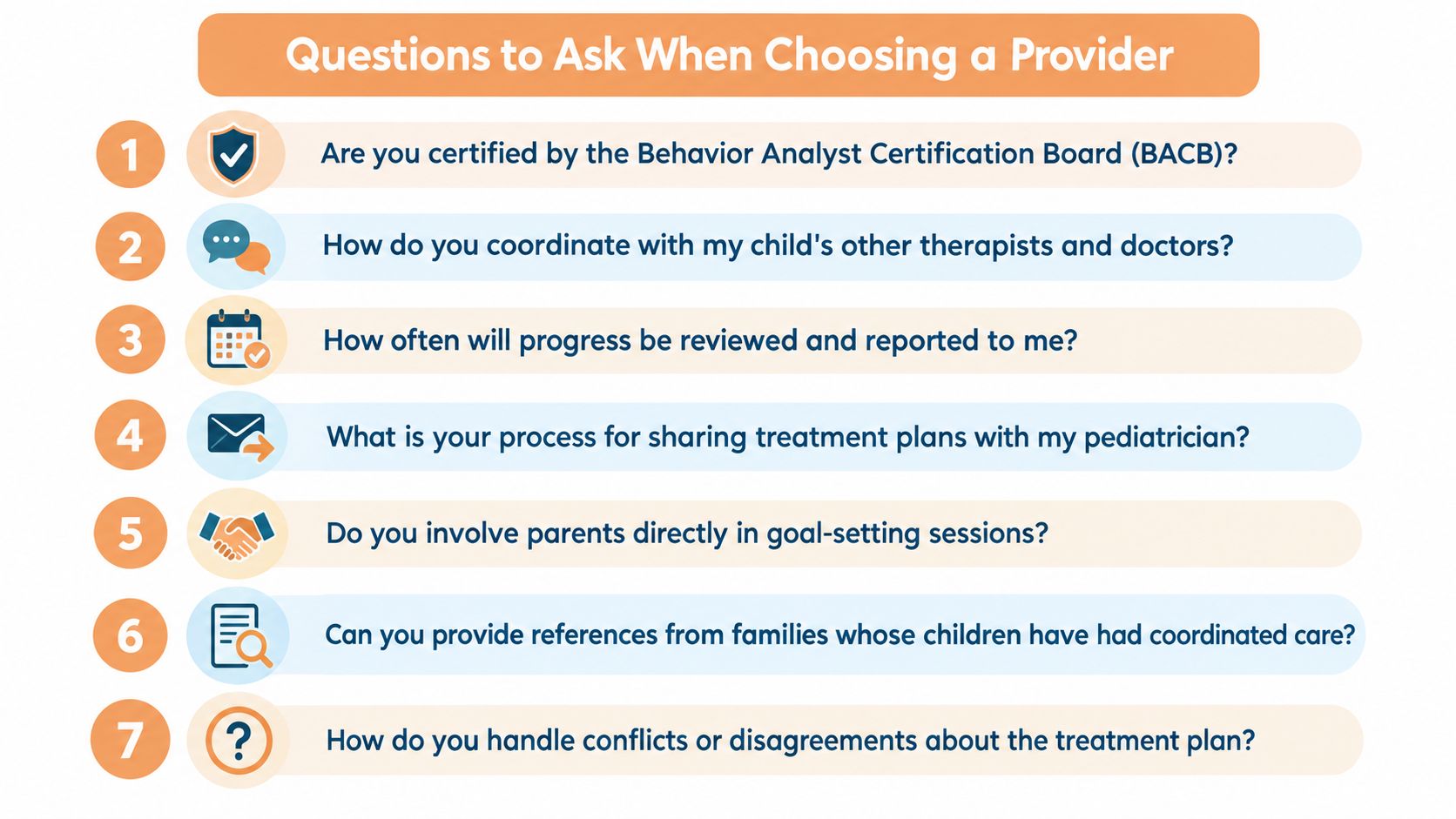
A provider may use the phrase “care coordination” to describe anything from appointment reminders to a structured partnership among families and professionals. You can learn the difference by asking what happens, who does it, and how often the team reviews the plan.
Start with the questions below. You don't need every answer immediately, but a thoughtful provider should explain its process in plain language.
Who will be our dedicated point of contact? Ask whether your family has a named coordinator and what kinds of questions that person handles. Clarify how you'll reach them and what happens when they're unavailable.
How do you communicate with schools, pediatricians, and other therapists? Ask how the provider obtains consent, shares relevant updates, and avoids making you repeat information. A useful answer should describe a process, not just promise that the team “collaborates.”
How are goals chosen? Your priorities should matter alongside clinical observations. Ask how the team includes routines such as getting dressed, playing, eating, communicating, or participating in school.
How often will you receive progress updates? Find out whether check-ins are scheduled and whether reports explain progress in language families can use. Ask how you can raise a concern between formal reviews.
What happens when an appointment is missed or a schedule changes? A coordinated provider should explain how it follows up, looks for barriers, and helps prevent a single disruption from becoming a pattern.
How do you support families navigating multiple systems? Ask about insurance paperwork, school meetings, referrals, transportation challenges, and communication with other services. Families with limited time or support should be able to understand what assistance is available.
How do you provide culturally and linguistically responsive support? Ask whether interpretation or translated materials are available and how the team adapts communication to your family's preferences. This is important since underserved, low-income, and minority children face greater risks of gaps in coordination and provider-family communication, as discussed in the research on equity in pediatric care coordination.
Look for a plan that changes with your child
National care-coordination standards call for a shared plan of care, team communication, family engagement, and supported transitions. They specify that reassessments should occur at least every six months, unless the family and care team agree together on different timing, according to the National Care Coordination Standards implementation guide.
Ask what a reassessment includes. Will the team review current goals, family priorities, school needs, communication methods, and barriers to participation? Will you receive an understandable summary of what changed and who will follow through?
You can also use this guide to choosing an ABA therapy provider when comparing clinical qualifications, service settings, parent involvement, and communication practices. A provider's answers should leave you feeling informed, not pressured.
Building a True Partnership for Your Child's Future
Good care coordination doesn't take your place on the team. It gives your voice a reliable path into the team's decisions.
You know which songs help your child settle, which transitions tend to be difficult, what motivates participation, and which routines matter most to your family. Clinicians bring specialized knowledge. Teachers understand the classroom environment. Pediatricians contribute medical context. A coordinator helps these perspectives meet without asking you to carry every message alone.
That partnership should extend beyond therapy sessions. Home-based ABA may address skills during play, dressing, meals, or family routines. School support can help adults communicate about classroom participation and peer interaction. Parent coaching can give caregivers practical ways to use agreed-upon strategies during ordinary moments, as described in parent coaching services.
Consistency can feel reassuring
Families comparing providers should look for individualized treatment planning, proactive communication, scheduled progress conversations, and a clear process for connecting home, school, and clinical settings. These features don't promise a specific outcome, but they can make it easier to notice what's working, discuss what isn't, and adjust support respectfully.
Care coordination also protects family capacity. When a coordinator follows up on handoffs, clarifies responsibilities, and keeps communication organized, parents have more room to be parents. You can focus on shared meals, play, connection, and celebrating emerging skills instead of constantly wondering which task is still unresolved.
If you're exploring ABA therapy or developmental support, start with one conversation. Ask how the provider would understand your child's strengths, include your priorities, communicate with other supports, and keep the plan current. The right partnership should feel personal, clear, and responsive from the beginning.
Friendly ABA Premier offers home-based ABA therapy, social skills development, school and community coordination, and parent coaching with a dedicated family coordinator and individualized treatment planning. Visit Friendly ABA Premier to learn how coordinated support can fit your child's routines and your family's needs.
Our Latest Insights
















































Experience ABA Therapy with a More Personalized Level of Support
Discover how FriendlyABA Premier combines evidence-based ABA therapy with dedicated coordination, proactive communication, and individualized family support.