

What Is Level 2 Autism? a Parent's Guide
What Is Level 2 Autism. Understand what level 2 autism means for your child. Learn diagnostic criteria, support needs, and how ABA therapy and parent coaching

Level 2 autism is the middle category in the DSM-5's three-level support scale, meaning a child requires substantial support for social communication and restricted or repetitive behaviors. It's also the most common classification among children with a recorded severity level, so your family isn't alone in navigating this path.
You may have heard “Level 2” during an evaluation and then driven home with more questions than answers. What does substantial support look like at breakfast, in the classroom, or during a change in plans? Does the label describe your child's future, or only what your child needs right now?
The most helpful answer is that Level 2 autism describes current support needs, not your child's worth, personality, strengths, or permanent potential. A thoughtful plan can turn a clinical description into practical help that makes communication, transitions, learning, and everyday participation more accessible.
Table of Contents
Understanding Your Child's Diagnosis
A parent might receive the diagnosis after describing mornings that rarely go as planned. Their child may understand familiar instructions but struggle to explain what they need, become distressed when breakfast changes, or stay on the edge of group play at school. The evaluation may then identify autism with Level 2 support needs.
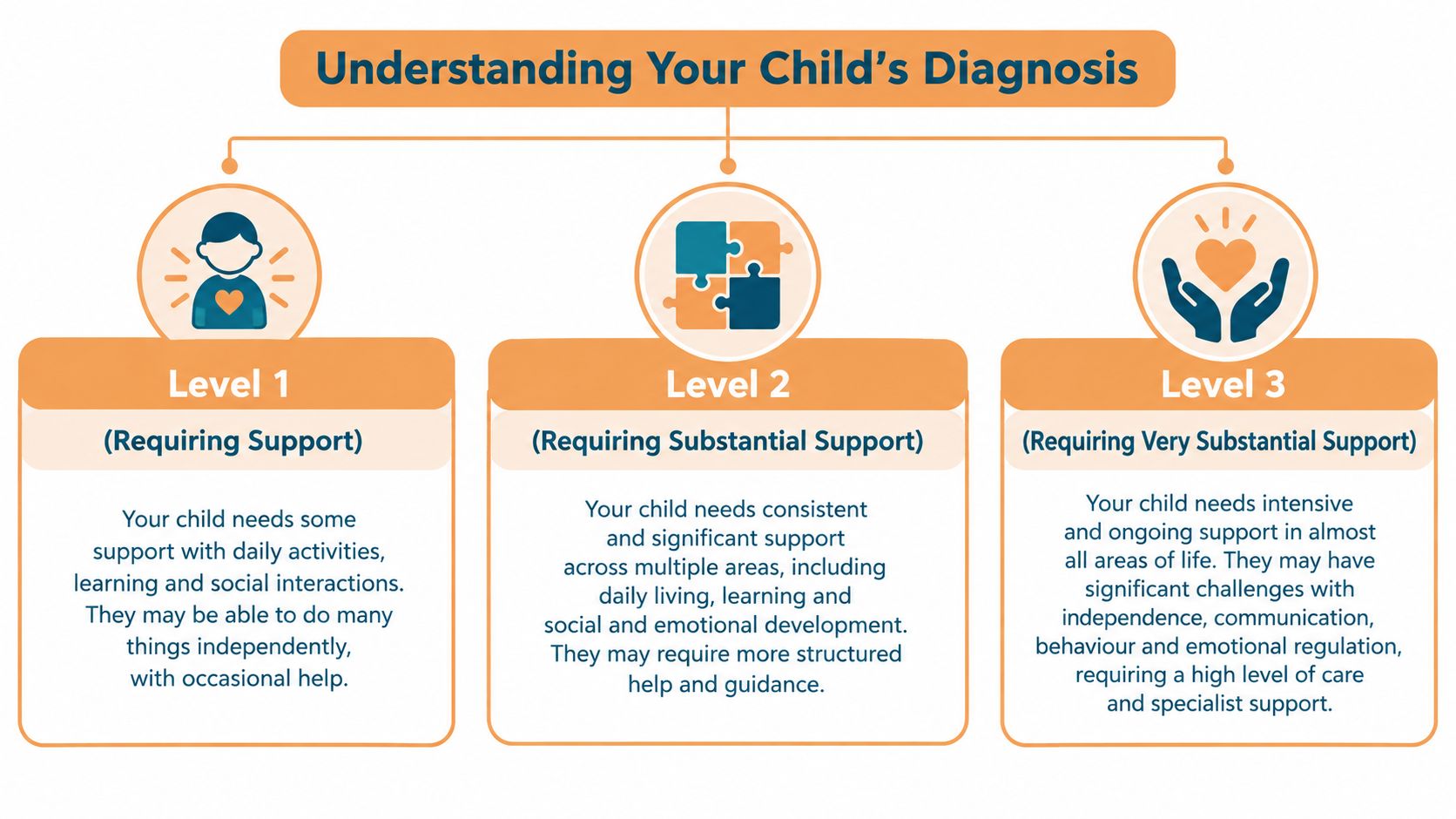
In plain language, Level 2 autism means requiring substantial support. The DSM-5 places it between Level 1, which requires support, and Level 3, which requires very substantial support. The classification reflects noticeable challenges in social communication and restricted or repetitive behaviors that remain apparent even when helpful supports are provided, as described in the CDC's diagnostic guidance.
A description, not a prediction
The word “level” can sound like a ranking. It isn't a measure of intelligence, love, effort, or how valuable your child is. It's a clinical shorthand intended to help professionals think about the amount of support a child may need across daily settings.
A child may speak in sentences and still need substantial help with back-and-forth conversation, flexible thinking, emotional regulation, or sensory demands. Another child may use fewer spoken words but communicate effectively with pictures, gestures, sign language, or an augmentative communication device. The same level can look different from one child to another.
The American Academy of Family Physicians' explanation of DSM-5 coding describes Level 2 through marked verbal and nonverbal social communication difficulties, limited initiation of interaction, and reduced or unusual responses to social approaches. Those words become more useful when your care team connects them to your child's actual routines.
Practical rule: Ask, “What support does my child need in this setting?” rather than, “How severe is my child?”
The Three Levels of Autism Support
The DSM-5 organizes autism support needs into three levels. These categories provide a shared language, but they don't capture every strength, challenge, communication style, or environmental factor. The CDC's diagnostic guidance continues to describe Level 1 as requiring support, Level 2 as requiring substantial support, and Level 3 as requiring very substantial support.
| Level | Support Needed | Key Characteristics |
|---|---|---|
| Level 1 | Requiring support | Social communication differences and restricted or repetitive behaviors create noticeable difficulties without support. |
| Level 2 | Requiring substantial support | Marked social communication differences remain apparent even with support, and rigidity or repetitive behaviors interfere visibly across settings. |
| Level 3 | Requiring very substantial support | More extensive support is needed for severe social communication difficulties and restricted or repetitive behaviors that substantially affect daily functioning. |
Where Level 2 fits
Level 2 sits in the middle of this framework. A child may need structured assistance to start or sustain interactions, respond to peers, follow changing routines, or communicate during moments of frustration. Support may need to be consistent across home, school, therapy, and community activities rather than limited to occasional reminders.
A 2026 Springer study of children with at least one recorded severity level found Level 2 was the most common rating across domains, appearing in 41.0% to 50.9% of cases, compared with 21.3% to 26.5% for Level 1 and 23.2% to 32.5% for Level 3. These figures describe the distribution among children included in that study who had a recorded level. They are not a prevalence rate for Level 2 autism, because Level 2 isn't a separate diagnosis. You can review the study in the published Springer research paper.
For broader context, the CDC estimated that about 1 in 31 U.S. eight-year-olds, or 3.2%, had autism in 2022. That figure concerns autism overall, not a particular support level, as reported in the CDC's surveillance information.
Why the level can't answer every question
The support level doesn't tell you exactly which therapy your child needs, how they'll communicate later, or whether they'll require the same help in every environment. A busy cafeteria may create more difficulty than a quiet home, while a familiar therapist may make communication easier than an unfamiliar adult.
Your child's team should look beyond the label. Ask about communication, play, self-care, sensory experiences, safety, transitions, learning, and family routines. This broader profile is what turns a diagnosis into an individualized plan.
What the DSM-5 Criteria Mean
Clinical language can make a familiar child sound unfamiliar. The DSM-5 description becomes easier to understand when you separate it into two areas: social communication and restricted or repetitive behaviors.
For Level 2, the communication differences are marked and remain visible even when supports are already in place. The AAFP summary of DSM-5 criteria describes Level 2 autism as requiring substantial support, with marked verbal and nonverbal social communication deficits that remain apparent despite support.
Social communication in daily life
“Social communication” includes more than spoken vocabulary. It covers how a child starts interaction, responds to another person, uses gestures or facial expressions, and keeps a shared exchange going.
You might notice that your child:
- Starts interactions infrequently: They may need an adult to help them ask for assistance, join a game, or show someone an interesting object.
- Has difficulty with conversation: They may answer a question but not continue the exchange, or talk at length about a preferred topic without noticing the listener's response.
- Uses nonverbal communication differently: Pointing, gestures, facial expressions, tone, or eye gaze may not work in the expected way.
- Responds unusually to social approaches: A greeting, invitation, or question may receive no response, a delayed response, or a response that doesn't match the situation.
These examples aren't a checklist for parents to use as a diagnosis. They're conversation starters for your child's evaluating clinician, speech-language pathologist, teacher, or behavior analyst.
Restricted and repetitive behaviors
The second area involves patterns that may include repetitive movements, repeated language, highly focused interests, or a strong need for sameness. These behaviors can serve a purpose, such as helping your child regulate, predict what will happen, or stay connected to a preferred activity.
A transition from tablet time to bath time may be difficult because the change interrupts a predictable sequence. A small alteration to a classroom routine may lead to distress because your child doesn't yet have a reliable way to understand or communicate what comes next.
The right response isn't to shame or automatically suppress a harmless behavior. It's to understand its function, protect safety, teach useful alternatives when needed, and adapt the environment so your child can participate with less distress.
Everyday Scenarios and Real-Life Examples
At home, substantial support may look less dramatic than the phrase sounds. It might mean an adult uses a visual “first, then” card before breakfast, models a request for a preferred food, and gives extra processing time before repeating an instruction.
Consider mealtime. A child may accept a familiar meal but become overwhelmed by a new smell, texture, seating arrangement, or unexpected ingredient. A supportive adult can offer predictable choices, use clear language, introduce changes gradually when appropriate, and observe what helps the child remain comfortable and engaged.
Playtime can bring a different need. Your child may want to play near other children but not know how to enter the game, share materials, or respond when another child changes the rules. An adult might model a simple phrase, practice turn-taking with a preferred toy, or arrange a shorter, quieter interaction before expecting participation in a larger group.
For families learning about communication differences, this guide to semi-verbal autism may provide useful language for discussing how a child communicates across situations. Spoken language can vary with fatigue, sensory load, familiarity, and the complexity of the interaction.
School drop-off and classroom routines
School may require support with several transitions in a short period. A child might need a visual schedule, a consistent arrival routine, help unpacking materials, and an adult who translates a teacher's multi-step direction into smaller actions.
The support plan should match the setting. A quiet corner, advance notice of changes, movement opportunities, visual instructions, or a peer model may help a student take part without treating participation as a test of compliance.
You can watch this video for another perspective on how structured support may fit into everyday autism care:
The same child, different environments
A child may manage a familiar home routine and struggle in a crowded store. That difference doesn't mean the diagnosis is inconsistent. It shows why support levels should be understood alongside context, communication demands, sensory conditions, and the people available to help.
A useful plan changes the environment and teaches skills. It doesn't ask a child to carry every adjustment alone.
How ABA Therapy Can Help
Applied Behavior Analysis, or ABA, is an approach that can help children build meaningful skills through careful observation, practice, and reinforcement. In plain language, a clinician identifies what a child is trying to communicate or accomplish, teaches a more accessible way to do it, and tracks whether the strategy is helping.
For a child with Level 2 support needs, goals might include requesting a break, responding to a peer, following a visual routine, tolerating a necessary transition, or completing parts of a daily living task. The goal shouldn't be to make a child appear less autistic. It should be to increase communication, participation, safety, autonomy, and comfort while respecting the child's individuality.
Families often benefit from learning how therapy works before choosing a provider. This parent guide to understanding ABA therapy can help explain common terms and questions to raise during an intake conversation.
What individualized care looks like
A thoughtful ABA plan starts with your child's strengths and your family's priorities. If mornings are the hardest part of the day, the team might begin with dressing, breakfast communication, or leaving the house. If school participation is the concern, clinicians may coordinate around classroom routines and teacher feedback.
Useful care often includes several connected supports:
- Home-based practice: Therapists use familiar routines, such as getting dressed, playing, or cleaning up, so skills have a clear purpose.
- Communication support: The team may collaborate with a speech-language pathologist and use spoken language, gestures, pictures, signs, or an AAC system according to the child's needs.
- Parent coaching: Caregivers learn how to prompt, model, reinforce, and respond consistently between sessions.
- School coordination: Goals can be aligned with classroom expectations without treating the school plan and therapy plan as separate worlds.
A provider such as Friendly ABA Premier offers home-based ABA, social skills development, school support, parent coaching, individualized treatment planning, and a dedicated care coordinator across CT, GA, MD, MA, NC, SC, VA, and WA. Families should compare providers carefully, ask how communication works, and choose a team that welcomes collaboration with caregivers and other professionals.
Next Steps for Parents and Caregivers
A diagnosis can become a practical starting point when you turn it into specific questions and manageable actions.
- Write down daily priorities. Note where communication, transitions, self-care, sensory experiences, or peer interaction create the greatest barrier. Include what already works.
- Ask for a cross-setting plan. Your child may need different supports at home, school, and in the community. Request goals that reflect real routines rather than isolated clinic tasks.
- Participate in the IEP process. If your child attends school, ask how the Individualized Education Program will address communication, transitions, classroom participation, social learning, and accommodations. Bring examples from home and ask how progress will be shared.
- Coordinate the care team. Speech therapy, occupational therapy, school staff, ABA professionals, and caregivers should understand their respective roles and communicate with appropriate consent.
- Review progress without treating the level as permanent. Support needs can change as skills develop, environments change, and assessment practices differ. The useful question is whether current supports are helping your child participate and communicate more effectively.
A behavior intervention plan may be part of the school or clinical conversation. Learn how a behavior intervention plan works, then ask your team to explain its goals, the skills it teaches, and how it protects your child's dignity.
You don't have to solve everything at once. Start with one routine that matters to your family, choose a measurable and compassionate goal, and invite your care team to help you build the next step.
Friendly ABA Premier provides personalized, home-based ABA therapy, social skills support, school coordination, and parent coaching for children and families across its service states. Visit Friendly ABA Premier to start a conversation about your child's support needs and schedule a consultation.
Our Latest Insights











Experience ABA Therapy with a More Personalized Level of Support
Discover how FriendlyABA Premier combines evidence-based ABA therapy with dedicated coordination, proactive communication, and individualized family support.