

Skill Acquisition Plan: A Parent's ABA Guide
Understand what a skill acquisition plan is in ABA therapy, its key components, and how to evaluate your child's personalized treatment

You've just received your first ABA assessment report. The pages are full of unfamiliar terms, and you're trying to understand what they mean for breakfast routines, playground conversations, school transitions, and bedtime at home. You may be wondering whether the report describes your child as a whole person or only lists skills that need support.
A skill acquisition plan should help answer those questions. It turns a broad priority, such as communication or independence, into teachable steps that the care team and family can understand, practice, measure, and adjust together. A thoughtful plan focuses on what your child can build next, while also respecting preferences, family routines, and the environments where those skills matter most.
Table of Contents
Receiving Your First ABA Report
A parent might sit across from a clinician with a report open to a page titled “Skill Acquisition Plan.” The page could include terms such as operational definition, task analysis, prompting, and acquisition criteria. None of those terms means you're expected to become a behavior analyst overnight.
Think of the plan as a shared teaching roadmap. If the priority is requesting help, the plan should describe what requesting help looks like for your child, how the therapist will create opportunities to practice, what assistance may be offered, and how the team will know when the skill is becoming more independent.
Turning broad hopes into practical goals
“Improve communication” expresses an important family hope, but it doesn't tell anyone exactly what to teach or measure. A more useful target might describe how your child will request a break, indicate a preferred item, answer a familiar question, or get an adult's attention during a daily routine.
The same approach applies to independence. Rather than writing “improve self-care,” a plan might focus on placing dirty clothes in a basket, completing part of a handwashing routine, or putting a lunch container in the sink. These details aren't meant to reduce your child to a checklist. They make progress visible and give adults a consistent way to support it.
An initial assessment helps the clinician identify existing strengths, emerging abilities, and areas that may make daily life easier. You can learn more about how this information is gathered in this guide to an initial competency assessment.
A plan should change as your child grows
A skill acquisition plan isn't a permanent judgment. It's a working document that can be updated when a teaching strategy isn't helping, a goal no longer reflects your family's priorities, or your child is ready for a new level of independence.
Parents should feel comfortable asking, “What does this look like at home?” and “How will we know whether this skill is useful outside therapy?” Those questions help shift the conversation from paperwork to participation in real life.
A useful plan describes the next meaningful step, not everything your child may eventually need to learn.
Your child's preferences and communication style belong in that conversation. A goal should support access, autonomy, connection, and everyday participation. It shouldn't exist only because it's easy for adults to count.
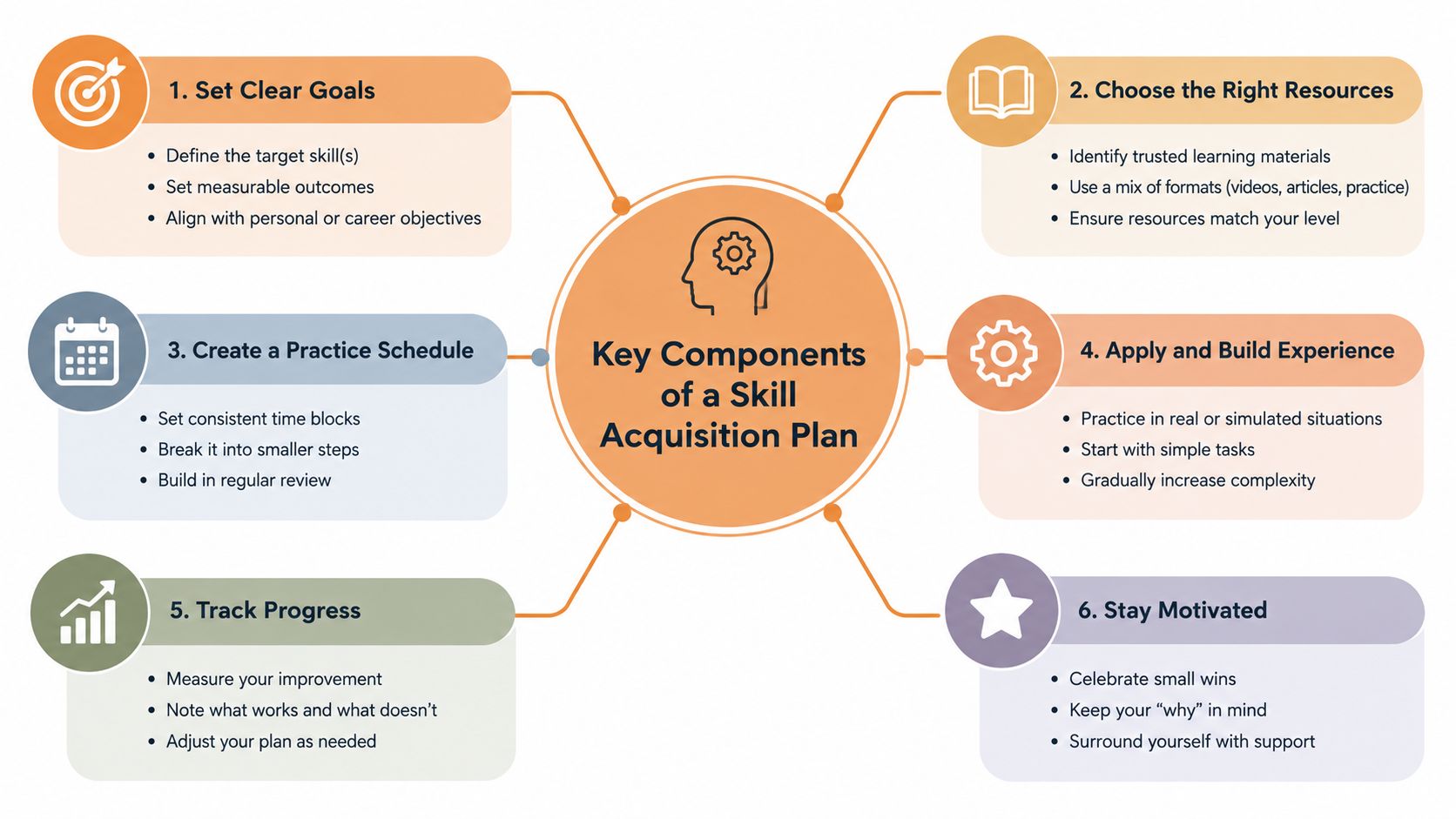
Key Components of a Skill Acquisition Plan
A strong skill acquisition plan answers several practical questions: What are we teaching? What can the child do now? How will teaching happen? How will help be reduced? What counts as meaningful progress?
Start with the current picture
Baseline means a clear description of what your child does before teaching begins. For handwashing, the baseline might show that your child turns on the water independently but needs help with soap and rinsing. For classroom participation, it might describe how long your child remains with an activity, what prompts are needed, and when participation is most successful.
Nevada's ABA guidelines specify that goals should include the child's current level, an operational definition, instructional methods, the date the goal begins, an estimated mastery date, and a plan for using the skill in other settings. The Nevada ABA guidelines for autism services offer a concrete example of the level of detail families can reasonably expect.
Operational definition describes the skill in observable terms. “Cleans up” is open to interpretation. “Places the cup in the sink after finishing a drink” gives the team something specific to observe.
Make the teaching steps visible
Task analysis breaks a complex routine into smaller parts. A dressing goal might include choosing a shirt, orienting it correctly, placing the head through the opening, and pulling the shirt down. Breaking the routine apart helps the team see which step is ready for teaching and which steps are already strengths.
Teaching procedures explain what the therapist or caregiver will do. The plan may use structured practice, natural opportunities during play, modeling, or a combination of methods. It should also identify what makes practice worthwhile for the child, whether that's access to a preferred activity, social connection, a break, or another meaningful consequence.
Prompts are forms of assistance, such as a gesture, verbal cue, model, or physical guidance. A complete plan describes which prompt to use, when to provide it, and how it will be reduced. The peer-reviewed protocol-development paper on skill acquisition procedures identifies operational definitions, prompt fading, error correction, generalization, maintenance, and data analysis as core parts of a defensible protocol.
Mastery criteria state what level of performance indicates that the skill is established for the current teaching phase. The criterion should fit the skill and should consider accuracy, independence, duration, or other observable dimensions.
For a parent-friendly explanation of how these pieces can appear in practice, review these ABA treatment plan examples. You don't need to memorize every term. You do need to know what your child is learning, how you can participate, and how the team will judge progress.
Beyond the Therapy Room, Generalization and Maintenance
A child may learn to request a break with one therapist at a table. The more important question is whether that request appears when a classroom task feels difficult, during a noisy community outing, or with a caregiver who hasn't practiced the routine recently.
Generalization means using a skill with different people, materials, instructions, and settings. Maintenance means continuing to use the skill after intensive teaching has decreased. Both matter because a skill that appears only in one therapy routine may not yet be functional in everyday life.

Why higher criteria can matter
A 2022 systematic review examined skill-acquisition research published in three applied behavior analysis journals from 2017 through 2019. Of 587 total research articles, 212, or 36.1%, targeted skill acquisition. Among those studies, 163, or 76.8%, explicitly reported an acquisition criterion and were included in the statistical analysis, as described in the systematic review of acquisition mastery criteria.
The analysis found that higher acquisition criteria were associated with stronger maintenance and generalization outcomes across different populations, interventions, and teaching methods. In everyday language, a brief successful response may show that learning has started, but repeated accurate performance can provide stronger evidence that the skill is becoming durable.
This doesn't mean every goal should use an identical threshold. A safe and practical plan chooses criteria that fit the child, the skill, and the setting. It also checks whether the child can use the skill without unnecessary adult assistance.
Build transfer into the plan
A family might practice requesting help during meals, while a teacher practices the same communication during classroom work. A caregiver might use the same visual cue as the therapist, then gradually provide more opportunity for independent responding. A school partner could report whether the child uses the skill during transitions rather than only at a desk.
The plan should answer practical questions:
- Who practices the skill? Identify caregivers, therapists, teachers, siblings, or other familiar people.
- Where does practice happen? Include home routines, school activities, community spaces, and other relevant environments.
- What changes across practice? Vary materials, people, wording, and distractions in a planned way.
- How often is the skill checked later? Schedule maintenance probes after the skill meets the initial criterion.
- What happens if performance drops? Decide whether to review prompts, revisit an earlier step, increase practice opportunities, or change the teaching approach.
For a closer look at transferring learning across contexts, explore this example of generalization.
This also explains why more therapy time by itself isn't the complete answer. Without deliberate transfer and maintenance procedures, a child may perform successfully with a therapist yet still need considerable support at home, school, or in the community.
The following video can help families visualize how learning support may connect with daily routines.
A generalization plan should fit the family's actual life. If transportation is limited, practice may need to center on home and nearby routines. If caregivers work different schedules, the plan should identify low-burden opportunities rather than assume one adult can attend every session.
Real-World Examples of Teaching Procedures
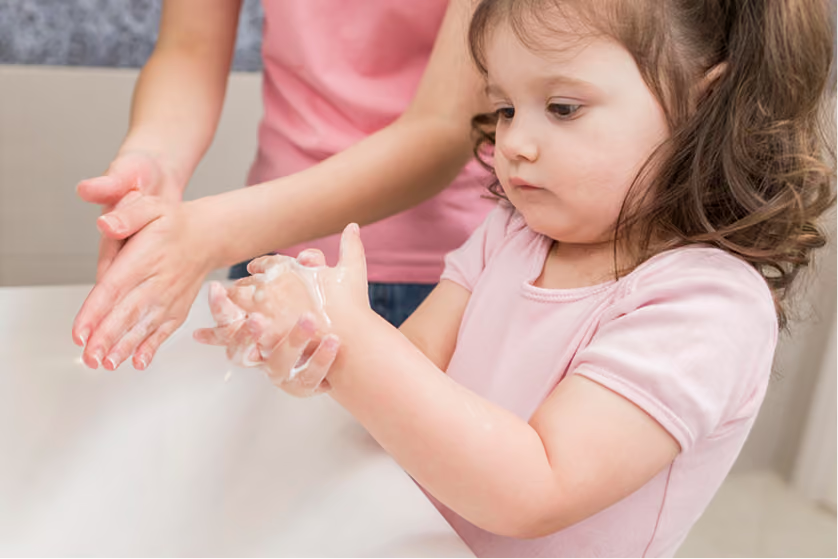
Consider a broad goal such as independent handwashing. A useful plan doesn't treat “handwashing” as one indivisible behavior. It identifies the parts of the routine and records which parts are already independent.
From one goal to a teachable sequence
A task analysis might include:
- Approach the sink and turn on the water.
- Wet both hands under the water.
- Apply soap.
- Rub hands together for the planned duration.
- Rinse the soap away.
- Turn off the water and dry hands.
The exact sequence should reflect the child's needs, the bathroom setup, and the family's routine. A clinician may teach the first step that needs support, use forward chaining by teaching the beginning of the routine, use backward chaining by teaching the final step first, or practice the entire routine with assistance.
Prompting without creating dependence
Suppose a child reaches for the soap but doesn't dispense it. The plan might begin with physical guidance, then move to a model, gesture, or brief verbal cue as the child becomes more successful. The important part is that the plan states when and how the prompt will be faded.
One studied sequence began with a full vocal prompt, shifted to partial prompts after a two-second delay, then a four-second delay, and eventually no prompt. The researchers advanced after the learner met the assigned mastery percentage for two consecutive sessions, as described in this study of prompting and prompt fading.
Parents can ask whether the child's data distinguish between independent and prompted responses. A child who completes every step with adult help is showing participation, but that performance tells the team something different from independent completion.
Defining mastery clearly
One published example defined mastery as independently completing at least 80% of six steps across three sessions, according to this description of mastery criteria in skill teaching. That example isn't a universal requirement for every child or every goal. It shows how a plan can turn “doing better at bedtime” into an observable statement.
The same structure can support other priorities:
- Communication: The child requests help during a puzzle, meal, or dressing routine using their preferred communication system.
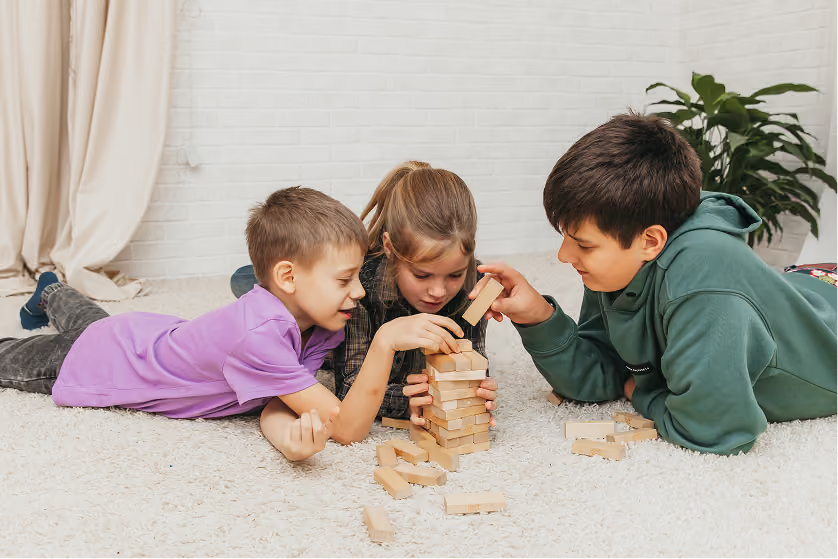
- Social participation: The child takes a turn in a game with a sibling or peer, with prompts faded according to the plan.
- Classroom readiness: The child follows a visual sequence for unpacking, joining an activity, and putting materials away.
- Daily living: The child completes selected steps of toothbrushing, dressing, or meal preparation with decreasing assistance.
A good procedure also includes error correction. If the child responds incorrectly, the adult should know whether to model the response, return to an earlier step, offer a prompt, or create another opportunity. That consistency helps the team learn whether the teaching strategy is working.
What Parents Should Expect From Their Provider
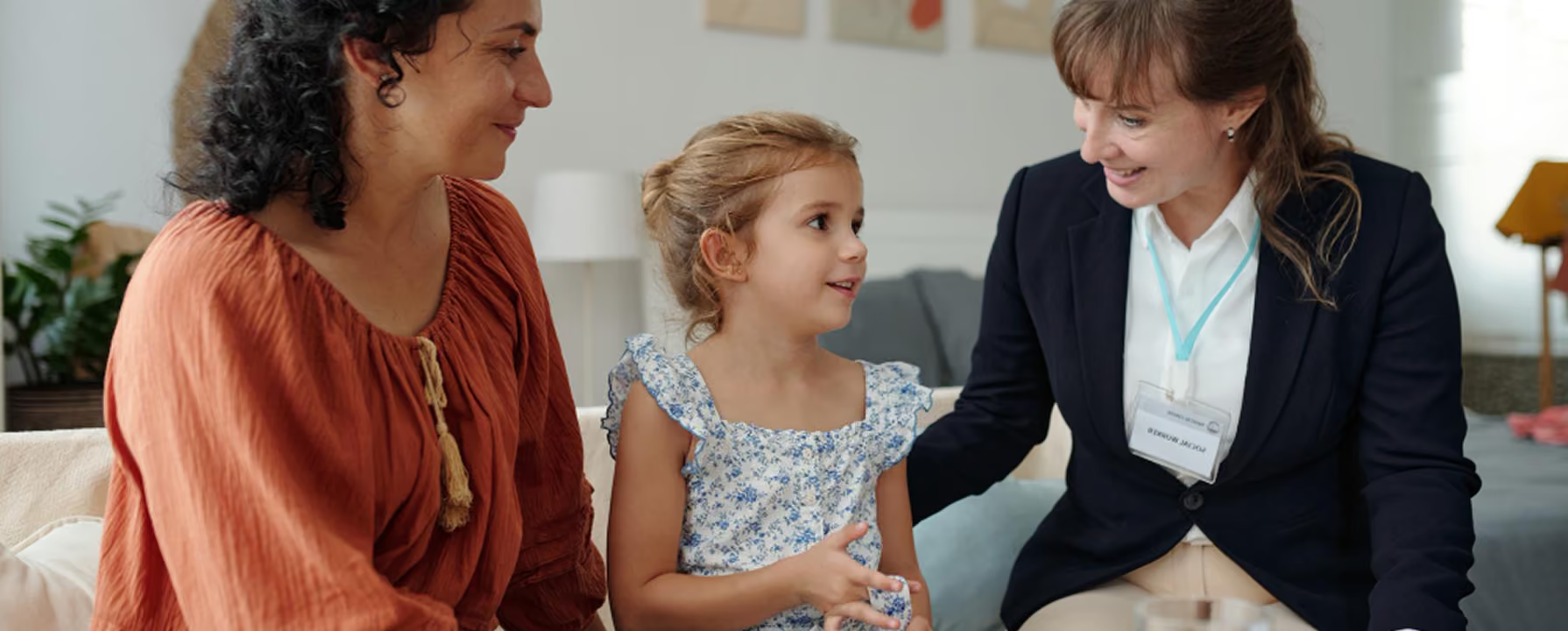
Parents shouldn't have to decode a plan alone. A provider should explain the target in ordinary language, show what practice looks like, and make clear how data will guide decisions.
You can ask to see the baseline, the operational definition, the prompt hierarchy, the reinforcement approach, and the mastery criterion. You can also ask how the team will check the skill with different people and in the routines where your child needs it.
Caregiver participation belongs in the plan
Caregiver coaching isn't an optional extra. Federal Medicaid ABA guidance calls for measurable goals for the child and caregiver, separate documentation of caregiver training, baseline measurement, planned activities and hours, a time-limited duration, and a transition plan. The Medicaid ABA services toolkit also describes parent goals that include a caregiver baseline, the behavior the caregiver is expected to demonstrate, mastery criteria, an estimated mastery date, and a generalization plan.
That might mean practicing a prompting routine during mealtime, then applying the same routine during play or a school-related activity. The goal isn't for parents to become unpaid technicians. It's to make support more consistent and useful in the moments that matter to the family.
Look for responsive coordination
A collaborative provider welcomes family observations. If a child uses a skill at home but not at school, the team should investigate the differences in materials, expectations, communication partners, sensory conditions, or prompts rather than just labeling the skill unsuccessful.
A dedicated care coordinator, proactive communication, scheduled progress check-ins, individualized planning, home-based therapy, school support, and parent coaching can help connect the clinical plan with everyday routines. Families should also expect conversations about cultural fit, language, transportation, caregiver workload, technology access, and the child's preferences.
Research on rural Appalachian families identified provider shortages, geographic isolation, affordability, and limited autism-specific knowledge as barriers. In that research, 40% of caregivers reported receiving information about available resources after diagnosis, while 13.3% reported receiving no additional information, according to the report on access to autism services for rural Appalachian families. Those figures reinforce a simple point: a plan must be practical for the family who will use it.
Ask for a plan that works in your home, not only a plan that reads well in a clinic file.
Moving Forward With Confidence
A skill acquisition plan can make ABA feel less mysterious. It gives the team a common description of the skill, identifies the child's starting point, organizes teaching into manageable steps, and explains how progress will be measured.
The most meaningful plan also looks beyond the session. It asks whether your child can use a skill with familiar and unfamiliar people, in different routines, with fewer prompts, and over time. It includes caregivers as partners and makes room for the family's culture, resources, schedule, priorities, and the child's own preferences.
You can begin by choosing one goal that matters in daily life and asking a few direct questions: What can my child do now? What will the teaching steps look like? How will prompts be faded? Where will we practice? How will we respond if the skill doesn't carry over?
Progress may look like a child requesting help before frustration grows, joining a classroom routine with less assistance, completing part of a hygiene routine, or communicating a preference during a community outing. Those moments are meaningful because they expand participation and choice, not because they make a child appear more like someone else.
If you're reviewing a plan with your care team, bring examples from home and ask for explanations in plain language. Individualized guidance should come from the professionals who know your child and can adapt teaching to your family's circumstances.
Friendly ABA Premier offers individualized ABA planning, home-based therapy, social skills development, school support, and parent coaching with dedicated care coordination and proactive progress communication. If you'd like to discuss how a skill acquisition plan can connect therapy with home, school, and community routines, visit Friendly ABA Premier to contact the team.
Our Latest Insights




















Experience ABA Therapy with a More Personalized Level of Support
Discover how FriendlyABA Premier combines evidence-based ABA therapy with dedicated coordination, proactive communication, and individualized family support.