


ABC Data Collection: A Parent's Step-by-Step Guide
Learn ABC data collection step by step. Simple templates, real examples, and tips to track behaviors at home with confidence.


You're watching the same moment happen again. Dinner is on the table, your child seems settled, then a small change, a louder room, a request to switch from preferred to non-preferred food, or a timer ending, suddenly changes the whole mood. That kind of pattern can feel confusing in the moment, but it also gives you clues, and abc data collection is the simple structure that helps you capture them without guessing.
At heart, this is organized observation. You note what happened before a behavior, what the behavior looked like, and what happened after it, so your care team can look for patterns over time. That's why families often find it reassuring: it turns a stressful moment into something understandable, and it gives everyone on the team the same language to work from.
Table of Contents
Understanding ABC Data Collection Basics
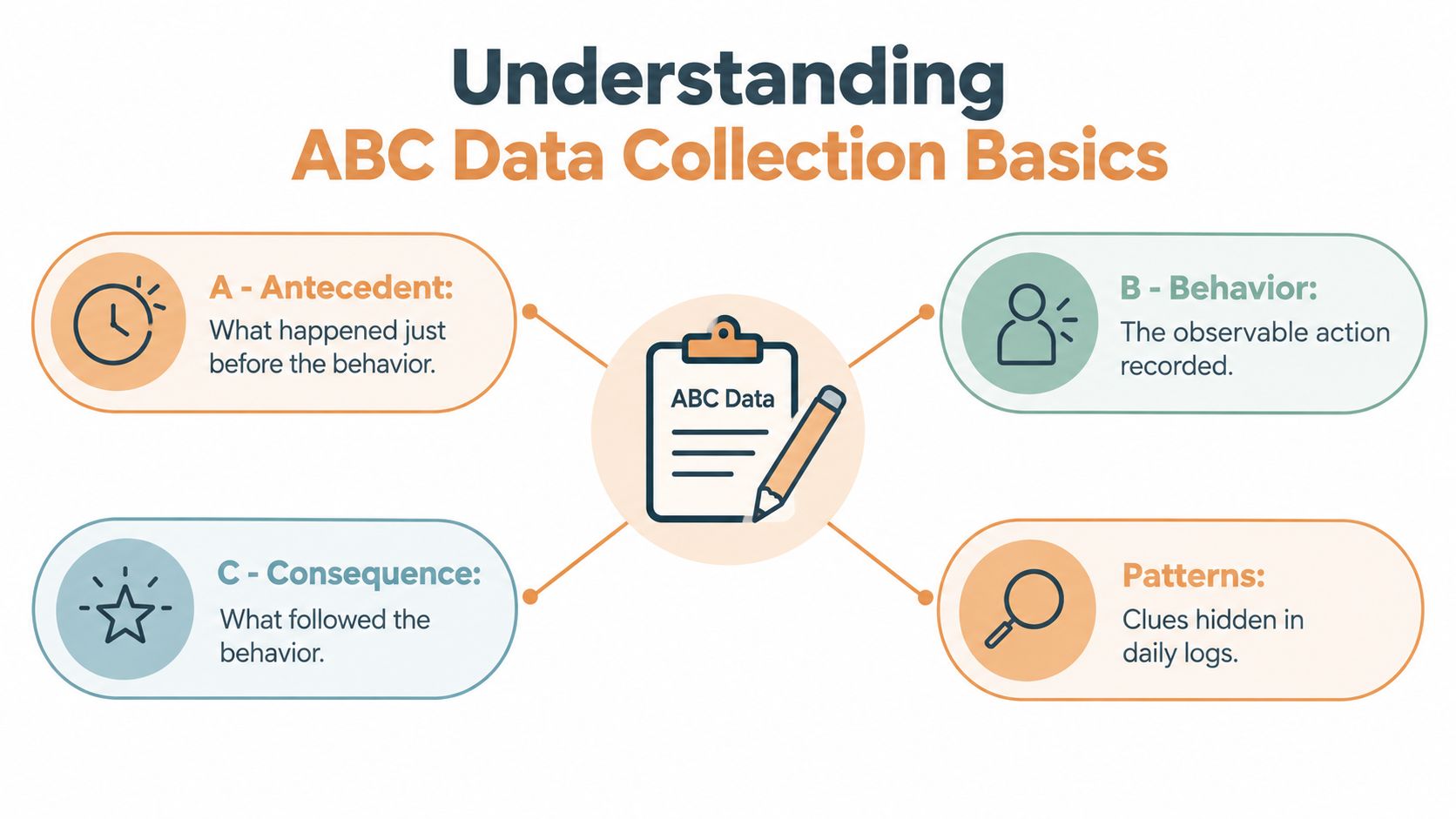
The easiest way to think about ABC data collection is as a short story with three parts. Something happens first, your child responds in a way you can see, and then something follows. When parents start using that simple frame, they often realize they've already been noticing pieces of it, they just haven't been writing them down in a consistent way.
A common home example is a transition. Your child is playing with a favorite toy, you mention that it's time to clean up, and the next thing that happens may tell you a lot about what part of the moment was hard.
The three parts in plain language
Antecedent means what happened just before the behavior. That could be a request, a sound, a change in activity, or even a missed snack.
Behavior is the exact action you can see. It's better to write “dropped to the floor and cried” than “had a meltdown,” because the first version tells the team what happened.
Consequence means what happened right after. Maybe the task paused, maybe an adult gave attention, or maybe the activity kept going.
Practical rule: if another adult could read your note and picture the moment clearly, you're probably collecting useful ABC data.
Behavior rarely appears out of nowhere. ABC notes help your team see which parts of the day may be connected to stress, communication needs, or changes in routine, and that makes later planning much more useful.
What to Look for During Observation
Good observation starts with describing the behavior in a way anyone can see or hear. In ABA, that's often called operationalizing the behavior, which just means giving it a clear, measurable name instead of a fuzzy label. Saying “hitting” or “leaving the table” is much more helpful than “being difficult.”
Write down the date, time, setting, activity, and who was present. Those details sound small, but they often explain why one moment went smoothly and another didn't.
The details that make a note useful
A solid entry usually includes the event itself and the context around it. A child might be calm during playtime and then struggle when a sibling joins the game, or do well at home but have a harder time when a classroom routine changes.
A careful note can also include things like noise, crowding, or a transition between activities. The more concrete the description, the easier it is for your care team to compare one day with another and separate facts from assumptions.
Write what you saw, not what you think it meant.
That sentence is hard to follow at first, because parents naturally try to explain behavior in the moment. Still, the most reliable ABC notes stick to visible pieces only. If a child cried after a demand, write that a demand was given, the child cried, and the adult responded in a certain way. Leave the “why” for the team to review later.
It also helps to define the replacement behavior before data collection begins. A team may want to see not only what the challenging behavior looked like, but also what skill the child is learning instead, such as asking for help, waiting, or using a break card.
Why Structured Data Beats Random Notes
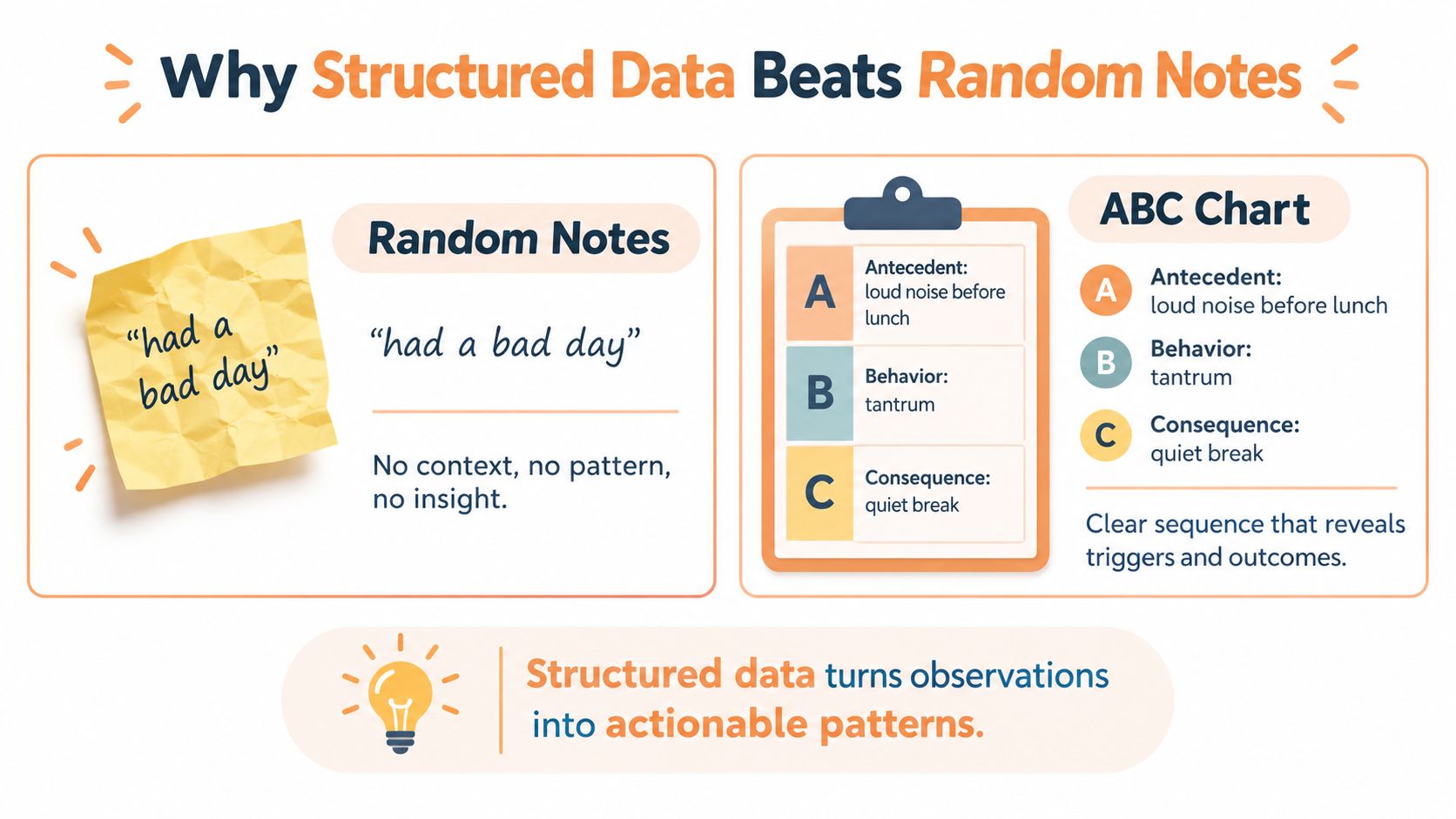
Loose notes can feel helpful in the moment, but they often miss the pattern. A line like “rough day” or “seemed upset after school” may be true, yet it doesn't tell a clinician what came before the behavior, what the behavior looked like, or what followed it.
Random notes versus a repeatable chart
A random note might say, “Had a bad day.” That leaves out the setting, the activity, and the response that followed.
A structured ABC entry might say, “Antecedent, loud noise before lunch. Behavior, tantrum. Consequence, quiet break.” That sequence gives your team something they can review and compare with other days.
Structured notes are also easier to share across caregivers. When everyone uses the same simple format, home, school, and therapy notes start to match. That consistency matters more than fancy wording, because it helps the team see whether the same pattern shows up in different places.
The chart format doesn't need to be complicated to work well. A simple template often does more than a long paragraph because it keeps the focus on facts instead of memory.
You may notice that the best notes are not dramatic. They're plain, brief, and repeatable. That's a strength, not a weakness, because repeatable data is what lets a care team compare one situation with another and avoid guessing.
Creating Your Home Data Template
A home template should be simple enough that you'll use it on a busy day. Start with a sheet that has spaces for the date, time, place, activity, antecedent, behavior, consequence, and any quick notes about who was there. If it takes too long to fill out, it won't survive real family life.
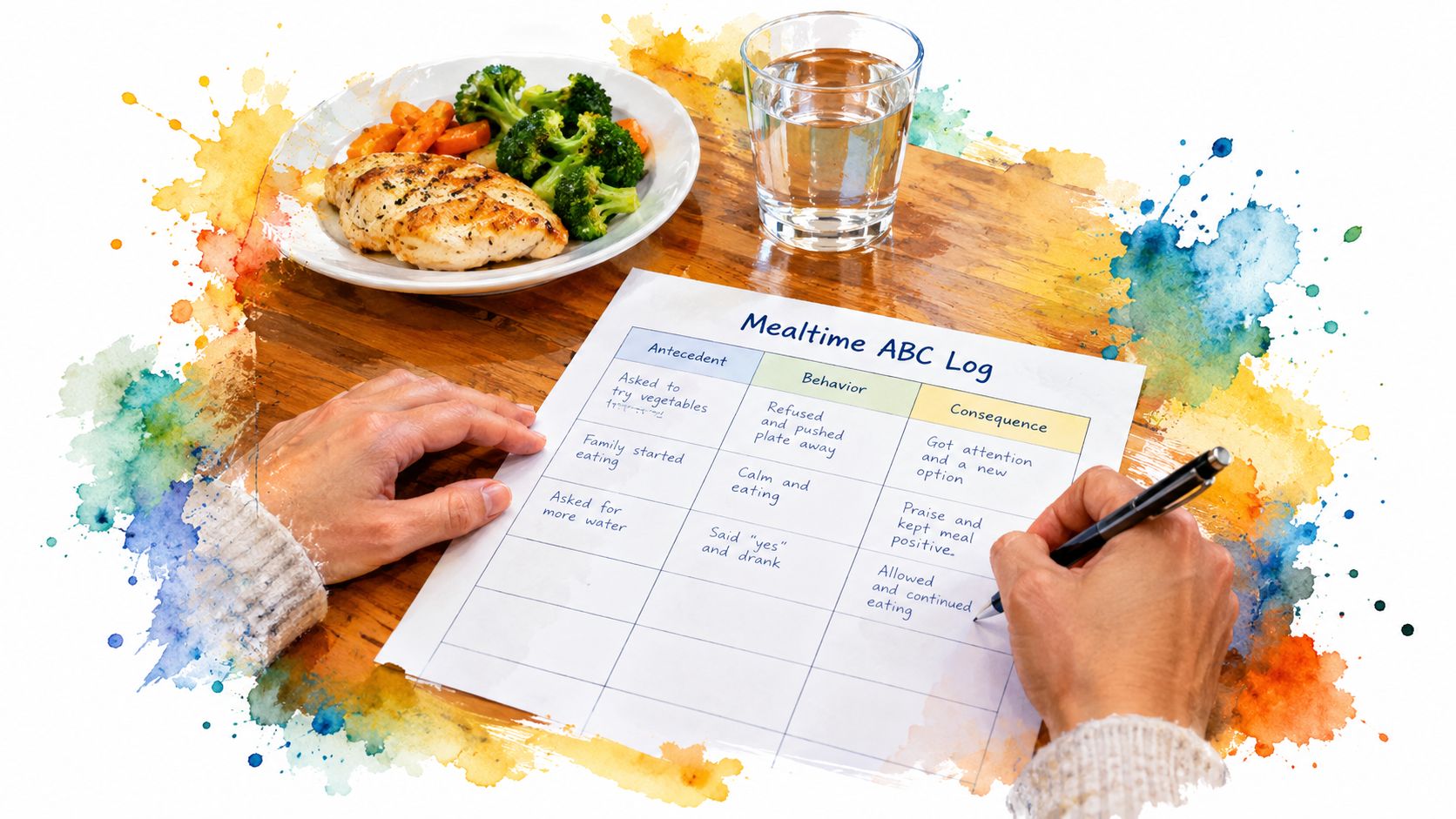
A mealtime example can make this feel more concrete. Suppose dinner starts, your child sees broccoli, and the chair gets pushed away. The antecedent is the meal presentation and the food change, the behavior is the chair push or refusal, and the consequence might be that the adult pauses the meal or offers help.
A simple home layout
Use a short form like this:
- Date and time: When did the moment happen?
- Setting: Kitchen, bedroom, backyard, classroom, car, or store.
- Activity: Dinner, homework, play, dressing, or cleanup.
- Antecedent: What changed, what was asked, or what came first?
- Behavior: What did your child do that you could see?
- Consequence: What happened right after?
That structure keeps the focus on patterns, not perfection. A note from one dinner won't explain everything, but several similar entries can help the team see whether mealtime, transitions, or another routine needs support.
If you want a broader at-home starting point, this guide on doing ABA therapy at home can help you think about how data fits into daily routines. The goal isn't to turn your home into a clinic, it's to make daily life easier to understand.
Good home data feels small in the moment, but it becomes powerful when your team can compare it across days.
How Clinicians Use This Data
Parents often wonder whether the notes they write matter. They do, because clinicians use ABC information to look for the function of behavior, which is the reason a behavior seems to keep happening. That doesn't mean they label a child or jump to conclusions, it means they review what tends to come before and after the behavior so they can choose a better teaching plan.
This is one place where the handoff between home and therapy matters a lot. A dedicated care coordinator can help make sure the same observations are being collected in a way that is easy to review, especially when multiple adults are involved. Friendly ABA Premier also shares parent coaching and support around these daily routines, which can make the process feel more manageable for families who want one coordinated system rather than scattered notes.
A functional assessment looks at the bigger picture, and ABC data is one of the tools that helps build it, as outlined in this overview of functional behavior assessment. The team may notice, for example, that a child's behavior happens more often when a task is hard, when attention is delayed, or when a preferred activity ends.
What happens after the pattern is clear
Once patterns show up, the team can teach replacement skills that fit the child's real life. That might mean asking for a break, requesting help, waiting with support, or using a communication tool before frustration builds.
A strong data system also helps track whether a plan is still a good fit. If the same template is used at home and during therapy, the team can compare progress in a fair way instead of relying on memory.
Some families worry that data collection will make their home feel cold or overly clinical. In practice, the opposite is often true. The right system gives adults a calmer way to respond, because they're no longer trying to interpret every moment alone.
Tips for Consistent Success at Home
Consistency matters more than intensity. A few short notes written regularly are usually more helpful than a long burst of perfect tracking that stops after a week.
Try to record the moments that happen in ordinary routines, not only the hardest ones. Data only on difficult days can hide the difference between a hard morning and a typical morning, so it helps to include calm periods too. That balance makes the pattern clearer for your care team and for you.
If you're coordinating with therapists, school staff, or another caregiver, keep the format simple enough that everyone can use it the same way. A shared routine is the goal, not a complicated form that no one finishes. A parent coaching approach, like the one described in this overview of the parent coaching model, can help families keep the process realistic.
A few habits that make the process easier
- Keep it brief: One or two sentences is often enough.
- Use the same labels: Don't rename the same behavior three different ways.
- Include neutral days: They help show what's different when things are harder.
- Ask for support early: A care team can help refine the form before frustration sets in.
If you miss a day, start again the next day. Data collection is a tool for understanding, not a test you can fail.
Friendly ABA Premier helps families build ABC data routines that are simple enough for home use and useful enough for clinical planning. If you want support with parent coaching, school coordination, or a more organized way to share observations with your care team, visit Friendly ABA Premier to learn how a dedicated coordinator can help you get started.
Our Latest Insights











































Experience ABA Therapy with a More Personalized Level of Support
Discover how FriendlyABA Premier combines evidence-based ABA therapy with dedicated coordination, proactive communication, and individualized family support.