


What Is an RBT? a Parent's Guide to the Role
Understand what is an RBT, their daily role, supervision requirements, and how they fit into your child's ABA therapy journey.

If your child has recently started ABA therapy, you may be wondering who the person entering your home or meeting your child at school is. You might hear the title Registered Behavior Technician, notice that the RBT spends much of the session with your child, and still feel unsure about who creates the plan, who answers your questions, and who makes changes.
That uncertainty is understandable. An RBT may become the most familiar face in your child's therapy, but they're part of a larger care team. Once you understand the difference between the person delivering the session and the supervisor guiding the program, the role becomes much easier to understand.
Table of Contents
Meeting Your RBT for the First Time
It's a Tuesday evening, and your child's new RBT arrives with a warm greeting, a few activity materials, and a plan for the session. Your child may be interested in the flashcards, a favorite game, or a toy the RBT brought along. You may be standing nearby, trying to understand whether this person is a teacher, therapist, coach, or something else entirely.
The simplest answer is that the RBT is the trained professional who works directly with your child during many day-to-day ABA sessions. They may practice communication during snack time, support turn-taking during play, or help your child follow a familiar routine such as putting toys away. The work should feel connected to your child's interests, strengths, and everyday life, rather than like a generic lesson delivered the same way to every child.

The person in the room
During a session, the RBT may:
- Practice specific skills: This could include requesting help, transitioning between activities, joining a game, or completing a daily routine.
- Follow the treatment plan: The RBT uses procedures selected by the supervising clinician instead of creating a separate plan independently.
- Observe and record information: Notes about your child's responses help the clinical team understand what is helping and where adjustments may be needed.
- Build a comfortable relationship: Trust matters. A child is more likely to participate when learning is woven into play, movement, conversation, and familiar routines.
You're also allowed to ask what the RBT is working on and how the session connects to your child's goals. The RBT should be able to explain their immediate activities in clear language. Questions about changing goals, interpreting broader progress, or altering treatment should be directed to the supervising clinician.
A helpful way to think about it: The RBT is often the person carrying out the plan with your child, while the supervisor provides the clinical direction and accountability behind that work.
Your first meeting is also a chance to notice how the team communicates. Do they listen to your observations about mealtimes, school, sleep, play, and communication? Do they explain what they're doing without making you feel judged? Those early conversations can help establish a partnership that supports your child across settings.
What Does It Mean to Be an RBT
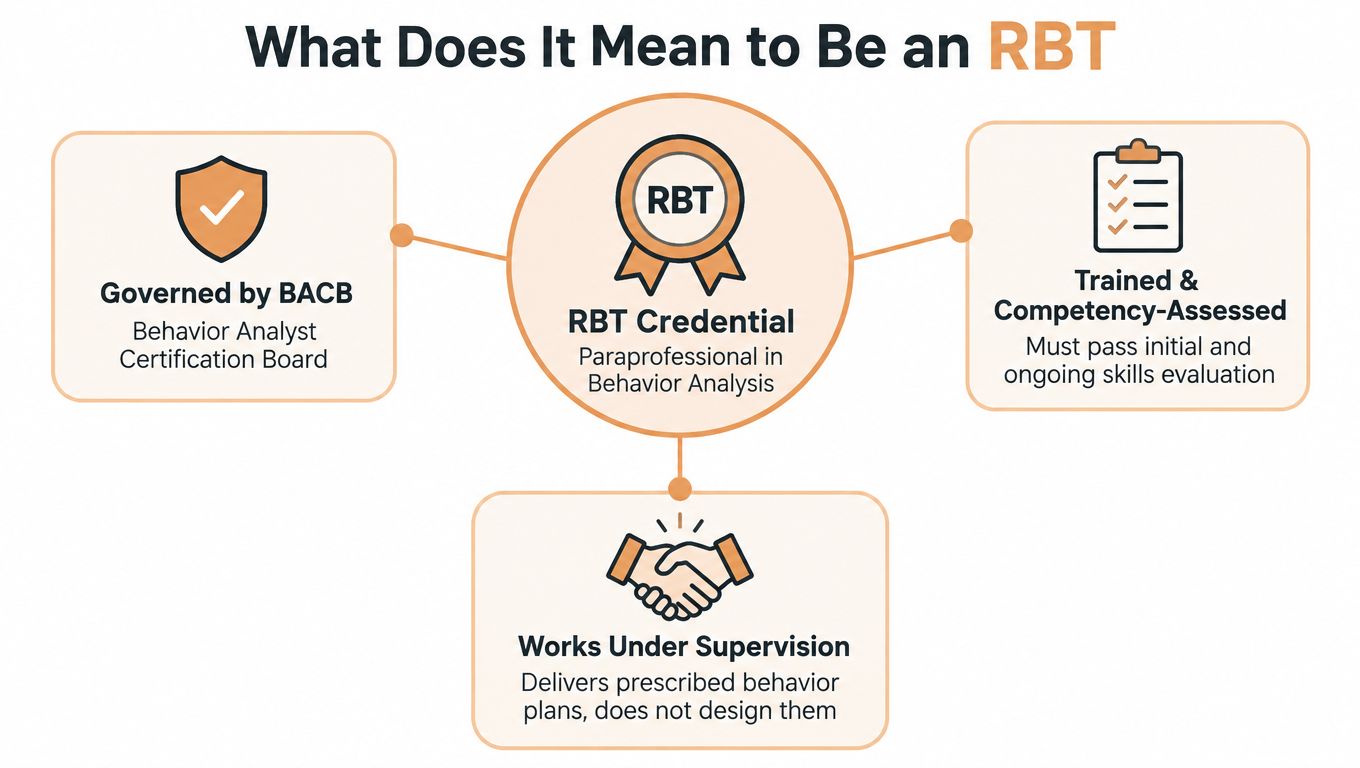
An RBT, or Registered Behavior Technician, is a paraprofessional credential in behavior analysis created and governed by the Behavior Analyst Certification Board, or BACB. “Paraprofessional” means the RBT has specialized preparation and performs important hands-on work, but doesn't hold an independent clinical role.
A useful analogy is a care team building a bridge. The supervising clinician helps determine where the bridge should lead and how it should be designed. The RBT helps build the daily path with your child, one practical step at a time. The RBT's work is essential, but the RBT isn't independently designing the treatment program.
The credential has defined entry requirements. An applicant must be at least 18 years old, have a high school diploma, pass background and abuse registry checks, complete 40 hours of training, and pass a certification exam, according to the BACB RBT Handbook.
Training and competency
The 40-hour training isn't the entire certification process. The training must be completed in no fewer than 5 days and no more than 180 days, and it must be designed and overseen by a BCaBA, BCBA, or BCBA-D who has completed the required 8-hour supervision training, as described in the BACB RBT training curriculum.
After training, the applicant completes an Initial Competency Assessment. This assessment can't begin before the training is finished, and the responsible assessor must keep documentation of each assessment for at least 7 years, according to the BACB Initial Competency Assessment requirements. These steps create a more structured process than just assigning someone to a child after informal workplace orientation.
What the credential doesn't mean
An RBT credential doesn't mean the person independently assesses your child, writes treatment plans, or changes clinical goals without oversight. The RBT's strength is careful implementation, observation, relationship-building, and communication with the supervising team.
Parents sometimes assume that the person who spends the most time with their child must be the person making every clinical decision. That isn't how the role is structured. The credential itself is designed around supervised practice, so the RBT should have access to guidance when a situation is unclear or a child's needs change.
If you want a closer look at the evaluation step, the Initial Competency Assessment guide can help explain how skills are reviewed before certification.
How Supervision Makes the Difference
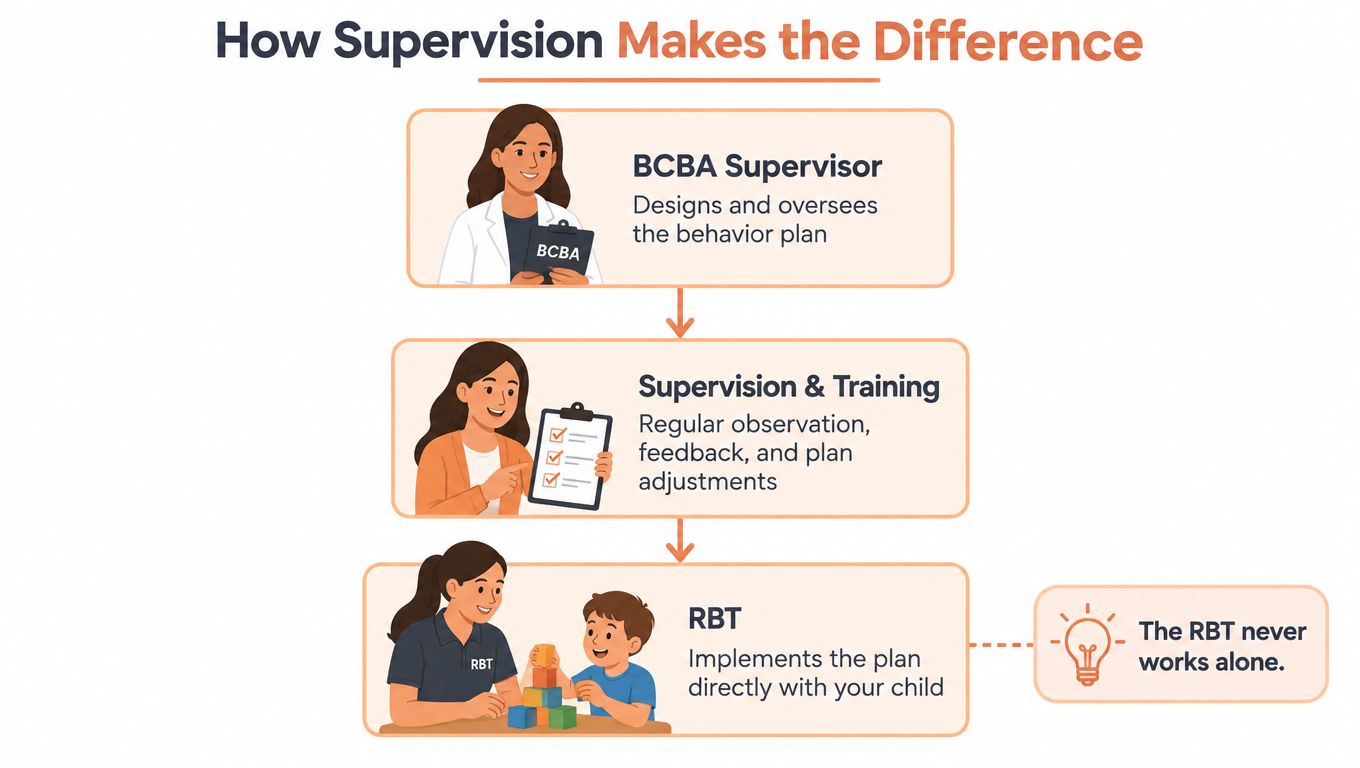
The most important answer to “what is an RBT?” is that an RBT doesn't work alone. The RBT may be sitting on the floor with your child, leading a game, or helping with a routine, but a qualified supervisor remains responsible for the work performed.
The BACB requires ongoing supervision of at least 5% of the hours spent providing behavior-analytic services each calendar month. The BACB RBT requirements also specify at least two face-to-face contacts and at least one individual meeting within that structure. One of those contacts must involve observing the RBT providing services with a client, according to the BACB supervision requirements.
These requirements matter because supervision isn't just a meeting where someone signs paperwork. Observation allows the supervisor to see how the RBT applies procedures, responds to your child, records information, and handles unexpected moments. Feedback can then be specific and timely.
Who does what
You can picture the care structure this way:
- The BCBA or other qualified supervisor: Assesses needs, develops and oversees treatment, reviews information, coaches the RBT, and determines when a plan needs adjustment.
- The RBT: Implements the procedures, practices targeted skills, observes responses, and shares session information with the supervisor.
- The parent or caregiver: Provides important knowledge about the child's routines, preferences, communication, culture, and priorities. Families also help the team understand whether strategies fit naturally at home.
An RBT's close supervision protects your child from a one-person approach. If a strategy isn't working during a difficult transition, the RBT shouldn't have to guess at a major change. They can document what happened, contact the supervising clinician, and receive direction based on the broader treatment plan.
Practical rule: You should know who supervises your child's RBT, how to reach the clinical team, and how concerns are handled between scheduled sessions.
The video below offers another visual explanation of how the roles connect.
Supervision also depends on communication. A strong system gives parents a clear way to share a change in routine, a new concern, or a success that occurred outside therapy. Information from home can help the supervising clinician make thoughtful decisions instead of relying only on what happens during a scheduled session. A dedicated care coordinator can also help families understand who to contact and keep practical details from falling through the cracks. Learn more about care coordination and case management.
A Day in the Life of an RBT
An RBT session may look more like structured play than a traditional classroom. The teaching happens inside meaningful activities, with the RBT breaking a larger goal into smaller steps your child can understand and practice.
At breakfast, the RBT might support a child in requesting a preferred food or indicating that they're finished. During play, they may practice taking turns, choosing between activities, or asking another person to join. During cleanup, the RBT may use a visual sequence or simple directions to help the child move from one step to the next.
Small goals inside familiar routines
The RBT follows the procedures selected by the clinical supervisor and watches how your child responds. For example, if your child has difficulty moving from tablet time to a family activity, the RBT may practice that transition in a calm, predictable way rather than waiting for the most difficult moment of the day.
The RBT may also use encouragement, preferred activities, choices, and repetition to support participation. The exact approach should be individualized. What motivates one child may not interest another, and a strategy that works at home may need to look different at school or in the community.
During these activities, the RBT records information about what happened. That information helps the supervising clinician review progress, identify patterns, and decide whether the current approach should continue or be adjusted.
According to the BACB description of the RBT role, an RBT delivers behavior-analytic services under close, ongoing supervision from an RBT Supervisor and/or RBT Requirements Coordinator. The RBT implements procedures, while the supervisor remains accountable for the work performed.
What parents may notice
You may see the RBT pause before helping, offer your child a choice, or wait for an attempt to communicate. You may also see the RBT change an activity when your child becomes tired, overwhelmed, or especially engaged in something else. These moments can be part of making practice respectful and useful.
A thoughtful RBT also learns from you. You know how your child communicates hunger, discomfort, excitement, fatigue, and interest. Sharing those details helps the team make sessions feel more natural and supports consistency across home, school, and community routines.
RBT Autonomy and Parent Expectations
It's natural to look to the RBT for answers when they're the person you see most often. You may ask, “Should we change the morning schedule?” or “Is my child ready for a different goal?” The RBT may have valuable observations, but decisions about treatment changes belong with the supervising clinician.
That boundary is a safeguard, not a limitation in care. The RBT sees important details during direct sessions, while the supervisor reviews those observations alongside the treatment plan, family priorities, assessment information, and progress data. Separating implementation from treatment design helps prevent a major decision from being based on one difficult afternoon or one encouraging moment.
What your RBT can answer
Your RBT can usually explain:
- What happened today: They can describe activities, participation, communication attempts, and moments that were challenging.
- What they practiced: They can connect a game, routine, or teaching activity to the current goals.
- What you can share: They can tell you what information would help the supervising team understand your child's experience.
- What needs follow-up: They can bring questions or concerns to the supervisor instead of making a clinical change independently.
Questions about diagnosis, treatment goals, safety concerns, significant changes in behavior, or whether therapy should continue should go to the BCBA or appropriate care team member. If the RBT doesn't know an answer, “I'll bring that to my supervisor” is a responsible response.
A clear boundary builds trust: Your RBT should be comfortable saying when a question belongs with the supervising clinician, and the clinical team should be available to answer it.
Parents shouldn't have to choose between trusting the RBT and asking questions. You can appreciate the RBT's daily observations while still expecting transparent communication from the supervisor. Parent coaching can make this partnership even more practical by showing you how strategies connect with routines such as dressing, meals, homework, and community outings. The parent coaching model explains how caregivers can become active partners without having to become clinicians.
Choosing the Right Support System
Two providers may both offer RBT sessions, yet feel very different to a family. The meaningful difference often lies in what surrounds the RBT: supervision, communication, coordination, training, and the provider's willingness to individualize care.
Ask each provider how the clinical team will work with your family. You're looking for clear answers, not promises that sound impressive but remain vague.
Questions worth asking
- Who supervises the RBT? Ask for the supervisor's role and how often they observe sessions or communicate with you.
- How will progress be shared? Find out whether you'll receive regular updates and whether your observations can shape planning.
- What happens between visits? Ask who to contact when a routine changes, a concern arises, or the RBT is unavailable.
- How is continuity protected? Discuss what happens if staffing changes and how the provider supports consistent care.
- Is parent coaching available? Look for practical guidance that fits your family's routines, not instructions that assume every household works the same way.
- How are goals individualized? The plan should reflect your child's communication, interests, daily living needs, school environment, and family priorities.
A provider with a dedicated care coordinator can make these connections easier by helping organize communication between caregivers, clinicians, therapists, and schools. Proactive check-ins also give families a place to raise small concerns before they become larger sources of stress.

Your child's RBT may become an important and trusted part of the week. The strongest support system, however, gives that relationship a dependable clinical foundation. It values the RBT's observations, makes supervision visible, invites your voice, and adjusts services to the child and family rather than forcing everyone into the same routine.
If you're comparing ABA providers, Friendly ABA Premier offers individualized ABA therapy, home-based support, social skills development, school support, parent coaching, and a dedicated care coordinator for families in its service areas. Visit Friendly ABA Premier to talk with the team about how RBT supervision, family communication, and personalized care could fit your child's needs.
Our Latest Insights















































Experience ABA Therapy with a More Personalized Level of Support
Discover how FriendlyABA Premier combines evidence-based ABA therapy with dedicated coordination, proactive communication, and individualized family support.