

ABA Therapy Treatment: A Parent's Guide to Getting Started
Learn how ABA therapy treatment works, what to look for in a provider, and how families can support meaningful progress at home with confidence.

You may have heard “ABA therapy treatment” from a pediatrician, school team, or another parent, and now you're trying to understand what happens next. You may be wondering how many hours your child will need, whether therapy takes place at home, and how much you'll be expected to do.
Those questions are reasonable. ABA isn't one fixed curriculum or a test your child has to pass. It's an individualized way to teach useful skills, measure progress, and adjust support around your child's strengths, needs, preferences, and daily routines. A thoughtful provider also considers family capacity, school goals, communication needs, and your child's comfort.
Table of Contents
- What ABA Therapy Treatment Really Means for Your Family
- Understanding the Core Principles of ABA
- What families should look for in the evidence
What ABA Therapy Treatment Really Means for Your Family
Applied behavior analysis, or ABA, focuses on how people learn and how adults can make helpful skills easier to practice. The work might involve requesting a favorite snack, moving from playtime to bedtime, participating in a classroom routine, or taking turns during a game. The goal isn't to make every child behave the same way. The goal is to support meaningful communication, participation, independence, safety, and connection.
A first assessment usually begins with listening. A clinician may observe your child, ask about daily routines, review strengths and challenges, and learn what matters most to your family. One child may need support with functional communication, while another may be working on dressing, peer play, tolerating changes, or asking for a break.
A useful starting question: “What skill would make one ordinary part of our day easier or more enjoyable?”
Your care team should turn the answer into a clear, observable goal. Instead of saying “improve communication,” the plan might focus on helping your child request help using speech, pictures, gestures, or a communication device. Instead of “reduce difficult behavior,” the team might identify what happens before a challenging moment and teach a safer way to communicate a need.
Families often benefit from reading a plain-language overview of behavior analysis and ABA before an assessment. You don't need to memorize technical terms. You do need to feel comfortable asking what your child will practice, how sessions will be adapted, and how your observations will shape the plan.
The journey may include home sessions, school collaboration, social-skills support, parent coaching, and regular progress reviews. Some families need a gradual start because of work schedules, transportation, or a child's tolerance for new people. Others begin with a more structured schedule. There isn't one correct path, and a strong provider should explain the reasoning behind the recommendations.
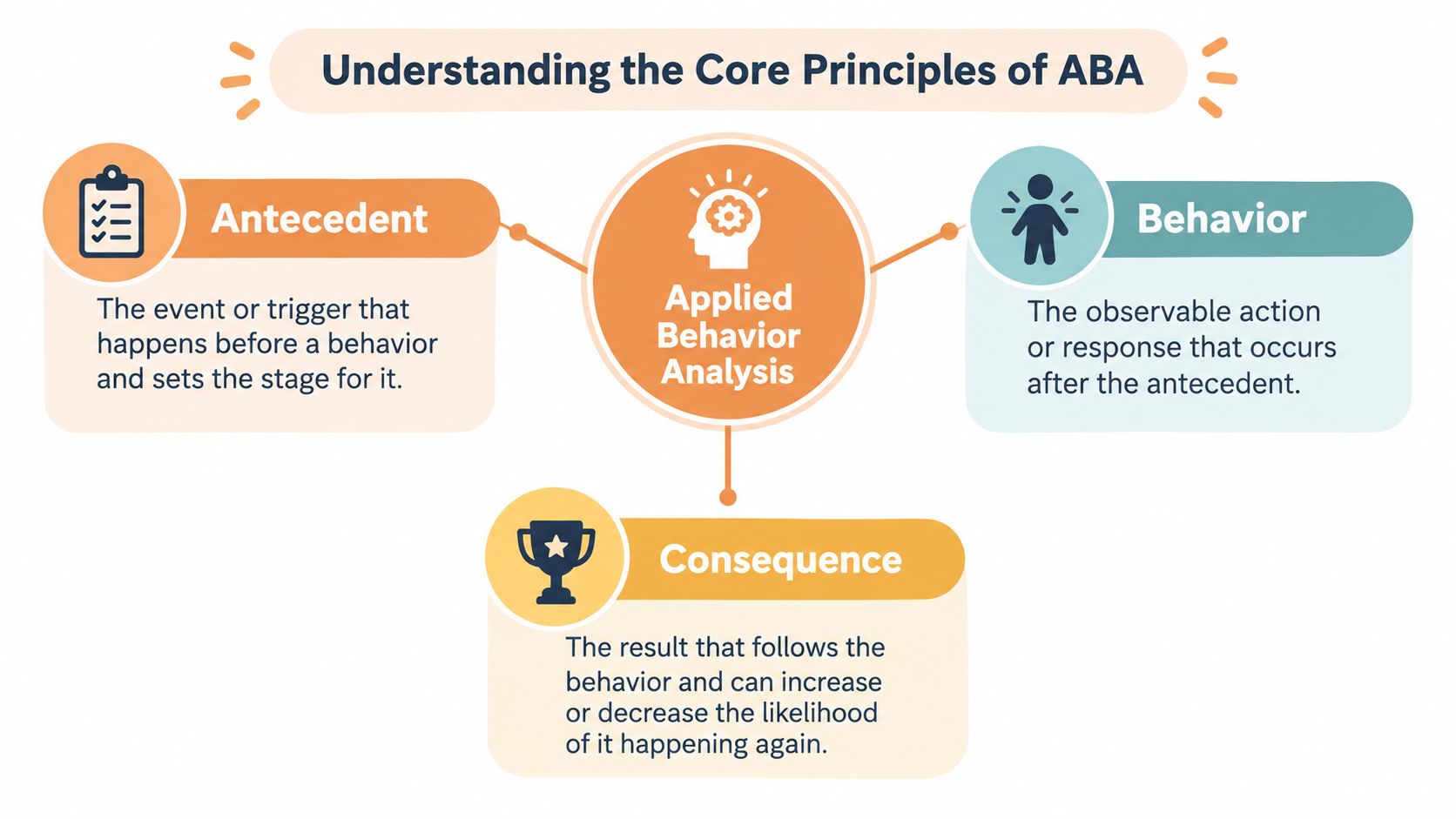
Understanding the Core Principles of ABA
ABA becomes easier to understand when you connect it to an ordinary moment. Suppose your child wants a drink but reaches, cries, or pulls you toward the kitchen. A therapist may arrange the moment so your child has a reason to communicate, wait for an attempt, and then provide the drink promptly after the request. Over time, the child learns that communication works.
Therapists often look at three parts of an interaction:
- Antecedent: What happens immediately before a behavior, such as seeing a snack, hearing “clean up,” or being asked to wait.
- Behavior: What the child does, such as pointing, saying “juice,” leaving the room, or handing over a picture.
- Consequence: What happens afterward, such as receiving help, getting a break, or practicing the request again.
This framework helps the team understand what a behavior communicates and what might make a useful skill more likely. It isn't about blaming a child or treating every behavior as a problem. A child who leaves a noisy room may be communicating that the environment feels overwhelming. The next step could be teaching a break request and making the space more manageable.
Positive reinforcement means that something meaningful follows a skill, making the child more likely to use it again. That “something meaningful” might be praise, access to a preferred activity, a turn with a favorite toy, movement, or getting a need met. Therapists should learn what motivates your child rather than assuming the same reward works for everyone.
Goals are broken into manageable steps. A bedtime routine might begin with entering the bathroom, then putting pajamas nearby, then completing one part of dressing. The therapist can adjust prompts, give the child time to respond, and gradually reduce help as independence develops.
The CDC's overview of autism treatment and ABA-related practices notes that the National Clearinghouse on Autism Evidence and Practice identified 28 evidence-based practices for autistic children and youth, 20 of which have an ABA origin. These include reinforcement, prompting, naturalistic intervention, functional communication training, parent-implemented intervention, and self-management.
The range matters. A thoughtful plan may use play, routines, communication supports, visual schedules, or structured teaching depending on the situation. ABA is a framework for individualized teaching, not a single set of exercises.
What the Research Says About ABA Outcomes
Research can offer useful context, but it can't predict exactly what will happen for one child. Outcomes differ according to the child's starting skills, age, goals, treatment quality, family involvement, and how consistently skills are practiced across settings.
A 2021 individual-participant-data meta-analysis found that young children receiving early intensive ABA-based intervention improved more than comparison groups after two years. The reported mean difference was 7.00 points on the Vineland Adaptive Behavior Scales and 14.13 points in cognitive ability, as described in the published analysis of early intensive ABA-based intervention. The same analysis found that adaptive-behavior gains were not yet clear at one year.
That timing is important. A short period of therapy may not show the full picture, particularly for skills such as independence, communication across settings, or adaptive behavior. Progress should be reviewed longitudinally, using both formal measures and everyday observations.
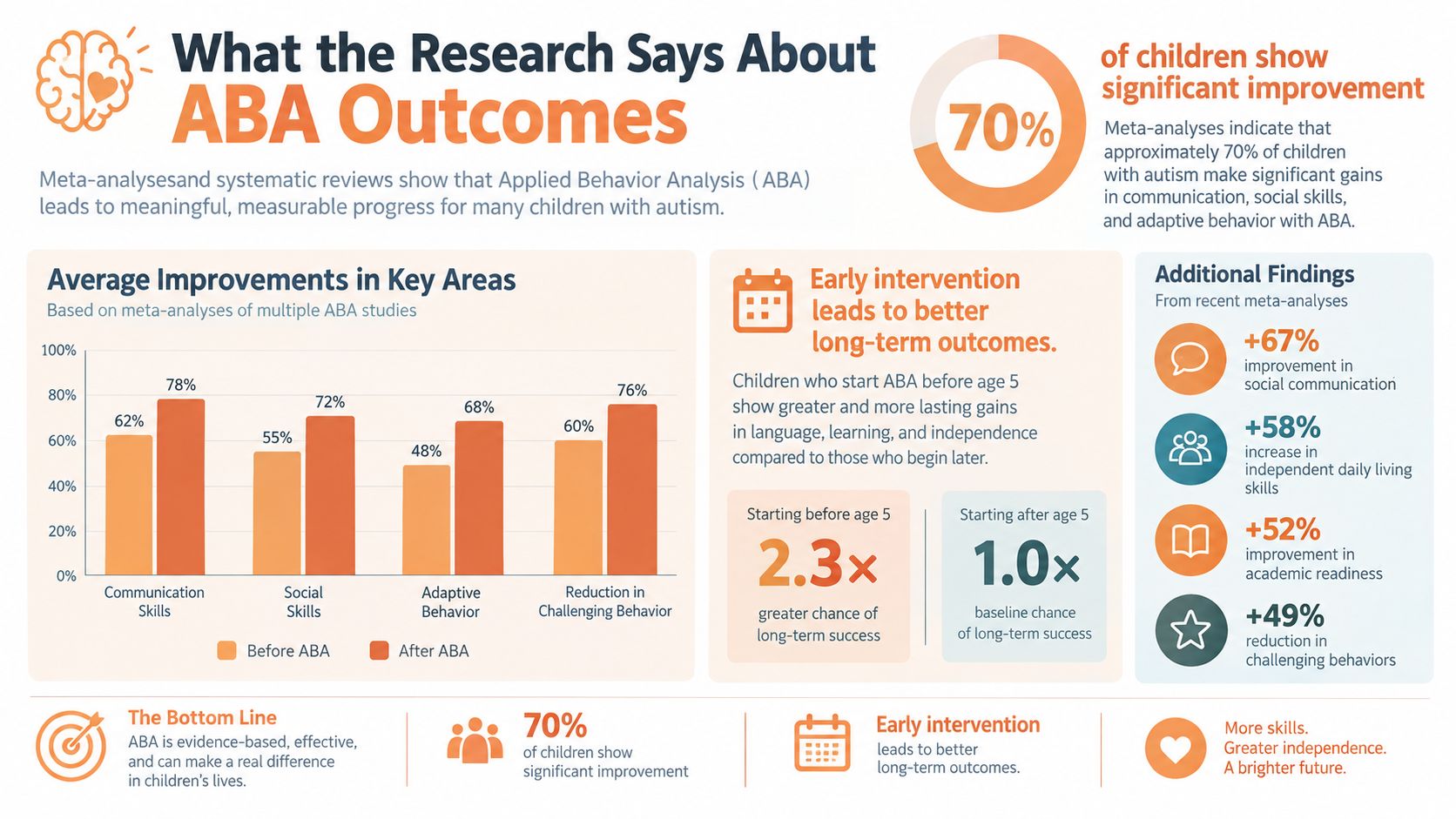
A 2023 systematic review and meta-analysis reported medium effects for ABA-based interventions relative to treatment as usual, minimal treatment, or no treatment in intellectual functioning and adaptive behavior. The review reported a standardized mean difference of 0.51 for intellectual functioning and 0.37 for adaptive behavior, with confidence intervals reported in the PubMed review. It did not find improvement beyond comparison groups for language ability, symptom severity, or parental stress.
Those findings argue against simple promises. More hours don't automatically create broad improvement, and one outcome may change before another. Intake language skills and child age may influence results, while treatment intensity may have less effect as children get older.
What families should look for in the evidence
A useful provider doesn't point to one number and declare success. The team should define goals that matter in daily life, measure whether a skill is acquired, check whether it continues over time, and see whether it appears at home, school, and in the community.
Ask whether the plan tracks:
- Functional communication: Can your child request help, make choices, reject something, or ask for a break?
- Adaptive skills: Is your child becoming more independent with routines such as eating, dressing, or hygiene?
- Participation: Can your child take part in classroom, family, or community activities with appropriate support?
- Well-being: Does the plan consider comfort, autonomy, stress, and your child's ability to communicate preferences?
Good evidence supports careful planning. It doesn't replace listening to the child and family.
Home Based ABA Therapy Compared to Clinic Settings
The setting changes what a therapist can practice. In a home, the clinician can work with the routines your child already knows, such as getting dressed, eating a meal, putting toys away, or transitioning to school. The family can see how a strategy works in the moment and adapt it to the household.
Home-based sessions may also reveal barriers that aren't visible in a clinic. A child may communicate successfully at a table but struggle when a sibling is nearby, the television is on, or a preferred activity ends. Practicing in those real conditions helps the team design supports that fit everyday life.

A clinic can offer different advantages. The environment may provide consistent materials, predictable routines, and opportunities for structured peer interaction. A child working on turn-taking might practice with another child, while a therapist supports waiting, joining a game, and responding to a peer.
| Setting | What it can support | Questions to consider |
|---|---|---|
| Home | Daily routines, caregiver coaching, communication during real activities | Can the family protect a calm therapy space? Which routines matter most? |
| Clinic | Structured learning, planned social opportunities, peer practice | Is travel manageable? Does the environment fit the child's sensory and communication needs? |
| School or community | Classroom participation, transitions, social learning in natural settings | How will the provider coordinate with educators and other professionals? |
Neither setting is automatically better. Some children benefit from home-based sessions first and later add clinic or community practice. Others need a clinic environment for specific social goals but still require home support for dressing, meals, sleep routines, or family communication.
Families considering a clinic model can review center-based ABA therapy and compare its structure with what home-based care can offer. The most useful decision is the one tied to your child's goals, your family's schedule, and the settings where skills need to work.
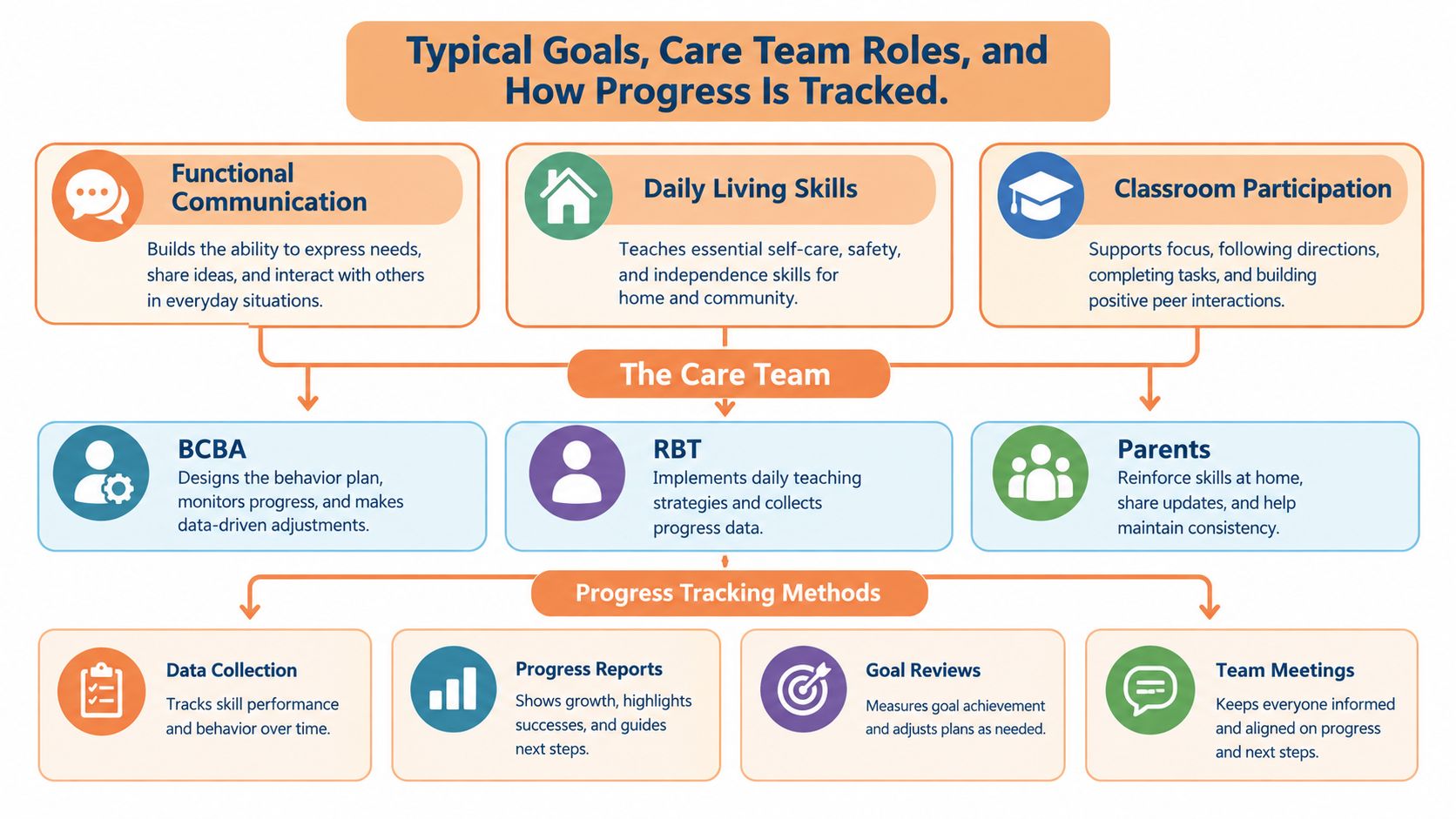
Typical Goals, Care Team Roles, and How Progress Is Tracked
A strong ABA plan describes what your child will do, not just what adults want to stop seeing. Goals may include requesting a preferred item, answering a question, following a morning routine, joining a peer activity, tolerating a change, or using a break card before becoming overwhelmed.
The team may divide a larger goal into smaller steps. For classroom participation, the first step could be sitting with the group briefly. Later steps might include looking toward the activity, responding to a teacher, completing part of an assignment, and asking for help.
The people around your child
A BCBA, or Board Certified Behavior Analyst, typically assesses needs, designs the treatment plan, reviews data, and supervises implementation. A Registered Behavior Technician, or RBT, often works directly with the child, practices the planned skills, records session information, and shares observations with the supervising clinician.
Parents and caregivers are also part of the team. You know which foods, sounds, routines, people, and activities matter to your child. Your observations can explain why a skill works at therapy but not during the morning rush.
A dedicated care coordinator can help keep communication organized across clinicians, caregivers, schools, and other providers. That role may include scheduling progress conversations, helping families understand next steps, and making sure questions don't disappear between appointments.
What progress tracking should show
Session-level data might show how often a child uses a request, how much prompting is needed, or whether a routine is completed independently. Standardized tools, including the Vineland Adaptive Behavior Scales, can provide a broader view of adaptive functioning. Family reports and school observations add context that numbers alone may miss.
North Carolina Medicaid's person-centered care policy says treatment plans should include individualized goals, outcome-measurement criteria, direct-service and supervision hours, service location, caregiver participation needs, progress-evaluation frequency, and the responsible provider, as described in the North Carolina policy on person-centered autism care.
Ask to see how often the team reviews data and what happens when progress slows. A responsive plan may change the teaching steps, adjust prompts, revise the goal, or practice in another setting. Scheduled check-ins and proactive communication should make this process understandable, rather than leaving you to chase updates.
How Many Hours a Week and What Intensity Actually Means
Parents often hear a recommended number of hours and assume it represents a standard prescription. It doesn't. Intensity should reflect the child's goals, age, learning profile, daily schedule, support needs, and the family's ability to participate.
The Medicaid Applied Behavior Analysis Toolkit reports that intervention intensity can range from about 5 hours per week for lower-intensity services to as much as 40 hours per week for higher-intensity services. The same toolkit reports that Medicaid and CHIP beneficiaries receiving ABA averaged 17.33 hours per week in 2025. That average describes a population, not a target for every child.
| Intensity Level | Approximate Hours per Week | What It Often Focuses On |
|---|---|---|
| Lower intensity | About 5 | A focused set of communication, daily-living, or participation goals |
| Moderate intensity | A schedule between lower and higher ranges | Several goals practiced across routines and settings |
| Higher intensity | Up to about 40 | Broad, frequent support across developmental and adaptive goals |
The table is a starting point, not a treatment recommendation. A child may need fewer hours with carefully selected goals, or more support during a period of significant change. The plan should explain why the recommended schedule fits the child and how the team will decide whether to increase, reduce, or change services.
Ask three practical questions:
- Who determines the recommended hours?
- How are direct therapy, supervision, caregiver coaching, and coordination divided?
- What data will support a change in intensity?
A sustainable schedule matters. If the plan overwhelms the household, the team should know early and help adjust routines rather than treating missed sessions or limited caregiver availability as a failure.
Parent Coaching Without the Overwhelm
Parent coaching isn't supposed to turn you into a full-time therapist. It should help you understand a small number of strategies well enough to use them naturally during meals, play, dressing, errands, or transitions.
Caregiver involvement is part of many service systems. Texas Medicaid rules require participation by a legally authorized representative, parent, or caregiver in education and training sessions at a frequency and duration agreed upon with the family. The treatment plan must also include caregiver-training goals and consider progress toward those goals when ABA services are evaluated, according to the Texas Medicaid rule on caregiver participation.
Make participation sustainable
Start with a minimum viable home routine. That might mean practicing one request during snack, one transition before bedtime, or one dressing step each morning. A care coordinator can help you choose a routine that is realistic instead of adding a long list of assignments.
You can also:
- Share responsibilities: Rotate coaching and practice among caregivers when possible.
- Name constraints early: Tell the team about work, siblings, transportation, fatigue, or scheduling barriers.
- Use short check-ins: Bring one success and one difficulty to each progress conversation.
- Practice during real life: Ask the therapist to coach you during a routine you already need to complete.
- Track caregiver capacity: Let the team know when a strategy is too demanding or creates stress.
Parent coaching and training works best as a partnership. The therapist explains the reason for a strategy, demonstrates it, watches you try it if you're comfortable, and adjusts the plan based on what fits your home.
Insurance Coverage and Choosing the Right Provider
The need for developmental and behavioral services has become more visible as identification has increased. CDC surveillance estimates for monitored U.S. communities reported autism prevalence among 8-year-old children rising from approximately 1 in 15 in 2000 to 1 in 31 in 2022, as reported in the CDC autism data and research overview. These surveillance estimates aren't a direct measure of treatment need, and the monitored communities aren't nationally representative, but they help explain why more families, schools, insurers, and pediatric providers are navigating service access.
Insurance coverage varies by state, plan, eligibility rules, and authorization requirements. Before starting, ask the provider's intake team to explain benefits, prior authorization, covered settings, documentation, supervision requirements, and what happens during ongoing reviews.
Use your first conversations to compare the service experience, not only the number of available hours. Ask:
- Who designs and supervises the treatment plan?
- How will my child's goals reflect strengths, preferences, communication, and well-being?
- How often will the team share progress data?
- How are caregivers coached, and what happens if our schedule changes?
- Who coordinates communication with school and other providers?
- How does my child request a break, refuse an activity, or share a preference?
- What will cause the team to revise the plan?
Friendly ABA Premier provides home-based ABA therapy, social-skills development, school support, and parent coaching across Connecticut, Georgia, Maryland, Massachusetts, North Carolina, South Carolina, Virginia, and Washington. Its model includes individualized treatment planning, a dedicated care coordinator, scheduled progress check-ins, and proactive communication, with insurance support for families using participating plans.
If your family is comparing ABA therapy treatment options, Friendly ABA Premier can help you discuss home-based care, caregiver coaching, school support, and individualized goals. Visit the site to request a consultation and talk with a team about a practical starting plan for your child and family.
Our Latest Insights










































Experience ABA Therapy with a More Personalized Level of Support
Discover how FriendlyABA Premier combines evidence-based ABA therapy with dedicated coordination, proactive communication, and individualized family support.